From 2010-2011, Weintraub covered all things Google for Fortune Magazine, amassing an impressive rolodex of Google contacts and a love for Silicon Valley tech culture.
It turns out that his hobby – the 9to5Mac news site – was always his favorite, and in 2011, he went full time adding his Fortune Google followers to 9to5Google, in addition to adding the style and commerce component of 9to5Toys gear and deals site. In 2013, Weintraub bought one of Tesla’s first Model S EVs off of the assembly line, which began his love affair with electric vehicles and green energy — this, in turn, became Electrekin 2014.To cover the burgeoning world of drones and UAVs led by China’s DJI, DroneDJ was born in 2018, and then more recently, Connectthewatts and SpaceExplored were launched to cover connected fitness and space.
From 1997-2007, Weintraub was a Global IT director and Web Developer for a number of companies, with stints at multimedia and branding agencies in Paris, Los Angeles, New York, Sydney, Hong Kong, Madrid, and London before becoming a publisher/writer.
Seth received a bachelor’s degree in Industrial and Systems Engineering from the University of Southern California with a minor in Multimedia and Creative Technology in 1997. In 2004, he received a Master’s from NYU’s Tisch School of the Art’s ITP program.
Weintraub is a licensed single-engine private pilot and a certified open-water scuba diver, and he spent over a year backpacking to 60 cities in 23 countries. Whatever free time exists is now guaranteed to his wonderful girlfriend, Alana, and two amazing sons.
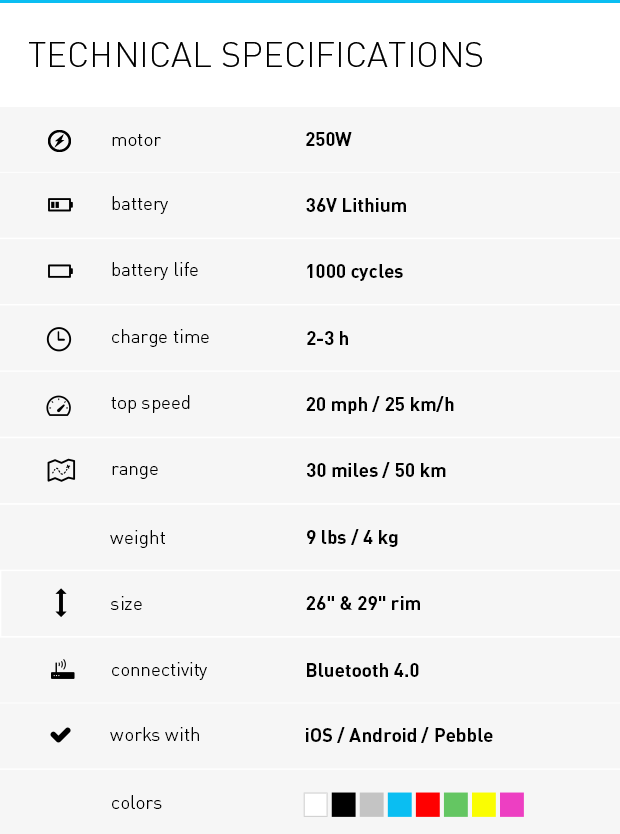
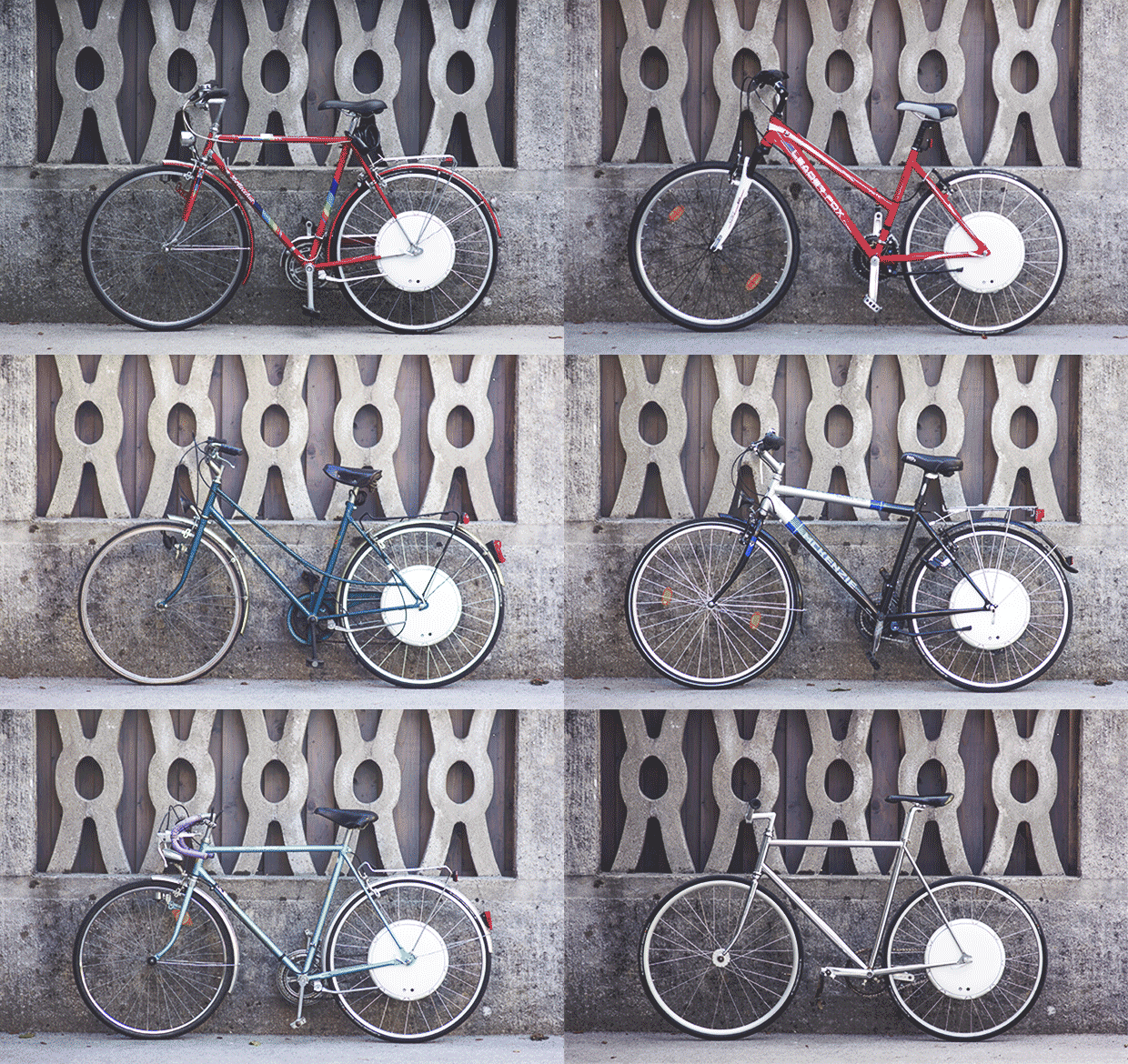
It is hard not to like this idea: You replace your rear bike wheel with this special FlyKly wheel which houses a motor, a controller, and some batteries. You set the speed with a smartphone or Pebble app.
On the downside, you are also replacing your rear gear sprockets and shifting mechanism and it doesn’t seem like you can have too much control with a smartphone for changing speeds while biking.
Estimates look like the product will hit production late next year.
I’m living proof the Model S is the safest car ever made!
Yesterday I was in a terrible car accident with my beloved Model S. I was hit by a driver who was talking on her cell phone and blew a red light. I got slammed at full speed while passing through an intersection. I was luck enough to walk away with no broken bones while the person who hit me left in an ambulance. I can tell you with absolute certainty, my model S protected me where other cars would have failed. This recent story of the car being unsafe due to a battery fire is ridiculous. My car did not so much as smoke, and not a drop of liquid was released. This is the safest car on the road hands down, and for me, I can say honestly say it saved my life. Thank you Elon..
What’s interesting to me is that, just like the Tesla fire victim, this accident survivor couldn’t be happier with the Tesla and is immediately getting a new one.
Being shown filling up is not exactly good PR for BMW who’ve already shown off the full sized carbon-fiber i8 in promos. This would be one of the first public sightings. If you aren’t familiar with how the i8 works, it has an interesting 131 hp front electric engine and a rear 231HP engine that sends it hurdling forward with a 4.4 0-60.
Think further to go further. The intelligent plug-in hybrid system in the BMW i8 combines the benefits of an electric motor and a petrol engine into an extraordinary driving experience: highest efficiency and maximum dynamics are simultaneously possible. The electric drive, a powerful 96 kW (131 hp), is located on the front axle. The rear axle is driven by an authoritative BMW TwinPower Turbo 1.5-litre three-cylinder petrol engine with 170 kW (231 hp) of peak performance and up to 320 Nm of torque; combined with the electrical boost of the hybrid system, it guarantees typical BMW driving pleasure.
Together the pair accelerates the BMW i8 from 0 to 100 km/h in 4.4 seconds*. And this with an enormous saving in fuel consumption and CO2 emissions, as it uses just 2.5* l per 100 km and emits 59 g/km*.
Although I’m not a fan of the 131 EV engine (matches $19K Chevy Spark!) I do like the look of this thing!
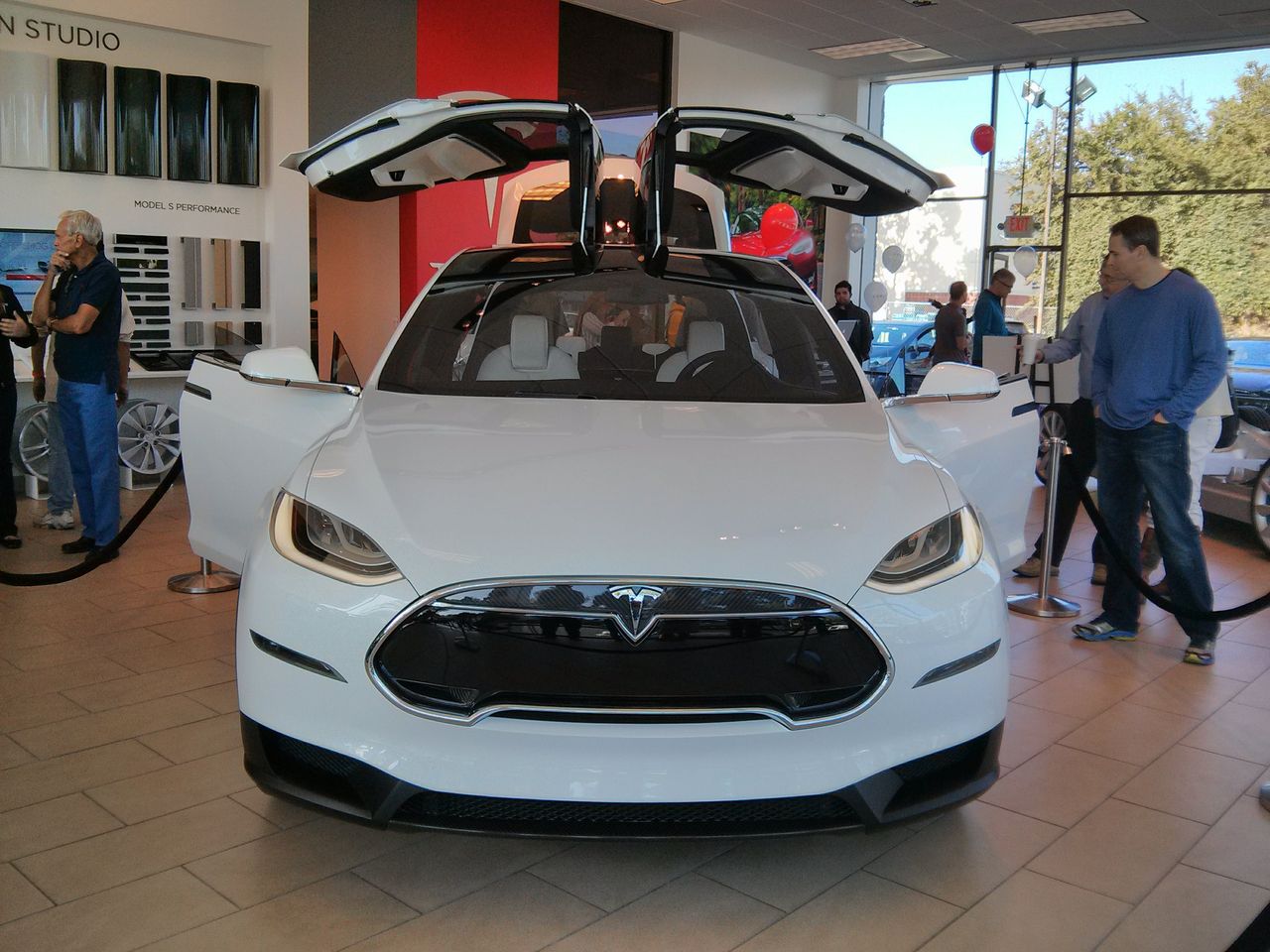
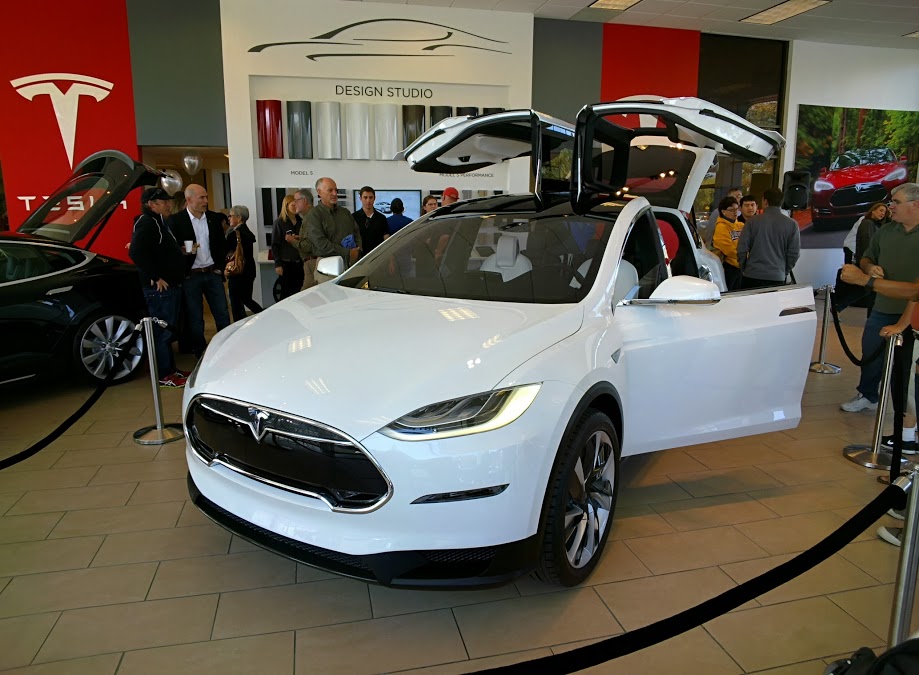
As predicted, Tesla did showcase its Model X SUV-Crossover at its Palo Alto Store today and it differed in a few ways from what we’d seen before.
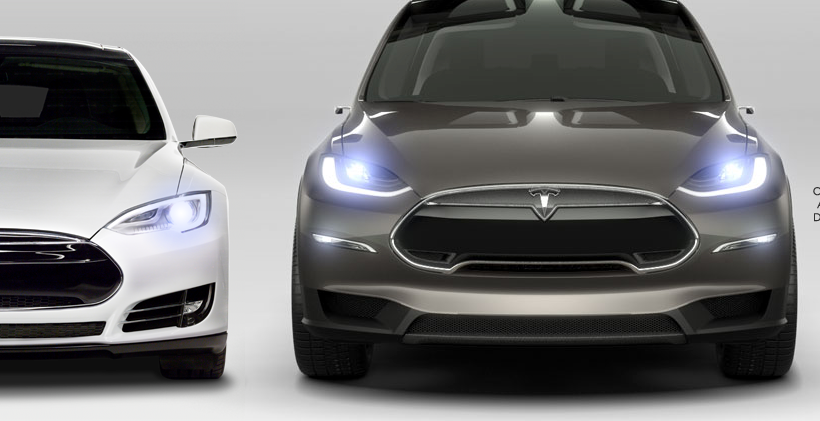
Perhaps most noticeably, the virtual side rear view windows which worked as cameras (pictured from Tesla’s web page, above) were replaced by Tesla Model S-lookalikes (below). That could indicate that Tesla isn’t going to get government clearance to do away with the side rear view mirrors. Or perhaps Tesla hasn’t yet gotten clearance and needed to put something legal on the road. The cameras were intended to reduce drag that would likely be lost with the added height of the Model X.
Next, the steering wheel appears to have replaced the hardware buttons on the model S with iPod nano like 2-inch touch screens (these aren’t necessarily new, they have been in the Tesla Model X webpage for months). I have mixed emotions about this. The obvious advantage is that Tesla can change what’s on the screen giving them more UI control (especially good when global markets are considered). On the other hand, the steering wheel buttons are the one hardware button on the Model S that you can actually feel and navigate without your eyes, something that is key when driving a car.
Two pictures of the new display steering wheel and the website:
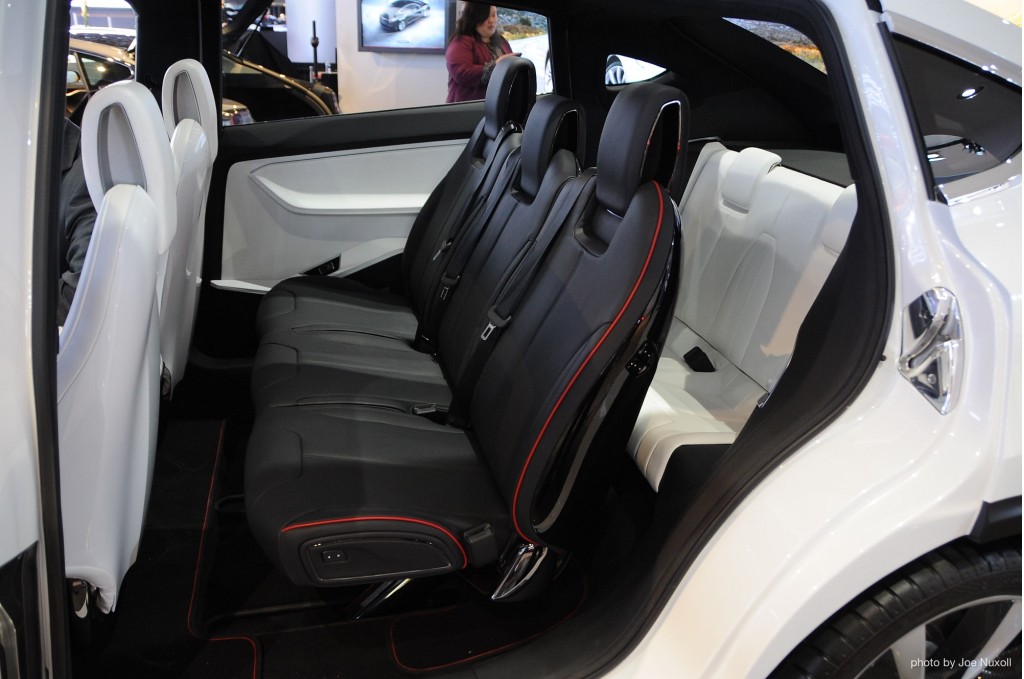
The big question: Can you really fit 7 adults in this thing comfortably? Tesla hasn’t changed the wheelbase nor the overall length of the vehicle so how do they make more room? From the first glance, it appears that those back seats aren’t going to have a lot of legroom.
For kids, this is fine, but saying that 7 normal sized adults can fit in this thing seems a little bit of a …stretch. I really like the ‘jump seat’ model in the Model S which puts 2 kids rear facing seats in the back while leaving plenty of legroom for the now middle compartment. This model seems to compromise the middle compartment to give room for forward facing rear seats.
Finally, no one saw that mystery app icon (far right, below) on the Model X website did they? It looks like a download option but I’m still not sure what this is for.
The Model X is supposed to go on sale in about one year with similar cost and configurations as the Model S. Expand Expanding Close
Technology Review looks at the differences between Porsche’s new Panamera S Plug in ‘E-Hybrid’ and the Tesla Model S. The main difference is obviously that the Porsche uses both gas and electric powertrains while the Tesla is pure electric (fun fact: the original Model S designs were gas hybrids).
Both cars weigh about the same and have the same horsepower but the Porsche uses an order of magnitude smaller batteries yielding only a 30 or so mile range on electric only. The rest of the weight is an internal combustion engine, drivetrain, fuel tank and everything else that comes along with it.
Also the Panamera S electric motor is under 100HP so if you want to achieve the high speeds (Porsche claims 5.2 0-60 vs Tesla’s 4.2), you are going to be burning lots of petrol.
The new Porsche isn’t quite as responsive—or spacious—as the Tesla Model S that it’s meant to compete with…Aside from the Porsche’s acceleration, two other things stood out during my test drive. The first is that the Porsche feels far more cluttered and cramped than the Model S. The transmission and electric motor run between the front seats. The large number of buttons and dials contrasts sharply with the relatively simple interior of the Model S, which uses a 17-inch touch screen in place of buttons.
Check the video below for the space issues. Particularly the boot which is miniscule vs. the Model S trunk which fits 2 children and jump seats plus the extra ‘frunk’.
On the flip side, the gas and electric combined give the Panamera S a range of almost 600 miles (compared to the Model S’s 265) but at that point you no longer have an electric car. One thing I did like (and wish was an option on Plug-in Priuses:
The second is that Porsche has found a useful way to give feedback to the driver through the accelerator pedal. The gas engine is designed to switch on if you accelerate more than a certain amount. As you depress the accelerator, it gets slightly harder to push just before the gas engine kicks in, signaling that it’s about to come on. That makes it easy to stay in all-electric mode if you want to.
Good on Porsche for making this car, which will certainly serve as a gateway for petrol heads. However, as the review mentioned a few times, it is no comparison to the Model S.
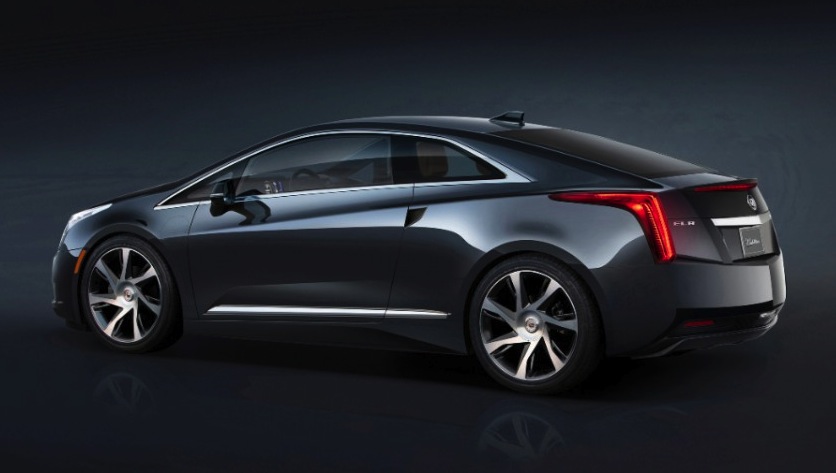
Introduced with pricing today and shipments in January, the $75,000 ($68K after Fed Tax Cred) car will have almost identical specs as the Chevy Volt in 35 miles in EV mode and 300miles on gas. That’s actually worse than the Volt’s upgraded 40 EV miles – probably due to the slightly higher performing engine on the Caddy. It even appears to have the same T-shaped battery going through the middle of the car as the Volt which makes it barely capable of seating of 4 people. Trunk space is listed at a comical 10.5 cubic feet which is about a third of the Tesla Model Sbefore you consider the “Frunk”.
The ELR is a two door which probably lends itself better to the 2+2 seating that the 4-door Volt has currently.
As for performance gains, there is no listed horsepower but the 295 lb-ft compares favorably to the 273 lb-ft. torque listed or the Volt. But, as a sad comparison, the sub-$20,000 Chevy Spark 100% electric vehicle produces 400lb-ft of torque so that $75K Caddy is likely going to get smoked by a $20K hatchback with over twice the amount of EV battery made by the same company.
I’m in full agreement with Ed Kim, vice president of industry analysis at AutoPacific Inc., who on Friday tweeted: “A Volt with a Cadillac body and badge for Tesla Model S money? Is GM on crack?”
A Volt with a Cadillac body and badge for Tesla Model S money? Is GM on crack? http://t.co/jBGKLjN1mj
The Volt is a great car but GM isn’t going to have any kind of success taking it into the Tesla price category without significantly upgrading the batteries and motor and bringing some more innovation to the table. This is embarrassing.
You don’t capitalize that ‘X’ by accident. Tesla’s Model X is a crossover/SUV built on the Model S frame with more headroom, gull falcon wing doors in the rear and room for 7 or 8 adults.
Tesla pushed the rollout of the X back to focus on meeting Model S supply but the product is due next year and can be reserved for $5000-$40,000.
Update: We’ve heard that the invite to the store says: “Come by to experience Model S and to see the Model X Design Prototype on display all weekend.”
Not much not to like here. How does $27,500 go for a $199/month lease? Add in the $7500 tax credit. I’ll be interested to see how low that 82 mile range gets in the winter – oh you can only get on in California and Oregon which have mild winters so we’ll have to wait awhile and see. Expand Expanding Close
If you wonder about the Solar future of vehicle transportation, this is where you should start. The World Solar Challenge has a great deal of innovation in the solar field as well as pushing innovation in efficiency and recovering electricity for electric cars.
In friendly competition with others attempting the same goals, the teams depart Darwin aiming to be the first to arrive in Adelaide, some 3000km to the south.
It’s all about energy management! Based on the original notion that a 1000W car would complete the journey in 50 hours, solar cars are allowed a nominal 5kW hours of stored energy, which is 10% of that theoretical figure. All other energy must come from the sun or be recovered from the kinetic energy of the vehicle.
These are arguably the most efficient electric vehicles.
Having made the journey to Darwin by successfully navigating quarantine, customs, scrutineering, safety inspections and undertaken event briefings, participants are ready to start their epic journey.
The elite Challenger class is conducted in a single stage from Darwin to Adelaide. Once the teams have left Darwin they must travel as far as they can until 5pm in the afternoon where they make camp in the desert where-ever they happen to be. Other classes have different requirements, but all teams must be fully self-sufficient and
for all concerned it is a great adventure – many say the adventure of a lifetime.
During the journey there are 7 mandatory check points where observers are changed and team managers may update themselves with the latest information on the weather and their own position in the field. Here teams may perform the most basic of maintenance only – checking and maintenance of tyre pressure and cleaning of debris from the vehicle.
There are also undisclosed check points which may be imposed by the event officials to ensure regulatory compliance.
Will a future Leaf or Tesla be solar powered? Probablynot any time soon, but slapping solar panels on top of electric cars can only help improve their efficiency, extend their range and rely less on the grid. If it is any indication how far we need to go, the Prius had a short lived solar panel that only cooled the car.
A curved section that fell off a semi-trailer was recovered from the roadway near where the accident occurred and, according to the road crew that was on the scene, appears to be the culprit. The geometry of the object caused a powerful lever action as it went under the car, punching upward and impaling the Model S with a peak force on the order of 25 tons. Only a force of this magnitude would be strong enough to punch a 3 inch diameter hole through the quarter inch armor plate protecting the base of the vehicle.
Interesting that this is written by Elon Musk (with some help likely) and he actually turns the tables at the end:
The nationwide driving statistics make this very clear: there are 150,000 car fires per year according to the National Fire Protection Association, and Americans drive about 3 trillion miles per year according to the Department of Transportation. That equates to 1 vehicle fire for every 20 million miles driven, compared to 1 fire in over 100 million miles for Tesla. This means you are 5 times more likely to experience a fire in a conventional gasoline car than a Tesla! For consumers concerned about fire risk, there should be absolutely zero doubt that it is safer to power a car with a battery than a large tank of highly flammable liquid.— Elon
The post also includes an email from the driver – who is also an investor – who can’t wait to get behind another Tesla shortly (a loaner is on the way). Expand Expanding Close
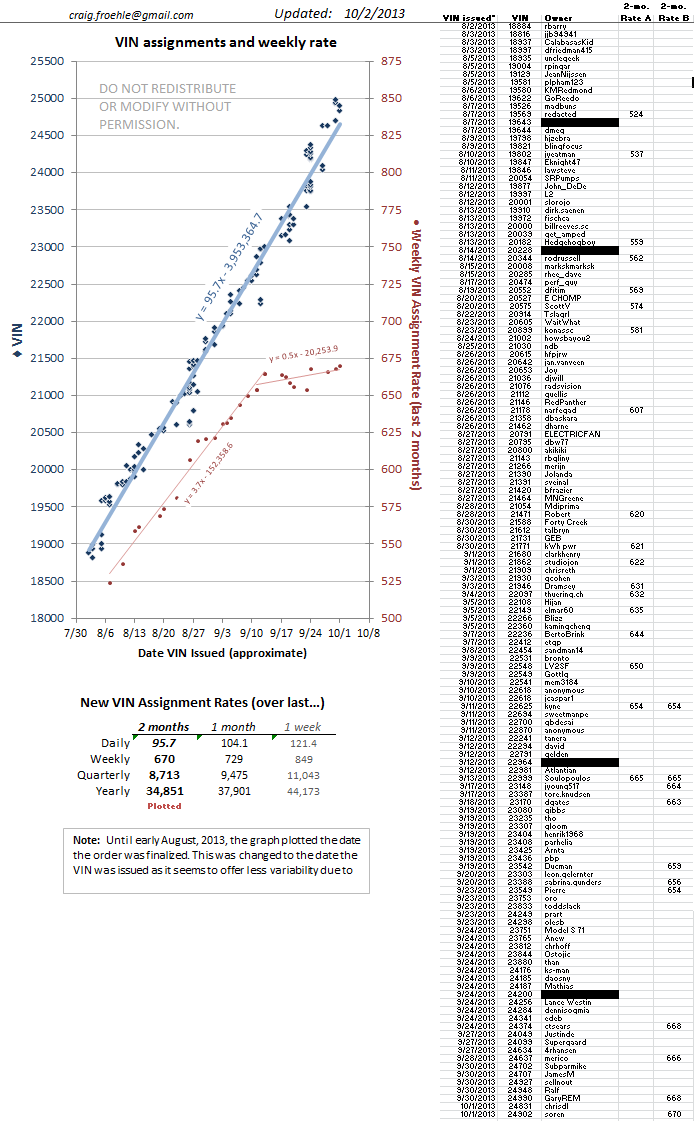
According to the chart above from the Tesla Forums, Tesla is still increasing its weekly production numbers of Model S vehicles and now is standing just shy of 675 a week. That number represents a leveling off of sorts after a strong growth from early August to early September. The still rising number puts Tesla at a 35,000 a year or 100/day. Craig Froehle, who maintains the list tells us why he’s cautious not to estimate 100/day just yet:
Some VINs are assigned to “internal” production vehicles, such as loaners, test mules, corporate cars, donor cars, etc. I don’t know how many that is, but I suspect it’s far less than 10%. Still, it’s not zero.
Plus, there’s a lag between issuing a VIN and a car rolling off the production line. Right now, that’s somewhere between 3 and 8 weeks, depending on various things. And then there’s another lag between production and delivery.
So, I suspect VIN issuance is a slightly inflated, lagging indicator of demand and a slightly inflated, leading indicator of production volume.
As the world loses its mind over the Tesla that caught on fire, it is important to note a few things. Above, from a conversation in July with owners and stockholders Musk indicates some of the pretty incredible considerations that went into building the Model S.
Last month, when announcing the best NHTSA ratings ever, Tesla expanded on Musk’s statement above –that statistically there was likely to be a battery fire.
The Model S lithium-ion battery did not catch fire at any time before, during or after the NHTSA testing. It is worth mentioning that no production Tesla lithium-ion battery has ever caught fire in the Model S or Roadster, despite several high speed impacts. While this is statistically unlikely to remain the case long term, Tesla is unaware of any Model S or Roadster occupant fatalities in any car ever.
The Seattle driver was fine so, as of as of this writing, no one has yet had a permanent injury or death from a Tesla Model S accident.
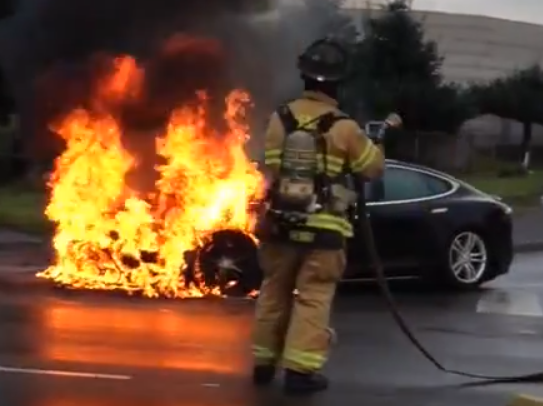
A Tesla Model S caught fire off of Washington State Route 167 outside of Seattle (Google Maps). This is kind of weird because there isn’t much flammable except some plastic in the front of the Tesla Model S. The ‘Frunk’ is an empty space where you can put (potentially flammable) cargo. There’s some plastic up front but nothing that would immediately seem to burn like that. The tires could (And eventually did) burn but again, nothing like what this video would appear to showing.
The batteries, which would be flammable, are located beneath the car between the wheels which don’t seem to be affected. There is a 12V battery up front (just like any other car) but again not something that would catch fire like this.
Update: Tesla has said that the crash was caused when the Model S hit a metal object
“Yesterday, a Model S collided with a large metallic object in the middle of the road, causing significant damage to the vehicle. The car’s alert system signaled a problem and instructed the driver to pull over safely, which he did. No one was injured, and the sole occupant had sufficient time to exit the vehicle safely and call the authorities. Subsequently, a fire caused by the substantial damage sustained during the collision was contained to the front of the vehicle thanks to the design and construction of the vehicle and battery pack. All indications are that the fire never entered the interior cabin of the car. It was extinguished on-site by the fire department.”
I would expect a post mortem on this in the coming days. The TSLA stock price is tumbling.
In an incident report released under Washington state’s public records law, firefighters wrote that they appeared to have Tuesday’s fire under control, but the flames reignited. Crews found that water seemed to intensify the fire, so they began using a dry chemical extinguisher.
After dismantling the front end of the vehicle and puncturing holes in the battery pack, responders used a circular saw to cut an access hole in the front section to apply water to the battery, according to documents. Only then was the fire extinguished.
The incident happened as the Tesla’s driver was traveling southbound on state Route 167 through the Seattle suburb of Kent, said Trooper Chris Webb of the Washington State Patrol. The driver said he believed he had struck some metal debris on the freeway, so he exited the highway and the vehicle became disabled.
“The reason why Toyota doesn’t introduce any major [all-electric product] is because we do not believe there is a market to accept it,” Mr. Uchiyamada said in an interview following a speech on Monday at the Economic Club of Washington, D.C.
Mr. Uchiyamada said he thinks electric vehicles require “two breakthroughs” on battery technology before they are viable as replacements for gasoline or hybrid-electric vehicles.
Toyota is an investor in Tesla Motors but doesn’t seem to quite be grasping the electric vehicle market. As an owner of a Prius plug-in, I can confirm that Toyota doesn’t grasp the concept. It is very poorly designed compared to the Tesla or even the Volt.
The AP reports today that IKEA will begin selling solar panels. Not just a back up iPad battery but like whole house to grid assemblies.
Swedish flat-pack furniture giant IKEA will start selling residential solar panels at its stores in Britain, the first step in its plan to bring renewable energy to the mainstream market worldwide. The company started selling solar panels made by China’s Hanergy in its store in Southampton on Monday. It will sell them in the rest of Britain in coming months, it said.
A standard, all-black 3.36 kilowatt system for a semi-detached home will cost 5,700 British pounds ($9,200) and will include an in-store consultation and design service as well as installation, maintenance and energy monitoring service.
Getting Solar in front of more eyes and making it easier for consumers to swallow is a big step in improving consumer adoption. If the UK test run is successful (and if you can sell solar in cloudy Britain, why not?) then I’m hoping to see a wider rollout globally.
Even in Britian, the break even point for solar is 7 years so I’d imagine sunnier places, like *everywhere*, will be more successful. The UK does have a solar friendly environment however:
The U.K. government offers private solar panel owners the opportunity to sell back electricity to the grid on days when they have surplus production and has a financing plan for solar power investments, which means residents can buy a system for no upfront cost and pay it off gradually.
People who arrive at California’s largest two airports will now be able to rent a Tesla Model S for around $500/day. As part of its fleet of elite ‘Dream Car’ vehicles which include Ferraris and Porches, Hertz rental car will offer around 5 of the vehicles to customers. Theoretically, those customers could take advantage of Tesla’s Supercharger network and drive throughout the state.