Nissan Leaf

See All Stories

Nissan Leaf review

Our most recent review of the Nissan Leaf was in early 2019 when we looked at Nissan Leaf Plus:

 The 40kWh Leaf has 150 miles of EPA range, whereas the Leaf Plus has 226 miles. A couple hundred pounds of extra weight from the larger battery reduces efficiency slightly, though we don’t have EPA MPGe numbers yet, so we’ll have to extrapolate from the results of our drive.

So this review concludes by stating that the Leaf Plus is more of a good thing. Nissan has put together another solid package that improves on last year’s offering in many ways, and offers good options for buyers. Those who realize they’ll rarely need 200 miles of range can save several thousand dollars with the base model, and those who want more power, greater range, and additional included features still have a good choice in the Plus. Assuming the price comes in at the level we guessed above, the Leaf Plus remains an easy car to recommend for buyers looking for a comfortable, usable daily driver.
In 2018, we also reviewed the 2017 model:

I think the 60kWh LEAF will probably fade a little when compared to the Bolt and Model 3 unless Nissan can come up with a way to keep the price a little lower than those two cars, but it is a solid entry and bridge between the two EV markets/price points as they currently stand.

As a solid EV that outshines the Hyundai Ioniq EV in most ways and comes in significantly under the price of the Model 3 and Bolt EV, the new Leaf is easy to recommend.

Nissan Leaf price

The current Nissan Leaf starts at $31,600 before any upgrades or tax credits.

Shopping for the best prices for EVs can be time-consuming. At Electrek, we’ve done the hard work of finding the best purchase and lease pricing for a long list of electric vehicles.

Best pricing on Nissan LEAF: Purchase | Lease

Nissan Leaf features

The Nissan Leaf comes with a 151-mile range by default, but the Leaf Plus option raises it to 226.

Nissan touts its ProPILOT Assist as a headline feature of the Leaf lineup. ProPILOT Assist helps keep you in the middle in your lane through the straightaways, and even through gentle curves. ProPILOT Assist can keep a set distance from the car ahead of you based on the traffic flow. It can even come to a complete stop and bring you back up to speed when traffic starts moving again.

Continue scrolling for the latest news

Nissan confirms LEAF 2016 details: 107 miles of range on 30 kWh, $34,200 starting price for SV and more

Nissan confirmed through a press release this morning the details of the 2016 version of its flagship electric vehicle: the LEAF. Information leaked through a dealership earlier this year already disclosed that the LEAF 2016 will have a 30 kWh battery pack option, but today Nissan confirmed the information and expects the pack to allow for an EPA-rated range of 107 miles.
Expand
Expanding
Close

Possible Nissan LEAF 2016 spotted at Nissan HQ in Franklin TN

Nissan has been careful not to release too much information about the 2016 update of its flagship electric vehicle, the LEAF, most probably not to hurt the sales of its current model. Though we learned through information leaked from dealerships that Nissan should offer a bigger battery pack option for more range in the 2016 version.  The new model is expected to arrive at the end of month like most 2016 cars, but we have yet to get an official launch date or see one in the flesh, until now…
Expand
Expanding
Close

A Nissan LEAF caught fire in North Texas – cause currently unknown

A spectacular short video posted to Youtube earlier this week shows a Nissan LEAF on fire. According to a post on the My Nissan Leaf forum, the event happened on September 1st in North Texas.

This is quite possibly to first reported instance of a Nissan LEAF catching fire even though Nissan sold over 180,000 LEAFs to date worldwide.
Expand
Expanding
Close

Nissan LEAF US sales down 56% ahead of next generation release

Nissan released its monthly US sale reports today and the company reported a 56% decrease in LEAF sales versus August last year. The decrease is a clear example of the Osborne effect, which refers to the unintended consequences of the release of information about an upcoming product can have on a current product. In this case, the release of information on the 2016 LEAF is having a significant effect on the sales of the 2015 LEAF.


Expand
Expanding
Close

2016 Nissan Leaf will feature 30kWh battery w/110 mile range option

Site default logo image

It looks like a Nissan dealership either jumped the gun or is making claims it probably shouldn’t on the upcoming 2016 Nissan Leaf.  Andy Mohr Nissan (via InsideEVs/Green Car reports) publishes the following info on the 2016 Nissan Leaf:

2016 Nissan Leaf Changes

While there are many features that make the Leaf a popular vehicle, there is one thing it’s known for above all else: its battery. The 2016 Nissan Leaf redesign will bring a first to the electric car: your choice of two different batteries.

  • The standard Leaf will come with the same battery as the 2015 model, featuring an EPA-estimated driving range of 84 miles.
  • Drivers of higher trim levels will enjoy a battery with as much as 25% increased capacity, delivering a driving range of as much as 110 miles.

The majority of electric cars only feature one battery option, and by providing drivers with their choice of a lower capacity battery if they don’t intend to drive long distances, the new Leaf can find a home in even more garages.


Expand
Expanding
Close

2016 Chevy Volt has 53 mile battery range says EPA, will that make a difference?

Site default logo image

The all-new 2016 Chevrolet Volt electric car with extended range, showcasing a sleeker, sportier design that offers 50 miles of EV range, greater efficiency and stronger acceleration.

The results are in: the new 2016 Chevy Volt will get 53 miles of electric range on a charge of its new 18.4-kWh lithium-ion battery according to EPA numbers. That’s close to 40% more than the previous Volt’s 38 miles and a big psychological jump for buyers.

The typical American commute is around 48 minutes so adding those extra miles gets a lot more people home without using gas. Chevrolet expects many next-generation Volt owners will use power solely from their batteries for more than 90 percent of trips. Today, Volt owners use battery power on 80 percent of their trips.

The biggest turn off for me in the old Volt was the back seat which was split in half by the battery bar. The 2016 lowers the batteries so that a car seat or a passenger can straddle the bar which is worlds better for families.

That, and when you went to gas – like for long trips – you’d only get around 35 miles/gallon with the range extender. The next-generation Volt’s new 1.5L range-extender, designed to use regular unleaded fuel, offers a combined EPA-estimated fuel efficiency of 42 MPG. That’s very respectable but not yet on the same level as a Prius which typically sees 50+ mpg.

I think the new Volt is hitting new spec points that will make sense for a lot more buyers. It doesn’t have any range anxiety problems and it is getting pretty close to the range of the Nissan Leaf and BMW i3 (which also has a very small REX engine). Also, the faster acceleration, better back seat and sportier looks will draw new buyers along with the proliferation of EV charging points around the country.

The new EPA sticker is below:
Expand
Expanding
Close

Where are the electric vans, trucks and SUVs for famlies?

Site default logo image

If you are a family who lives in snowy weather, you don’t have many EV options. You want an SUV with 4-wheel drive. You want the ability to carry more than 5 people at a time. Maybe you just want to carry more than 5 people or some cargo?

Sure, I know that almost all 7-seat, $70,000+  Tesla Model S’s are now AWD and the Model X “Crossover” is about to debut but what about a family that wants to spend a lot less on a vehicle that can be used day to day and doesn’t require over 100 miles of range.
Expand
Expanding
Close

Average Wh/mile readings from all over US show temperate warm climates excel, extremes lag

Site default logo image

In a new paper in the ACS journal Environmental Science & Technology, Tugce Yuksel and Jeremy Michalek at Carnegie Mellon University have shown the average energy usage per mile of electric cars across the US.  You’ll note that warm but temperate climates like the California Coast and the Deep South especially Florida fare the best. Very hot desert areas like Arizona don’t do well because of the energy required to cool off bith the batteries and cabin. The North does poorly because batteries lose power as weather gets cooler.  Below, a Nissan Leaf efficiency is graphed at different temperatures which illustrates this disparity more clearly. The optimum range for operation is between 45 and 82 degrees where the 300W/mile threshold is beaten.

This all translates to CO2 emissions obviously and with the West making their energy much cleaner, they produce about 1/3rd the CO2 emissions as the north Midwest which is basically one big coal plant. In fact, that area’s energy is so CO2 intensive that running an electric car there (assuming you don’t have your own solar/wind) rivals the CO2 emissions of a fuel efficient car like a Prius.

The big takeaway is that moving to electric cars isnt enough. The grid also needs to move to cleaner power like wind and solar.


Expand
Expanding
Close

Tesla CHAdeMO adapter gets slashed to $450, might actually go on sale soon

Site default logo image

We’ve seen Tesla’s CHAdeMO adapter in the wild and it might soon be hitting the streets. The Tesla Motors Shop now has the adapter, with the same “Coming Soon” designation but with a drastically reduced $1000 $450 price tag.  That means there is some movement on the product and you might actually be able to buy one soon.

The one we saw a few months ago was working well but our tipster said that because of the variances between CHAdeMO stations it was still being tuned.

Tesla launched in Japan last month where CHAdeMO stations are plentiful. But as you can see from the map of CHAdeMO adapters from the standard body’s site, they are also plentiful and growing in the US.

CHAdeMO is the official DC fast charging option used by Nissan for the Leaf and a few other Japanese electric car manufacturers. As of October 7th, 2014, the CHAdeMO Association web site states that there are 2,129 DC Quick Chargers installed in Japan, 1327 in Europe, 731 in the USA and 54 elsewhere

Tesla charging times vary depending on the amperage on the stations but the fastest will approach the speeds of Tesla’s Superchargers.

Nissan Leaf to get redesign and double range for mid 2016?

Site default logo image

Not only is the car redesigned but claimed to get more than double the current 85Mile range. The design is definitely more pleasing though I have to wonder what that huge front grill is all about.

Nissan is hard at work developing the next-generation Leaf, focusing on improving the range with new battery tech and – as our exclusive images show – a more conventional look. The new car is expected to be on sale late in 2016, with prices starting around £17,000…Nissan bosses are promising new battery technology is on the way, with better energy density for a more usable pure electric vehicle. A figure of about 186 miles is likely to be the target.

via AutoExpress

Nissan and Mitsubishi to form joint venture to produce lost cost sub-$15K electric car

Site default logo image

Nikkei:

Nissan Motor and Mitsubishi Motors will work together to develop a minicar-based electric vehicle, aiming to release a new model in fiscal 2016 at the lowest price among major automakers. The carmakers have set up a 50-50 joint venture to pursue development. Nissan, which released the Leaf electric car in 2010, is the world’s largest manufacturer of electric vehicles, with global sales of at least 124,000 units. Mitsubishi has a track record in this area as well, including the minicar-based i-MiEV released in 2009. They plan to co-produce the new car and work together to procure such key components as lithium-ion batteries. The i-MiEV is the cheapest electric passenger car on the Japanese market, starting at 2.52 million yen ($24,300). When government subsidies of up to 740,000 yen are included, it can be purchased for as little as 1.78 million yen.

This will be interesting if they can build a car as good as a Leaf for as little or less than a i-MiEV. If they can do this, the math is almost unstoppable especially a gas prices rise.

Nissan expands “No Charge to Charge” program to 25 markets, giving 2 years of free public charging

Site default logo image

Smart move from Nissan which will subsidize public charging for two years for its Nissan Leaf at ChargePoint, Blink Network from Car Charging Group, AeroVironment and NRG eVgo charging stations.

As an EV buyer, knowing you won’t pay a penny for public charging for 2 years is a great incentive.

Details in press release that follows:
Expand
Expanding
Close

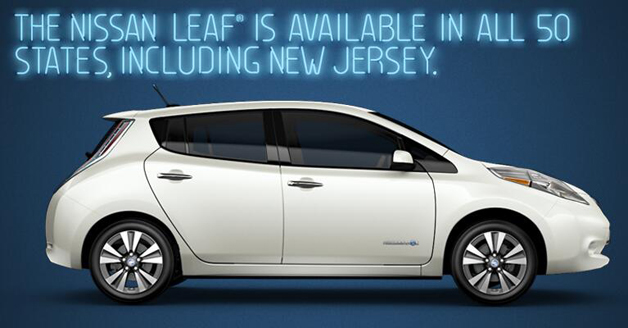
Nissan’s Leaf social media team disses Tesla over NJ loss, deletes tweet

Site default logo image

After Tesla lost in New Jersey, Nissan’s social Media Team Tweeted the “dickish” image above from the Leaf account according to ABGreen. They quickly realized the folly of their ways and deleted it and perhaps someone was straighend out (the door?) over the matter.

I mean we’re all in this together and rising waters raise all ships and all that, right?
Expand
Expanding
Close

Elon Musk says mass market Tesla car (Model 3) will have a ~48kWh battery, be 80% the size of the Model S

Site default logo image

[youtube=http://www.youtube.com/watch?v=h5N9xIfTU5g]

There is a lot of interesting info from a talk that Elon Musk gave at the CPUC last week. Of particular note, Musk gave some spec estimates for the mass market “Model E” vehicle expected to be released in 2017 with batteries coming from the Gigafactory. In the video above he says the car will have a 200 mile range and be 20% smaller than the Model S. Therefore the battery will need to have about 80% of the energy of the current Model S (Musk’s words). To be clear, since Tesla uses the constant sized 18650 cells (and looks to continue to do so) physical size and Watt-hours are fairly constant.

So given that a 60kWh Model S has a range of around 200 miles (EPA 208), that means that the Model E would need to have a battery around 80% the size of the Model S or 48kWh.

That’s still about double what leading ‘mass market’ electric cars have today. The Chevy Spark EV, with a range of 82 miles has a 21.3 kWh battery. The Nissan LEAF which has a 75 mile EPA range rating has a 24 kWh battery. The Chevy Volt has a 16kWh battery while the BMW i3 is 18.8.

Tesla cancelled its $49,000 40kWh battery Model S before it got an EPA estimate but most guesses were that it would get around 150 miles.  Add another 8kWh to the battery and take off 20% of the overall car size and 200 mile range seems doable.

Musk also mentions that besides the 20% drop in price, he expects economies of scale and other innovations to drop the price another 30% on the battery alone helping to get the Model E to around 50% the cost of the Model S at $35,000.

[tweet https://twitter.com/fatihguvenen/status/440248060958896128]

Below is a snippit of Musk talking about the upcoming battery swap:
Expand
Expanding
Close

Chevy SparkEV, more torque than a Ferrari 458 Italia at a tenth the price

Site default logo image

[youtube=http://www.youtube.com/watch?v=YAG8QpbEAS4]

I’m still infatuated with the Chevy Spark EV. The Korean/American EV can be had for significantly under $20K or $200/month meaning it can be free after gas cost savings for big commuters. The practical little 4 seat hatchback can go around 80 miles on a charge and can be charged quickly using the same SAE DC  charger as the BMW i3.

There’s more!

It has more torque (over 400ft/lbs) than a Ferrari 458 Italia and can hit 60 miles per hour in 7 seconds flat.

Did I mention it is essentially free if you currently spend $10/day on gasoline?

The Spark EV starts its life in Changwon, South Korea where gasoline and electric sparks are built by GM Korea, which was once known as Daewoo. But the heart of the Spark comes from America. GM is building the permanent magnet motors in Maryland, and instead of LG batteries made in Korea (like the Volt) GM is using American-made batteries courtesy of B456 (formerly A123. I’m not making this up). For reasons we don’t understand, GM isn’t “doing a CODA” and shipping cars sans-drivetran to America for assembly. The plant in Maryland ships the batteries and drivetrain to Korea, GM Korea inserts it in the car and ships the completed unit back to the USA.

Anyway, here’s a great review. I have no idea how they keep these in stock. Chevy please send these outside of California and Oregon.  Money quote:

Power is supplied by a 560lb, 21.3 kWh lithium battery pack located where the gas tank is in the gasoline Spark. As with the Chevy Volt, GM is taking the cautious path to battery preservation equipping the pack with an active heating and cooling system. That’s a stark contrast to the Nissan Leaf which uses a passive cooling system. Thanks to the lightest curb weight in the group (2,989lbs), the Spark scores 82 miles of EPA range and the highest efficiency rating of any EV to date. Depending on the weight of my right foot, my real world range varied from 70-100 miles.

The Chevy Spark EV gets fast charging option [video]

Site default logo image

[youtube=http://www.youtube.com/watch?v=_fcMJf0tDRY]

A nice option for a truly impressive little EV car. However 20 minutes for every 80 miles of drive time doesn’t really let you take long trips (vs 20 minutes for 170 miles on the Tesla Model S.

It would also have been nice if Chevy was compatible with Nissan/Toyota/Mitsubishi’s CHAdeMO Fast DC chargers so the companies could blanket more the the country with compatible chargers.
Expand
Expanding
Close

Tesla passes Nissan becoming best selling Electric Car Make in Canada in 2013

Site default logo image


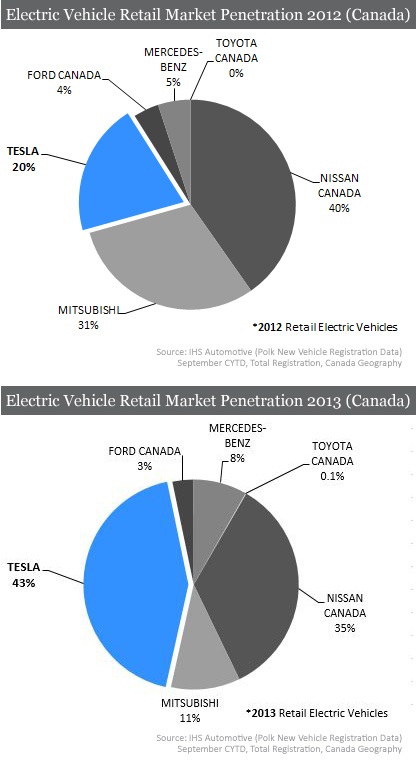
According to Polk/IHS, Tesla has passed Nissan to become the best selling Electric car in Canada for the 2013 year. It moved from selling 20% of Canada’s Electric Cars in 2012 to 43% of the cars in 2013.

Consumer research shows that within its release year, the Model S captured a staggering 20% of the electric vehicle market share. Over the course of the next year (2013), it more than doubled to 43%, outselling all other OEMs. It is important to note that with such tremendous gains, Tesla did not necessarily conquest customers from other electric vehicle OEMs, but instead, brought new customers from outside the electric vehicle market to grow the current EV customer base. After all, the current EV competition includes the Nissan Leaf, Mitsubishi Imiev, Smart Fortwo, Ford focus EV, Toyota Rav4 EV and the Chevrolet Spark.

Georgia Man charged with theft, does jailtime, after charging his Nissan Leaf (5 cents worth) at a school

Site default logo image

Interesting story here and one that will likely set some precedents/laws or at least force some type of decorum when it comes to charging cars.

One Saturday in November, Kaveh Kamooneh drove his Nissan Leaf to Chamblee Middle School, where his 11-year-old son was playing tennis.

Kamooneh had taken the liberty of charging the electric car with an exterior outlet at the school. Within minutes of plugging in the car, he says a Chamblee police officer appeared.

“He said that he was going to charge me with theft by taking because I was taking power, electricity from the school,” Kamooneh said.

Kamooneh says he had charged his car for 20 minutes, drawing about a nickel’s worth of juice. Don Francis of Clean Cities Atlanta, an electric vehicle advocacy group, says the estimate of 5 cents is accurate.

They compare charging a cell phone or people drinking water from a spigot but it isn’t so obviously clear. Sure, $.05 is nothing, but what if someone was drawing $10/day from an unsuspecting neighbor?  What if you drove a truck full of batteries to a rest stop on the highway and took a few hundred $ worth of electricity (hypothetical, I know).

Clearly this guy should not have been jailed or fined – a warning probably should have sufficed.

But perhaps the most important part of this story is that Electric is so cheap – illustrated but the sub-$.05 of usage. Sure that’s only a few miles but hopefully that puts THIS GRAPH RIGHT HERE in people’s minds.

More below:
Expand
Expanding
Close

Top Gear USA takes on electric cars: Fiat 500E, Ford Focus E and Nissan Leaf. Winner gets to test Tesla [Video]

Site default logo image

Top Gear USA did an Electric Episode called ‘Fully Charged’ yesterday showcasing three all-electric cars: Fiat 500E, Ford Fusion and Nissan Leaf. The tests were mostly silly and these petrol-heads probably aren’t a good representation of the car-buying public

  • “I guess a silent car is good if you want to kill blind people”
  • Reverse Race.
  • Race through a mall vs. Mall cop on a Segway
  • Burglar test: silence through suburbs

..but there were a few redeeming moments.

They took a break from the silly tests to show electric dragsters which smoked a decked out Camaro ZL1. Also at the end, a Tesla Model S smoked that same Camaro ZL1 in a drag test then proceeded to beat a $100K Mercedes in a road test (with an extra large man in the car). If you can’t view it at the History Channel, this Reddit thread has some other ideas.
Expand
Expanding
Close