Chris Evans was until recently the head of Google’s Project Zero, a team of hackers employed full-time by Google to find zero-day vulnerabilities on not only their own products, but any software that could affect Google’s users. Today, Evans announced that he will soon join Tesla Motors to lead its security team. Expand Expanding Close
Google is currently operating a fleet of Lexus SUVs retrofitted with their self-driving technology – these cars were recently being tested in Austin – but Google is also testing a fleet of prototypes developed in-house from the ground up (picture above). The company’s different approaches to the car business can get confusing and adding to the confusion, according to documents recently obtained by the Guardian, the company created a wholly owned subsidiary to operate their car business – Google Auto.
There are a lot of different reasons for a large corporation to create a subsidiary, but with this being a first for a project coming out of the Google X division, for example the company didn’t create a subsidiary for Google Glass, it raises a few questions. Expand Expanding Close
Google’s fleet of self-driving Lexus cars have notched up a total of 140,000 miles on public roads, and the company is now ready to begin road-testing its first purpose-built autonomous cars.
We first saw the cute-looking cars almost a year ago, when the company explained that they were not intended to ever make it to public sale. Their purpose is to see how people respond to a next-generation driverless car before later seeking partners to actually bring the technology to market.
We learned earlier this week that Google’s existing Lexus fleet has been involved in three low-speed accidents, none of them the fault of the car, but the company still isn’t taking any chances in this latest phase … Expand Expanding Close
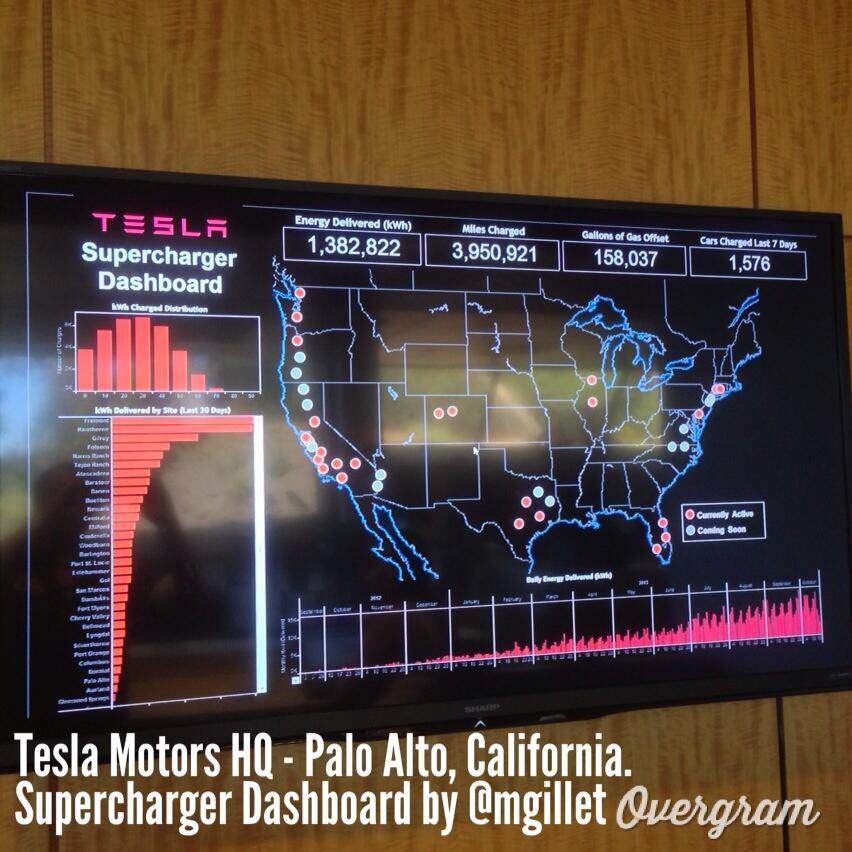
Great find from @mgillet onTwitter. This appears to be a Tesla dashboard at the headquarters showing significant growth in charging over the past few months. More importantly, we some highly anticipated charging stations ‘coming soon’. Probably most exciting for Tesla is the Oregon and northern California stations that will close the I5 corridor meaning the West Coast will be covered. Also two stations on the California/Arizona border will allow trips to/from Phoenix and LA/San Diego.
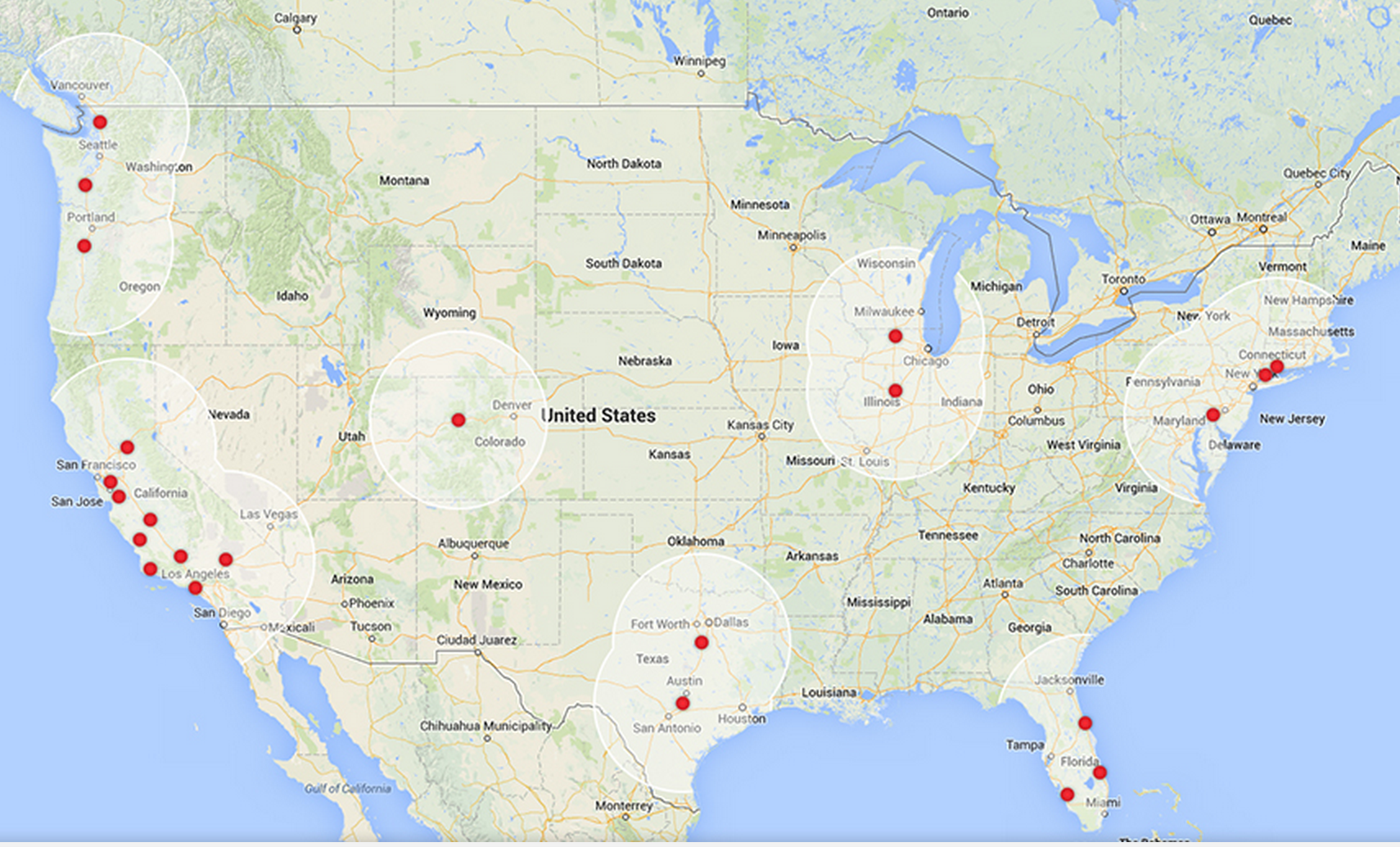
You’ll notice that two stations, one in Colorado and one in Texas, are lit up even though Tesla hasn’t pushed to the Supercharger Station website Map, below.
Texans will get two more Supercharger stations in Eastern Texas linking them to Arkansas and Louisiana. East coasters will get a couple in Northern New Jersey as well as Virginia and North Carolina allowing folks in Vermont/New Hampshire to travel to the Carolinas and vice versa.
Some fun facts:
Fremont (Tesla Factory) and Hawthorn in SoCal seem to be far and away the busiest Superchargers with Gilroy coming in third over the last 30 days.
Unsurprisingly, most people put 20-40kWh into their Teslas during a stop.
1576 cars visited superchargers in the last week
Almost 4 million miles have been charged at Supercharging stations…
That equates to 14,000 MWh…
Which has saved nearly 160,000 gallons of gas.
Compare with the current map as of today, 10/21/2013:
After plans for Autonomous driving were revealed this week via Tesla’s job site, Musk went on the offensive saying that yes they were working on a program and the team reports directly to him.
This is a stark (get it?) change from a previous stance where Musk said Tesla was taking a more wait and see approach. Perhaps Google’s plans to build their own car spurred him on? Expand Expanding Close