From 2010-2011, Weintraub covered all things Google for Fortune Magazine, amassing an impressive rolodex of Google contacts and a love for Silicon Valley tech culture.
It turns out that his hobby – the 9to5Mac news site – was always his favorite, and in 2011, he went full time adding his Fortune Google followers to 9to5Google, in addition to adding the style and commerce component of 9to5Toys gear and deals site. In 2013, Weintraub bought one of Tesla’s first Model S EVs off of the assembly line, which began his love affair with electric vehicles and green energy — this, in turn, became Electrekin 2014.To cover the burgeoning world of drones and UAVs led by China’s DJI, DroneDJ was born in 2018, and then more recently, Connectthewatts and SpaceExplored were launched to cover connected fitness and space.
From 1997-2007, Weintraub was a Global IT director and Web Developer for a number of companies, with stints at multimedia and branding agencies in Paris, Los Angeles, New York, Sydney, Hong Kong, Madrid, and London before becoming a publisher/writer.
Seth received a bachelor’s degree in Industrial and Systems Engineering from the University of Southern California with a minor in Multimedia and Creative Technology in 1997. In 2004, he received a Master’s from NYU’s Tisch School of the Art’s ITP program.
Weintraub is a licensed single-engine private pilot and a certified open-water scuba diver, and he spent over a year backpacking to 60 cities in 23 countries. Whatever free time exists is now guaranteed to his wonderful girlfriend, Alana, and two amazing sons.
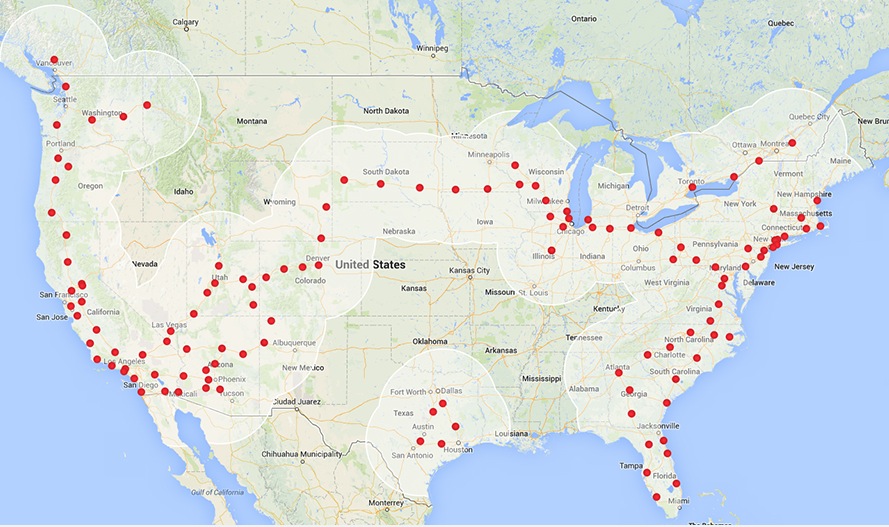
Tesla upgraded its Supercharger Map this week to reflect some new “Coming soon” Superchargers. Most notable is the SE Canada route from Windsor to Quebec City which will soon be traversable via Tesla Model S.
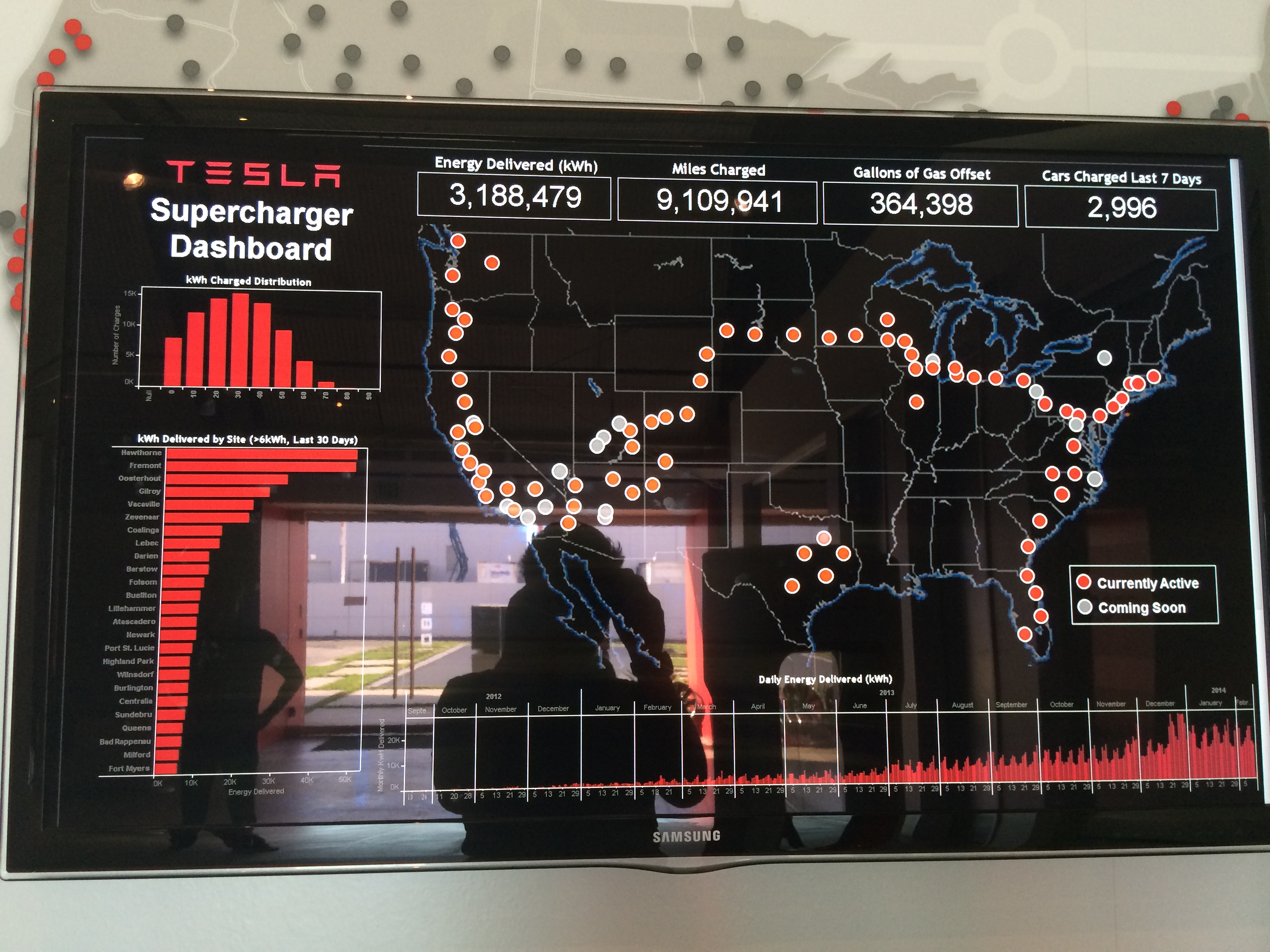
Here’s Tesla’s latest internal dashboard for the stations to go live next (Yay Albany!)
Also Tesla looks to have a second cross country option in the West as a bunch of new stations open up in Utah.
The East Coast is also expecting some more stations especially in Georgia on the way to Atlanta. Check the Supercharg.info for more details. Expand Expanding Close
From the creators of the Glass Tesla App, just what you’ve always wanted: A better way to control the charging, temperature and other interfaces in your Tesla remotely. Smartcar.io automatically learns your habits to have your Tesla at your desired temperature when you hop in every morning. It also allows learns your local utility rates to charge your Tesla when the rates are lowest, perhaps saving as much as 75% on utility charges. It might just pay for itself!
Pre-order now to get $50% off the yearly $100 subscription.
Update: Apparently those front wheels are naturally kicking up snow without any power because I’ve been told by Tesla that the video is only a teaser for another video, not AWD.
It isn’t hard to imagine what they are getting at – you’ll notice the front wheels accelerating through a turn in the (until now) rear-wheel drive Model S.
There is a lot of interesting info from a talk that Elon Musk gave at the CPUC last week. Of particular note, Musk gave some spec estimates for the mass market “Model E” vehicle expected to be released in 2017 with batteries coming from the Gigafactory. In the video above he says the car will have a 200 mile range and be 20% smaller than the Model S. Therefore the battery will need to have about 80% of the energy of the current Model S (Musk’s words). To be clear, since Tesla uses the constant sized 18650 cells (and looks to continue to do so) physical size and Watt-hours are fairly constant.
So given that a 60kWh Model S has a range of around 200 miles (EPA 208), that means that the Model E would need to have a battery around 80% the size of the Model S or 48kWh.
That’s still about double what leading ‘mass market’ electric cars have today. The Chevy Spark EV, with a range of 82 miles has a 21.3 kWh battery. The Nissan LEAF which has a 75 mile EPA range rating has a 24 kWh battery. The Chevy Volt has a 16kWh battery while the BMW i3 is 18.8.
Tesla cancelled its $49,000 40kWh battery Model S before it got an EPA estimate but most guesses were that it would get around 150 miles. Add another 8kWh to the battery and take off 20% of the overall car size and 200 mile range seems doable.
Musk also mentions that besides the 20% drop in price, he expects economies of scale and other innovations to drop the price another 30% on the battery alone helping to get the Model E to around 50% the cost of the Model S at $35,000.
That was the topic of discussion when I went on Bloomberg today. A few reasons I think it is Nevada’s to lose:
Nevada is geographically close to Tesla’s Fremont CA plant. Northern Nevada is on a quick direct Train route.
Northern Nevada also is the US’s only meaningful Lithium mine. Another huge deposit is located in near by Wyoming.
Nevada’s energy prices are higher than New Mexico or Arizona but still relatively low. Tesla however plans to use Solar and wind power, both of which northern Nevada has in spades
Texas won’t let Tesla sell cars direct to customers in the state. Arizona can’t go a year without trying to pass some crazy laws against gays, immigrants or other minorities.
Nevada has low taxes and pro-corporate laws.
Elon Musk likes going to nearby Burning Man
As for the cost of Li-ion batteries, Lithium is just a small bit. Cobalt and other materials are much more costly components. Expand Expanding Close
Tesla just announced details of the Battery Gigafactory to be located in the Southwest US. The location hasn’t yet been selected but will provide 6500 US jobs and, in 2020, enough batteries for 500,000 electric vehicles.
Tesla also announced a $1.6B convertible notes offering to fund the Gigafactory and other ramping.
As we at Tesla reach for our goal of producing a mass market electric car in approximately three years, we have an opportunity to leverage our projected demand for lithium ion batteries to reduce their cost faster than previously thought possible. In cooperation with strategic battery manufacturing partners, we’re planning to build a large scale factory that will allow us to achieve economies of scale and minimize costs through innovative manufacturing, reduction of logistics waste, optimization of co-located processes and reduced overhead.
The Gigafactory is designed to reduce cell costs much faster than the status quo and, by 2020, produce more lithium ion batteries annually than were produced worldwide in 2013. By the end of the first year of volume production of our mass market vehicle, we expect the Gigafactory will have driven down the per kWh cost of our battery pack by more than 30 percent. Here are some details about what the Gigafactory will look like.
Tesla would no longer be able to sell its luxury electric vehicles directly to consumers under a new bill in the New York State Legislature.
Groups representing the state’s automobile dealers met with Governor Andrew Cuomo in November to push a bill that would prevent automobile manufacturers from selling their vehicles directly to consumers, public schedules show. Deborah Dorman, president of the Eastern New York Coalition of Auto Dealers, was at that meeting and said Tuesday Cuomo aides told the group the governor would sign the bill if it passes.
She said the bill was designed to protect consumers because it required companies to create a storefront in the state and was not directed at Tesla because it sold electric vehicles. Some environmentalists have claimed the bill unfairly targets electric car manufacturers.
A fantastic litmus test to see if your state government represents the people or corporate interests. 90+% of voters want to be able to buy cars outside of the dealership monopoly. If your state even votes on something so lopsided, they should be voted out. Heck, just introducing such a bill should automatically dissolve the government and force new elections.
Panasonic Corp is inviting a number of Japanese materials suppliers to join it in investing in a U.S. car battery plant that it plans to build with Tesla Motors Inc, with investment expected to reach more than 100 billion yen ($979 million), the Nikkei reported.
The plant, expected to go on-stream in 2017, will bolster Panasonic’s supply of lithium-ion batteries to the U.S. electric-car maker.
Last week, Tesla shed some light on its plans for building a lithium-ion battery plant, or “giga factory,” that will cut battery costs and allow the company to launch a more affordable electric car in 2017. However, it said at the time that further details would be announced this week.
The U.S. plant, which will handle everything from processing raw materials to assembly, will produce small, lightweight batteries for Tesla and may also supply Toyota Motor Corp and other automakers, the Nikkei said.
Battery costs have been a major stumbling block to widespread electric car adoption in the United States, according to analysts. Tesla’s giga factory will lower costs by shifting material, cell, module and pack production to one spot.
In Tesla’s earnings conference call last week, Chief Executive Elon Musk said the electric car maker expects to build the factory with more than one partner, but a “default assumption” was that Panasonic, as a current battery cell partner, “would continue to partner with us in the giga factory.”
“The factory is really there to support the volume of the third generation car,” Musk said on the call. “We want to have the vehicle engineering and tooling come to fruition the same time as the giga factory. It is already part of one strategy, one combined effort.”
The pieces are starting to come together. The biggest question now is how Tesla funds the other $4B in costs. Will it issue more stock? Will it bring in some very rich partners like Apple? On that note we go to last week’s earnings call for more color on that: Expand Expanding Close
BEST OVERALL: Tesla Model S ($89,650) This electric luxury vehicle offers blistering acceleration, razor-sharp handling, a compliant ride, and a versatile cabin with room for a small third-row seat. This technological tour de force, while pricey, is brimming with innovation and offers a 225-mile driving range and 5-hour charges with Tesla’s special connector.
In a nod to a decade ago, CR named the top “Green Car” the Toyota Prius saying:
Toyota Prius ($26,750) There’s no shortage of hybrids on the showroom floor; however none can match the combination of affordability, practicality, and fuel efficiency that the Prius delivers—which is why it leads in this category for the 11th year in a row. Its 44 mpg overall is still the best Consumer Reports has measured in any five-passenger, non-plug-in vehicle. And its roomy interior and hatchback versatility make it practical.
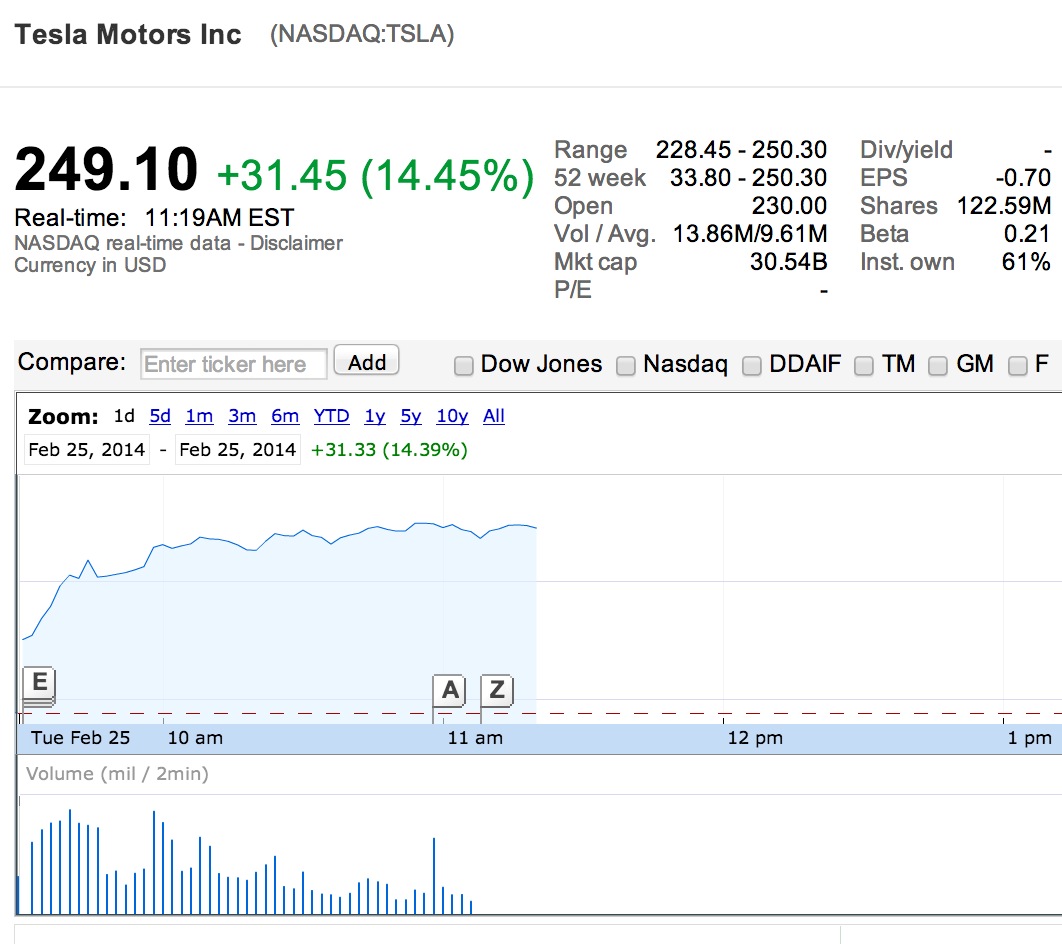
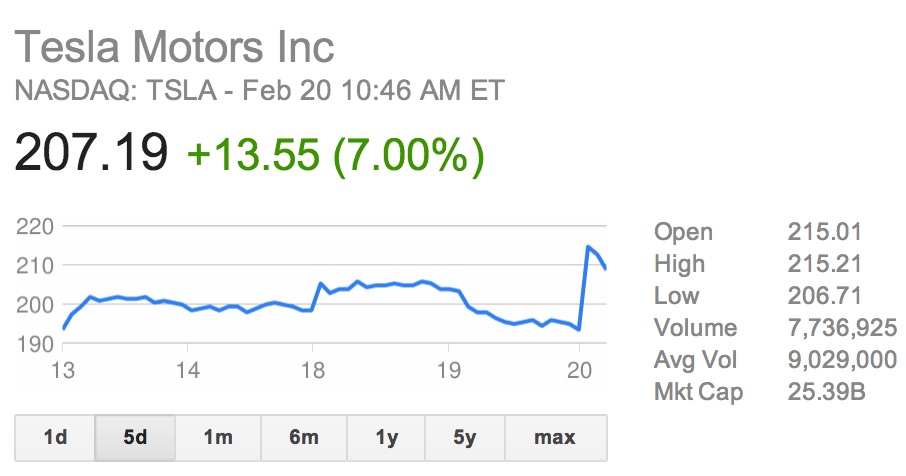
It is a good day to be a $TSLA owner as the stock shot up to near 250 putting the company at a valuation over $30B. The lift comes via Morgan Stanley analyst Adam Jonas who more than doubled his price target speculating that Tesla’s Gigafactory batteries could wind up powering the US Grid or being a fallback.
Tesla Motors – Morgan Stanley analyst Adam Jonas reiterated an Overweight rating on and raised the price target from $153.00 to $320.00 saying the company’s bid to disrupt the auto industry may also affect electric utilities.
The analyst wrote that, “Tesla is an extremely ambitious company for whom flooding the market with fun-to-drive EVs and giving competitors a headache might not be the endgame. Tesla’s limited addressable market, a long-time bear thesis on the stock, appears well up for grabs here.”
Dougherty & Company analyst Andrea James (who has a buy recommendation on shares of Tesla) mentions grid storage, military operations and unmanned aerial vehicles as potential future applications for the batteries. “In our view, Tesla has always essentially been in the cell business,” she said in a note.
Morgan Stanley, which also is bullish on the stock, is even more ebullient. “We are witnessing the most disruptive intersection of manufacturing, innovation and capital experienced by the auto industry in more than a century,” gushed analyst Adam Jonas in a note. “Tesla may be in position to disrupt industries well beyond the realm of traditional auto manufacturing. It’s not just cars.”
It’s too early yet for me to think that Tesla is going to dominate the battery business and its been known for quite some time that lithium batteries are big business. But the higher level thought I have on this is that Tesla isn’t doing anything amazing or quickly. They are making good decisions and moving deliberately while the industries and companies of old are just watching it unfold seemingly unable to do anything about it.
Why isn’t GM or Samsung building a battery plant? Why isn’t Nissan rolling out a Supercharger network? Why is BMW’s i8 a golf cart with a sub 20 mile range when it is electric only?
This 2 seater only goes about 20 miles on its 100HP electric engine so its (sub-Tesla 7 seat Model S) 0-60 in 4.4 is mostly a petroleum feature. But it does look very, very cool. More videos here
“We raise our PT to $253 (from $230) as we begin to give TSLA credit for executing on improving manufacturing margins, noting that near-term demand appears to be outstripping our previous estimates. Our PT is based on 25x 2020E non-GAAP EPS of $20.33 (from $18.50).” Northlan Capital Markets said in a note to clients
“TSLA’s drivetrain technology generates a significant amount of torque. We continue to believe that TSLA could easily develop vehicles for light and medium duty hauling. We also see an opportunity for TSLA to begin to offer value added services/aps from its platform not dissimilar to other consumer electronic devices which could generate high-margin revenue from an already loyal customer base” it added.
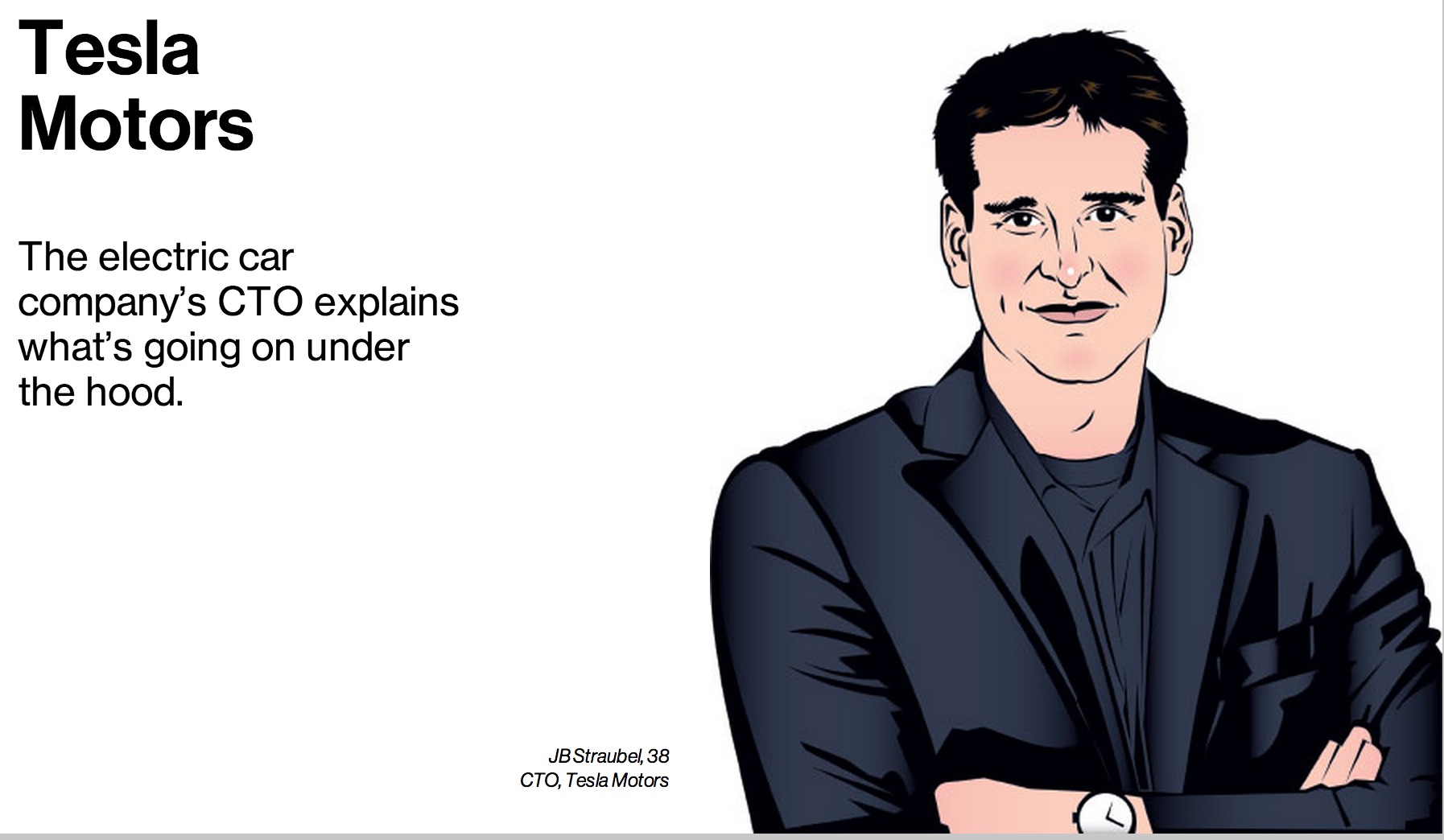
Nice interview with Tesla CTO JB Straubel in the MIT Technology review. In it he talks about how doing the technology internally rather than outsource in key areas like digital motors, laptop Lithium cells and Superchargers allowed them to innovate faster. And that allows them to make the next big step:
[JB:] People think the battery accounts for most of the cost of an electric car, but that’s not the case at all. For the Roadster [Tesla’s first car], the battery was already down below half the cost. Now we’re down to a quarter of the cost in most cases. We’re on track to getting to costs that will allow us to make a $35,000 car [the cost of the GM Volt] with a greater-than-200-mile range. It doesn’t require some mythical invention. All the pieces are fundamentally there.
Bloomberg asked for my input on Tesla’s battery factory and if it really made sense for Apple to get involved. I am skiing in Vermont this week so the red hoodie is my casual Wednesday. Also, 9to5Tesla?
Musk was vague on a possible Tesla acquisition but did confirm talks with Apple.
If one or more companies had approached us last year about such things there’s no way we could really comment on that. We had conversations with Apple, I can’t comment on whether those revolved around any kind of acquisition…
If there was a scenario where it seemed like it would be more likely that we would be able to create the mass market sort of affordable, compelling car then possibly it would make sense to entertain those discussions. I don’t currently see any scenario that would improve that probability, so that’s why I think it’s very unlikely.
• Record 6,892 Model S vehicles sold and delivered in Q4
• World’s highest Consumer Reports customer satisfaction score of 99/100
• Q4 auto gross margin of 25% with no zero emission vehicle (ZEV) credit revenue
• Supercharger network built across most of USA and Northwest Europe
• Net income of $46M and $0.33 EPS (non-GAAP), loss of $16M and $(0.13) EPS (GAAP) in Q4
• Positive free cash flow of $40M in Q4
• Expecting over 55% vehicle delivery growth in 2014 and 28% auto GM by Q4
Webcast Instructions
As previously announced, Tesla management will host a live question & answer (Q&A) webcast at 2:30 p.m. Pacific Time (5:30 p.m. Eastern Time) to discuss the company’s financial and business results and outlook. To access the webcast, go to http://ir.teslamotors.com. Under “Events & Presentations,” you will see a link to the Tesla Fourth Quarter 2013 Financial Results Q&A Webcast; click on that. Click on “Listen to webcast,” which should take you to a registration page. Once you’ve completed that information, you should be taken to the webcast page. Again, the webcast itself will begin at2:30 p.m. Pacific Time (5:30 p.m. Eastern Time)
Kenguru has a long, courageous back story. The original concept, developed by Istvan Kissaroslaki from Hungary many years ago, hadn’t been able to go to market without substantial financial backing. But in 2010, Stacy Zoern, an American lawyer disabled from a muscle disease, came across the Kenguru online and thought it was just what she needed. Zoern eventually convinced Kissaroslaki to move the company to Austin, Texas. The pair has been aggressively pursuing investors ever since.
So nice and portable in fact, I’d be tempted to take this thing inside.
The rear end strength is important, especially with the rear facing child seats in the back which Tesla has said could take a highway speed impact. Well, above you see the results of a rear ending . The Tesla barely looks scratched while the other car looks like those EV1s that GM tried to get rid of.
I like this kickstarter campaign. If they can somehow get the price under $1000 and deliver a great experience, they’ll have a hit. Anything more and you might as well grab a Copenhagen wheel.