From 2010-2011, Weintraub covered all things Google for Fortune Magazine, amassing an impressive rolodex of Google contacts and a love for Silicon Valley tech culture.
It turns out that his hobby – the 9to5Mac news site – was always his favorite, and in 2011, he went full time adding his Fortune Google followers to 9to5Google, in addition to adding the style and commerce component of 9to5Toys gear and deals site. In 2013, Weintraub bought one of Tesla’s first Model S EVs off of the assembly line, which began his love affair with electric vehicles and green energy — this, in turn, became Electrekin 2014.To cover the burgeoning world of drones and UAVs led by China’s DJI, DroneDJ was born in 2018, and then more recently, Connectthewatts and SpaceExplored were launched to cover connected fitness and space.
From 1997-2007, Weintraub was a Global IT director and Web Developer for a number of companies, with stints at multimedia and branding agencies in Paris, Los Angeles, New York, Sydney, Hong Kong, Madrid, and London before becoming a publisher/writer.
Seth received a bachelor’s degree in Industrial and Systems Engineering from the University of Southern California with a minor in Multimedia and Creative Technology in 1997. In 2004, he received a Master’s from NYU’s Tisch School of the Art’s ITP program.
Weintraub is a licensed single-engine private pilot and a certified open-water scuba diver, and he spent over a year backpacking to 60 cities in 23 countries. Whatever free time exists is now guaranteed to his wonderful girlfriend, Alana, and two amazing sons.
Ooooh what have we here? It appears Tesla uses the same test track as Mythbusters and what a great place to see the Model X being tested at some pretty high speeds.
I’ve heard the front end got a big redesign as well.
The Osborne effect is a term referring to the unintended consequences of a company pre-announcement made either unaware of the risks involved or when the timing is misjudged, which ends up having a negative impact on the sales of the current product. This is often the case when a product is announced too long before its actual availability. This has the immediate effect of customers canceling or deferring orders for the current product, knowing that it will soon be obsolete, and any unexpected delays often means the new product comes to be perceived as vaporware, damaging the company’s credibility and profitability.
The term was coined after the Osborne Computer Corporation, in which the company took more than a year to make its next product available and eventually ran out of cash and went bankrupt in 1985.
I think this is something that as a company with tech roots, Tesla, understands. They were pumping out Model Ses with driver assist hardware before the announcement was even made (and had a few leaks as a result). The same with the P85D. You could buy one as soon as it was announced and they shipped a few weeks after.
Chevy, on the other hand is advertising a far superior Volt 2016 at least 6 months ahead of when you can actually get one – without even a price. Who is going to buy the current Volt (without a very significant discount) when they know a better one is right around the proverbial corner?
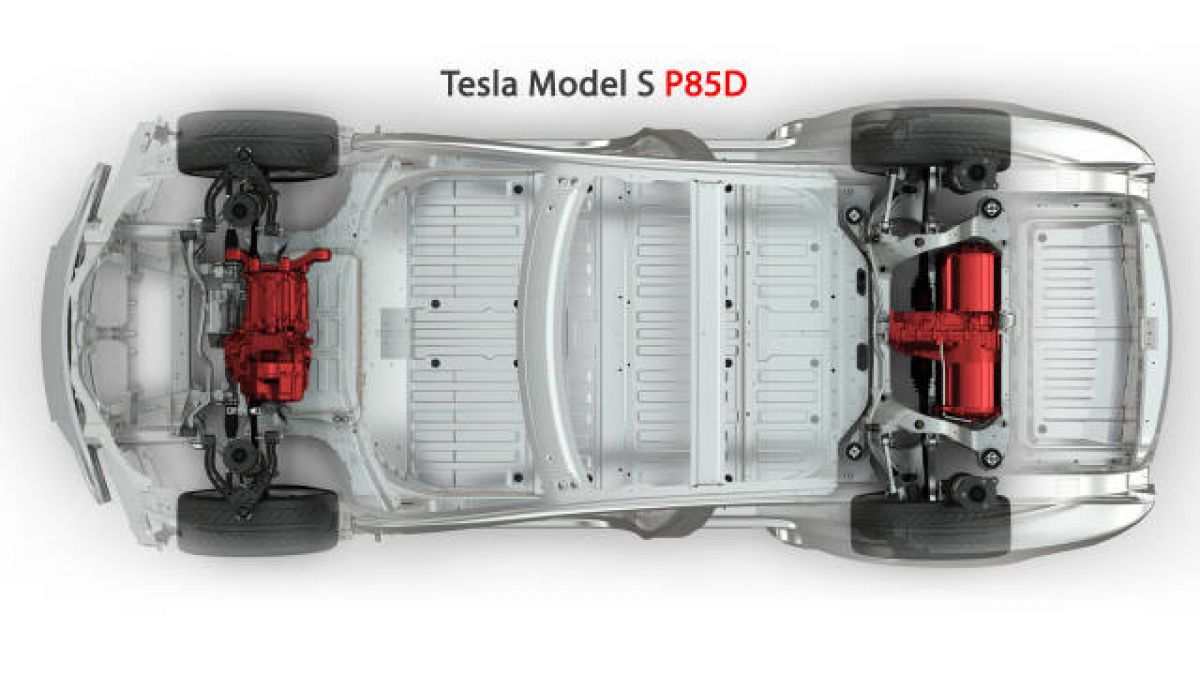
I’m not usually one to post rumors found in a forum but when I’ve heard similar claims and so have a lot of forum members, we start to see a pattern. Over at the Tesla Motor Club Forum, a number of Tesla Owners are reporting that a firmware update will push the P85D 0-60 time down near or below 2.8 seconds.
I’m happy to bring you a TMC exclusive rumor. According to my sources deep inside Tesla, a firmware update for the P85D will increase its 0-60 performance from 3.2s to 2.8s. I have not personally operated this P85D, but my sources have allegedly seen it in action and historically these sources have been accurate for Tesla rumors. Please take it with a grain of salt because I have not seen or operated this vehicle myself.
What’s perhaps not expected is what Tesla has been able to squeeze out of this battery and Dual-motor beast. My understanding is that the vehicle has been testing (unofficially) under 3 seconds on the 0-60. This is incredibly fast.
That is supercar land my friends and blows away all but the very high end supercars out there like the high end Bugattis, Lamborghinis, Mclarens, Ferraris and Porsches.
That was from a Tesla person and it turned out that Tesla’s marquee feature on the Model P85D was its 0-60 time, though the official time was 3.2 seconds and it has been verified at 3.1 seconds. How does Tesla get down to 2.8 seconds and why didn’t they show it off originally? Some hypotheses:
I heard this rumor on October 10th, when I ordered my P85D. Except the Tesla rep said that he saw long strings of 0-60 runs between 2.7 and 2.75 seconds. Based on the inverter readings from my current P85D, I think this has to be true. My inverter gauge has never made it all the way up to 480kW at full throttle, and the promised 691 hp cannot be achieved until the inverters are providing 515 kW.
There may be a number of reasons Tesla has been holding back the power, including collecting data for risk management purposes. I think it’s time to see what this beast can really do. Release the hounds!
And another:
Yes the 0-60 time can be decreased by optimizing the torque on the two axis. Actually I read on TMC that such a decrease was possible from the very beginning of the P85D life but that Tesla designers decided to get 3.2 secs because they didn’t manage to have a continuos acceleration by lowering such a number to 2.8 secs. In fact they had issue to harmonize the acceleration of the two motors.
Maybe that now in Tesla they managed to work out the issues between the two motors and get 2.8 secs.
But IMO the driver should enter a password to get 2.8 secs just to let him think twice before of using such an acceleration.
A firmware update knocks .4 secs off an already low 3.2 second 0-60 time? I can’t wait to see the reaction.
Good ad spot to hit the masses with on Superbowl Sunday. I agree with the thesis that the idea electric cars is in its infancy but the future is so certainly bright. Expand Expanding Close
Redditor AFDIT gives a good overview overview of the talk above:
EVs:
Disruption = a new market / complete take over of an old one.
You can’t compete with the performance.
Costs for batteries / EVs keep coming down. Gigafactory etc will bring EV prices to mid-range car levels by 2017, to low cost car prices by 2020. By 2030 there will be no non-EVs being manufactured. Petrol will no longer be produced by 2030.
Self-driving cars around the corner. Also has ever-reducing prices as with EVs. Market is ready for them (poll in the ground). Will use “unused road space on the highways”.
As-A-Service cars will be driving themselves 99% of the time. Projection is that manufacturers will reduce sales by 80% as there will be fewer cars necessary. Car parking will no longer be needed. This will lead to city re-designs.
Solar:
Cost has dropped from $100W to $65W. This helped cause installation growth at 100x between 2000 & 2013 (43% per year). Projection at this rate shows all global energy produced by Solar by 2030.
Relative to Oil Solar has “increased it’s position” 5300x
“Grid cost convergence” will beat all other fuel costs by ~2017.
Tony Seba, author of “Clean Disruption” gives the keynote address at the AltCars Expo and Conference,Sept 19, 2014.The keynote is titled “Clean Disruption: 100% electric transportation and 100% solar power by 2030″.
The book ‘Clean Disruption’ and this keynote assert that by 2030: • All new mass-market vehicles will be electric. • All of these vehicles will be autonomous (self-driving). • Up to 80 per cent of parking spaces and highways will be redundant. • Taxis as we know them will be obsolete. • The concept of car ownership will be obsolete. • Oil will be obsolete • All new energy will be provided by solar (and wind)
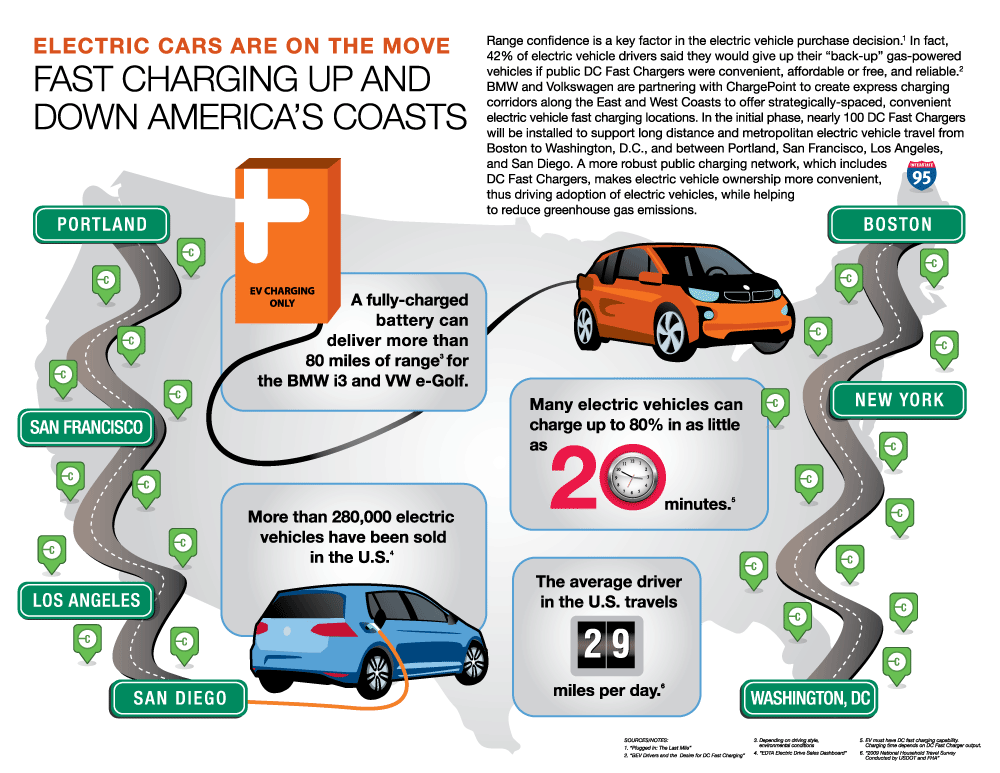
BMW of North America, Volkswagen of America and ChargePoint Inc. will construct up to 100 charging stations in “express charging corridors” from San Diego to Portland, Ore., on the West Coast and Boston to Washington on the East Coast.
Construction has already started on the Western corridor, where a string of new charging stations will allow vehicles to travel the length of California and into Oregon. As many as 100 stations will be up and running by the end of 2015, said Pasquale Romano, ChargePoint’s president and chief executive.
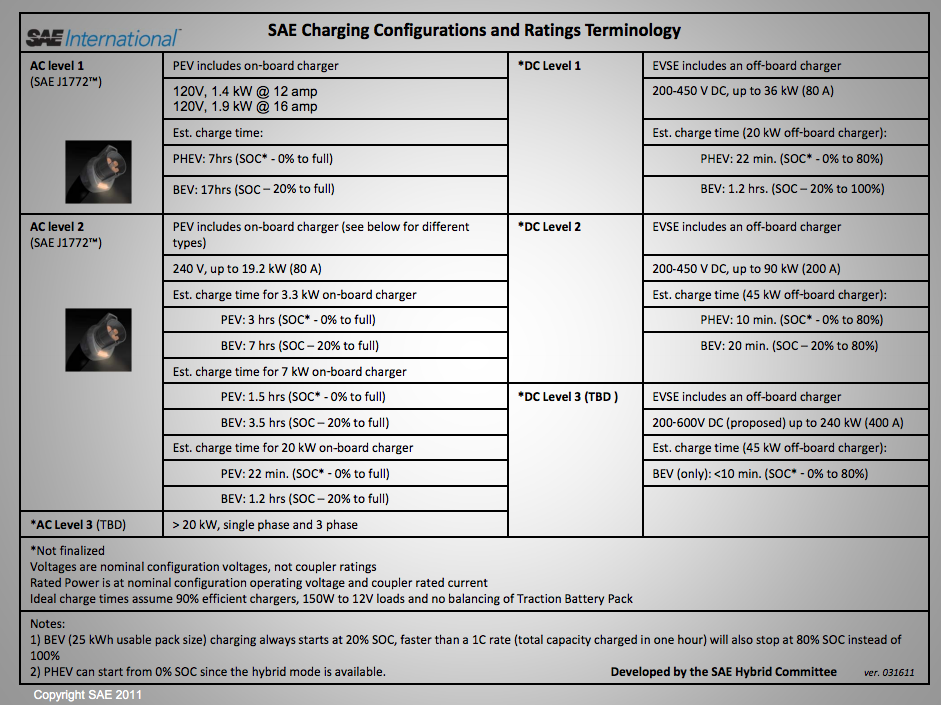
Each station will include one or two 50-kilowatt DC Fast chargers or 24-kilowatt DC Combo Fast chargers, developed by BMW in partnership with Bosch. Those chargers — typically used for BMW and VW vehicles, as well as the Chevy Spark EV — can bring a vehicle up to 80% power in less than 30 minutes.
A lot of important considerations here (original Press release). These may or may not be compatible with Chademo cars (Nissan Leafs in particular) and Tesla will need an adapter if these will work at all with their vehicles. (All Electric Vehicles can take advantage of the Level 2 AC chargers but those only provide 20 or so miles per hour of charge).
The bigger consideration for the broad idea of these chargers is that for sub-100 mile vehicles, it doesn’t represent a complete long distance solution. The BMW i3, Chevy Spark, Volkswagon eGulf and all of the other cars that get <100 miles/charge and indeed what Chargepoint is calculating in the Press release and the graphic – this only represents a stop gap.
You travel for an hour (maybe 90 minutes tops) then you charge for a half hour (20 minutes gets you to 80% in a perfect situation).
That’s not going to be a great trip, though it may make a trip from Boston to New York or other 150-200 mile trips bearable.
Tesla is still king of the EV road trip wit its 200-300 mile batteries and Supercharger network which allows fast charging up to 130kW. That means Tesla drivers can easily travel 3 hours between charging and get back on the road in about a half hour – which is similar to gas road trips.
GM and others are planning 200+ Mile EVs for 2017 and beyond however these charging stations are going to max out at 50kW meaning that to fill a 200Mile range battery will take an hour plus – still not a great situation for road trips. SAE Level 2 DC charging spec maxes out at 90A, already far below Tesla’s 130KW Superchargers.
SAE DC level 3 charging however might be a solution with its insane 240kW max. That would theoretically take a 300 mile battery pack to 80% charge in 10 minutes…the future.
At a earnings call last year, Tesla CEO Elon Musk noted that the Chinese market for Teslas was tricky because most of the target audience was chauffeur-driven. At the time, he said an executive back seat option was in the works. Together with the update of the site this weekend, Tesla introduced a new option for an executive rear seat which unsurprisingly looks like the front seats with cupholder/armrest but not as much lateral support.
I have a feeling these will be popular outside of China as well. Expand Expanding Close
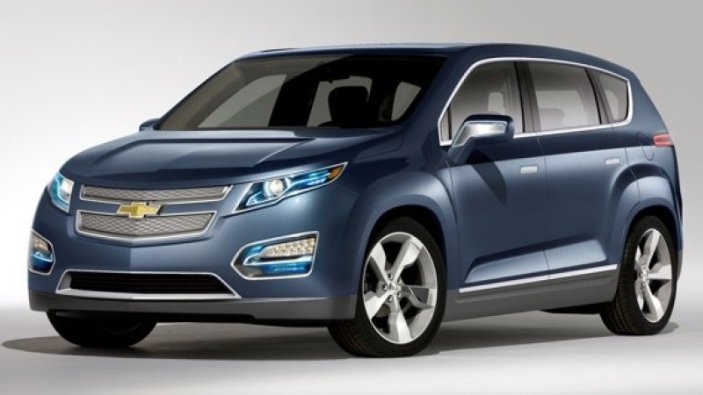
As predicted, Chevy announced a Tesla Model 3 competitor called the Bolt EV concept today.
I can’t say I agree with the color choice but I like the specs. Specifically “over 200 miles on a charge for a $30,000 price tag” makes it a game changer and puts it in line with the Tesla Model 3. It also doesn’t look like it will be crippled in the interior space category like the Volt.
As for aesthetics, it looks like a Spark EV super-sized.
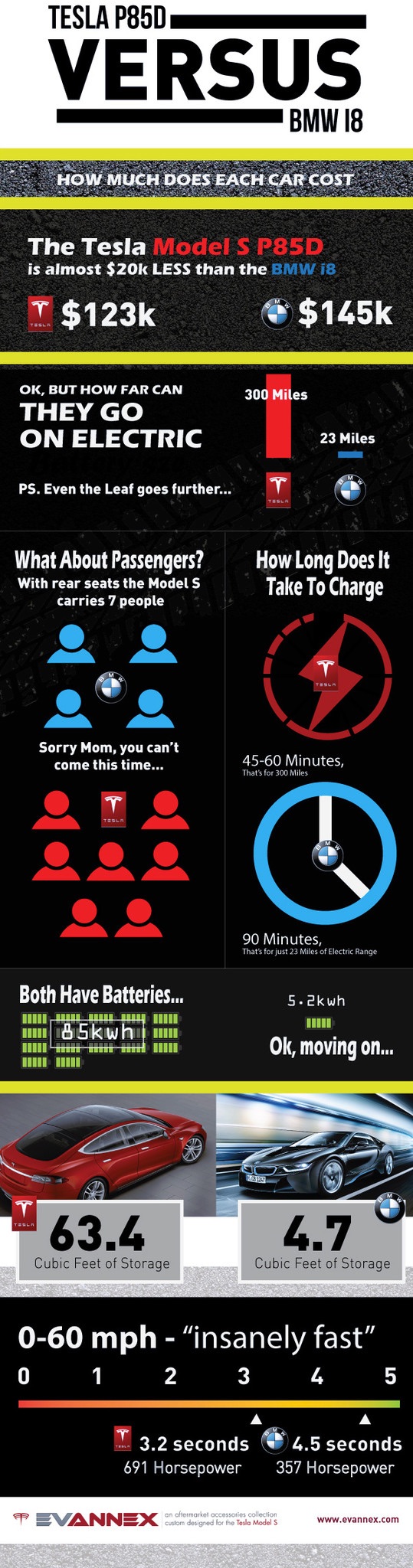
This is what I’ve been saying. As a plug-in Prius owner with more than half the i8’s range I can tell you both are BS as electric cars. Sure it looks sporty, but it ain’t a great car.
Yeah, that’s a clickbait title but truth be told…well…the reaction is probably as good or better than the title would have implied. I’ll let myself out now (sorry)
This is the same prototype Model X that has been shown off at other venues and isn’t the final version but it was nice to get a good look at it. Seeing it in person, I noticed the frunk is huge. What isn’t huge however is the legroom in back. I’m hoping Tesla has some novel solution to adding more legroom in the back.
Also, where does my snowboard go on the roof with those Falcon wing doors?
General Motors Co. plans to launch a $30,000 electric vehicle called the Chevrolet Bolt that would be capable of driving 200 miles on a charge by 2017, according to people familiar with the strategy, a move to gain ground on Tesla Motors Inc.
GM will show off a concept version of the Bolt on Monday at the Detroit auto show, eight years after the auto giant disclosed it would re-enter the electric car market with the Chevrolet Volt. The Volt, on sale since late 2010 and redesigned for 2015, is being upgraded to get better capability and sharper design, and has a backup gasoline motor on board in case juice runs out.
The Chevy Bolt, carrying a more capable battery manufactured by South Korea’s LG Chem Ltd. , will be aimed squarely at Tesla’s forthcoming Model 3, a $35,000 electric car also slated to debut in 2017. The concept version of the electric car will be a hatchback designed to look more like a so-called crossover vehicle, according to people familiar with the design. The Bolt will be capable of driving four times farther than a Chevrolet Volt plug-in hybrid on a single charge.
This is great news for electric vehicle fans but a lot of questions still need to be answered. The foremost on my mind is quick charging. Will GM set up a global network of fast DC charging stations? With the Bolt be able to charge as fast as Tesla’s offering?
The pack for GM’s new vehicle could be built in LG Chem’s Holland, Mich., plant, where the Volt batteries currently are made by the same supplier. That plant would have a capacity to build about 60,000 Volt battery packs, or 20,000 of the larger packs for a new EV, or a mixture of the two.
LG Chems’s battery improvements to make it possible to for GM to create the low-cost EV include better durability and electrical controls. Also, LG will use more of the available storage capacity in the cell than it does on the Volt. Plug-in hybrids can use less available storage capacity because of the constant charging from the gasoline engine. If more charge is used, it would limit the life of the battery.
“We have progressed far enough that it gives us a high level of confidence that in the 2017 kind of a time frame, there are no show stoppers or gotchas that we don’t know how to get over,” Prabhakar Patil, the chief executive of LG Chem Power Inc., the U.S.-based battery arm of the Korean electronics giant, said in an interview.
Reports out of the Bay Area this morning say that a man and his 2014 were found at the bottom of a cliff off the 1A in Sonoma county north of San Francisco. The man was pronounced dead at the scene and represents the first owner fatality of a Model S driver. It isn’t clear yet if the crash was an accident.
A male driver died after crashing off of state Highway 1 north of Jenner in Sonoma County Tuesday morning, according to the California Highway Patrol. The crash was reported at about 8:20 a.m., when a passerby observed a car that had gone off of the highway and went about 300 feet down a cliff, CHP officials said. Emergency responders found a 2014 Tesla at the bottom of the cliff with a male dead behind the wheel, according to the CHP. The crash remains under investigation by the CHP and no other information was immediately available this afternoon.
This might improve the resale value of these guys though I don’t think Tesla has any plans to release a new one. As Musk adds, nothing is immediately in the works for the Model S but I’ve heard that a 100+kWh battery is being tested for possible future use with the Model X.
Battery technology has continued a steady improvement in recent years, as has our experience in optimizing total vehicle efficiency. We have long been excited to apply our learning back to our first vehicle, and are thrilled to do just that with the prototype Roadster 3.0 package. It consists of three main improvement areas.
1. Batteries
The original Roadster battery was the very first lithium ion battery put into production in any vehicle. It was state of the art in 2008, but cell technology has improved substantially since then. We have identified a new cell that has 31% more energy than the original Roadster cell. Using this new cell we have created a battery pack that delivers roughly 70kWh in the same package as the original battery.
2. Aerodynamics
The original Roadster had a drag coefficient (Cd) of 0.36. Using modern computational methods we expect to make a 15% improvement, dropping the total Cd down to 0.31 with a retrofit aero kit.
3. Rolling Resistance
The original Roadster tires have a rolling resistance coefficient (Crr) of 11.0 kg/ton. New tires that we will use on the Roadster 3.0 have a Crr of roughly 8.9 kg/ton, about a 20% improvement. We are also making improvements in the wheel bearings and residual brake drag that further reduce overall rolling resistance of the car.
Summary
Combining all of these improvements we can achieve a predicted 40-50% improvement on range between the original Roadster and Roadster 3.0. There is a set of speeds and driving conditions where we can confidently drive the Roadster 3.0 over 400 miles. We will be demonstrating this in the real world during a non-stop drive from San Francisco to Los Angeles in the early weeks of 2015.
We are confident that this will not be the last update the Roadster will receive in the many years to come.
Same as Ferrari. The first 30 seconds seems unbeatable by ICE engines according to Motor Trend. The P85D takes 0.83 seconds to hit 24 mph and 1.2 seconds to reach 33 mph. They clocked the full 0-to-60 run at 3.1 seconds, a tenth of a second quicker than Tesla’s own number.



 That’s not going to be a great trip, though it may make a trip from Boston to New York or other 150-200 mile trips bearable.