
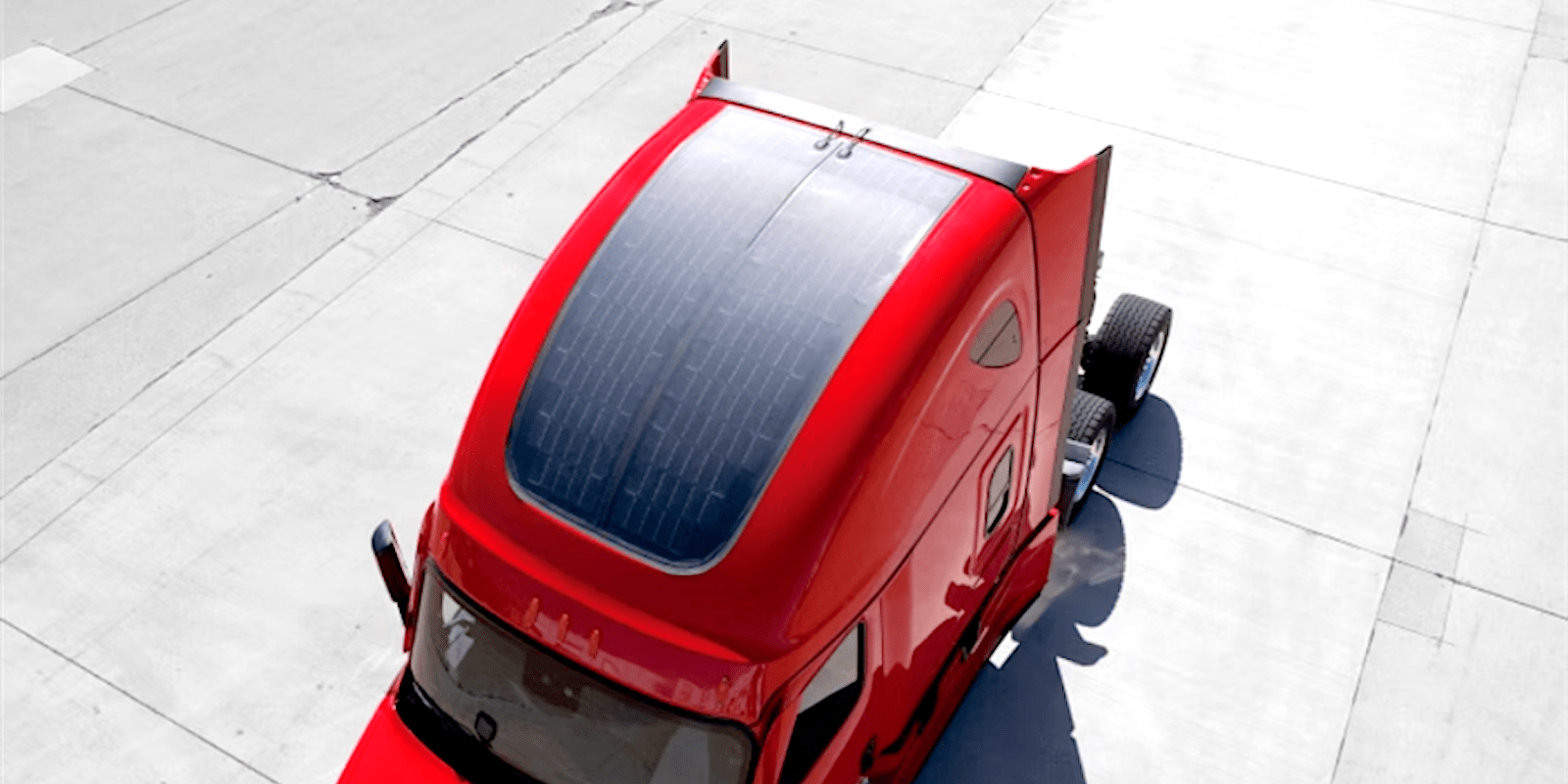
The worst kind of vehicle emissions aren’t the ones that move dirt or haul freight – they’re the ones that don’t. Every hour, every minute, ever second a combustion engine spends idling at a truck stop or job site is fuel burned, money lost, and air polluted for no productive reason. Vanair’s patented solar panel system for semi trucks is ready to help slash idle times.
Both long-haul and daycab drivers alike deal with brutal heat and cold, whether they’re stuck in port queues, or hoteling between runs. Keeping the truck’s cabs livable and the devices that keep them connected powered up takes power, and that typically means running a generator or idling a diesel. Vanair thinks they have a better solution: solar power.
“Vanair has spent more than five decades providing its mobile power solutions for work truck and vocational fleets, and the challenges facing Class 8 fleets are fundamentally the same,” said Chip Jones, national manager of the Electrified Products Group for Vanair. “Drivers need reliable heating, cooling and electrical power without running the main engine. Fleets need to protect expensive assets from the wear that idling causes. What we bring to this market is not a single-purpose APU. It’s a complete, integrated power ecosystem that scales to the application.”
It’s a money issue

All that idle time doesn’t just reduce emissions – it can also have a major impact on operating costs. A typical Class 8 truck can burn close to a gallon of diesel per hour while idling. Multiply that 5-6 hours of idling per day by 200-300 days/year, and you get thousands of dollars of wasted diesel and engine hours every year.
Dubbed EPEQ Solar Assist, Vanair’s self-described “ecosystem” fights those costs by pairing a modular battery pack with flexible solar panels mounted to the truck’s cab fairing to work as a replacement for traditional, diesel-powered APUs. The all-electric Vanair system powers the truck’s HVAC, lift gates, and onboard electronics without firing up the main engine.
It’s important to note here, again, that these solar panels don’t drive the truck, and aren’t necessarily designed for electric semi trucks (though, they can be). What they do do is help keep the batteries topped off, even in low light, reducing the need to plug in to grid power or charge the batteries with the main engine.
The company says its 1/8″ thick flexible panels can to most cab fairings, trailer rooftops, and other curved surfaces (think: roof and hood) without raised mounting platforms, and that they’re durable enough to survive, “more than 130,000 vibration cycles.”
Top comment by Garry masters
To do more and maybe even assist a phev/rhev version they need solar on the larger real estate of the trailers. This might be different for various segments of the industry but perhaps entities like Walmart, Amazon etc that own both the tractors and the trailers could make that work?
Vanair has direct-fit configurations available for most major OEM platforms, pairing those with ELiMENT 12-volt LiFePO4 batteries in 100 Ah and 200 Ah configurations and with pure sine wave inverters in 1,000W, 2,000W and 3,000W sizes – enough to power onboard electronics, charge up cordless power tools, and run some 120V equipment.
SOURCE | IMAGES: Vanair, via Power Progress.

If you’re considering going solar, it’s always a good idea to get quotes from a few installers. To make sure you find a trusted, reliable solar installer near you that offers competitive pricing, check out EnergySage, a free service that makes it easy for you to go solar. It has hundreds of pre-vetted solar installers competing for your business, ensuring you get high-quality solutions and save 20-30% compared to going it alone. Plus, it’s free to use, and you won’t get sales calls until you select an installer and share your phone number with them.
Your personalized solar quotes are easy to compare online and you’ll get access to unbiased Energy Advisors to help you every step of the way. Get started here.


FTC: We use income earning auto affiliate links. More.




Comments