
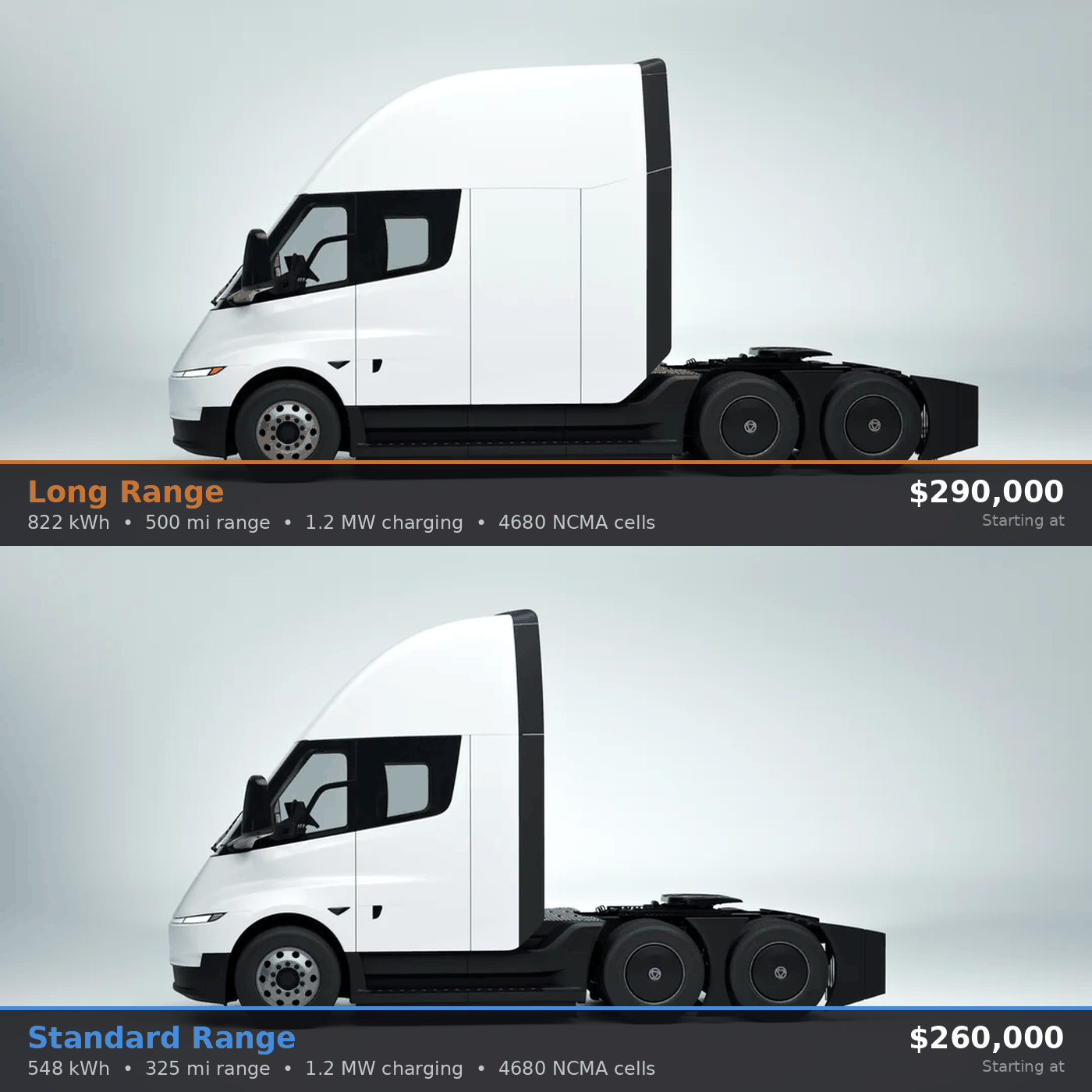
California’s Air Resources Board has officially confirmed the Tesla Semi’s battery capacities through a regulatory filing — and they’re smaller than what Elon Musk originally suggested back in 2022.
The CARB Executive Order A-374-0095, signed on April 15, reveals that the Long Range Semi carries an 822 kWh usable battery pack while the Standard Range comes in at 548 kWh, both using NCMA lithium-ion chemistry with Tesla’s 4680 cells.
Smaller packs, same range targets
When Musk first confirmed the Semi’s battery capacity in December 2022, he pegged it at “around 900 kWh” for the 500-mile Long Range version. That estimate was based on the truck’s confirmed 1.7 kWh-per-mile efficiency figure, which implied a pack north of 850 kWh to hit 500 miles.
The official CARB filing tells a different story. At 822 kWh, the Long Range pack is roughly 80 kWh smaller than Musk’s original figure — yet Tesla is still rating the truck at 500 miles of range at the full 82,000-lb gross combination weight. That gap points to meaningful efficiency gains Tesla achieved between the 2022 prototype runs and the production version that rolled off the Nevada line in April.
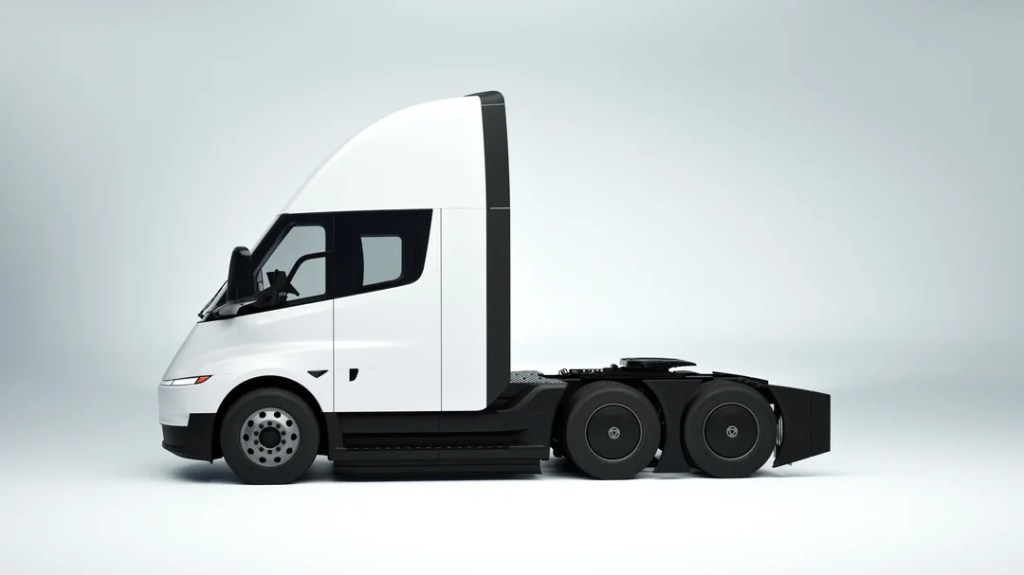
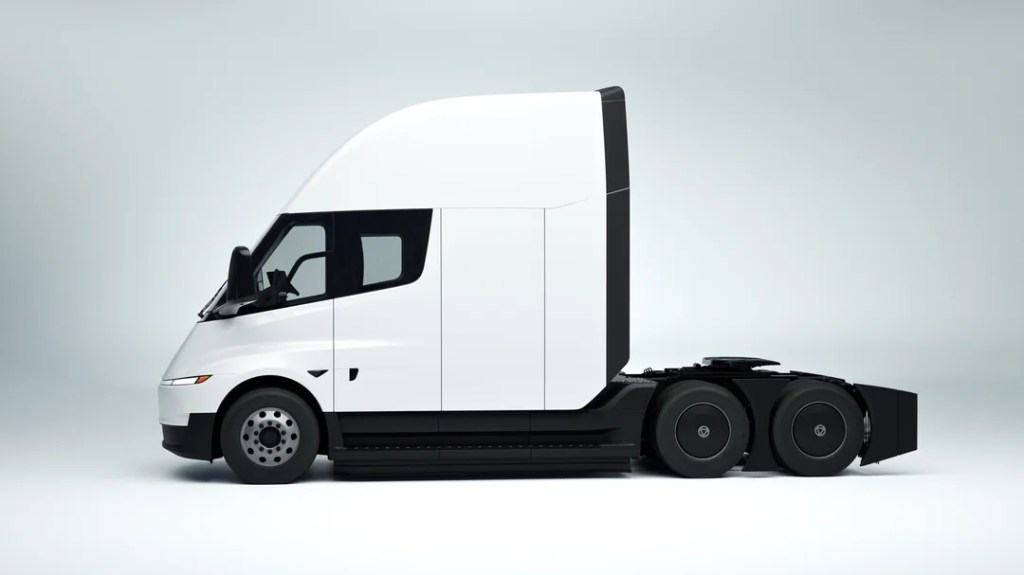
Part of the explanation lies in the truck itself. When Tesla showed the refreshed Semi design in March, it revealed the production version weighs nearly 1,000 lbs less than the original prototype. Less weight means less energy consumed per mile — allowing a smaller battery to deliver the same range.
Both trims share identical powertrain specs: an 800 kW (1,072 hp) tri-motor drivetrain with 525 kW sustained output, and support for 1.2 MW Megacharger speeds via an MCS 3.2 connector.
How the Semi stacks up against competitors
The battery specs give the Tesla Semi a significant capacity advantage over every other electric Class 8 truck on the market. The Freightliner eCascadia tops out at 550 kWh for just 230 miles of range. The Volvo VNR Electric maxes at 564 kWh for 275 miles. Even the Nikola Tre BEV, which claims 330 miles, can’t match the Semi’s 500-mile Long Range figure.
The efficiency gap is the real story. At 1.7 kWh per mile, the Tesla Semi extracts roughly 0.6 miles per kWh — significantly better than competitors that hover around 0.4-0.5 miles per kWh. Tesla attributes this to aerodynamic improvements, the tri-motor powertrain’s efficiency curve, and the weight reductions in the production design.
That efficiency translates directly into economics. Our recent total cost of ownership analysis showed the Semi operating at roughly $0.20 per mile in energy costs at $0.12/kWh, compared to $0.67 per mile for a diesel truck at $5.35 per gallon. Over 10 years, that adds up to over $400,000 in savings — though the math is highly sensitive to electricity prices.
The Standard Range changes the calculus
The 548 kWh Standard Range variant may be the more strategically important product. At an estimated $260,000 — $30,000 less than the $290,000 Long Range — it covers 325 miles on a charge, which handles the vast majority of regional haul routes.
Most Class 8 fleet operations run routes under 300 miles. For these operators, the Standard Range delivers the full diesel cost advantage without paying for 274 kWh of battery capacity they’ll rarely use. That’s a significant chunk of lithium, nickel, cobalt, and manganese that stays out of the bill of materials — and, critically, out of the truck’s weight.
The modular battery architecture Tesla employs makes this straightforward. The Standard Range reportedly removes one of three parallel battery modules from the Long Range configuration, dropping from 822 kWh to 548 kWh — almost exactly a one-third reduction.
With Tesla’s Megacharger network expanding to 66 locations across 15 states and pricing starting at $188,000 for a two-post setup, the charging infrastructure is starting to materialize for both variants. At 1.2 MW, the Long Range can recover roughly 60% of its charge in 30 minutes — enough for a driver’s mandatory rest break to double as a charging window.
Electrek’s Take
Top comment by dashpool
I'm pretty sure Volvo's biggest electric truck (FH Aero electric) has a 780kWh pack option; not sure whether is is available in USA though.
There's also Windrose's entry with a 730kWh pack.
The CARB filing confirms something we’ve suspected since Tesla showed the lighter production Semi in March: the company squeezed meaningful efficiency gains out of the truck between the prototype era and volume production. An 822 kWh pack hitting 500 miles is more impressive than a 900 kWh pack hitting 500 miles. It means lower material costs, lower weight, and better economics for fleet buyers.
But we think the Standard Range at 548 kWh is the truck that will actually move the needle for Tesla Semi adoption. The 500-mile Long Range makes great headlines, but the math on regional hauling — where most Class 8 trucks actually operate — favors the cheaper, lighter truck with 325 miles of range. At $260,000, it starts to approach a price point where the diesel savings can justify the switch even for cost-conscious fleet operators who don’t care about emissions.
The competitive picture is stark. Freightliner and Volvo have been shipping electric trucks for longer, but neither can match the Semi’s range or efficiency at comparable battery sizes. Tesla’s 4680 cells and purpose-built platform are delivering real advantages — though we’ll want to see how 4680 reliability holds up in long-haul commercial duty cycles, especially given recent data raising questions about the cells’ real-world performance.
The pieces are falling into place: the truck is rolling off the production line, the battery specs are officially certified, and the Megacharger network is expanding. Now Tesla needs to prove it can actually build these at volume. Analysts project 5,000 to 15,000 deliveries this year — a wide range that reflects how much uncertainty remains around the Nevada ramp. I think it would be positive for Tesla if it could deliver even just 1,000 trucks this year.


FTC: We use income earning auto affiliate links. More.




Comments