
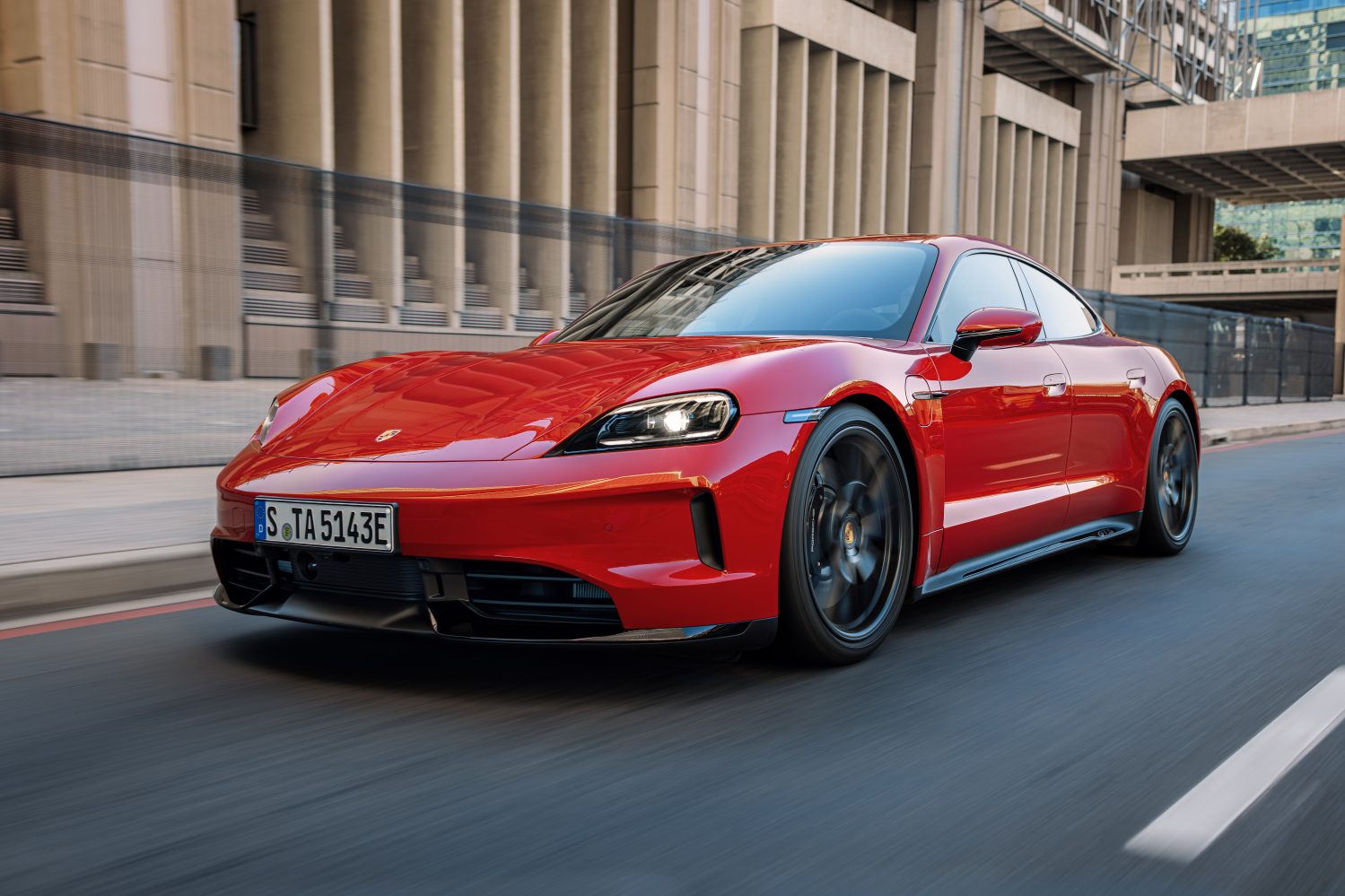
Porsche is updating its four-door electric sportscar for the 2027 model year, with a few consequential updates and one new optional feature that I still cannot fathom why anybody would want.
The Porsche Taycan is a downright venerable member of the electric car community at this point, having been initially unveiled in 2019.
Over the years, it has received a number of updates, and has shown the sort of performance cred you’d expect out of Porsche, as the current holder of the Nürburgring EV record (after trading punches with Tesla, Xiaomi and BYD).
And now Porsche is announcing a new set of updates for the 2027 model year.
NACS DC port, bigger base model battery pack, software improvements
The most important change? The Taycan now has a native NACS port for high-speed charging.
But Porsche’s implementation is interesting, here. Instead of having all charging go through one plug, it has a DC charging port on the front passenger side (which makes it easy for Supercharger stations to reach the port when parking the Taycan nose-in) and a J1772 AC charging port on the front driver’s side. A CCS adapter is included as well.
One of the strengths of NACS is that you can carry both DC and AC through the same port, so it’s a little strange to use a NACS port only for DC and a J1772 port only for AC. But this does give access to the most-common DC charge port and the most-common AC charge port, so it’s kind of beneficial. This still feels like it would be confusing to newbies, but Porsche is confident its customers will be able to figure it out.
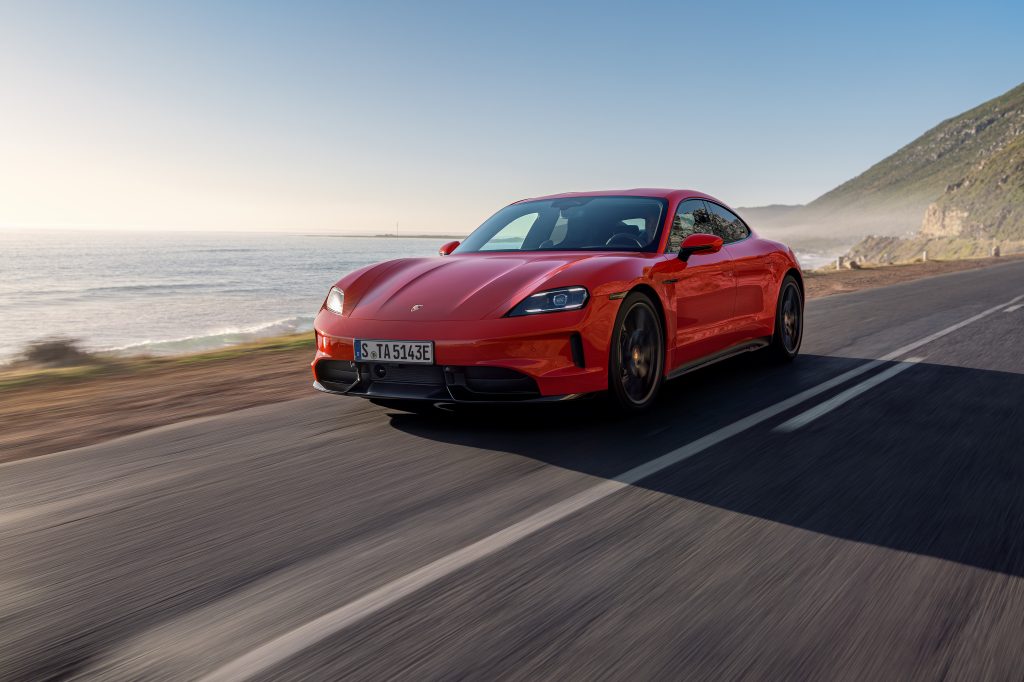
In addition, the base battery pack is getting a bump from 89kWh to 105kWh. 105kWh was available on previous model years, but now it’s standard on all trims of the Taycan for 2027.
To more efficiently find places to fill that battery, the 2027 Taycan gets an “optimized charging planner.” We’re not entirely sure what that entails, but when I played around with preliminary software on the Cayenne Electric, I was impressed with Porsche’s interface for finding and sorting charging stations.
Other bits of software are improved too. It has better voice controls, more apps and customizability, and better over-the-air update capability. It brings the Taycan more in line with the current Cayenne/Macan EV models, giving it nearly all the same software and connectivity capabilities.
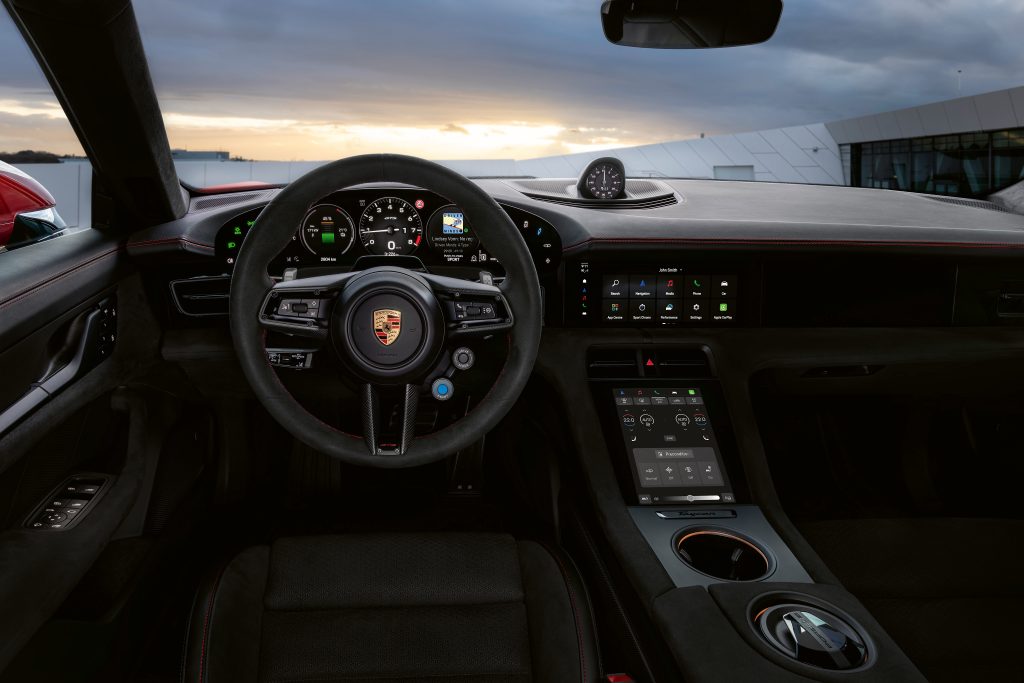
These changes come alongside a bump in base price, from the current $105,800 to $111,900. However, given the upgrade to the 105kWh battery was $6,090 on the outgoing model, and the larger battery is now standard, that means the price of a similarly-equipped model has increased by a whopping… ten dollars.
So, while I’m mildly disappointed by the absence of a smaller battery option, this is a fine list of changes all told.
Then there’s one new option that I, at least, consider a bit controversial…
I still don’t see the point of fake gear shifts
A headline new feature of the 2027 Taycan is one that Porsche is calling “E-Shift.” This is available as an option on any version of the Taycan, and comes with a different steering wheel (with a switch to activate the mode and paddle shifters to control it).
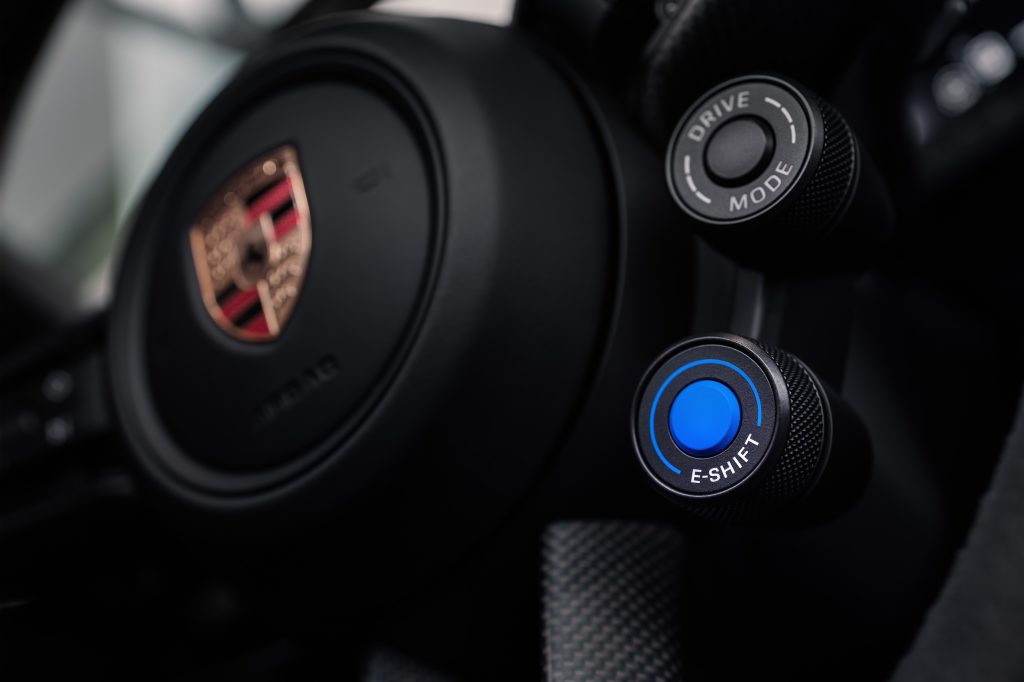
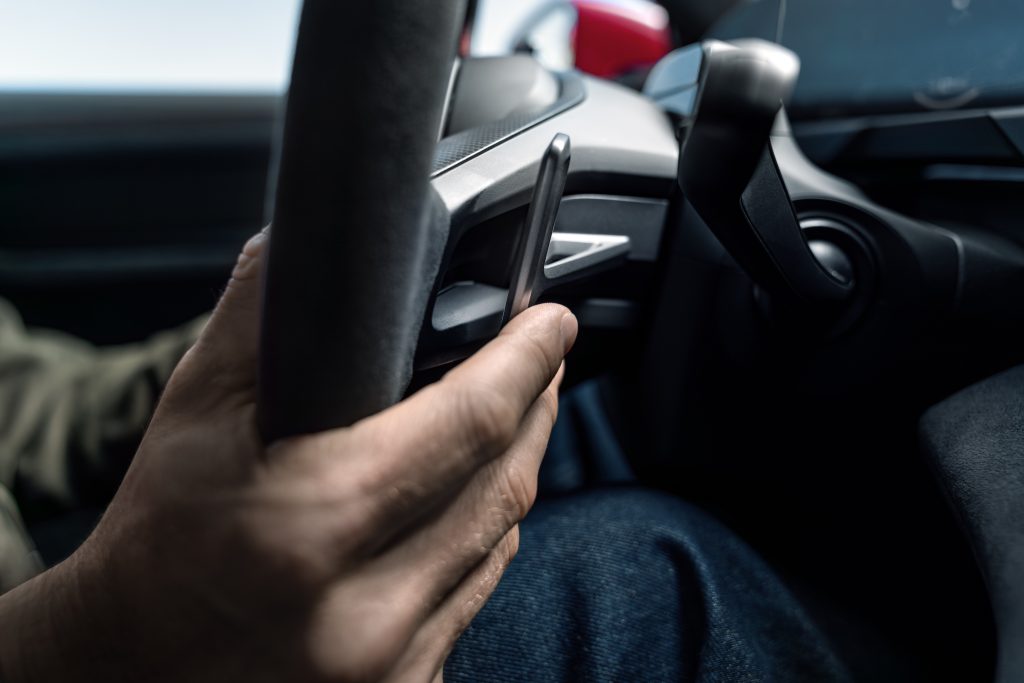
This is similar to what we’ve seen in some other vehicles, like Hyundai’s Ioniq N vehicles and the Mercedes AMG GT EV. In fact, Hyundai names its system “e-Shift,” so the inspiration for the system seems clear.
What they do, in short, is make a single-speed (or in Taycan’s case, two-speed) electric car feel and sound like a multi-speed manual transmission ICE vehicle. This generally includes fake engine noises piped through the speakers, a fake tachometer with a fake redline, and fake gear shifts that momentarily cut motor power to make it feel like you’re shifting gears.
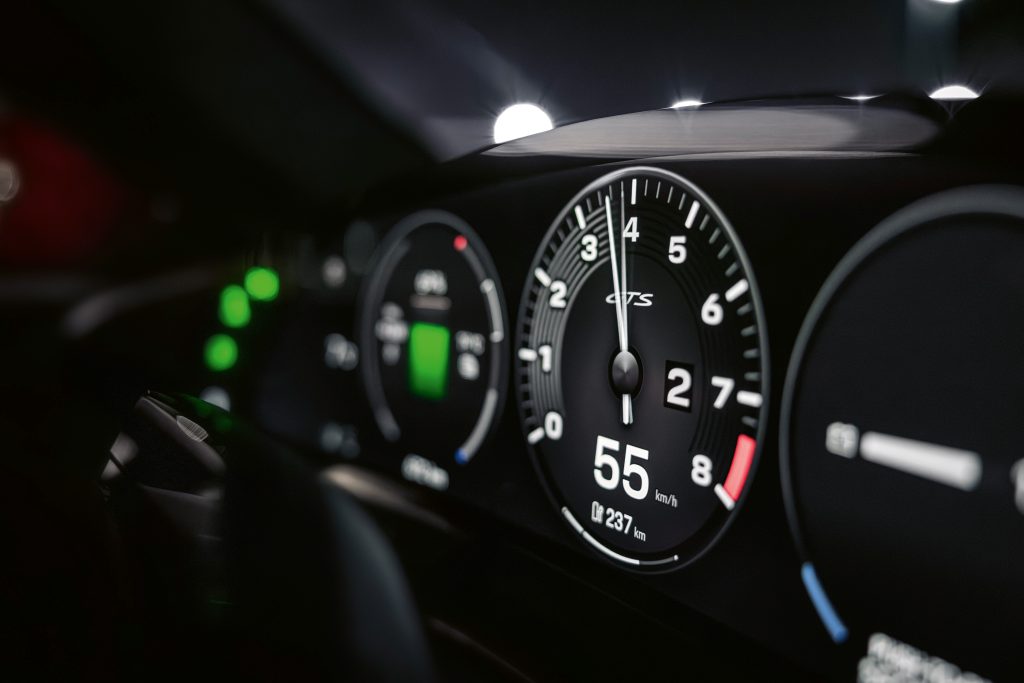
These systems have received a lot of attention, on the theory that people don’t want to drive EVs because they don’t go vroom vroom.
From the way Porsche talks about it, it sounds like their implementation is similar to the others we’ve seen. It can be used in either automatic or manual mode, and Porsche says it’s “modeled to feel authentic with noticeable gear shift feel, gear-specific drag torque – comparable to the engine braking behavior of a combustion-engined car – and a virtual rev limiter.” Yes, that means that if you floor it in manual mode, the car will bounce off the rev limiter until you upshift.
(and with the mention of engine braking, does this mean Porsche is finally going to allow one-pedal driving… but only in E-Shift mode?)
It also includes a “reinterpreted Porsche Electric Sport Sound” (a feature that I had an expectedly snarky opinion of on the original Taycan). Here is an example of the new sound, which replaces the old tech-y sound with one that now sounds like an engine (sigh):
While I do respect the decision to go all the way, and to imitate even the worst parts of the internal combustion engine (power interruptions, rev limiter, the noise of wasted energy, etc), I still don’t see why people would want to make their car worse on purpose.
It’s a fun party trick, something to show off to your friends or to journalists on a drive event, but not something most people would keep active during their commute – or even on track.
We don’t have numbers for the Taycan yet, but the Ioniq 5N is 0.4 seconds slower 0-60 and 1.1 seconds slower 0-100 when fake gear mode is turned on. I could see something similar happening here. It makes me wonder why people would pay for performance upgrades and then turn on a mode that neutralizes them, that makes the car less responsive and less predictable.
And it’s all especially a little strange to see on the Taycan, given that it already had fake motor noises (Electric Sport Sound), and already has a real transmission – though it’s a two-speed, rather than an 8-speed like E-Shift.
Top comment by ModernMarvalFan
"I still don’t see why people would want to make their car worse on purpose."
Because you aren't the kind of people who would appreciate it. People knows that driving a manual transmission is slower but plenty of people who love performance vehicles still want it. So, if you don't understand, then it isn't for you.
But in the end, it’s not that big a deal because it’s all optional. You have to pay to get the optional upgrade in the first place, and E-Shift mode can be enabled or disabled at will.
I suspect the vast majority of miles will be driven with this mode turned off, especially after the initial ooh-wow period. I’d hope that even the most reticent petrolheads could eventually come to recognize the benefits of having a faster, more responsive, quieter vehicle if they give it a chance.
So, as I’ve said before, if the party trick gets people in the door, and serves as a Trojan Horse of electrification, then I’ll take it. But I wouldn’t use it myself, except to goof around.
Charge your electric vehicle at home using rooftop solar panels. Find a reliable and competitively priced solar installer near you on EnergySage, for free. They have pre-vetted installers competing for your business, ensuring high-quality solutions and 20-30% savings. It’s free, with no sales calls until you choose an installer. Compare personalized solar quotes online and receive guidance from unbiased Energy Advisers. Get started here. – ad*


FTC: We use income earning auto affiliate links. More.



Comments