
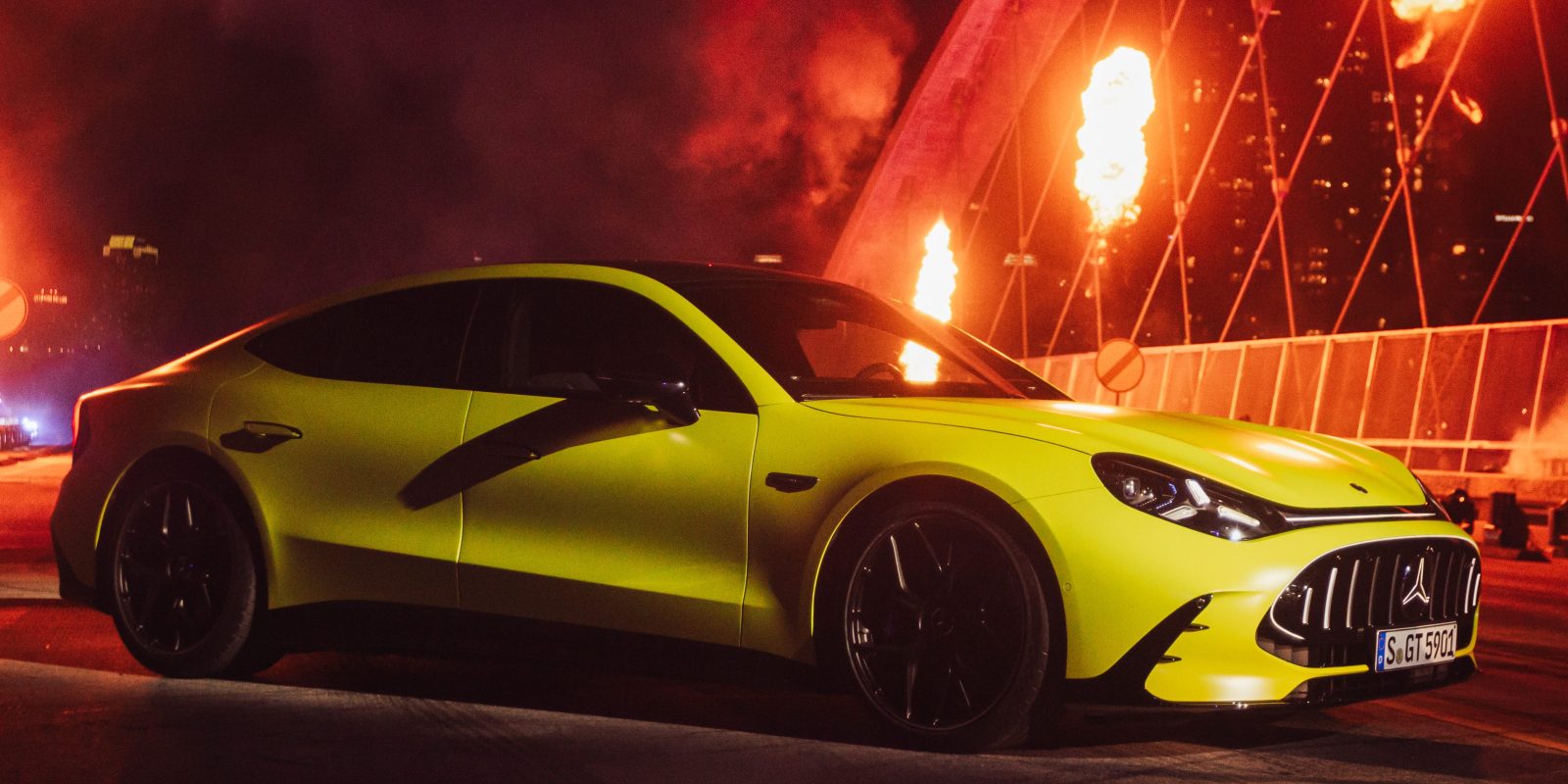
We’re in LA for the world premiere of Mercedes’ upcoming ultra-high performance EV, the AMG GT 4-Door Coupe, with race-ready features and more power than any Mercedes ever released… along with silly fake V8 noises (but at least you can turn them off).
(Update: We got a test ride! Scroll to the bottom of the post)
The new AMG GT 4-door coupe is a car that Mercedes says will “carry the legacy of AMG into the electric era.” It’s also the first EV AMG, Mercedes’ high performance division, has made (well, except this extremely limited production one).
Mercedes has a tough customer base to work with on this one – it was an early mover on electric ambitions, but it has since backtracked on that as its staid crowd of buyers have rebelled against such trivial things as aerodynamic grilles.
And the AMG customer is a very particular one. This is the high-end Mercedes, with both high performance and comfort, and a lot of “heritage” sprinkled on top.
So it has had to find some ways to offer compromises – the unrivaled performance of an electric car, along with audible and tangible calls to Mercedes loud, rumbling past (which some customers, for some reason, still want).
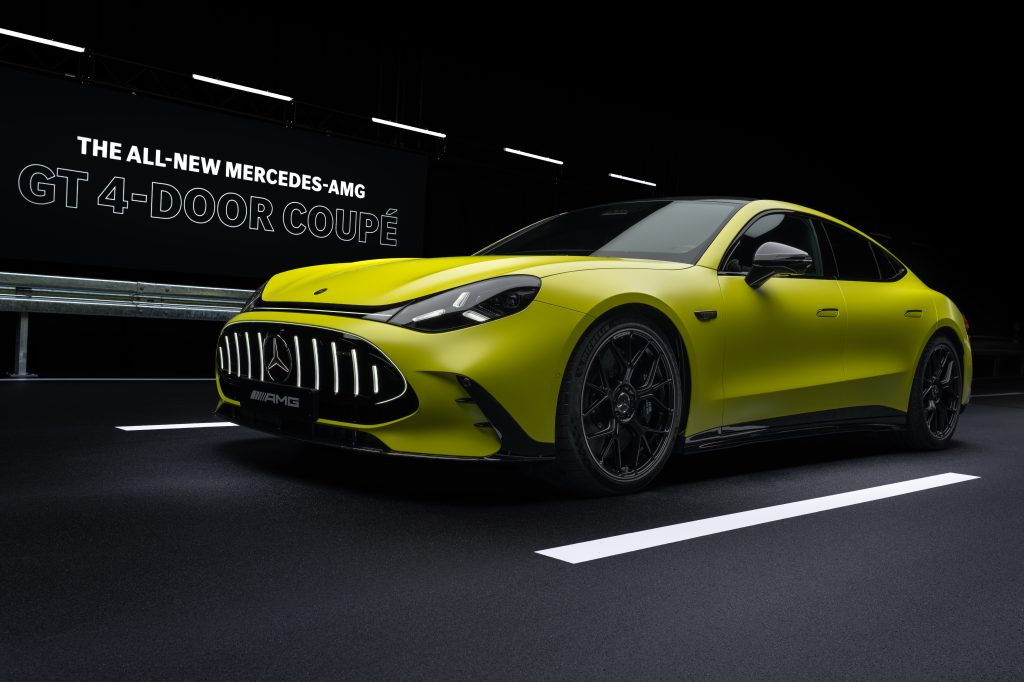
That’s why the highlight feature of its new AMG is a set of fake V8 noises, fake transmission, and fake vibrations to make it feel more like the V8s of the past, alongside the absurd electric performance of the present – including several new innovations that Mercedes is bringing to consumer vehicles for the first time.
Tech from Mercedes record-breaking GT XX concept
Mercedes says it’s using similar technology for its motors, batteries and charging as it used on its GT XX concept, which it drove “around the world in 8 days” last year, setting an EV distance record of 24,901 miles (40,075km) in 8 days around the Nardo test track in Italy.
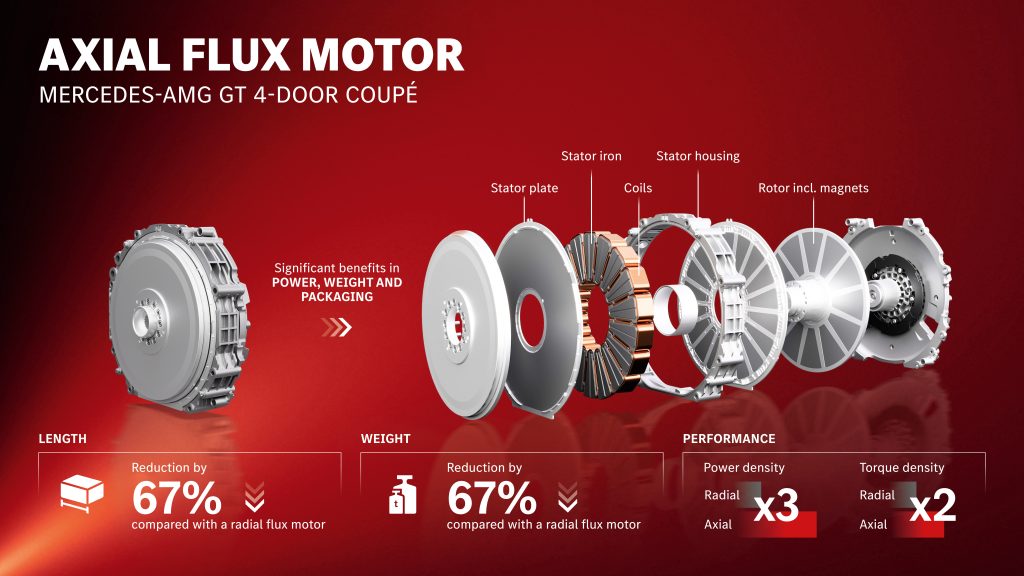
One cool feature here are its axial flux motors. Mercedes says the AMG GT is the first series production EV to use them.
Axial flux is an electric motor technology which uses flat circular plates instead of a rotating cylinder, which can offer higher torque in a small package. Each of the AMG GT’s motors are under 3.5 inches thick, 67% smaller and lighter than traditional radial flux motors, with twice the torque density and three times the power density.
In 2021, Mercedes acquired YASA, a company which has developed record-breaking power density in its axial flux motors. It has supplied motors for other hyper-performance hybrids, like the Koenigsegg Regera, Ferrari SF90 and Lamborghini Revuelto.
The concept has also been considered for in-wheel motors due to its small size – though the AMG GT eschews this idea and mounts its three axial flux motors inboard on the axle, with one on the front axle and two on the rear.
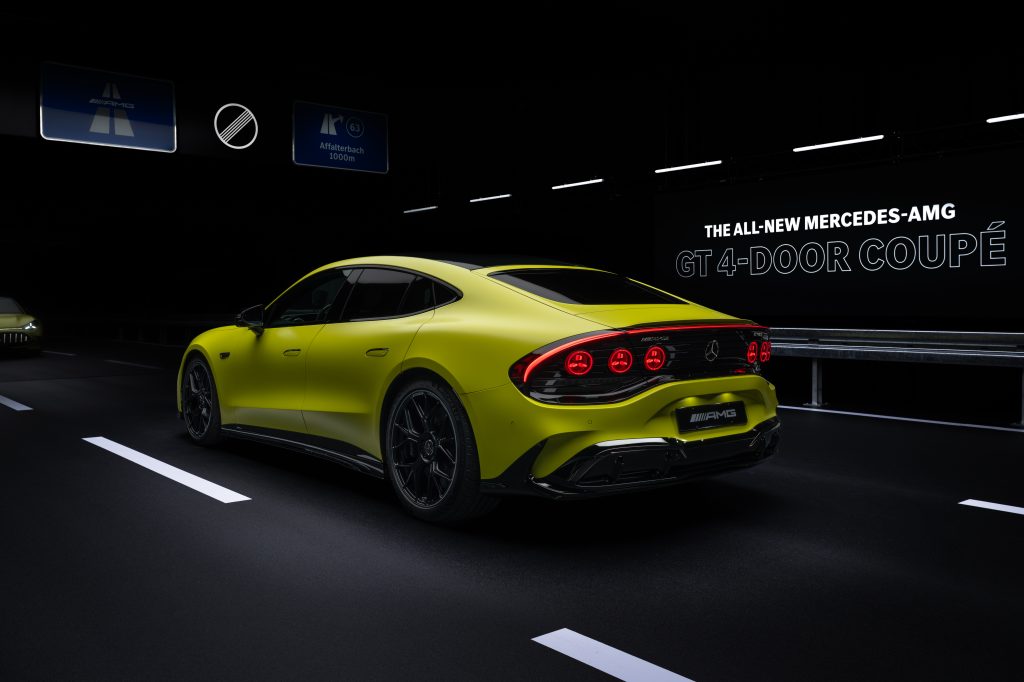
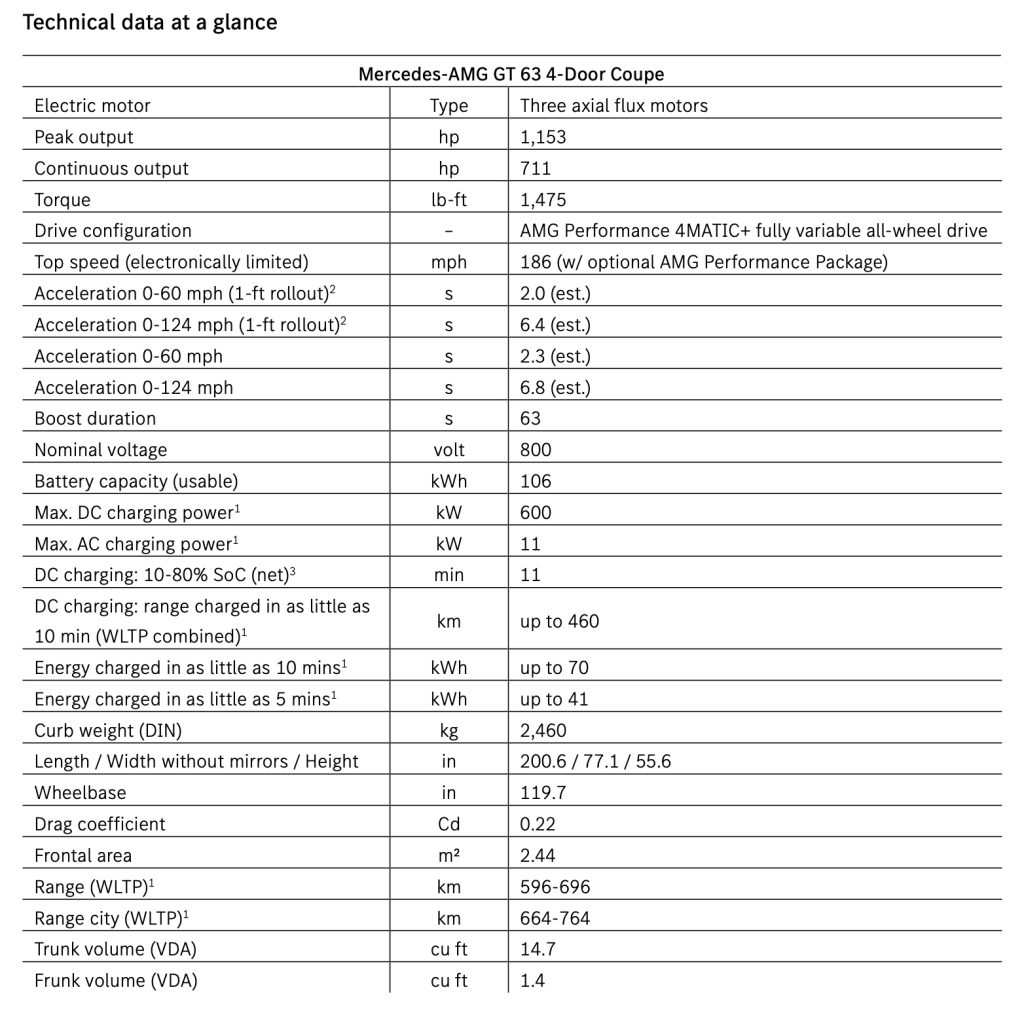
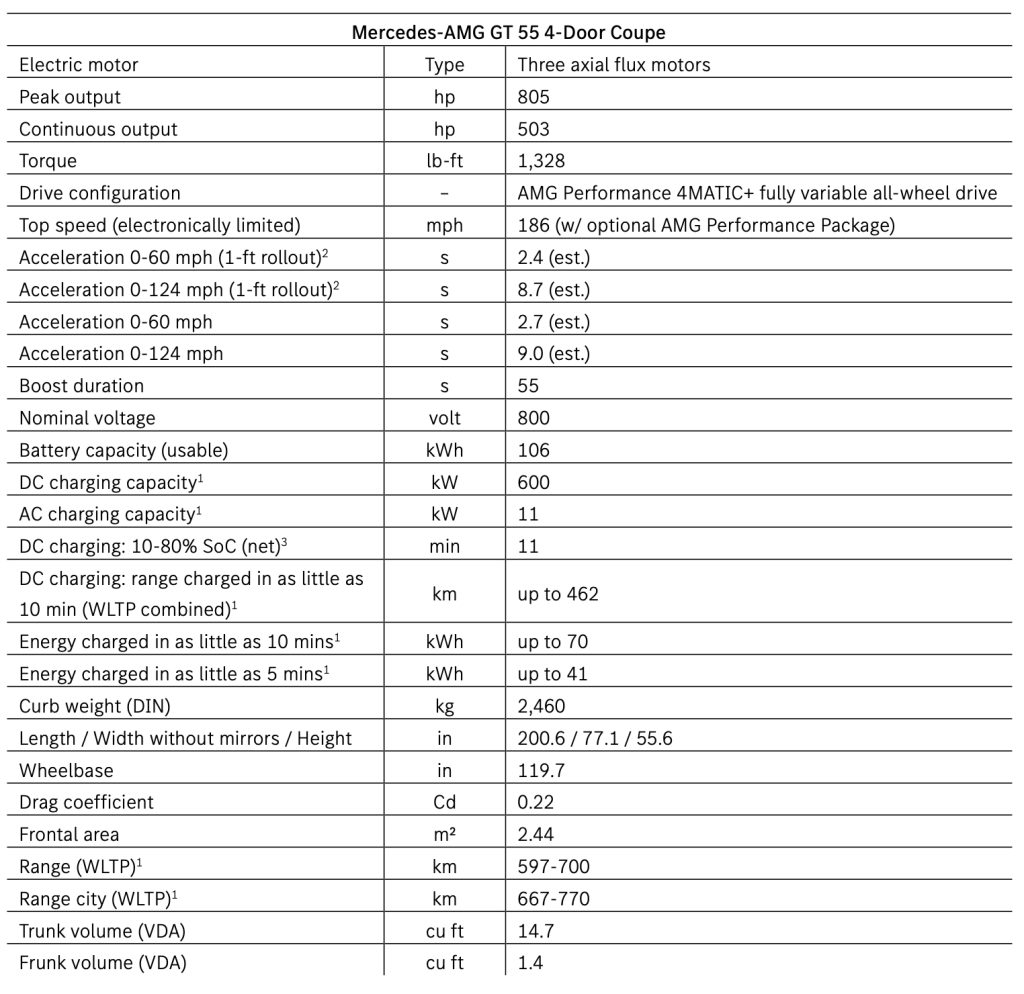
Combined, the system offers up to 1,153hp on the top-spec AMG GT 63 model when combined with launch control and an 80%+ battery state of charge. On the lower-spec AMG GT 55 model, that’s 805hp. The electrical architecture of the vehicle has been designed to be capable of outputting up to 1,300hp, so we might even see more power from a future model.
That horsepower number is in fact the biggest one ever to come out of Mercedes’ factory gate, beating the limited-edition, $2.7 million Mercedes AMG ONE hybrid which had an absolutely pathetic 1,049 peak horsepower. Barely enough to beat a bicycle off the line, really.
All that gives the top-spec version a 0-60 time of 2 seconds, a 0-124mph (0-200km/h) time of 6.4 seconds (both better than the AMG ONE), with a 186mph (300km/h) top speed. The lower-spec does 0-60 in 2.4, and 0-124 in 8.7.
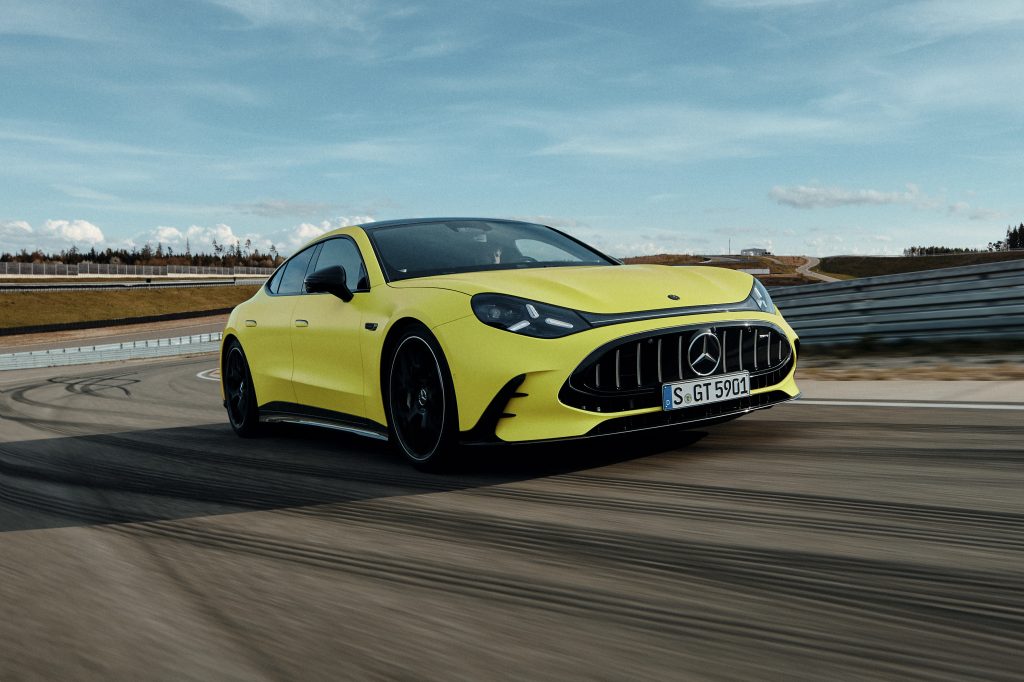
Beyond these power numbers, the AMG GT also has a number of high-performance features. Optional active aerodynamics features modify airflow around the rear diffuser (Mercedes says this is a world first), underbody, rear spoiler, and air intakes to improve performance at high speeds. Standard air suspension modifies ride height based on vehicle speed. Rear wheel steering improves cornering both at low speeds and high.
The biggest downside on performance is the car’s massive 5,432lb curb weight. That’s on par with the current hybrid BMW M5, which also gained ~1,000lb in its most recent refresh.
Other performance features include selectable drive modes modifying many aspects of vehicle performance, including drivetrain response, handling and traction aids. There are 6 pre-set drive modes and one customizable drive mode, allowing you to have control over various vehicle features.
Some words on fake V8 noises
One of those features is a set of fake V8 noises, in case you want to waste energy making your car sound slower than it is. By default, this turns on in Sport+ mode, which also includes a fake 9-speed transmission. You can change these fake gears with paddle shifters on the back of the steering wheel.
Mercedes had one of its F1 development drivers and its CEO take the car around for a test drive, in which you can hear the fake V8 noises (about 3:28 into the video… or scroll down to the bottom of this post for a quick video from our test ride):
Mercedes says it put a lot of effort into this, getting the sound exactly right, copying all the (bad) characteristics of a combustion engine – redlining, bogging down and so on. It even added motors to vibrate the seats and a fake tachometer meant to simulate the RPMs of the previous-gen V8 (the fake redline is 7k RPM – the real redline is 13k on the rear motors and 15k on the front). It even simulates the torque curve, giving you less power if you’re outside of the optimal part of the powerband.
Personally, I think this is all highly unnecessary and disadvantageous – why waste energy making noise that you could spend making the car move? Why cut motor power to simulate gear shifts, instead of just allowing for the relentless acceleration of an electric motor? Why add vibration for a worse driving experience? Why have sound-dampening material inside the car, and then add extra sound on top? If there’s so much focus on reducing weight, why all this unnecessary fluff?
Mercedes says it’s “emotional,” but the only emotion I feel when my car doesn’t do what I tell it to do is frustration.
All that said… I have tried a similar fake-gear system in the Ioniq 5N, and while I still think it’s dumb and would not keep it on in normal use, I do at least respect the distance they went with it, even limiting you to ~20mph unless you shift out of “first gear.”
Mercedes seems to have gone to a similar distance here, which is respectable enough – if you’re going to do it, at least do it all the way. But I still doubt people will leave it on long term, if they allow themselves to experience the superiority of electric driving.
But really, these last few paragraphs don’t matter much. In the highest-performance mode, Race mode, there are no torque interruptions or fake gears, just pure power. So if you want that, you have it. And in any other mode, the car already has such an absurd amount of power and you’ll never feel wanting anyway. So, it really is a matter of choice – pick the mode you want, customize it as much as Mercedes allows, and have the car that you like.
I think, in the long-term, most people will choose a silent, gear-less drive experience, if they give it a chance. But if the “emotional” experience of the V8 gets more people in the door, a Trojan Horse of electrification so-to-speak, then I’ll accept it.
Innovative battery design
The AMG GT uses another relatively new technology, a silicon anode attached to an NMCA-type cathode. Mercedes would not confirm whether or not this tech came from Sila Nano, another company that Mercedes made a significant investment in. Mercedes previously used silicon anodes in its electric G-Class.
This improves energy density while still allowing for rapid charging, giving the car a WLTP range of 371-435mi (this is still an estimate, and is WLTP; EPA numbers will be smaller) from its 106kWh battery.
The battery is an 800V native system, and can charge at up to 800A on an 800V charger, meaning a DC charge rate of over 600kW – faster than just about anything you’ll find in the wild these days – and can step down to 400V when needed.
That’s enough to fill the battery from 10-80%, adding some ~280 miles of range, in around 11 minutes. It will come equipped with a NACS port in the US, or other appropriate charge ports in other locales.
It’ll charge slower at 400V, with a peak rate of more like 320kW. But given the peak of the charge curve is so high, the car will still charge extremely fast on a slower-speed charger.
Mercedes told us that, when connected to a 200kW charger, the charge curve “is a flat line.” So, even at high SoC, the AMG GT will charge faster than many cars’ peak rate. Impressive.
The battery is placed low in the vehicle, and uses 2,660 individual cells, each 105mm high and 26mm in diameter. Using small cells helps with cooling efficiency for the liquid cooling system by increasing surface area as compared to large cells. But this is a bit larger than the standard 18650/21700 form factors, and was custom-made by Mercedes – this is the only car using this form factor.
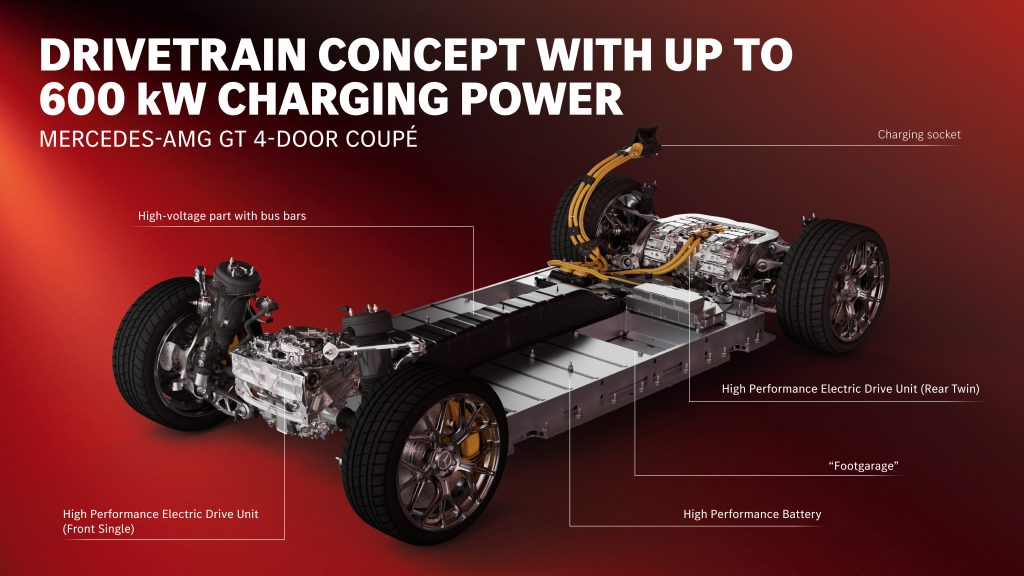
But the battery isn’t just flat in the floor like on many EVs. There are rear “foot garages,” cutout areas for the rear passengers to allow for more foot and knee space in the rear, which also allows for a lower seating position and therefore more headroom. EVs can often feel like the floor of the vehicle is higher due to the battery being slung low in the car’s structure, and this is Mercedes’ way around this.
In fact, the vehicle is actually an inch and a half lower than the outgoing 4-door AMG GT, despite the battery.
Interior & usability
Despite all this talk about performance, it’s still a 4 door, so it still needs to be usable.
On the interior, we see massive screens across the dash (have we reached “peak screen”?), with two meant for the driver and one for the passenger. The dash lacks physical controls for HVAC and volume, two of the more common requests in these days of screen-focused UX, though the steering wheel does have a volume knob.
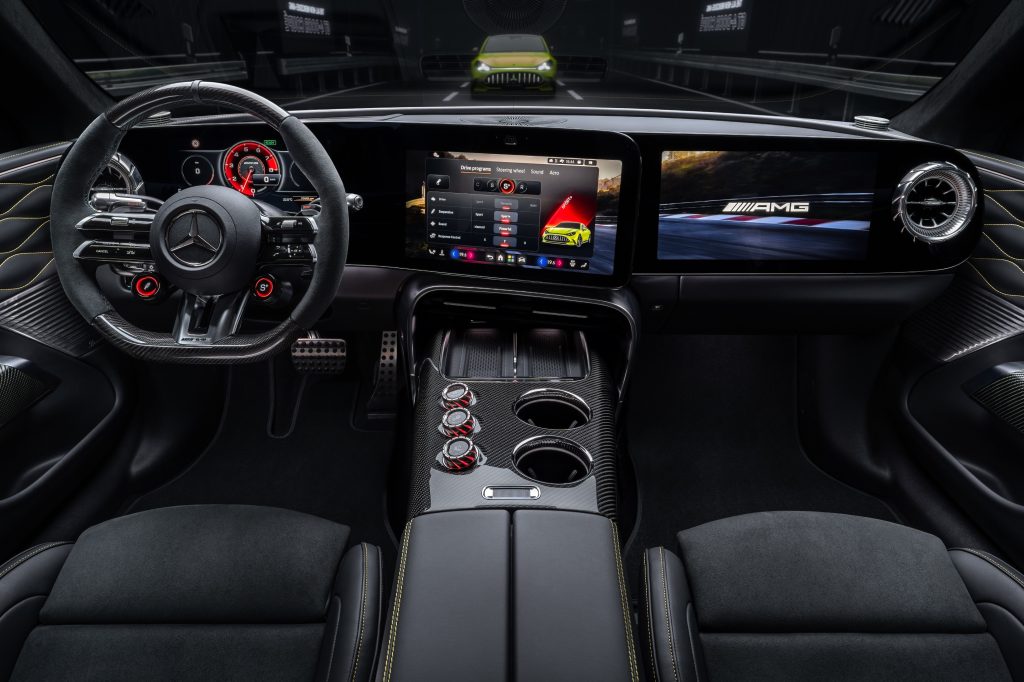
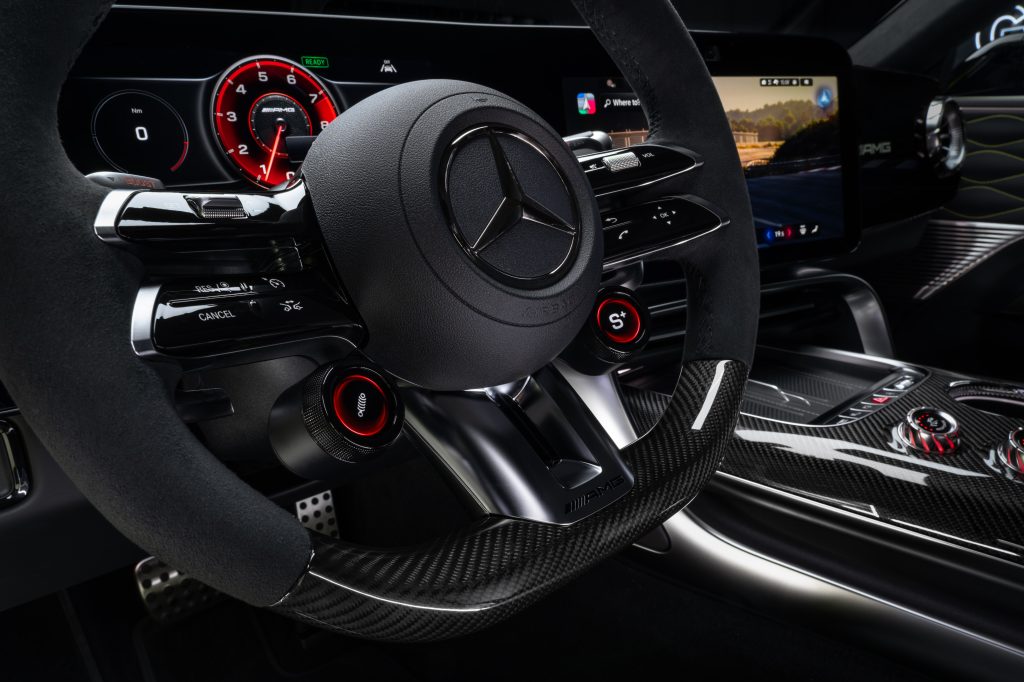
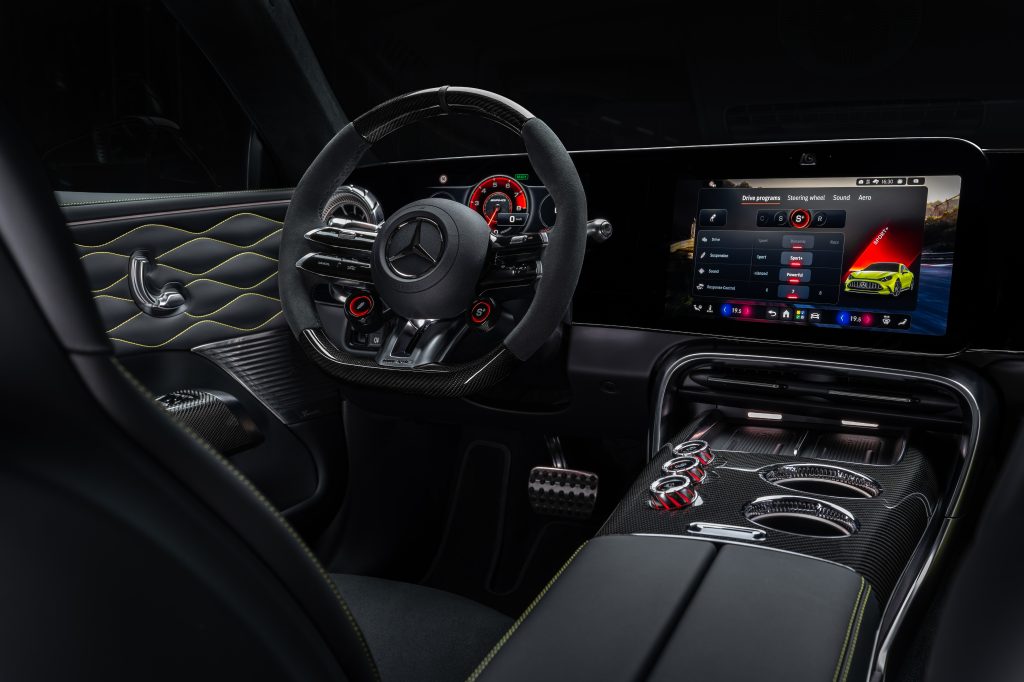
The three physical knobs on the center console adjust driving characteristics – response, agility, and traction. Mercedes calls this its “AMG Race Engineer” system.
Mercedes’ heads-up display is optional on the base model and standard on the higher one. Mercedes has one of the better heads-up displays we’ve used (and notably works while wearing polarized sunglasses, which many others don’t). It comes configured with race analysis tools like sector timing, pre-programmed with some of the world’s more famous racetracks.
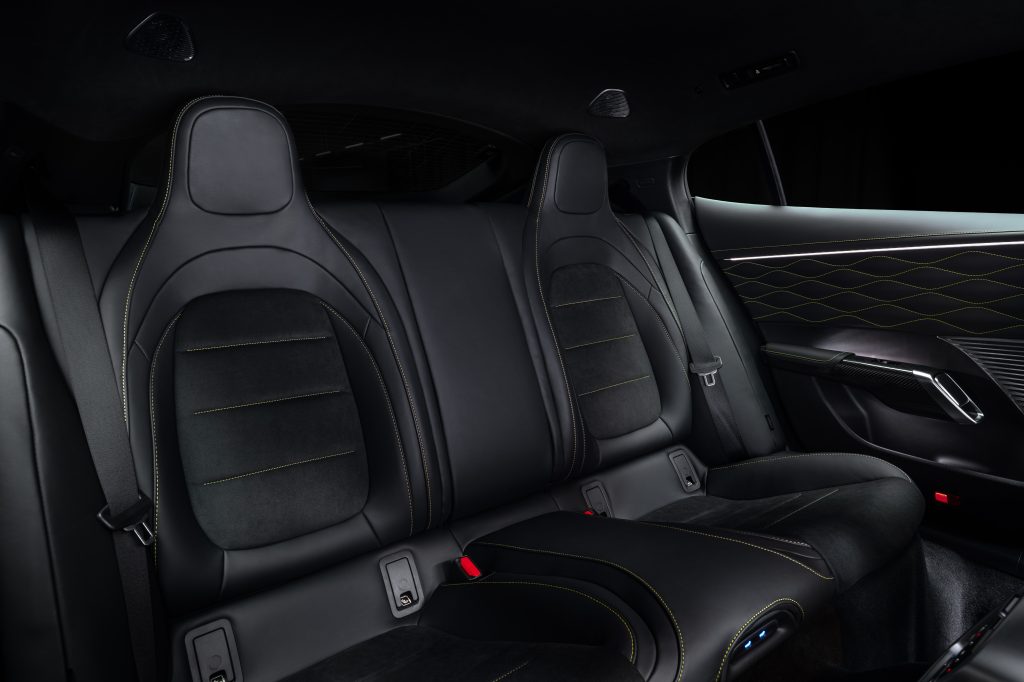
The car’s four seats are heavily bolstered to keep you inside them during ambitious driving maneuvers, though we wonder how common those will be when the car has a full complement of passengers. A rear bench seat for three rear passengers is optional, though the middle seat will have less legroom as it doesn’t have its own “foot garage.”
Despite being a low-slung, high-performance vehicle, the AMG GT actually has a huge trunk, and reasonable size frunk.
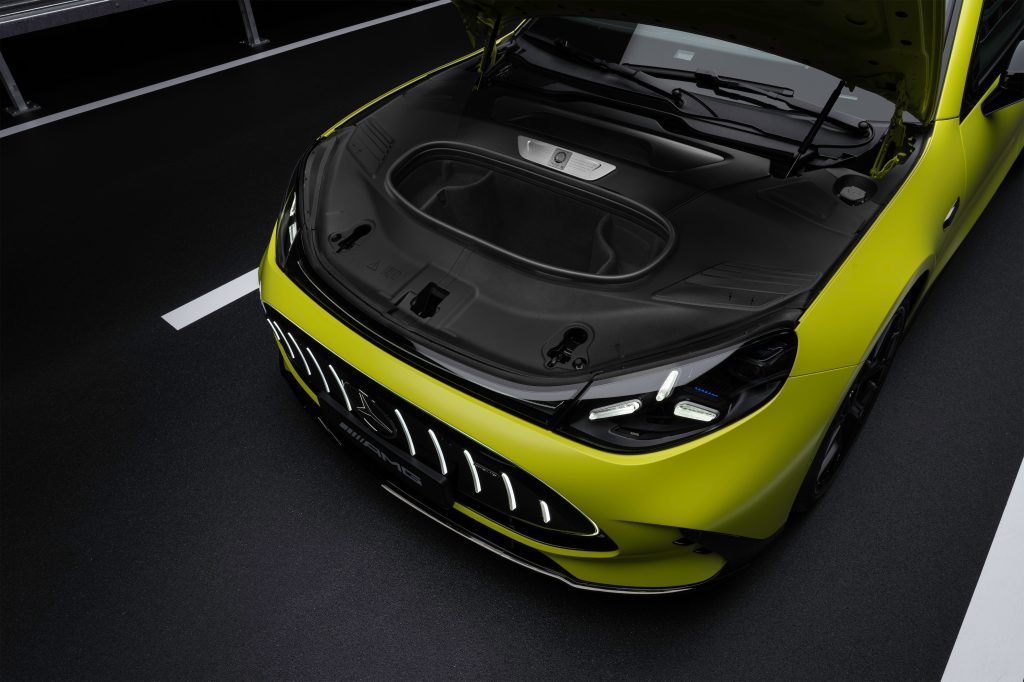
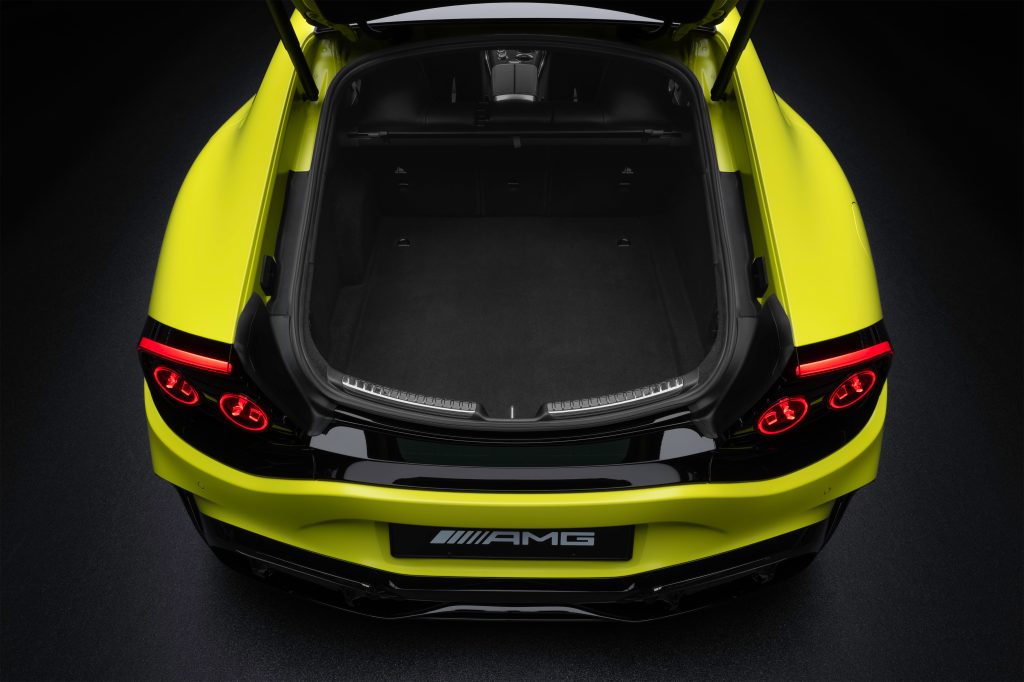
Mercedes says the rear trunk can hold 3 pieces of luggage, 2 golf bags, or skis for 4 people – through the pass-through in the middle. 4 people could go skiing in this car.
The most striking feature in the interior is the panoramic glass roof, surrounded by ambient lights and made of electrochromic glass (a feature we’ve seen on the Cayenne EV… and the Nissan Leaf). The glass switches between opaque and transparent modes in various patterns, and the ambient lights can produce a “sparkling canvas with a unique light display.” The ambient lights are just for fun though – they don’t communicate useful information like nav directions or blind spot warnings, like we’ve seen on other cars.
One thing missing from our technology presentations was any mention of ADAS/self-driving technologies. I had to ask around, and eventually got the answer that the car does have your standard complement of level 2-ish driver aids, but that it will eventually get access to Mercedes Drive Pilot level 3 system. I was very impressed when I got to try this system, which you can read about here.
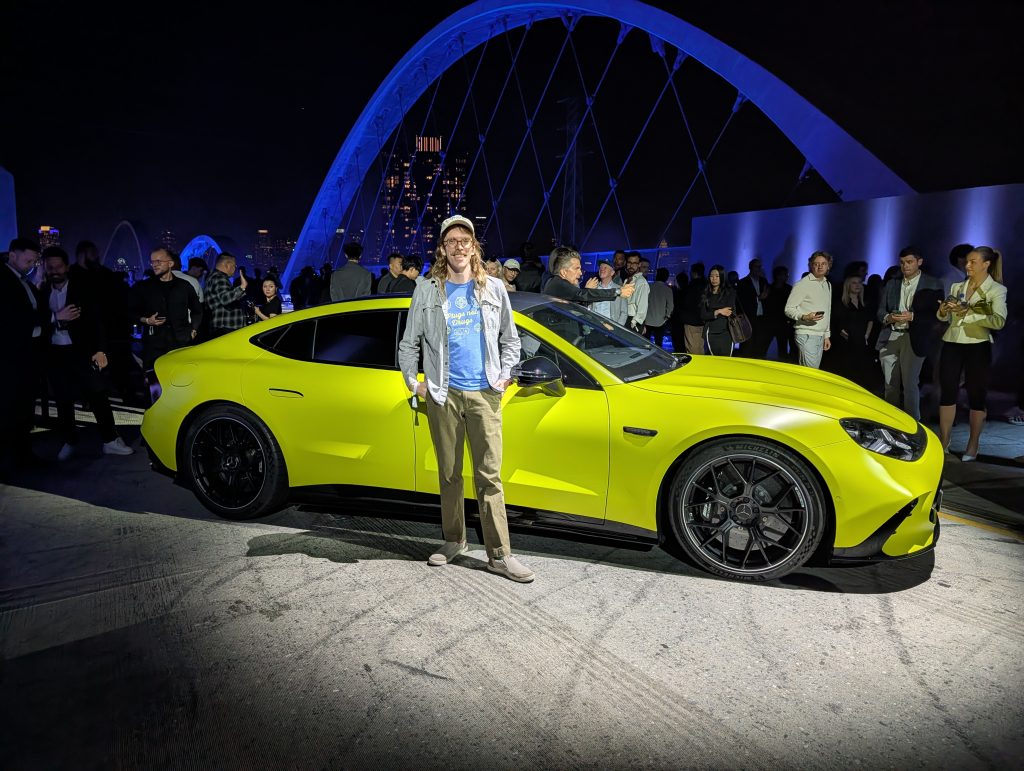
The 2027 Mercedes-AMG GT 4-Door Coupe arrives at U.S. dealerships later in 2026 starting with the Mercedes-AMG GT 55 4-Door Coupe, followed by the Mercedes-AMG GT 63 4-Door Coupe in early 2027.
Top comment by Dennis Constantinos
I like the rear but not sure about the front. With 600kw peak and 11min 10-80% this is officially the fastest charging non-Chinese EV and is really knocking and within striking range of what the best China has to offer. Tesla at this point is thoroughly mediocre in charging and battery performance even with their 800V Cybertruck.
Mercedes hasn’t yet released pricing, but it says it will pursue a similar pricing strategy as on the predecessor AMG GT, so you can expect six figures to start.

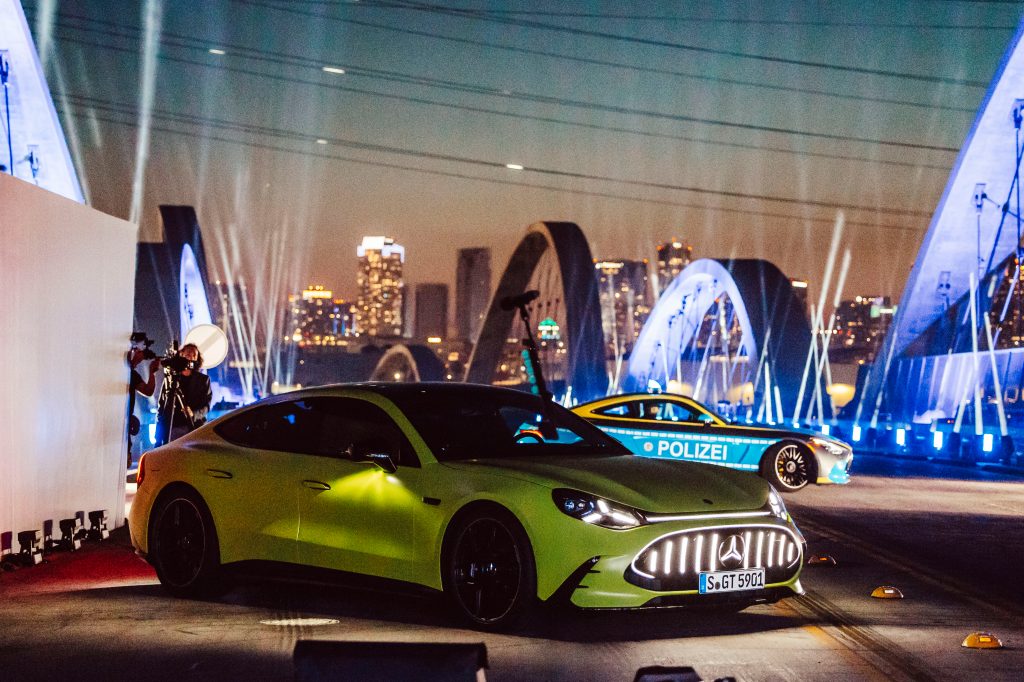
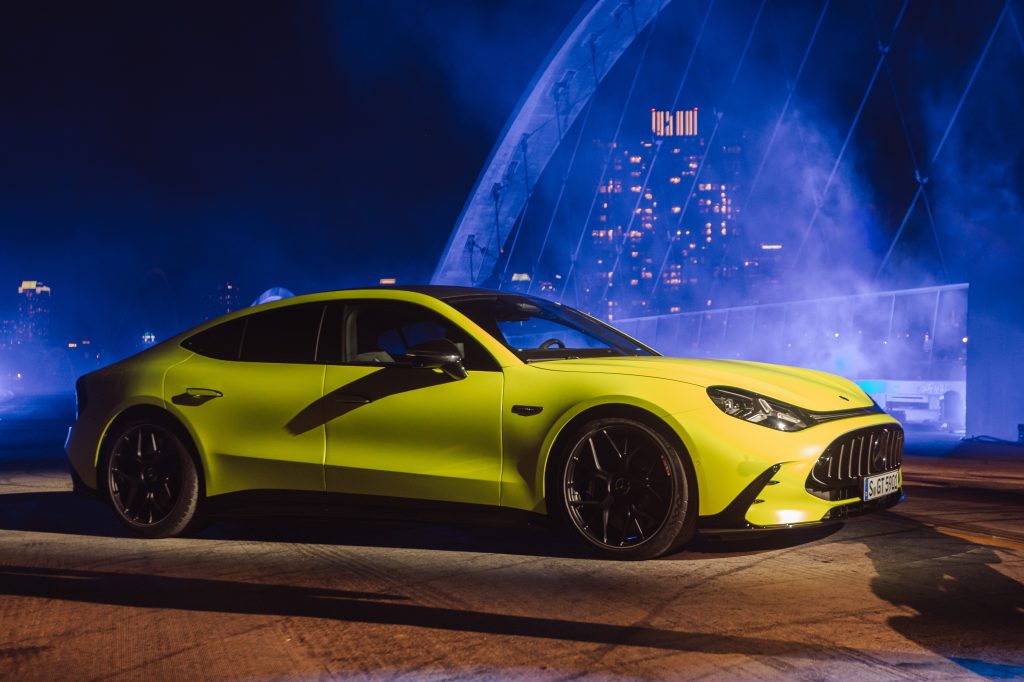
Update: We got a test ride! Check out the two videos below. Just a quick back and forth on the 6th street bridge in LA. And holy heck, this this pulls and pulls and pulls… (also, you can kind of see the ambient light pattern on the glass roof in this video)
And now from the front camera for a quick run back. Note the fake tachometer with 7k redline, and that this must be in some sort of “automatic mode” as it doesn’t look like the driver is tapping the paddle shifter:
Charge your electric vehicle at home using rooftop solar panels. Find a reliable and competitively priced solar installer near you on EnergySage, for free. They have pre-vetted installers competing for your business, ensuring high-quality solutions and 20-30% savings. It’s free, with no sales calls until you choose an installer. Compare personalized solar quotes online and receive guidance from unbiased Energy Advisers. Get started here. – ad*


FTC: We use income earning auto affiliate links. More.




Comments