
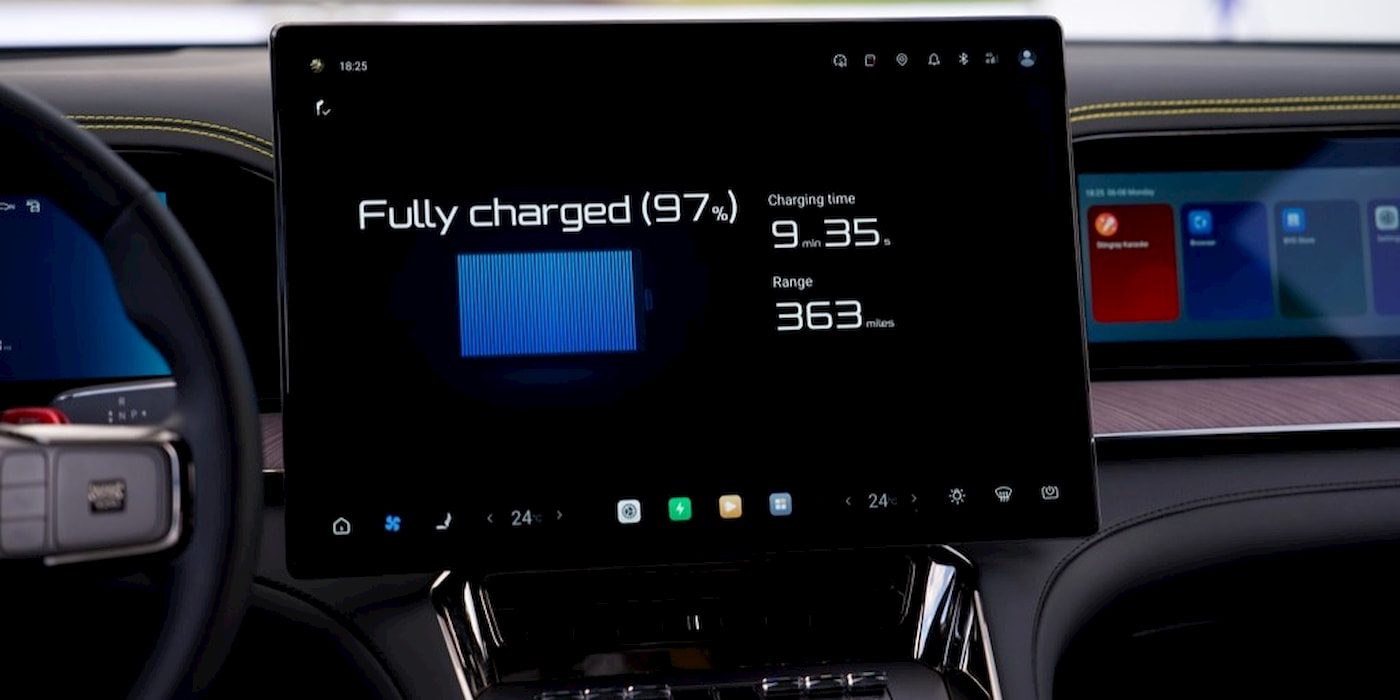
One of China’s newest EVs is also its fastest-charging, with the ability to fill its battery from 10-70% in 4 minutes and 22 seconds.
But that’s not the only recent announcement of a fast-charging battery that quotes how many seconds it takes to fill up, showing that the race for fast charging has entered a new era which treats seconds as the significant figure, rather than minutes.
Geely subsidiary Lynk & Co. recently launched its new 10 series EVs, complete with extreme fast charging speed. The cars are the first to use Geely’s “Golden Brick” battery, with more models coming soon at various Geely brands.
Meanwhile, BYD already has several vehicles out using its “Blade 2.0” battery, which also offers extremely fast charging.
These two batteries are both on the vanguard of a new generation of Chinese EVs that are making charging undeniably quick, at least if the right infrastructure is available.
Seconds are starting to matter in EV charging times
BYD says its Blade 2.0 can charge from 10-70% in 5 minutes. And Geely one-upped BYD by saying its Golden Brick can charge the same amount in 4 minutes and 22 seconds.
Another major battery manufacturer, CATL, recently showed off a commercial battery that can charge at an 8C rate, allowing a 20-80% charge in 6 minutes and 48 seconds. But that’s actually slow compared to its recent announcement of a consumer light-duty battery that can charge from 10-80% in just 3 minutes and 44 seconds.
CATL’s battery is not yet available in a vehicle, so it isn’t quite apples-to-apples when comparing to the BYD and Geely tech above, both of which are already on the road. But it’s not just a lab test of a cell, it’s a fully formed pack undergoing testing in real fast charging, and it’s from the world’s largest EV battery manufacturer, not some startup making stuff up in the hunt for venture capital.
CATL isn’t the only one with fast charging tech waiting in the wings. FAW group just announced a battery that can charge from 10-70% in 3 minutes and 41 seconds. That’s a slightly slower rate than CATL’s 10-80% in 3:44, but the difference there is mere seconds.
And so, we get to the point: the common thread among all of these is that each of them mention not just the number of minutes, but the number of seconds it takes to get a full charge. So China is now working with a different significant figure – seconds, not minutes.
Do such quick charge times matter?
The public has long felt that charging times are too long, and that EVs need to charge as fast as gas cars.
Never mind that that isn’t really true in practice – EV owners know that charging at home is even easier than going to gas stations, and on roadtrips, your car will often be ready by the time that you’re done with your stop. But the perception, among non-EV owners who are used to the anxiety-causing paradigm of being chained to gas stations, is that EV refueling needs to be substantially similar to the poor experience they’re used to.
There are still benefits. For example, higher power delivery means higher throughput, which means you can get more cars in and out of the same charging spot/station per day, which reduces land use needed. This can be important, particularly in urban environments, especially ones where people don’t have access to home charging.
So, regardless of whether these extremely fast charge times are necessary, the fact of the matter is that they already exist – at least in China.
What’s the best we have in the US?
Meanwhile, in the US, our fastest-charging vehicles have been the Hyundai/Kia E-GMP cars, which can charge from 10-80% in around 18 minutes on the right charger. That’s perfectly fine for roadtrips, especially since a driver will need to take a break every few hours while driving anyway.
But for people who rely on fast charging for all of their charging needs (seriously, try to find a way to charge at home if you can), even 18 minutes of sitting around in your car can feel like a long time. A 3 minute, 41 second charge seems a lot more palatable.
There is one vehicle coming out soon in the US which will be able to charge drastically faster than the E-GMP cars, the Mercedes AMG GT EV. That will be capable of about an 11 minute charge from 10-80% on a 600kW charger, which will put it well in the lead… but it’s going to be limited in production and cost well into the six figures. (In contrast, China’s fastest charging cars can be had for well under $30k)
But that one’s still measured in minutes. The difference between 11 minutes and 10 minutes and 30 seconds doesn’t seem like much, but the difference between 4 minutes and 3 minutes and 30 seconds seems a lot more significant. That’s why we didn’t start hearing seconds quoted in charging times until the minutes got down into single digits.
It’s not just the batteries, but the chargers, too
The question of 600kW chargers brings up another point – infrastructure rollout has been far faster inside China than outside it. Infrastructure is one of the major strengths of communist states, after all (for another example, see China’s rapid high speed rail network rollout).
BYD only announced its 1,500kW chargers earlier this year, and soon after, Geely rolled out 1,500kW chargers of its own. And then, just yesterday, state-owned Dongfeng announced its own 1,500kW charger, and says it’s working on even faster ones.
But it’s not just that the chargers exist, it’s that they’re already being deployed at a large scale. BYD plans to have 20,000 installed by year’s end, with several thousand already installed at this point. That sort of fast scaling simply doesn’t happen outside of China.
For example, it took about three years before the first “true” 500kW V4 Supercharger showed up in the wild (CEO Elon Musk’s idiotic move to fire the entire Supercharger team, thus causing complete chaos with contractors, couldn’t have helped).
Europe fares better with fast charging than the US, as there are several ~400kW charging units from companies like Alpitronic that are currently in operation, with 600kW stations rolling out this year.
But BYD isn’t content to wait in the overseas market, either. Europe recently got its first BYD flash chargers, and the company plans to roll out thousands of them in the next year. Perhaps BYD would roll out its flash charging system here, as it has in Europe, if the market were less hostile. But as of yet, it has no similar plans in the US (though Canada will get it soon.)
The US chose to have worse charging
It’s still rare to find even one or two 350kW chargers at a US charging station, let alone anything quicker.
President Biden’s Inflation Reduction Act and Infrastructure Investment and Jobs Act built programs to help accelerate the buildout of these chargers. But those programs have moved slower than they should, for several reasons both at the state and federal level.
One of those reasons is intentional, held back by the republican party, mostly at the federal level.
The reality TV contestant squatting in the Department of Transportation spent most of last year illegally trying to pause disbursement of funds, then being stopped by court. In addition, the joint office that Biden created to increase government collaboration and efficiency was dismantled, making DoT and DoE less efficient.
Even after being stopped by court, DoT has tried to put up more roadblocks by refusing funding to chargers with any Chinese components (the Biden-era regulation required a 55% US components, rather than 100%).
Not only is this impossible because the US simply doesn’t make all the parts needed for EV chargers, it also restricts America from having access to the best chargers available (as we learned above are being made by Chinese companies), and is done in the context of republicans shipping EV jobs to China by canceling Biden-era programs that had led to a renaissance in US manufacturing.
Top comment by WhereIsTheElectricMiata?
The growing number of tech bans on whole classes of products like robots (including Roombas) and routers is also keeping us from having nice things. Of course they claim it’s for security and to build our manufacturing base, and then they arbitrarily give waivers without regard for any security reassurances or plans for investments. And there is no effort to remediate the actual security and privacy issues that current products in our homes have.
All of this happened after the party’s candidate asked for and got bribes from the oil industry (in his campaign to run for an office he is Constitutionally barred from holding), so it’s no wonder why there have been so many attacks on the industry promising a better future than oil.
So, here, in the land of plenty, rather than competing to be the best of the best and working to onshore manufacturing of the best products out there, America is pushing those products away, and letting the rest of the world enjoy these cool things that we are deprived of (and China is profitinf from providing them to the world).
Instead, we wallow alone in the pollution forced on us as a result of those oil company bribes, subject to the whims of a senile dictator with no concept of how geopolitics (or anything) works, losing an industry we could have been a player in, and refusing to join the world in improving the fates of our citizens.
Charge your electric vehicle at home using rooftop solar panels. Find a reliable and competitively priced solar installer near you on EnergySage, for free. They have pre-vetted installers competing for your business, ensuring high-quality solutions and 20-30% savings. It’s free, with no sales calls until you choose an installer. Compare personalized solar quotes online and receive guidance from unbiased Energy Advisers. Get started here. – ad*


FTC: We use income earning auto affiliate links. More.



Comments