
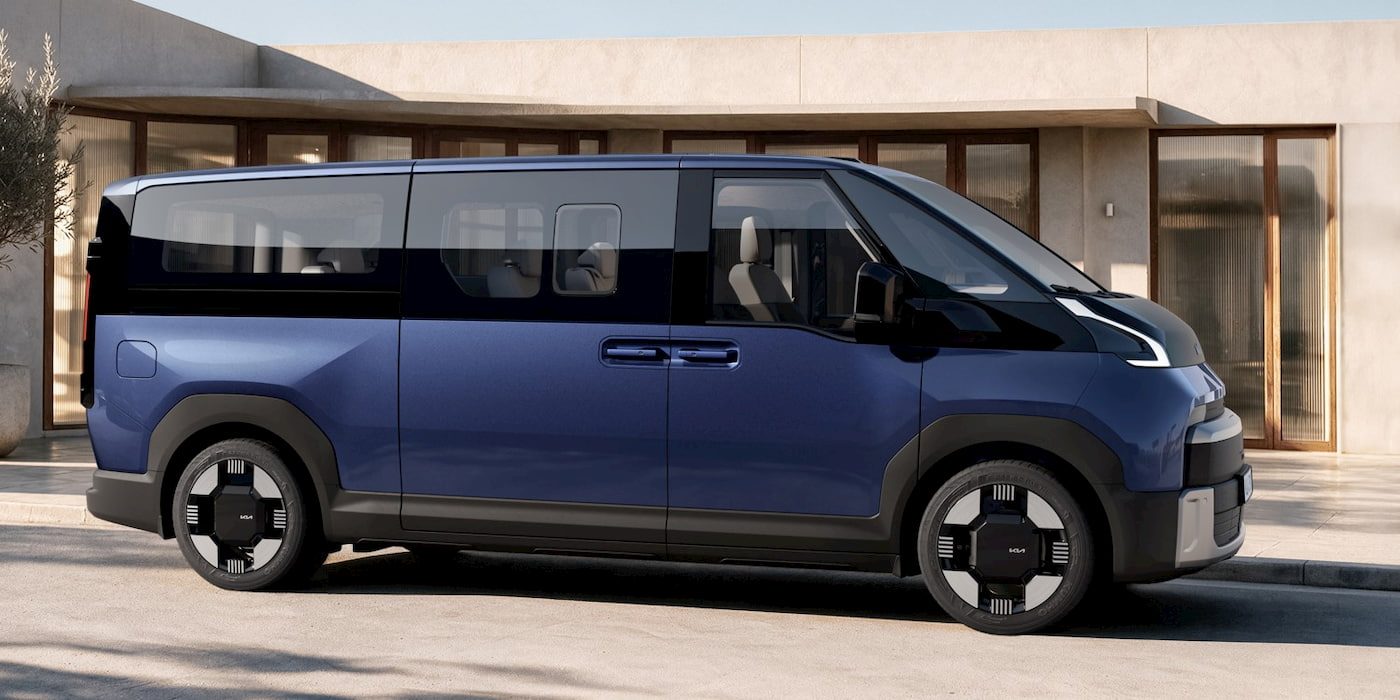
Kia unveiled the PV7 for the first time, its larger electric van with room for nine passengers or plenty of cargo. Here’s our first look.
Kia PV7 battery specs, range, and other details
The PV7 is Kia’s second all-electric van from its Platform Beyond Vehicle (PBV) business, following the PV5.
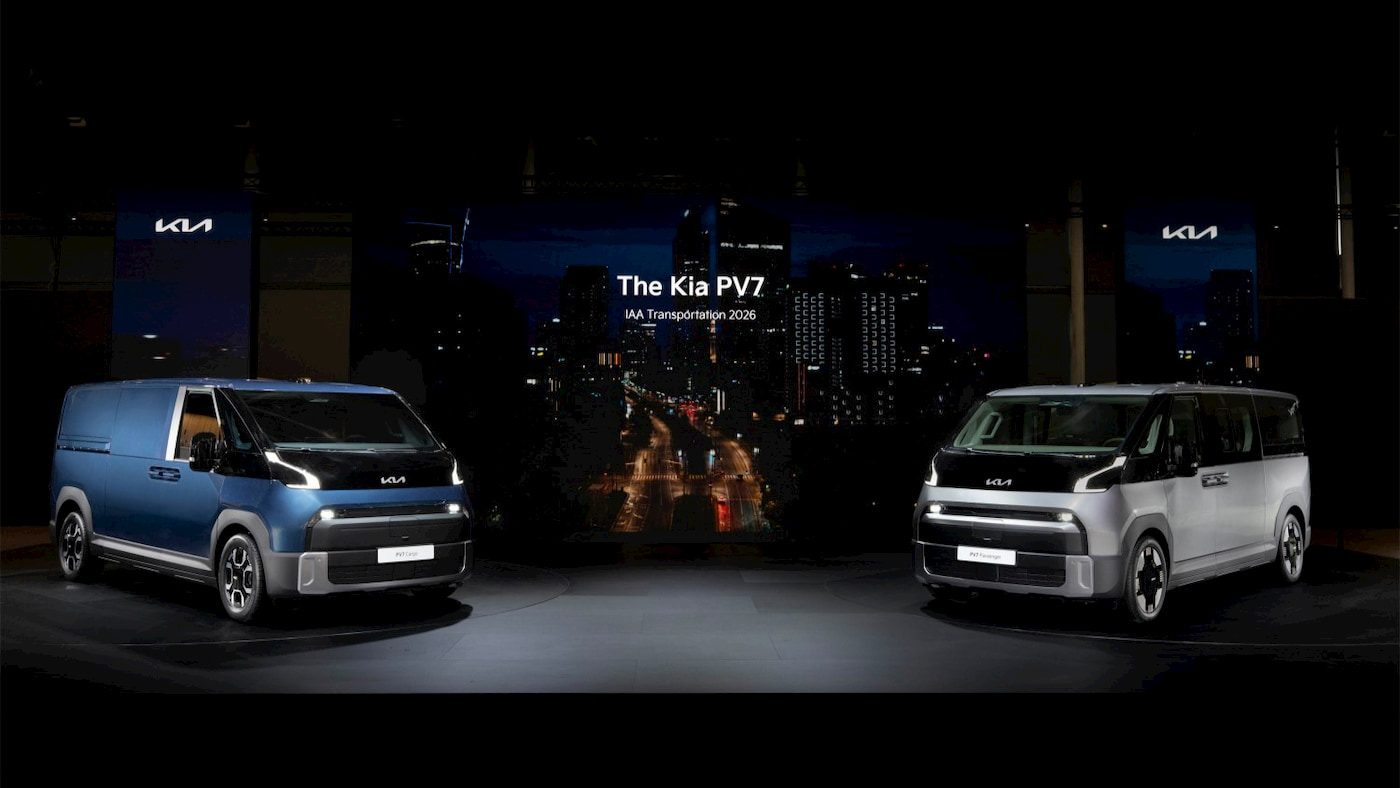
Kia unveiled the new EV van for the first time at IAA Transportation 2026 in Hanover, Germany, on Monday as it aims to capture a bigger share of the light commercial vehicle (LCV) market.
Built on the same E-GMP.S platform as the PV5, the PV7 offers a flexible, spacious interior thanks to its flat floor design.
The modular architecture enables Kia to introduce multiple “top hats,” or body styles custom-tailored for business and personal use. Kia plans to launch 23 different PV7 variants over the next few years, including Passenger and Cargo models.
Kia will offer the PV7 with two nickel-cobalt-manganese (NCM) battery packs: 71.5 kWh and 96.2 kWh. The Long Range Cargo version offers an all-electric range of over 460 km (285 miles) on the WLTP cycle.
Front-wheel drive (FWD) is standard, but Kia plans to add an all-wheel drive (AWD) option in the future.
Depending on the configuration, the front electric powertrain delivers up to 268 horsepower (200 kW) and 309 lb-ft (420 Nm) of torque.
Thanks to its 800V architecture, the Kia PV7 can charge from 10% to 80% in about 25 minutes using a 350 kW DC fast charger.


Flexible, spacious, and high-tech interior
Like the PV5, Kia’s larger electric van has Hyundai’s Pleos Connect infotainment system with 12.9″ and 14.6″ displays.
Based on Android Automotive OS, the setup is similar to using a smartphone with apps and customizable screens. It also includes Gleo AI, an AI-powered in-car companion that can answer questions, control navigation or vehicle functions, and more.


The Kia PV7 Passenger and Cargo measure 5,350 mm (17.55 ft) long, 1,995 mm wide, and 1,990 mm high, with a 3,500 mm wheelbase.
That’s considerably bigger than the PV5 Passenger, which measures just 4,695 mm in length, 1,895 mm in width, and 1,915 mm in height, with a 2,995 mm wheelbase. It’s also longer than the concept from CES 2024, which measured 5,270 mm in length.


Kia’s new EV van is even bigger than the long-wheelbase Volkswagen ID. Buzz, which measures 4,962 mm in length with a 3,239 mm wheelbase.
The PV7 Cargo is available in 2- and 3-seat configurations, offering up to 6.1 cubic meters of cargo space, while the High Roof variant extends it to up to 8 cubic meters.
Maximum payload is up to 1,165 kg (2,568 lbs) for the Long version and up to 1,200 kg (2,645 lbs) for the compact model.


Kia said the PV7 Long features a 550 mm loading height and enough capacity for up to three Euro pallets (800 x 1,200 mm). It also features a dedicated heavy-loading driving mode to optimize performance while carrying heavy payloads.
Buyers can also choose between full-open twin-swing tailgate doors or a lift-up tailgate, depending on the need.
Like the PV5, the larger electric van has vehicle-to-load (V2L) capabilities, enabling it to power tools, camping equipment, a worksite, or other external electronics.
New Variants, Derivatives, and conversions coming soon
The PV7 Passenger, on the other hand, is designed for shuttle, rental, and family use, with room for up to nine passengers in the global model. In Korea, it will offer up to 11.
The 7-seat variant is equipped with Long-Rail Easy Remove Seats, enabling multiple interior seating arrangements. The 9-seat model, on the other hand, is available with or without a fourth row.
Following the initial Passenger and Cargo models, Kia plans to introduce 23 PV7 variants. The full lineup will include Cargo (compact, long, high roof) and Passenger (compact, long) variants, a Chassis Cab, and a wide range of conversion models.


Kia will launch the PV7 Passenger and Cargo in Korea and Europe in the second half of 2027. Following that, it will introduce it to new markets while launching different derivatives and conversions.
The PV5 is already Europe’s top-selling small electric van. Offering more interior space, flexible seating, and several variants fit for about any use, the PV7 may be an even “bigger” hit.
Kia will reveal PV7 prices closer to launch. In Korea, the PV5 Passenger and Cargo Compact starts at 45.9 million won ($34,000) and 41 million won ($30,300), respectively. In Germany, the PV5 Passenger 5-seater starts at €38,390 ($44,200).


FTC: We use income earning auto affiliate links. More.



Comments