
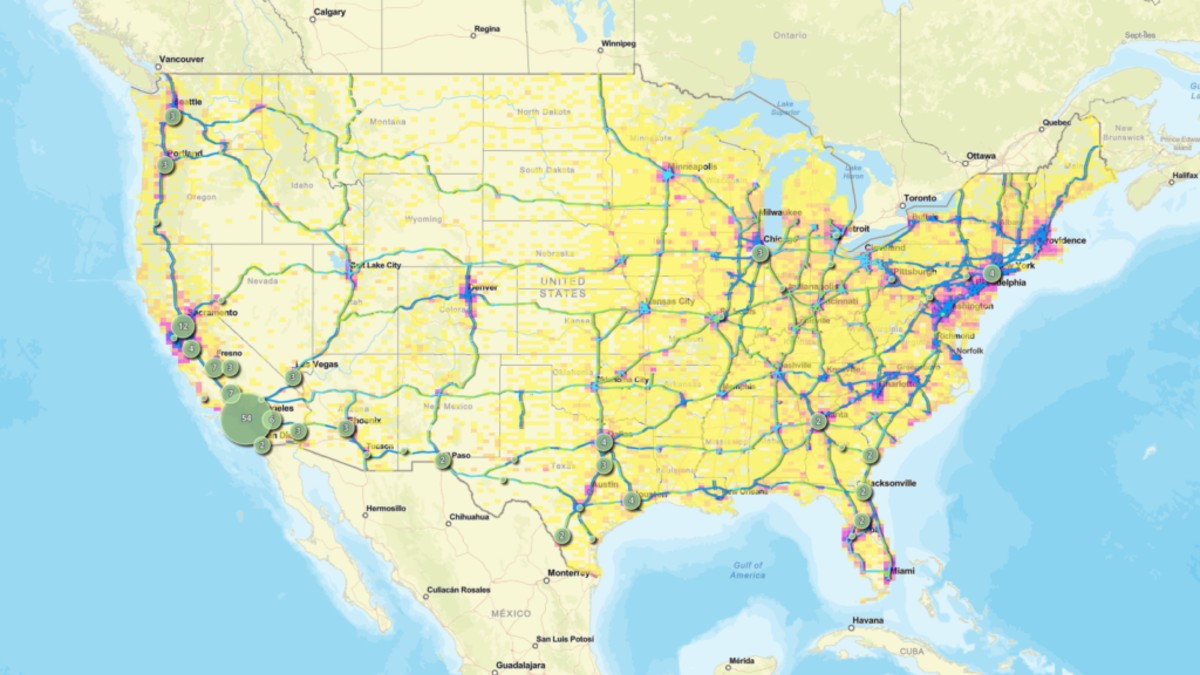
CALSTART has expanded its US map of medium- and heavy-duty zero-emission truck infrastructure, providing fleets with a clearer picture of where they can charge or refuel.
The updated National Medium- and Heavy-Duty Zero-Emission Infrastructure Map now includes around 162 infrastructure facilities across 17 states for electric and hydrogen-powered trucks. CALSTART says the additions line up with trends highlighted in its latest Zeroing in on Zero-Emission Trucks report, which found that public charging and refueling networks for commercial trucks are still in the early stages of scaling up.
The clean transportation nonprofit added 64 new electric truck charging and hydrogen refueling sites to the map, along with several new planning tools designed to show how truck charging demand could affect the grid over the next decade.
Truck drivers and fleet operators can now use the map to locate more than 1,500 EV charging plugs and 32 hydrogen refueling nozzles operated by various infrastructure providers.
Where truck charging could strain the grid
One of the biggest additions is a new overlay tied to CALSTART’s Phasing in US Charging Infrastructure Strategy. The feature compares today’s charging availability with the larger network buildout that CALSTART projects will be needed nationwide.
The map now also includes grid-capacity scenario layers showing projected peak charging loads for 2026, 2030, and 2035. Those layers compare managed and unmanaged charging scenarios to highlight where truck charging demand could put extra pressure on the grid and where more planning or utility investment may be needed.
The updates align with recent freight electrification research from the American Council for an Energy-Efficient Economy’s Pathways to Zero-Emission Freight Grid report.
Michael Joseph, CALSTART’s program manager for corridor planning and lead author of the Phasing in US Charging Infrastructure Strategy, said the map is intended to do more than simply show charging locations.
“This isn’t just a map of available ports; it’s a map of progress toward publicly available charging, which the industry needs to transition,” Joseph said. “Fleets and shippers can also use it to shift plans to electrify sooner: They can connect with a public site developer to use their site if their own depot facilities are hampered by utility delays.”
Major freight corridors are still unevenly covered
CALSTART says some major trucking corridors are moving faster than others in deploying zero-emission infrastructure.
The organization pointed to highways like I-5 and I-10 as examples where public electric truck charging infrastructure is ramping up. But other major freight routes, including I-80 and I-95, are still largely in the planning phase.
Priority freight hubs identified in the National Zero-Emission Freight Corridor Strategy are also highlighted in the broader infrastructure rollout strategy.
CALSTART launched the Medium- and Heavy-Duty Infrastructure Map in 2024 as a public tool to help truck fleets locate charging and hydrogen refueling stations. The nonprofit says it works directly with infrastructure providers to keep station data up to date and verify that locations are actually accessible to commercial zero-emission trucks.
“Fleets need to know what charging or refueling stations are out there so that they can make informed decisions about acquiring zero-emission trucks for their fleet,” said Jacob Richard, trucks project manager at CALSTART. “We make sure that every station is quality-checked to be accessible for zero-emission trucks. Every station listed is available for fleets to use with confidence, and this is the only centralized map that truly provides that.”
Electrek’s Take
One of the biggest hurdles for fleet electrification isn’t the trucks anymore – it’s confidence that electric truck charging will actually be there when operators need it.
Passenger EV charging maps are ubiquitous, but commercial trucking has very different requirements. A site that works for a sedan or SUV is likely to be unusable for a Class 8 truck hauling freight. That’s why a verified, truck-specific infrastructure map matters.
Top comment by skierpage
Just as happened with light-duty vehicles, if you explore CALSTART > Resources > "National Zero-Emission Medium- and Heavy-Duty Infrastructure Map", the electric charger infrastructure for trucking massively outpaces hydrogen refueling. Not surprising when the one and only company that produced 100 fuel cell trucks went bankrupt and there appear to be only a few dozen H2 semi trucks in operation.
The grid-planning overlays are also one of the more useful additions here. The industry already knows that freight electrification will require major utility upgrades in some regions, especially along high-volume freight corridors. Showing where bottlenecks could emerge before fleets fully electrify is much more useful than discovering them after trucks are already ordered.
Read more: High-power EV charging hits one of the US’s busiest freight routes

If you’ve ever considered going solar, make it easy by finding a trusted, reliable solar installer near you that offers competitive pricing by checking out EnergySage. It has hundreds of pre-vetted solar installers competing for your business, ensuring you get high-quality solutions and save 20-30% compared to going it alone. Plus, it’s free to use, and you won’t get sales calls until you select an installer and share your phone number with them.
Your personalized solar quotes are easy to compare online, and you’ll get access to unbiased Energy Advisors to help you every step of the way. Get started here.


FTC: We use income earning auto affiliate links. More.



Comments