

The Lucid Cosmos is out testing in California traffic. A camouflaged prototype of the midsize SUV was photographed on Highway 101 in Morgan Hill, about 40 miles south of Lucid’s headquarters in Newark.
The four photos show the sub-$50,000 SUV from the rear and the side. They come two months after Lucid pushed the Cosmos launch back to the second half of 2027.
Lucid Cosmos prototype spotted on Highway 101
Reddit user u/always_trolled posted the photos on the Lucid subreddit. Highway signs in the shots for downtown Morgan Hill, East Dunne Avenue, and Cochrane Road put the prototype northbound on US-101, heading toward San Jose.

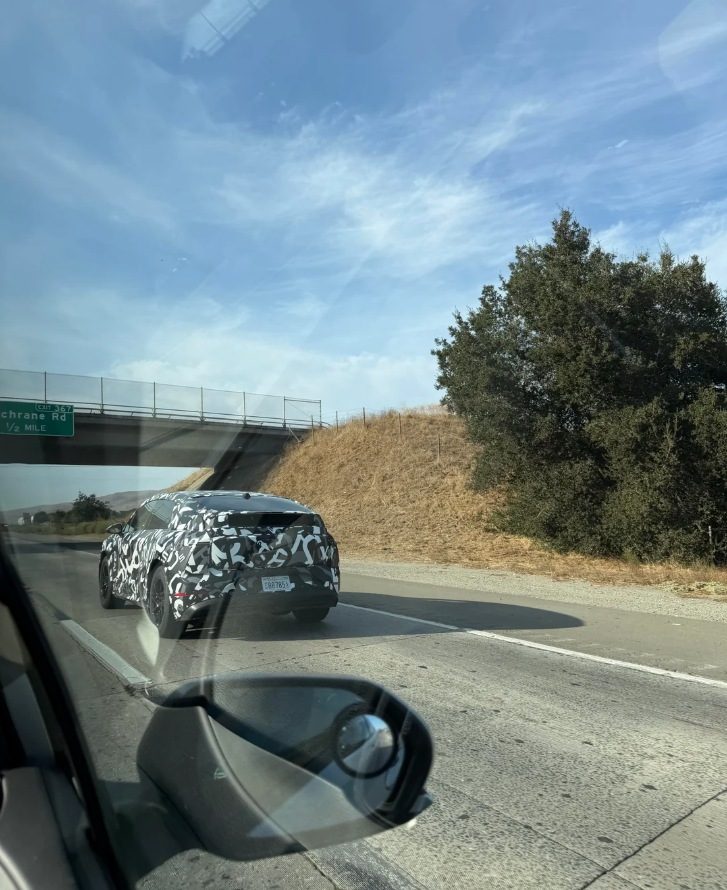
The car wears California plates and a black, white, and grey wrap made of jumbled letters. Not that the wrap hides much.
The roofline drops sharply toward the back, a spoiler sits at the base of the rear glass, and thin red light strips peek out from a covered panel that runs the width of the tailgate. That lines up with the Cosmos design Lucid registered in Europe in June.


From the side, you can see flush door handles and black five-spoke wheels with exposed lug nuts. The wrap covers the whole rear quarter behind the rear door window. There’s also a small green light lit on the driver-side B-pillar in both side shots.
In May, a Cosmos prototype was photographed next to a Tesla Model Y near Lucid’s factory in Casa Grande, Arizona.
Lucid announced the Cosmos in March with a 69 kWh battery pack, 300 miles of range, and a starting price under $50,000. The company claims efficiency of 4.5 miles per kWh and 200 miles of range added in 14 minutes. It uses Atlas, Lucid’s new drive unit, which has 30% fewer parts and costs 37% less than the current one.
Lucid Cosmos launch slips to late 2027
Production was supposed to start in late 2026. In August, new CEO Silvio Napoli pushed the Cosmos to 2027, “most likely the second half.”
“We’re not going to make the mistake of the past where products, great cars, were in fact tainted by launching before things were ready,” Napoli said.
Lucid needs this car. The company laid off 18% of its staff in June, its second deep cut in four months, and its stock crashed 40% in July on a bankruptcy report that Lucid denied. It says it has enough liquidity to last well into 2027.
And the competition isn’t waiting. Rivian started building the R2 in April, and its $45,000 base version is due in late 2027, the same window Lucid is now targeting for the Cosmos.
Electrek’s Take
A wrapped prototype on a highway isn’t big news by itself, but we are keeping a close eye on this program as it will make or break Lucid in our opinion.
We think Napoli made the right call on the delay. When we reviewed the Gravity earlier this year, the hardware was excellent and the software wasn’t ready. Lucid can’t repeat that with a car that has to sell in volume to buyers who are a lot less forgiving than early adopters.
The problem is the timing. Lucid says its liquidity lasts well into 2027, and the Cosmos comes in the second half of 2027. So the car that’s supposed to turn Lucid into a volume automaker shows up around the time its current cash is supposed to run out. That means another check from Saudi Arabia’s PIF, or maybe Uber, before the first customer delivery.
And the product is worth saving. Lucid claims the Cosmos is 10% more efficient than its closest competitor, and efficiency is how you get 300 miles out of a 69 kWh pack and a price under $50,000. Lucid’s powertrains are the most efficient in the business, and we’d love to see what they can do with a more mass-market vehicle.
Charge your electric vehicle at home using rooftop solar panels. Find a reliable and competitively-priced solar installer near you on EnergySage, for free. They have pre-vetted installers competing for your business, ensuring high-quality solutions and 20-30% savings. It’s free, with no sales calls until you choose an installer. Share your electricity bill to get a tailored proposal and compare offers. Get started here.


FTC: We use income earning auto affiliate links. More.




Comments