

Hesai is putting its lidar expertise to work no Westwell’s industry-leading autonomous yard tractors – a partnership that both companies will advance the state of the autonomous art.
There’s no question that electrification is the killer app for yard trucks and terminal tractors. The trucks operate on tight routes, the work demands instant low-end torque, and the crowded, ever-changing nature of the port environment they operate in rewards quiet operation (translation: when someone yells, “Stop!” the operator being able to hear them is a huge benefit). Toyota knows it. Volvo knows it. Heck, DHL knows it so well that they’ve been able to get a positive ROI on their fleet of Orange EVs that they’ve committed to electrify 100% of their terminal fleet.
But the proliferation of electric trucks at ports and terminals won’t matter if there aren’t enough people to drive them, and the national (if not global) shortage of young operators coming into the business is not just a favorite topic on The Heavy Equipment Podcast – it’s a multibillion dollar problem that the industry is racing to solve.
More than that, though, it’s a problem that Hesai thinks it’s closer to solving than anyone else.
For their part, Westwell seems to agree. The company’s autonomous logistics solutions – from terminal trucks to material handlers and forklifts – will soon be equipped with Hesai’s advanced lidar systems over 200 corporate clients across 20 countries.
Westwell believes this deep collaboration with Hesai enable it to offer its fleet customers higher productivity, along with significantly enhanced operating efficiency and quality while they reduce carbon emissions on a global scale.
Hesai, Westwell add lidar to autonomous trucks
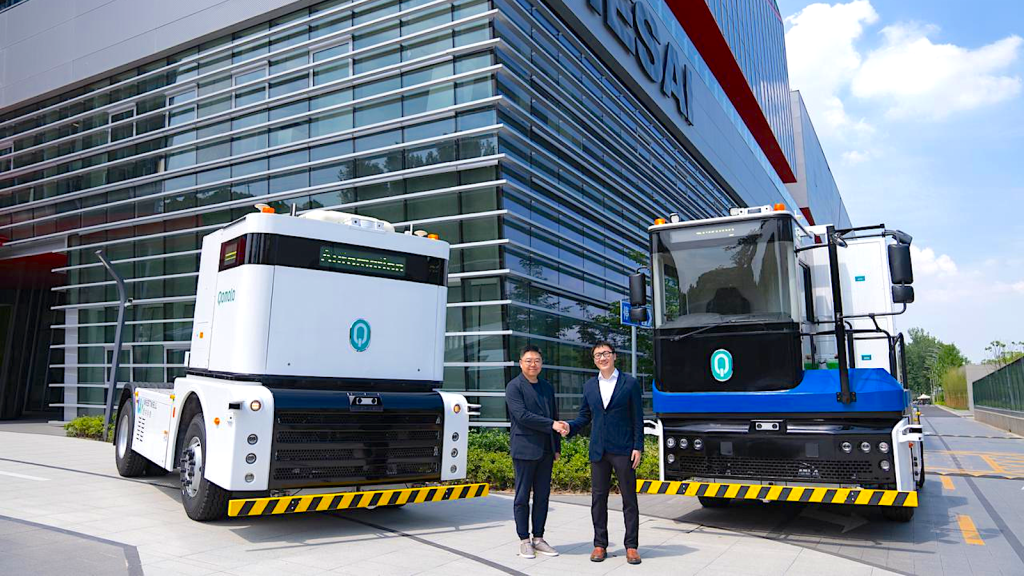
The Westwell R&D team is using a multi-sensor “fusion” approach, equipping a number of Hesai’s XT32 and AT128 lidars to each of their vehicles to ensure precise operations across various scenarios.
Top comment by Vic
My area of expertise... Automated ports already exist, like Singapore and Rotterdam, the 2 largest ports in the world, so these offerings are not novel but don't really exist in the US and there's a reason for that. Ports on the East and West Coast are unionized. They have fought port operation modernization for many decades and are certainly not going to let labor removing initiatives take hold.
The solution is to target smaller non union ports in Florida and Texas to promote these units, demonstrate game changing cost savings and entice shipping lines to bypass West and East coast ports for theirs. An arduous and very long process!
The more exciting and perhaps controversial part of the transition to EV in port operations is the impact on the neighborhoods of urban ports. Those are usually poor and crime ridden because few want to live near noise and pollution from the ships, container moving equipment and trucks coming in and out of ports.
But ships are now under obligation to connect to port electric infrastructure, shut their engines and polluting chimney exhausts. Once all land machines are converted to electric power, you remove both pollutants and noise.
Ports are on prime waterfront land, which make the area around them ripe for redevelopment, which invariably will push out poor renters, make homeowners and developers rich, bring increased taxes to the city coffers and reduce crime to the area.
That’s good, because port operations involve large trucks, massive amounts of weight, and a constant need for accuracy despite rapidly changing and potentially dangerous conditions. Simply put: cameras alone won’t cut it.
To their credit, Westwell claims its autonomous driving Q-Trucks and E-Trucks using Hesai’s XT32 mid-range lidar deliver an impressive +/- 5 millimeter range precision. The lidar provides high-quality point cloud data that autonomous driving algorithms can easily process, and its innovative optical system incorporates dirt and salt detection, as well as self-cleaning systems to ensure high-quality performance, which guarantees accurate vehicle alignment and interactions at ports.
Beyond the big trucks, Hesai believes its lidar can help empower industrial robotics by providing precise distance, speed, and imaging data, facilitating accurate positioning, obstacle avoidance, and navigation in complex environments.
SOURCE | IMAGES: HESAI.


FTC: We use income earning auto affiliate links. More.





Comments