
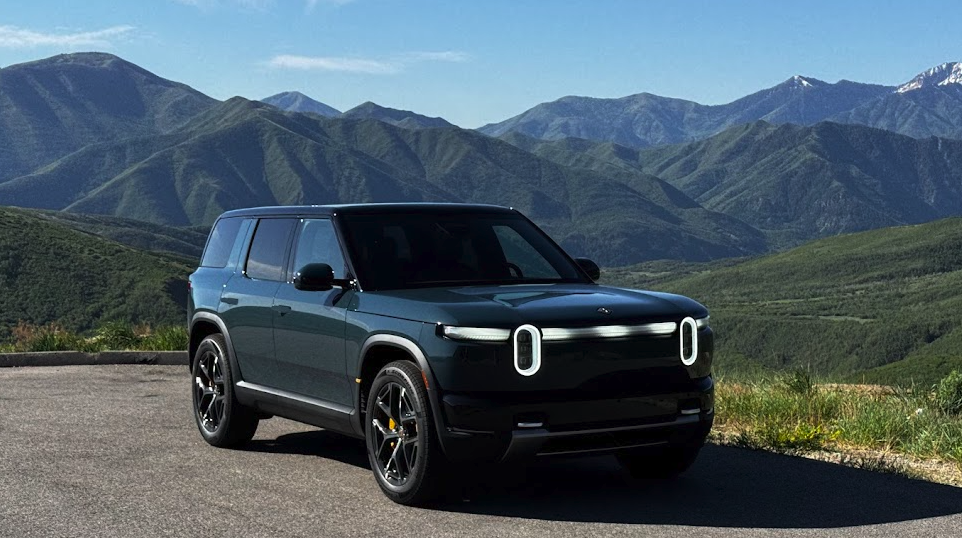
Rivian flew us out to beautiful Park City, Utah, to get a first test of the R2, its $45,000 “bet-the-company” mass market SUV that it has promised for years. Today it begins delivering these vehicles, and I can say unequivocally after driving a performance variant for 5 hours, that these early customers are going to be very happy, though with some notable caveats…
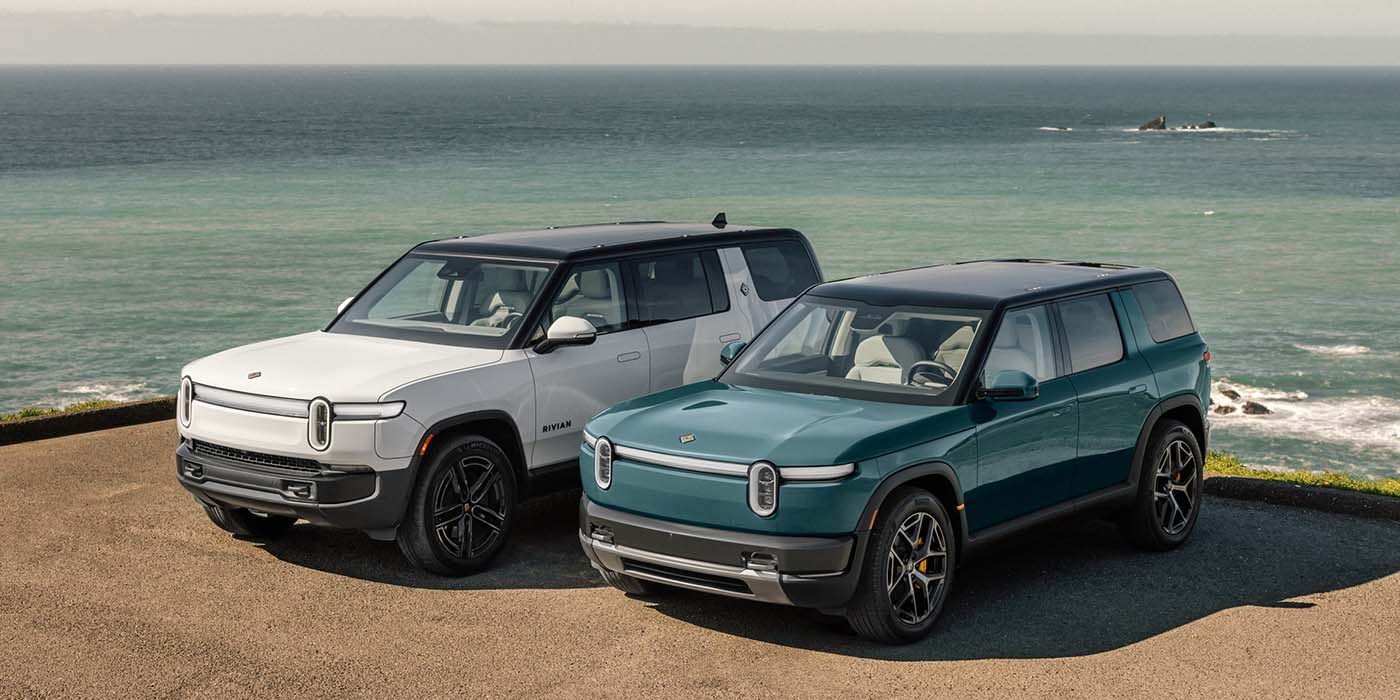
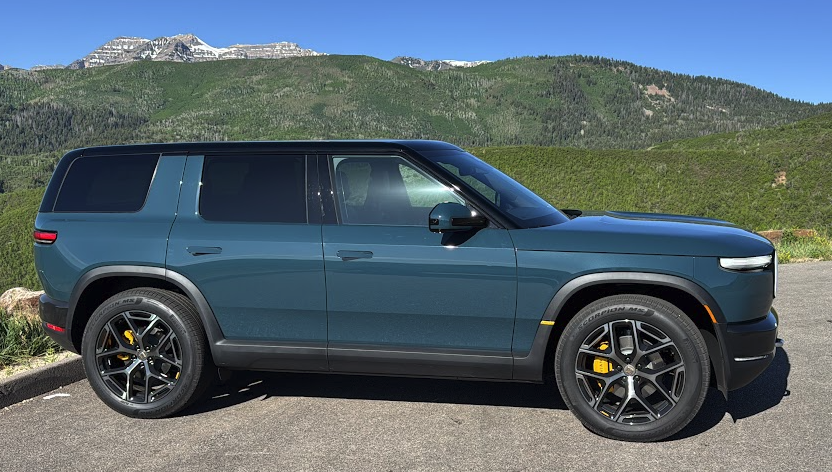
The R2 looks a lot like its bigger, heavier 3-row sibling, the R1S. Same oval lights, same boxy adventure SUV stance, same unmistakable Rivian fun ethos. Just scaled down to 5000lbs, 40cm more compact, 16 cm shorter with a 15cm smaller wheelbase. The battery scales down to 88kWh instead of the 92-141kWh on the R1S. And there are only…gasp…two rows of seats.
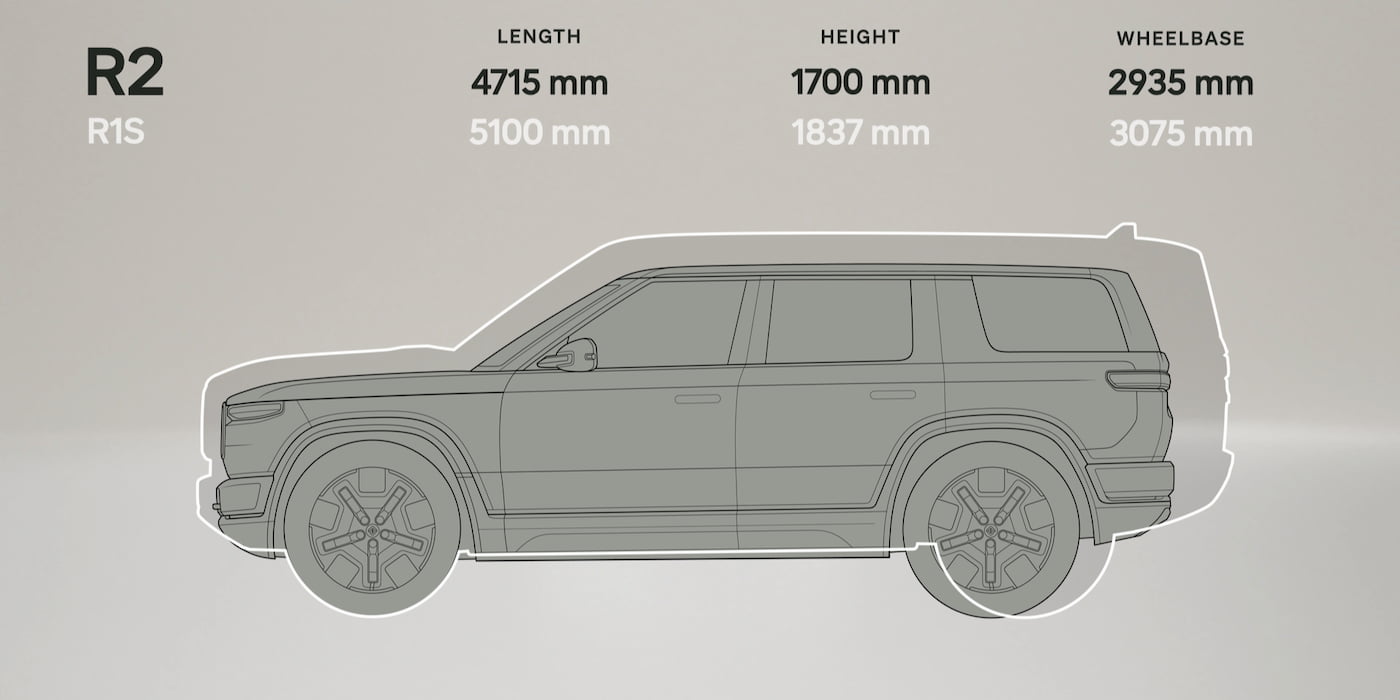
You get the picture, this thing looks like a smaller Rivian R1S. It doesn’t have the dorsal fin antenna (radios are now integrated into the rear), its front is cleaner, there are small visual optimizations everywhere. But that is just skin deep.
Better than R1
To sell a mass market number of these vehicles, the R2 has to be better than the bigger R1. The most obvious difference is the price. The R2 will eventually start at $45,000 for an RWD, smaller-battery variant that the company doesn’t think many people will want over the better-specced versions. The company often points toward Tesla’s demographics for its decisions, and Tesla’s Average Sale Price (ASP) is way over $50,000, and that’s with the discontinued Model S and X. Tesla’s base car price is close to its $35K Model 3 promise, but after destination and fees, is closer to $39,000. Just the same, Rivian think the sweet spot in terms of sales is probably an AWD Premium version that will cost over $55K after destination and other fees.
Rivian’s prices break out as such:
| R2 Trim | Powertrain | Battery Capacity (Usable) | Power | Torque | 0-60 mph Acceleration | Range | Starting MSRP | Availability |
| Performance | Dual-Motor AWD | 87.9 kWh | 656 hp | 609 lb-ft | 3.6 sec | 330 miles (EPA est.) | $57,990 (incl. Launch Package) | Spring 2026 (MY2027) |
| Premium | Dual-Motor AWD | 87.9 kWh | 450 hp | 537 lb-ft | 4.6 sec | 330 miles (EPA est.) | $53,990 | Late 2026 (MY2027) |
| Standard (Long Range) | RWD Long Range | 87.9 kWh | 350 hp | 355 lb-ft | 5.9 sec | 345 miles (Rivian est.) | $48,490 | Early 2027 (MY2028) |
| Standard | RWD | TBD | 350 hp | 355 lb-ft | 5.9 sec | 275+ miles (Rivian est.) | $44,900 (new) | Summer 2027 (new) |
The price isn’t the only R2 differentiator, however. The R2 drives much more like a sports car. Sport mode actually feels firm. All-purpose feels great. Even the off road mode feels much tighter. The lighter battery and lighter vehicle feel much more nimble. Acceleration in the Performance version feels much faster than the 3.6-second 0-60, and the acceleration from 40-75mph is even better. Mountain roads are much more fun and much less harrowing. The vehicle feels far more refined.
Sized up (and we love any spec sheet with a wading depth):
- Height 66.9 in
- Width (without side mirrors) 75.0 in
- Width (side mirrors folded) 78.1 in
- Overall Width 84.7 in
- Length 185.9 in
- Wheelbase 115.6 in
- Ground clearance 9.6 in
- Wading depth 19.7 in
- Approach angle 25°
- Departure angle 26°
- Breakover 20.6°
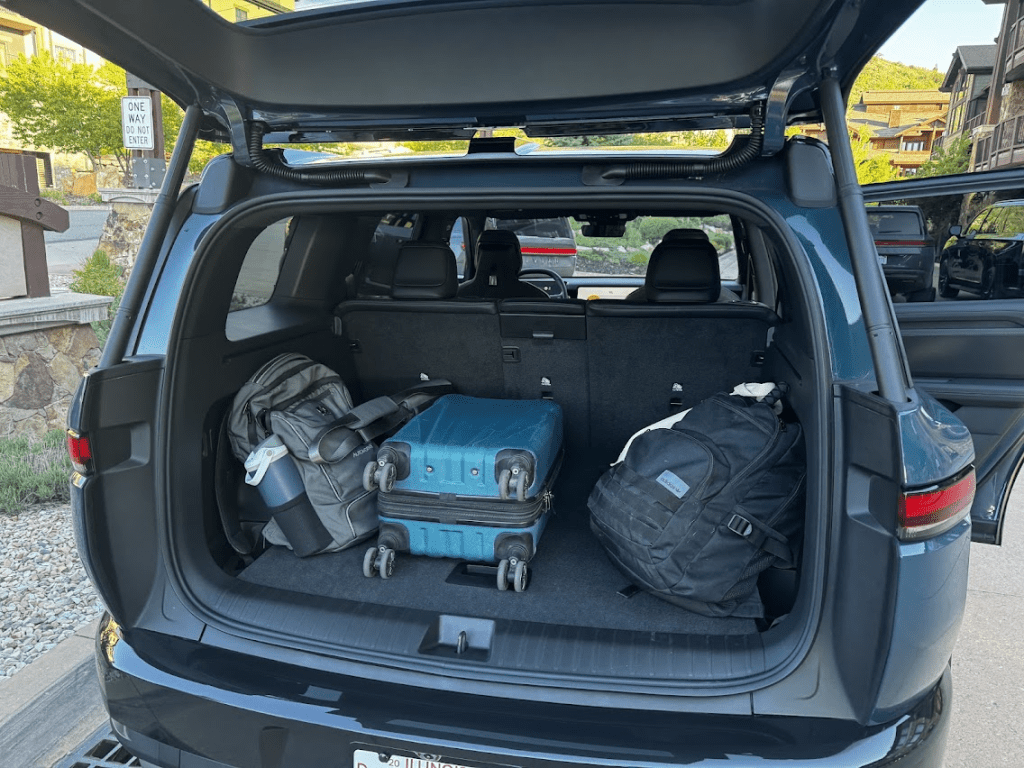
- Total enclosed storage 90.1 cu-ft
- Rear cargo area with seats folded 79.4 cu-ft
- Rear cargo area 28.7 cu-ft
- First row headroom 40.9 in
- Second row headroom 40.4 in
- First row legroom 41.4 in
- Second row legroom 40.4 in
- Couple distance, first-second row offset 37.2 in
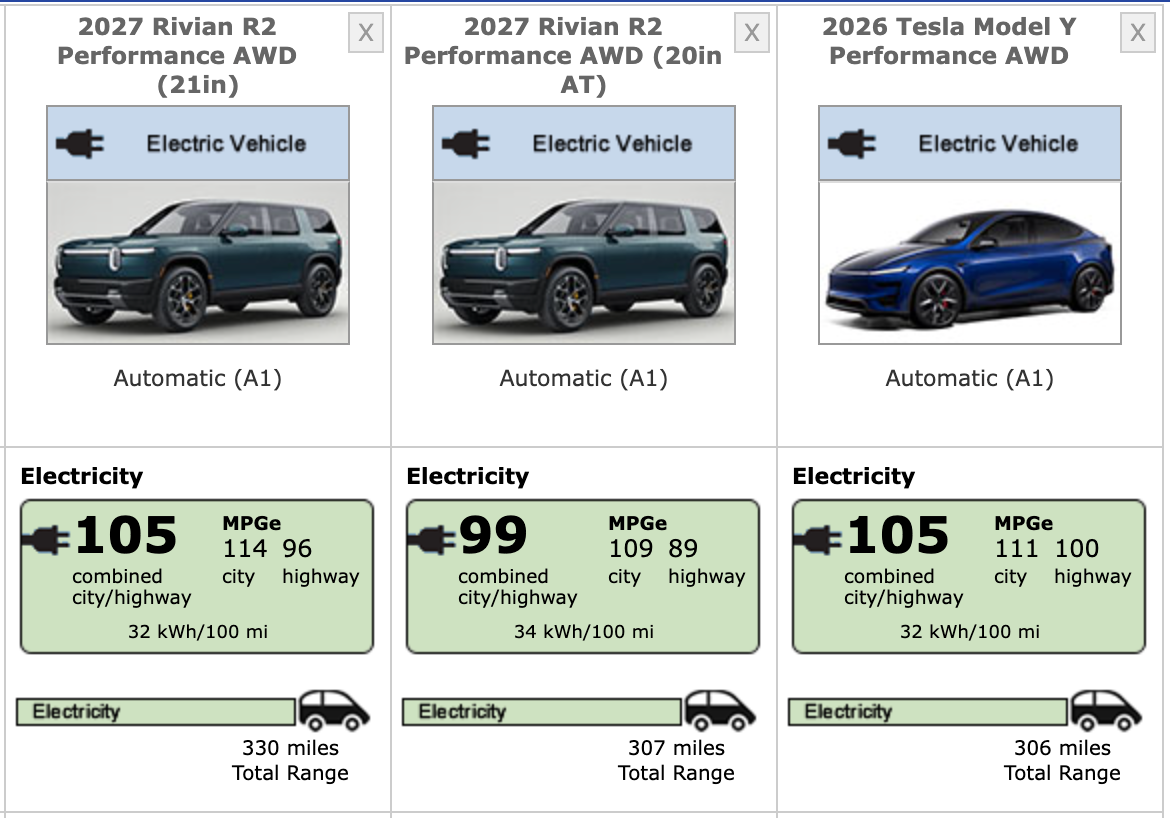
Probably the most striking claim, and in being in the mountains we weren’t able to accurately test this, about the R2 is its miserly electricity consumption. It, with its bigger, more off-road-capable tires and more boxy, higher-drag aerodynamics than the Tesla Model Y, uses about the same amount of energy to go the same distance. And we know that Tesla is already extremely ‘optimistic’ in its range estimates.
Charging will be faster, not necessarily because the car charges more quickly, but because the battery is smaller and it takes less time to fill. It will pull down up to 240kW at peak charging, and we even saw north of 170kW at over 50% state of charge on a NACS RAN charger a few miles from the hotel. Rivian says it will take less than 30 minutes to go from 10% to 80% charge, adding around 230 miles. While that is respectable, especially with a 400V system, it isn’t in the same league as 800V systems like Porsche or Hyundai, which can do the same 10-80% in under 20 minutes, let alone the Chinese, which are flirting with 5-minute charging times.
Bottom line: Road trips in the R2 will take less time than the R1. But stops will be about 10 minutes longer than 800V competitors.
Rivian lays out the next generation of technology:
● Designed for the Road Ahead: Rivian Autonomy+7 ($49.99/month or $2,500/one-time) hardware is built into all R2 trims and service is optional across the lineup (lifetime access to Autonomy+ included5 with Launch Package), bringing L2+ hands-free assisted driving to 3.5 million miles of roads across the U.S. and Canada with Universal Hands-Free6. Every Rivian comes standard with a system that continuously evolves with each software update, getting smarter right from your driveway, and foundational active safety and driver assistance features. All new R2 deliveries include a 60-day trial of Autonomy+.
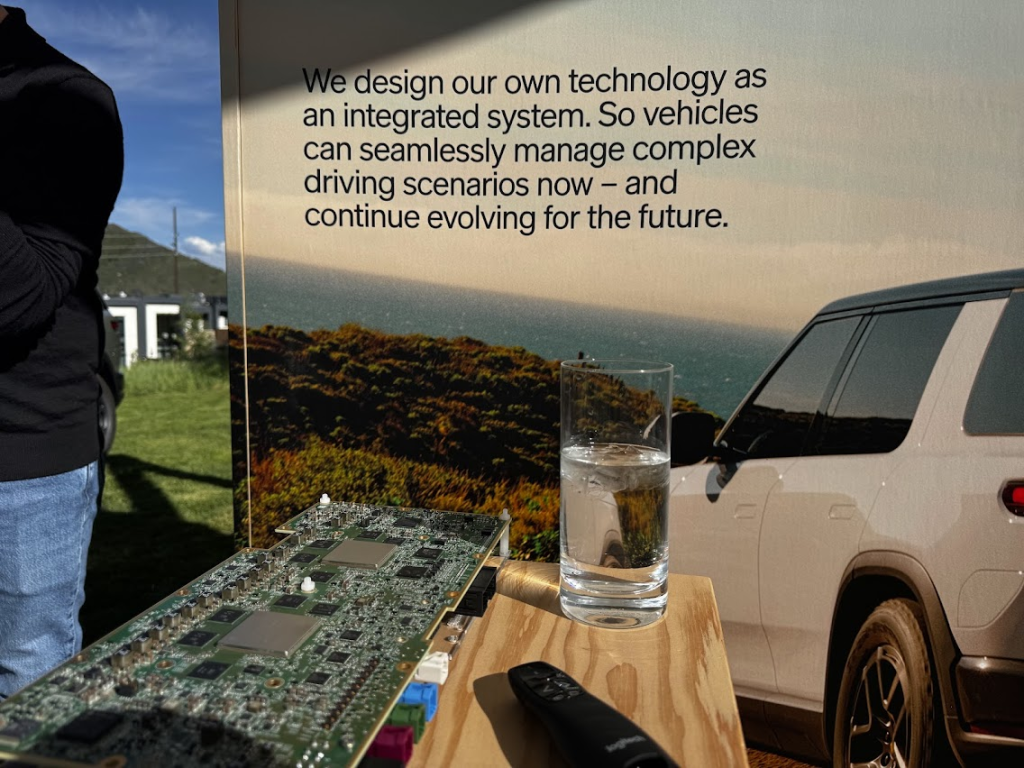
● AI Powerhouse: R2 is outfitted with 200 sparse TOPS of edge AI compute dedicated to the in-cabin experience. This includes enabling the forthcoming Rivian Assistant—our in-vehicle voice assistant that understands you, your vehicle and your context—to smoothly run complex tasks locally on the edge, even if the vehicle is offline.
● Haptic Halo Wheels: At the center of the R2 driving experience is a redesigned steering wheel featuring haptic ‘halo’ dials. These dynamic and context-aware controls—capable of scrolling, pushing, pulling and tilting—provide distinct physical responses for multiple functions, bridging the gap between digital software and tactile hardware to keep the driver’s focus on the horizon. Both the physical wheels and underlying haptic technology were designed in-house.
● Dual Digital Displays: R2 offers flexibility and control with two displays—a driver display in front of the steering wheel for more utility on the road, and the center display for a deeper dive into features.
● Software Updates: Rivian builds vertically-integrated hardware and software, enabling your vehicle to gain meaningful updates via software right from your driveway. R2 evolves this vertically integrated approach with a new, streamlined electrical architecture that delivers more capability with less complexity, providing ample headroom for the future.
Overall, however, the R2 is a major step up from the R1 in a lot of ways. In fact, I said the same thing to Rivian CEO RJ Scaringe that I said to Tesla after driving the Model 3. The R2 is going to cannibalize the sales of the more expensive R1 models. Tesla’s Model S and X turned into niche vehicles after the launch of the Model 3 and Y, which were recently discontinued to make way for robots. Scaringe points to upgrades coming to the Gen 3 R1 lineup that will close most of the feature gaps, but I also wonder how many people will pay up to double the price for a 3rd row, a few extra cubic feet, and perks. I think the R2 will become Rivian’s best-selling vehicle the minute they can make enough of them.
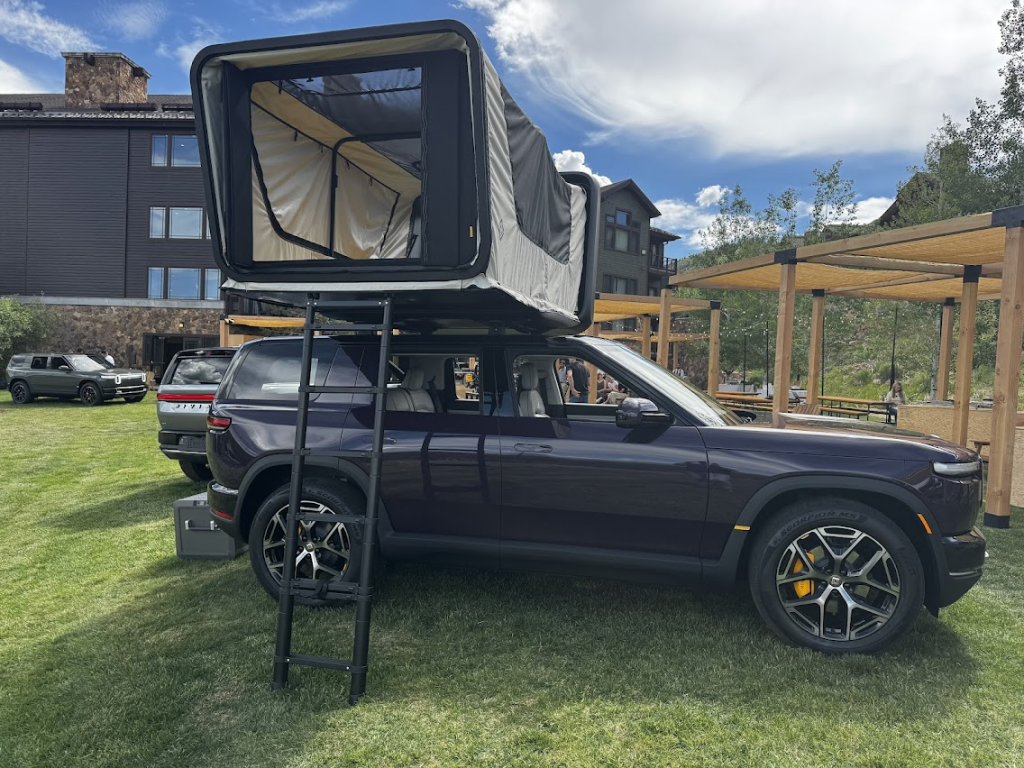
There are still things the R1S does better. Obviously, being bigger, it holds more stuff and still has a faster 0-60 time. It also does off-roading better, especially the quad motor variant with Kick Turn capability. But the R2 is no slouch, and we did get a 20 PSI, 20-inch wheel version to play with on the trails. As RJ put it, the Model Y (and most crossovers, electric and otherwise) wouldn’t have made it back from this trip.
Updates galore:
Rivian’s V2 software is a significant upgrade. In my limited testing, the UI was fast and efficient, though there was at least one incident where the GPS was off on a parallel road. Lots of little tweaks show that Wassym Bensaid and his team are really engaged in user feedback and making the Rivian driver and passenger’s experience better. Here’s an overview of what’s new:
Open questions: Autonomy and V2X
Today’s Rivians can do traffic-aware cruise control, which is helpful on highways. But it is far from Tesla’s FSD feature set. Rivian promises that at some point in the future, it will be able to do point-to-point navigation with the hardware in the R2 sold this year. However, for those who want Level 3 autonomy, where you can read a book or play with your phone while driving, you’ll have to wait for a Lidar version of these vehicles set to be released at the end of the year. That’s a big early adopter pill to swallow. Interestingly, Rivian will build a special Autonomous Robotaxi version of the R2 for Uber with additional hardware on the vehicle.
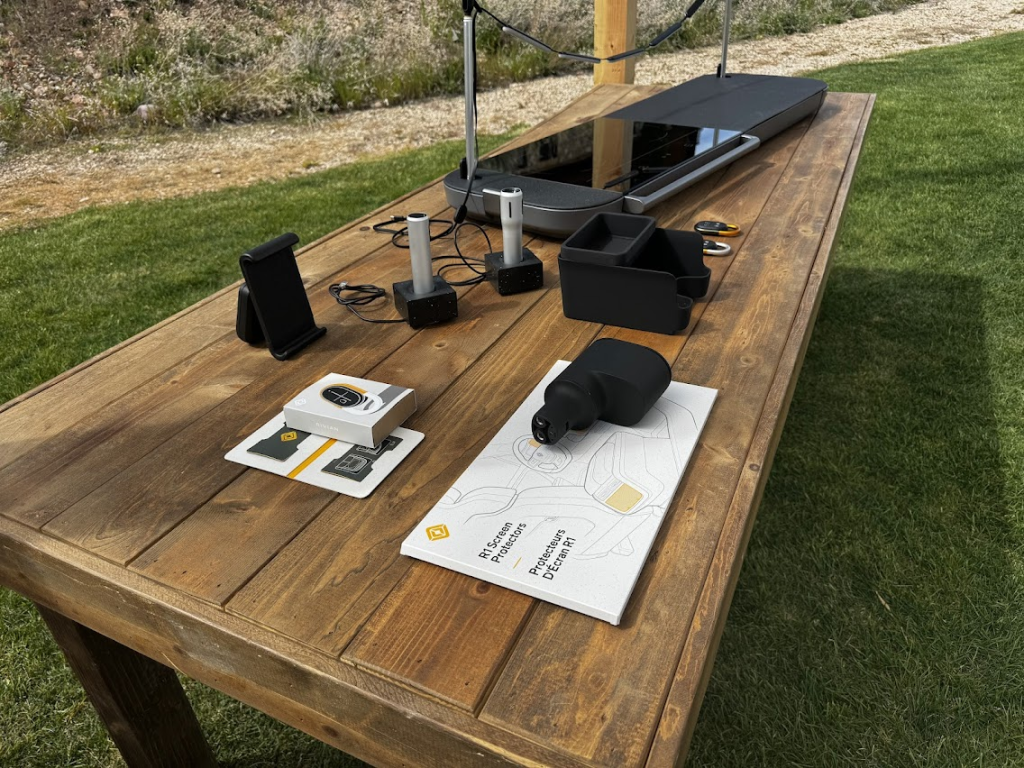
Also, Rivian has really been dragging its feet on Vehicle to Grid/Home/X and they didn’t have a product to show us this week. They did promise that the vehicle could put out 11KW of AC power (think 48A at 240V) though the charge port and still offers an internal 110V AC outlet. But they’ve been promising V2X since the R1S launched and we’re still waiting.
And talking to Rivian leadership about this is mind-numbing. Do they not know that LEGACY Automakers like Ford’s F-150 Lightning had 240V out 5 years ago? Do they not understand how valuable this is to a homeowner? Heck, I can power my home with my $28,000 Chevy Bolt today!? Do they think no one wants this? I’m officially done giving Rivian a free pass on this. Show us the goods! Catch up to Ford and Chevy technology!
Electrek’s take:
The R2 is a ‘bet the company’ vehicle for Rivian. If it fails, Rivian is done.
Top comment by petero
I do wish to see Rivian succeed. Not to 'crush' Tesla but to remind Ford, GM, Stellantis that EVs are relevant, building cars in the US is relevant, and politics and political agendas are not a successful path for long term success.
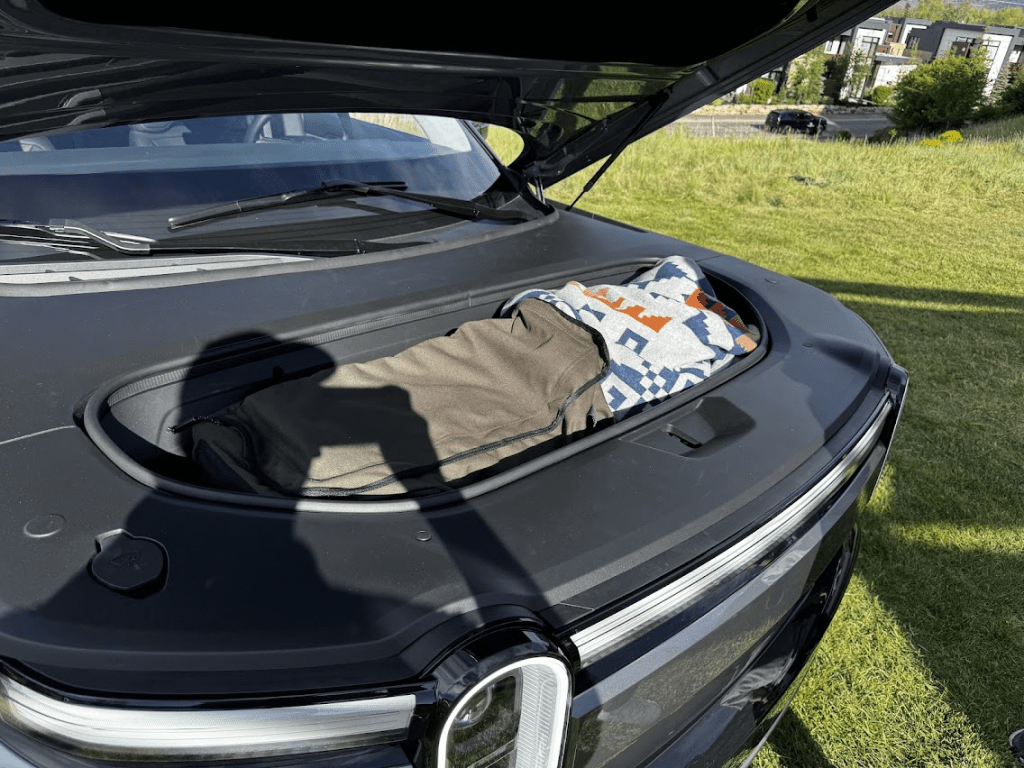
But the R2 is also a relatively safe bet in this form. It is the best vehicle Rivian has ever produced by a long shot. It is way more efficient, handles way better, and comes at a much more palatable price tag. It retains Rivian’s adventure ethos and, with features like drop-down rear glass, huge steering scroll wheels, and double gloveboxes, takes it a step further.
However, just because Rivian can make and show off a few R2s to journalists doesn’t mean they’ve reached a safe space. They still need to ramp this vehicle up through what Elon Musk called “production hell” – making the transition from a niche vehicle maker to a mass market vehicle maker, and just like it almost killed Tesla, it could also cause big problems for Rivian.
Also, there is the autonomy question: Rivian is far behind Tesla and others. Will they be able to catch up in a reasonable amount of time? Will the lack of Lidar on 2026 vehicles keep early adopters away? I’m not so sure I want to give up my 2020 Model Y with FSD for promises to be made at some uncertain point in the future. I also don’t want to buy a car with already outdated hardware. Give me the Uber Edition!
All of that said, if Rivian can make hundreds of thousands of the vehicles we drove last week and sell them at a profit, the company will thrive.


FTC: We use income earning auto affiliate links. More.


Comments