
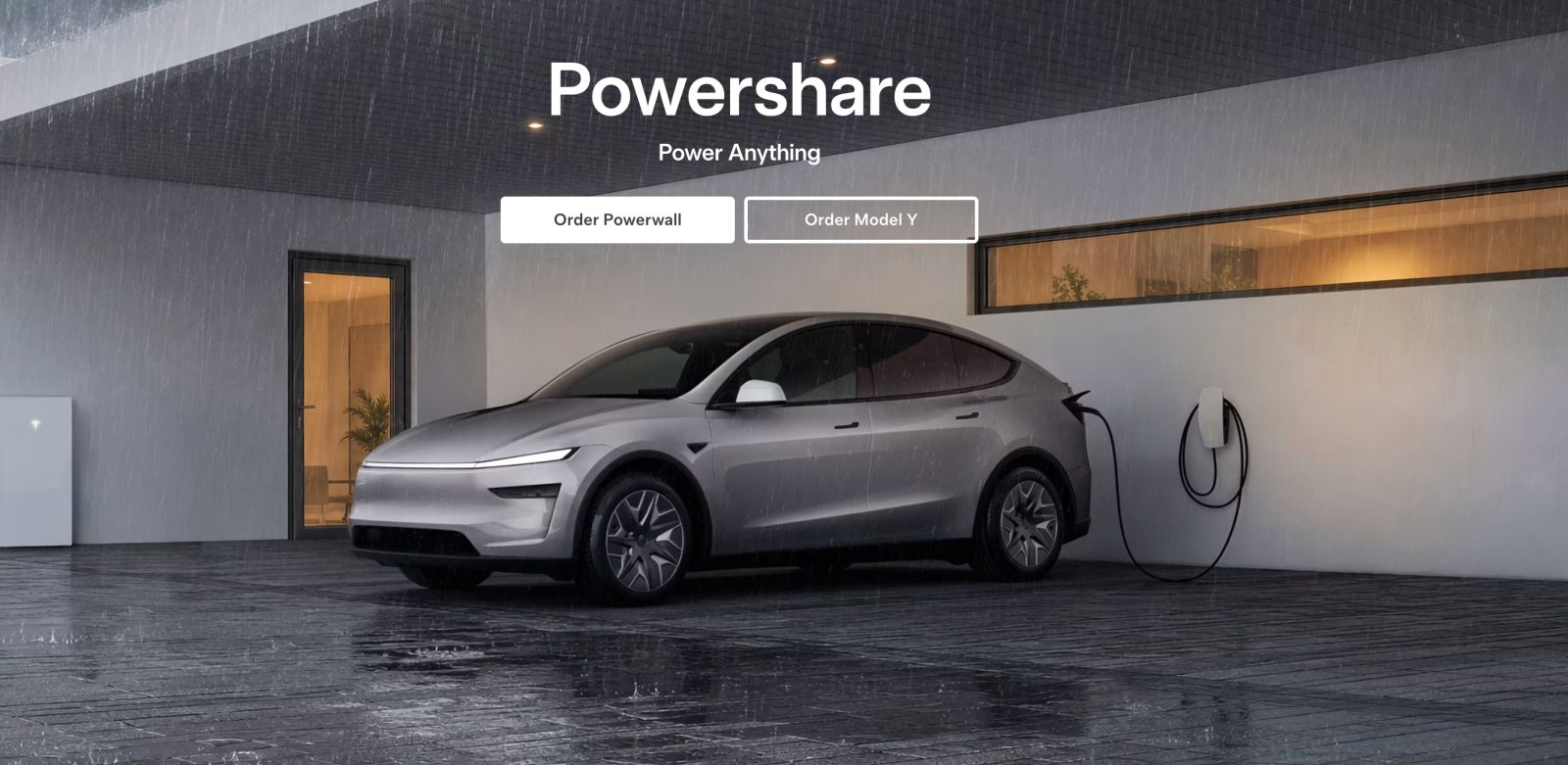
Tesla has turned on Powershare Home Backup for the Model 3 and Model Y, which means its two volume cars can now send power back into a house during an outage. Until today, the Cybertruck was the only Tesla that could do it.
There are limits. You need a Powerwall 3, and Tesla only guarantees the feature on cars ordered since October 1. For years, Ford and GM have been selling EVs that can back up a home.
What Tesla announced
Tesla Energy announced the launch on X today:
Tesla’s updated Powershare page says the feature is “currently available for all Cybertruck vehicles, and all new Model 3 and Model Y vehicles ordered on October 1, 2026 or later.”
Here’s how it works. You plug the car into a Wall Connector or Universal Wall Connector at a home that has a Powerwall 3. When the grid goes down, the car’s battery pack extends your backup.
Tesla says a Model 3 or Model Y adds “over two days” of backup for a home that uses 30 kWh a day, starting from a 90% charge. Standard trims get “up to two days.” A Cybertruck adds more than three. Tesla lists a maximum continuous output of 11.52 kW for the Powerwall setup.
If you already have a Powerwall 3 and a Wall Connector, Tesla says you don’t need any extra hardware. But you do have to contact Tesla support to get it turned on.
It’s a big change from two months ago. In August, Tesla added a 2.4 kW outlet adapter to the Model Y Premium, and its website still said Powershare was “not available” for the Model 3 and Model Y. Last month, Cybertruck’s Powershare started working with Powerwall 3 after repeated delays.
The fine print
The word “new” matters in that announcement.
Tesla’s footnote says the guarantee covers cars ordered in the US and Puerto Rico after October 1. For anything built before that, Tesla says “some, but not all” Model 3 and Model Y vehicles have the capability.
It comes down to hardware. Tesla says bidirectional power on the Model 3 and Model Y runs through an inverter it calls PCS2 Lite, and it hasn’t said when that part went into production on each trim. Owners can check on the touchscreen under Software, then Additional Vehicle Information. If “Powershare Support” is enabled, the car has it.
And there are more limits:
- Powerwall 3 is required. Tesla says Powerwall 2 and Powerwall+ support is “coming soon.”
- No Powerwall, no home backup. Cybertruck owners can use a Powershare Gateway instead, but Tesla doesn’t offer that option for Model 3 and Model Y.
- You can’t sell power back to the grid. Tesla says Grid Support is “not available for Model 3 or Model Y.”
- Model S and Model X aren’t included.
- It’s US and Puerto Rico only. Tesla’s Canadian site still lists Powershare as a Cybertruck-only feature.
Tesla is late to this
Ford launched home backup on the F-150 Lightning in 2022 with 9.6 kW of output. That’s four years ago.
GM committed in 2023 to bring vehicle-to-home to every Ultium-based EV by model year 2026, and it delivered. GM Energy’s compatibility list now includes the Equinox EV, Blazer EV, Silverado EV, the 2027 Bolt, GMC’s Sierra EV and Hummer EV, and five Cadillacs. Kia offers it on the EV9 through a Wallbox bidirectional charger, and we keep a running list of EVs that can power a home.
Tesla set its own deadline and missed it. At Investor Day in March 2023, Drew Baglino, then Tesla’s SVP of powertrain and energy engineering, said bidirectional charging could come “within the next two years.” That pointed to 2025.
At the same event, Elon Musk said: “I don’t think very many people are going to want to use bidirectional charging, unless you have a Powerwall.” Three and a half years later, that’s exactly how Tesla shipped it.
And a third party got there first. Last year, we reported that Sigenergy’s home battery system could do vehicle-to-home with Tesla vehicles over DC, without Tesla’s involvement.
Electrek’s Take
Tesla is playing catch-up here. Ford did this in 2022, and GM has it across its EV lineup. Tesla sells the cars, the chargers, and the home batteries, and it’s getting to it in late 2026. It is also attaching the feature to Powerwall 3, which clearly explains why Tesla didn’t want to do vehicle-to-home before: it didn’t want to cannibalize the Powerwall.
But better late than never. And there’s a lot to like.
Top comment by Beario
Too many requirements right now. I have wall connectors, but no interest in buying a new car or a powerwall to get this to work. I'm just going to go ahead and get an enphase battery to add to the existing setup.
The Model 3 and Model Y are Tesla’s volume cars, so this puts vehicle-to-home in a lot of driveways fast. If you already have a Powerwall 3 and a Wall Connector, there’s nothing else to buy. Ford and GM both make you install a separate inverter and backup hardware.
The only bummer is that Tesla is not turning this on for millions of vehicles, mainly just new ones. We would be talking about gigawatts of load that could be saved.
Nonetheless. A step in the right direction.
Charge your electric vehicle at home using rooftop solar panels. Find a reliable and competitively priced solar installer near you on EnergySage, for free. They have pre-vetted installers competing for your business, ensuring high-quality solutions and 20-30% savings. It’s free, with no sales calls until you choose an installer. Compare personalized solar quotes online and receive guidance from unbiased Energy Advisers. Get started here.


FTC: We use income earning auto affiliate links. More.




Comments