
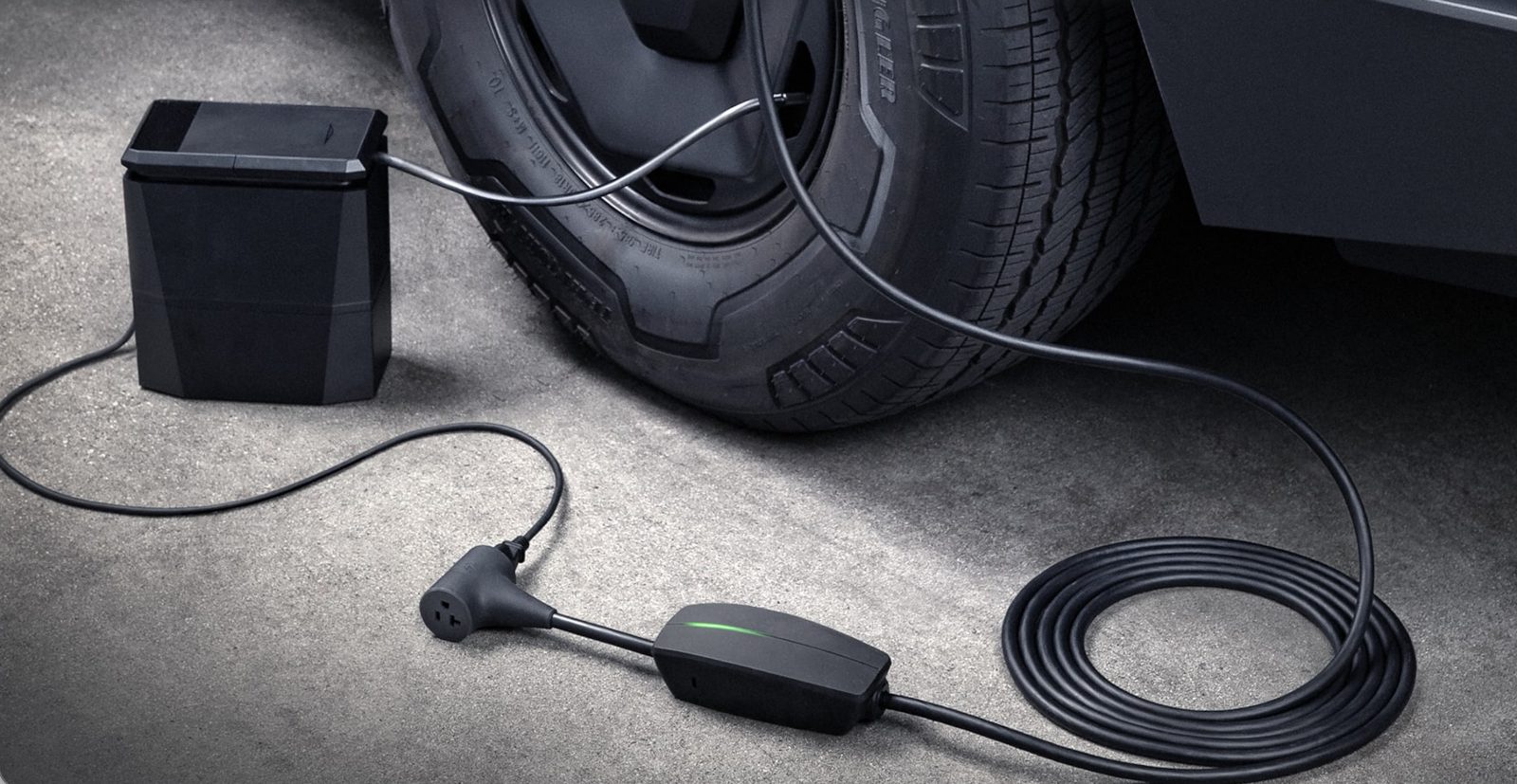
Tesla has switched on vehicle-to-load for the Model Y Premium in the US and Puerto Rico, letting owners pull 2.4 kW out of the car’s battery at 120 volts and 20 amps.
You need an $80 accessory to do it, and not every Model Y Premium can. Tesla says the adapter can be added during configuration or bought from the Tesla Shop.
What you actually need to make it work
The adapter is not an outlet built into the car. It’s a fitting that goes on the end of the Gen 3 Mobile Connector, the charging cable that comes with new Model Ys and sells for $300 on its own. Plug the connector’s handle into the charge port, clip the adapter onto the other end, and you get household outlets rated to 20 amps.
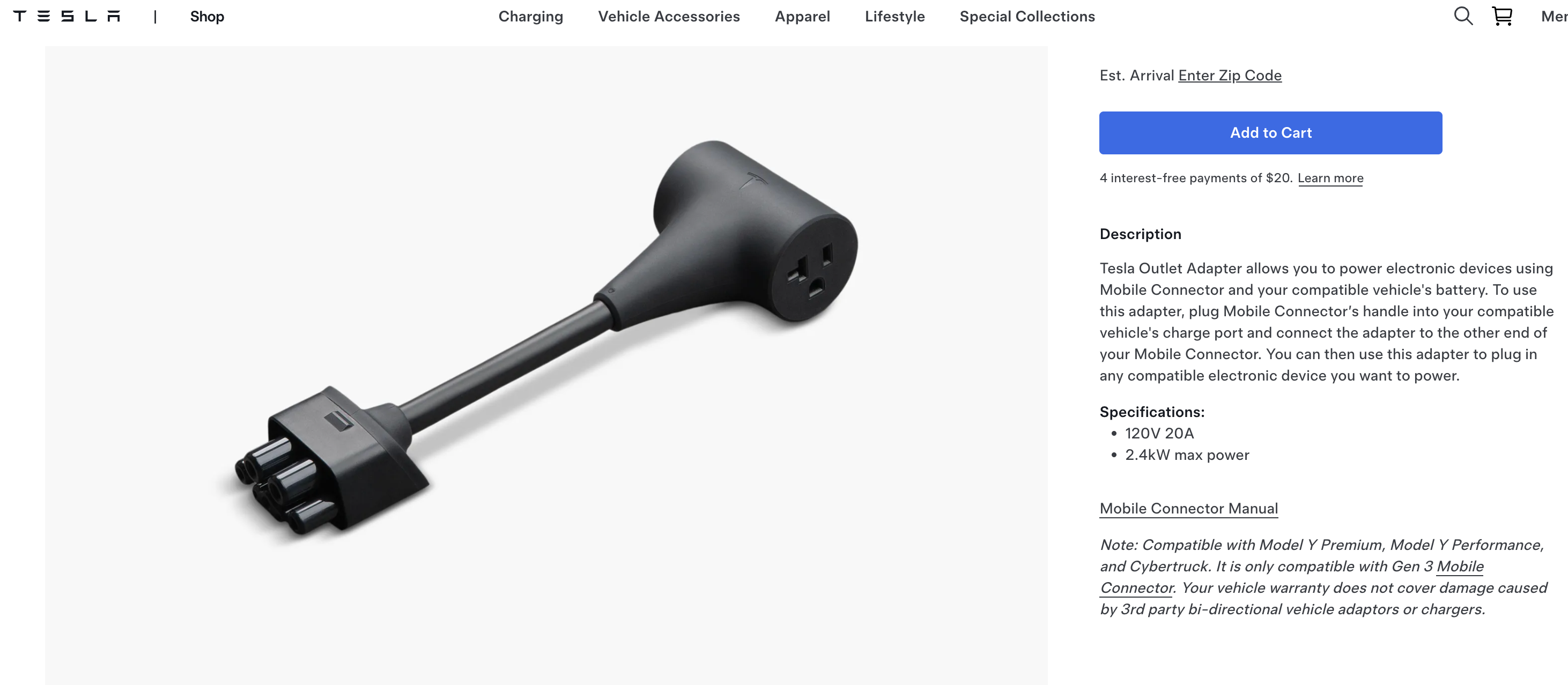
It’s the same part Tesla launched for Cybertruck owners in April 2025, at the same $80 and the same power ceiling. Tesla’s shop listing now names three compatible vehicles: Model Y Premium, Model Y Performance, and Cybertruck. The cheaper Model Y Standard and the entire Model 3 lineup are shut out.
None of this should be a surprise. We reported last October that the new Model Y Performance shipped with bidirectional charging hardware and argued the capability was being held back by trim strategy rather than engineering. Ten months later, it’s on the Premium.
Tesla is still at the bottom of the V2L pack
2.4 kW is not much. Hyundai has shipped V2L on the Ioniq 5 since 2021 at 3.6 kW, with an interior outlet and a charge-port adapter in the box, and Kia does the same on the EV6 and EV9. Ford’s F-150 Lightning starts at 2.4 kW and goes to 9.6 kW on extended-range trucks, through real outlets in the bed and the frunk. Chevy’s Silverado EV offers up to 10.2 kW.
Tesla is offering the entry-level number, through a charging cable, as a paid accessory. It’ll run a space heater, a fridge, a jobsite saw, or a camp setup.
They are fundamentally different than what most people think about when they hear a vehicle has bidirectional charging
Still no home backup on the Model Y
Tesla hasn’t closed the gap yet. Its own Powershare page still states plainly that “Powershare is not available for Model S, Model 3, Model X and Model Y.” Home backup remains a Cybertruck feature, where the truck pushes 11.5 kW into a house for three days or more, and where Tesla has already gotten the truck approved as a vehicle-to-grid asset with PG&E in California.
So the Model Y now gets the campsite version of bidirectional power. Not the version that matters during an outage.
Electrek’s Take
Top comment by Michael McCune
Be aware that this does not work for all Model Y Juniper editions even if it's not the standard Model Y. If you bought a Model Y Juniper before they had Model Y standard, it probably won't work.
The Tesla Vehicle-to-Load (V2L) outlet adapter does not work on early Juniper Model Y editions purchased before the updated hardware and trim specifications (rebranded to Premium) were implemented. The required internal power conversion hardware was only added to recently built Model Y vehicles, leaving out earlier builds.
We’ll take the win. It’s a move in the right direction even if I don’t understand why Tesla is still lagging behind the industry when it comes to bidirectional charging. An $80 adapter that turns your car into a 2.4 kW generator is a better deal than any portable power station on the market, and putting it on Tesla’s volume vehicle instead of just the halo trims is the right call.
It matches a feature Hyundai gave Ioniq 5 buyers five years ago, at two-thirds the power, and charges extra for the plug. For a company that sells home batteries, wall connectors, and grid services, being last to basic V2L is a strange place to end up.
And I don’t buy the cannibalizing Powerwall business excuse.
If you’re driving an EV, the cheapest electricity you’ll ever put in it comes off your own roof. With electricity rates up almost 10% last year and expected to keep climbing, going solar is one of the best ways to protect yourself against rising costs. And with lease and PPA options, you can do it with zero upfront cost and start saving immediately. If you want to find the best deal, check out EnergySage. It’s a free service with hundreds of pre-vetted installers competing for your business, so you save 20 to 30% compared to going it alone. No sales calls until you pick an installer. Get your free quotes here.


FTC: We use income earning auto affiliate links. More.




Comments