
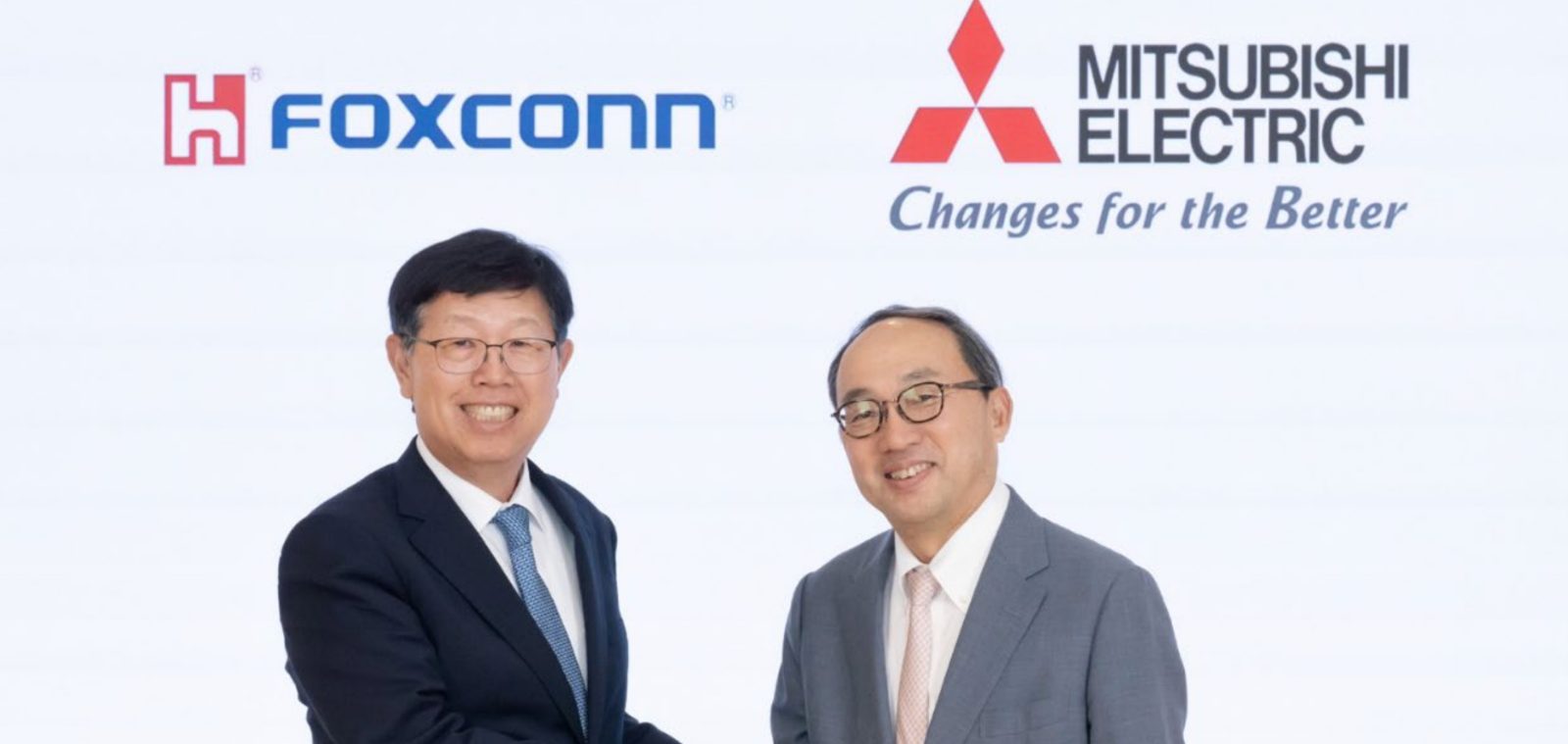
Foxconn is buying half of Mitsubishi Electric’s auto parts business for ¥115 billion ($727 million), its biggest bet yet on turning years of EV promises into a real car business.
But the target, Mitsubishi Electric Mobility, isn’t an EV company. It’s a traditional Tier 1 supplier that makes everything from alternators and ignition coils to radar sensors, with a smaller electric powertrain business attached.
Hon Hai Precision Industry, Foxconn’s formal name, announced on Friday that its investment arm, Lin Yin International Investment, signed a final agreement to take a 50% stake in the Mitsubishi Electric subsidiary. The two companies will run it as an equal joint venture.
The deal values the business at ¥320 billion ($2 billion) in enterprise value and ¥230 billion in equity value. Closing is expected on October 1, 2027, after antitrust reviews.
The pitch: Japanese EV platforms
The partners want to combine Mitsubishi Electric’s electric powertrain, software and vehicle control technology with Foxconn’s “speed and scale” to develop EV platforms in Japan. They plan to sell them to Japanese automakers first, then globally under a “Made in/by Japan” banner.
They’re targeting more than ¥1 trillion ($6.3 billion) in revenue for the fiscal year starting April 2030.
Jun Seki, Foxconn’s EV chief strategy officer and a former Nissan executive, told reporters that Mitsubishi’s electronic control technology was “the most attractive thing” about the deal. He said Foxconn wants to make Mitsubishi Electric “our anchor in Japan and team up with other parts makers and automakers.”
Foxconn is buying a parts supplier, not an EV platform
Mitsubishi Electric spun its automotive equipment group into Mitsubishi Electric Mobility in April 2024. Before closing, it will fold the rest of its car business, including the automotive operations of its overseas subsidiaries, into the unit. That combined business is what Foxconn is buying into.
Here’s what’s in Mitsubishi Electric’s automotive catalog:
- Charging and starting: alternators, starters and motor generators
- Engine and transmission: gasoline engine control units, ignition coils, fuel pump modules, turbo and variable valve timing actuators, EGR valves, transmission control units and a long list of sensors
- Steering: electric power steering motors and controllers
- Driver assistance: millimeter-wave radar, forward cameras, ADAS control units and driver monitoring systems
- Body electronics: smart entry, immobilizers and airbag control units
- Electrification: traction motors, inverters, battery management units, EV control units and on-board chargers
Mitsubishi Electric doesn’t break out revenue by product line. But its May 2025 strategy presentation points to “large market share” in rotary motors (alternators and starters) and car mechatronics, and says it runs its EV and combustion engine businesses “in a balanced way.” It’s already exiting car multimedia and fuel injectors, and it handed its lighting business to Stanley Electric. In July, the unit said it was reviewing its combustion engine business as EV demand slowed.
And the business is shrinking. It brought in ¥875.6 billion ($5.5 billion) in revenue and ¥54.4 billion in operating profit, a 6.2% margin, in the fiscal year that ended in March. That’s down ¥43.5 billion from the year before, which Mitsubishi Electric blamed on weaker sales by Japanese automakers in China and a smaller car multimedia business in North America. It expects ¥820 billion this year.
So the ¥1 trillion goal works out to roughly 5% growth a year. For a deal sold as an EV play, that’s modest.
No chips, and a discount price
Foxconn isn’t getting Mitsubishi Electric’s power semiconductors. The SiC and IGBT power modules that go inside EV inverters belong to a separate power device business, which Mitsubishi Electric put into merger talks with Rohm and Toshiba in March. The Foxconn deal covers the automotive equipment business only.
It isn’t getting a proven EV components partnership either. Mitsubishi Electric Mobility and Aisin agreed in May 2024 to form a joint venture for traction motors, inverters and control software. Five months later, they scrapped the JV and downgraded it to a business alliance.
Then there’s the price. The ¥320 billion enterprise value is about 0.37 times sales and roughly six times operating profit. The ¥230 billion equity value is also well below the roughly ¥352 billion in net assets on the business’s books (¥727.5 billion in assets minus ¥375.4 billion in liabilities), which is why Mitsubishi Electric expects to book a ¥100 billion impairment this fiscal year.
That’s not how anyone prices a growth business. Mitsubishi Electric is selling down a mature, low-margin division, much like Panasonic did when it sold a majority of its automotive systems unit to Apollo in 2024.
Foxconn’s EV track record
Foxconn has been talking big about EVs for six years. In October 2020, chairman Young Liu said the company wanted to supply components or services for 10% of the world’s EVs, around 3 million vehicles, sometime between 2025 and 2027.
Since then, it has unveiled a series of Foxtron prototypes, bought the former GM plant in Lordstown, Ohio, and lined up the Fisker Pear, and added a pickup and a crossover to the lineup. Fisker went bankrupt in 2024 and the Pear never made it to production. Foxconn sold the Lordstown factory last year for $375 million.
It also approached Nissan about a stake in early 2025, as the Honda-Nissan merger talks collapsed. Nothing came of it.
So far, the only legacy automaker to put its badge on a Foxtron-developed EV is Mitsubishi Motors, a separate company from Mitsubishi Electric. Its ASX VR-e, built by Yulon in Taiwan, is going on sale in Australia and New Zealand. Foxconn also has a bus joint venture with Mitsubishi Fuso and is a partner in Saudi Arabia’s Ceer EV brand.
Foxconn and Mitsubishi want to build the next wave of EV platforms, but you don’t have to wait for them to cut your driving costs: powering an EV with home solar can bring your fuel costs close to zero. With electricity rates up almost 10% last year and expected to keep climbing, going solar is one of the best ways to protect yourself against rising costs. And with lease and PPA options, you can do it with zero upfront cost and start saving immediately. If you want to find the best deal, check out EnergySage. It’s a free service with hundreds of pre-vetted installers competing for your business, so you save 20 to 30% compared to going it alone. No sales calls until you pick an installer. Get your free quotes here.


FTC: We use income earning auto affiliate links. More.



Comments