
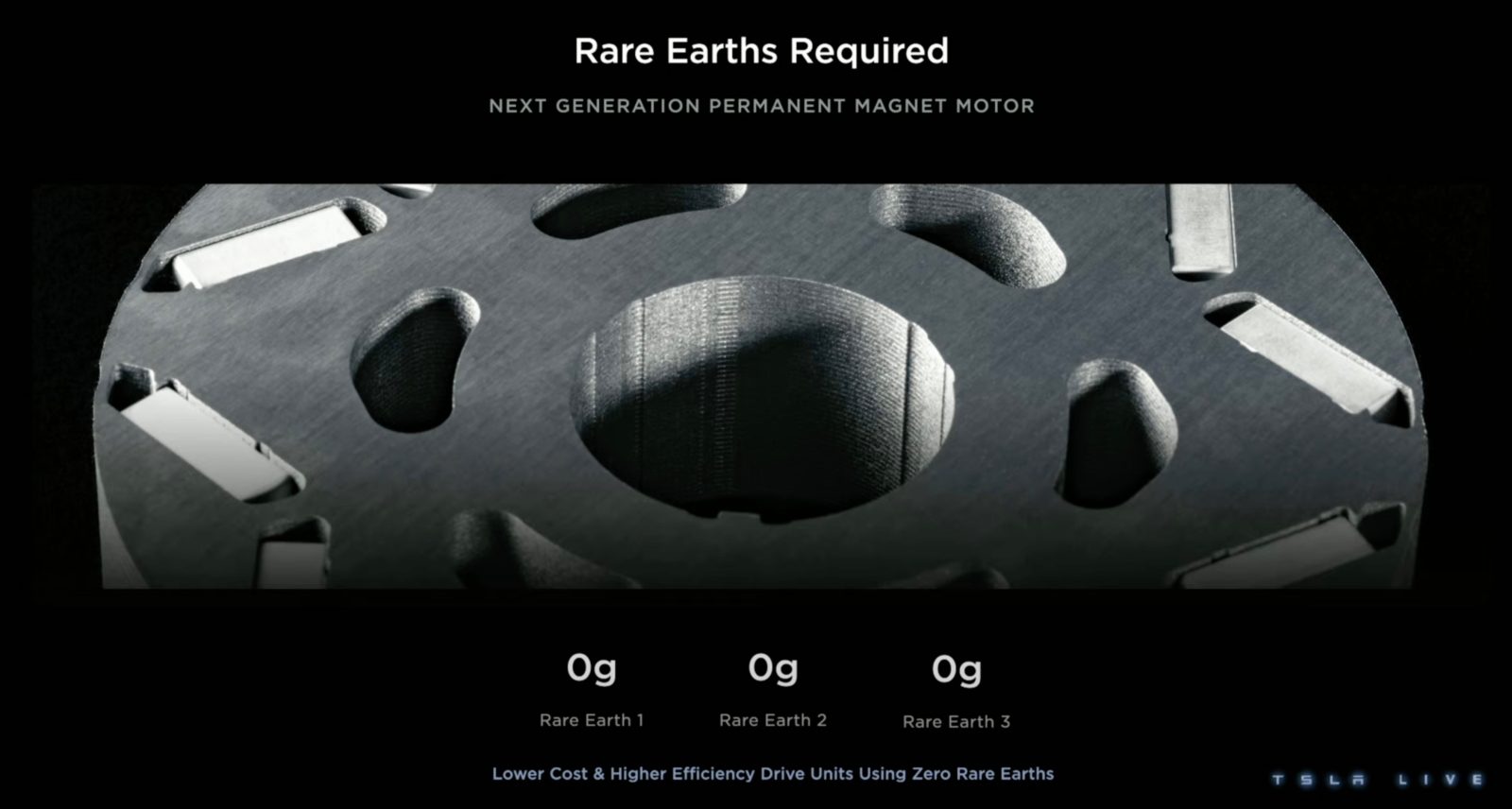
Alongside Tesla’s low-key Cybercab event this week, the company showed off its new rare earth-free Cybercab motor, which reportedly increases power density and efficiency significantly.
It’s some kind of an achievement, but to understand how much of an achievement it is, we must first understand what all of this actually means. Strap in.
Much has been said about the use of “rare earths” in electric vehicles. But there’s a problem: many who’ve heard this phrase have no idea what “rare earths” are, how they’re used, and what the implications of their use are.
The engineers designing these products of course know these things. Their job is to optimize whatever part of the vehicle they are working on, and there is always some sort of optimization to be done. And the supply chain managers purchasing the materials the engineers use have pressured those engineers to minimize the use of certain materials that are expensive or hard to get.
But all of that is inside baseball. The public mostly hears “rare earths,” thinks that sounds kind of scary, and moves on.
As such, there are a lot of misconceptions about what a rare earth actually is, and how it is used in an electric vehicle. I’m going to try to clear up some of those misconceptions here, and then explain what Tesla actually announced last night.
What is a “rare earth”?
On the periodic table, “rare earth elements” are those outlined in red in the graphic below – Lanthanides, plus Scandium and Yttrium. They are not actually all that particularly rare either, with Neodymium being about two-thirds as abundant as copper.
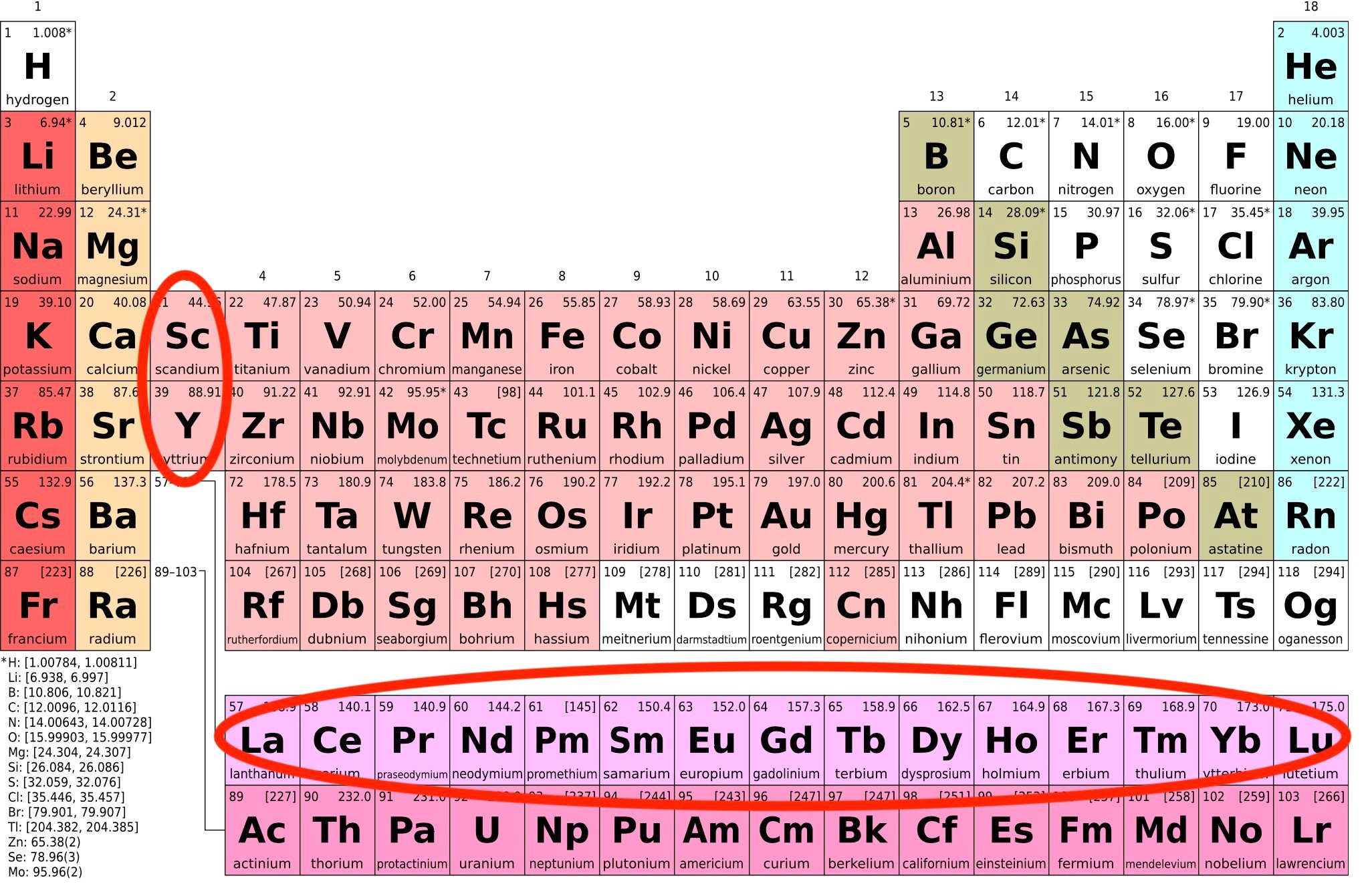
Neodymium is the one we’ll focus on the most here, as it’s the relevant one for electric cars. It’s used in powerful magnets, and thus ends up in electronics that need powerful, tiny magnets, like speakers, hard drives and electric motors. Dysprosium, Terbium and Praesodymium are also commonly used as additives in Neodymium magnets.
How are rare earths used in EVs?
And in fact, none of these elements are typically used in lithium-ion batteries. So the battery isn’t the issue here, it’s the motor. And an electric car motor only has around 1kg of these rare earth elements in it – very little per vehicle, but a lot when you’re talking about mass produced scale.
Further, rare earth elements are not used in every type of electric car motor – Tesla has used them in permanent magnet motors, but not in its AC induction motors. AC induction motors create magnetic fields through electric currents, not with a physical magnet.
Originally, Tesla used AC induction motors in its vehicles, which did not need rare earth elements. In fact, this is where the company got its namesake – Nikola Tesla was the inventor of the AC induction motor. But then when the Model 3 came out, the company introduced a new permanent magnet motor and eventually started using these motors in its other vehicles as well.
What’s Tesla’s new claim?
In 2023, Tesla announced that it would work on making permanent magnet electric motors with no rare earth elements. This likely involved Tesla looking into using iron ferrite or aluminum-nickel-cobalt for its magnets (though the latter of those just swaps one set of supply problems for another). There are other research materials out there, but these are likely too small scale for Tesla’s desires.
Last night, at Tesla’s Cybercab event, it claimed that the Cybercab uses a new motor which is 18% smaller, 25% lighter and more efficient than other top-performing drive units. Tesla CEO Elon Musk, who was not at the event, replied on twitter to add that the motor does not use rare earth metals.
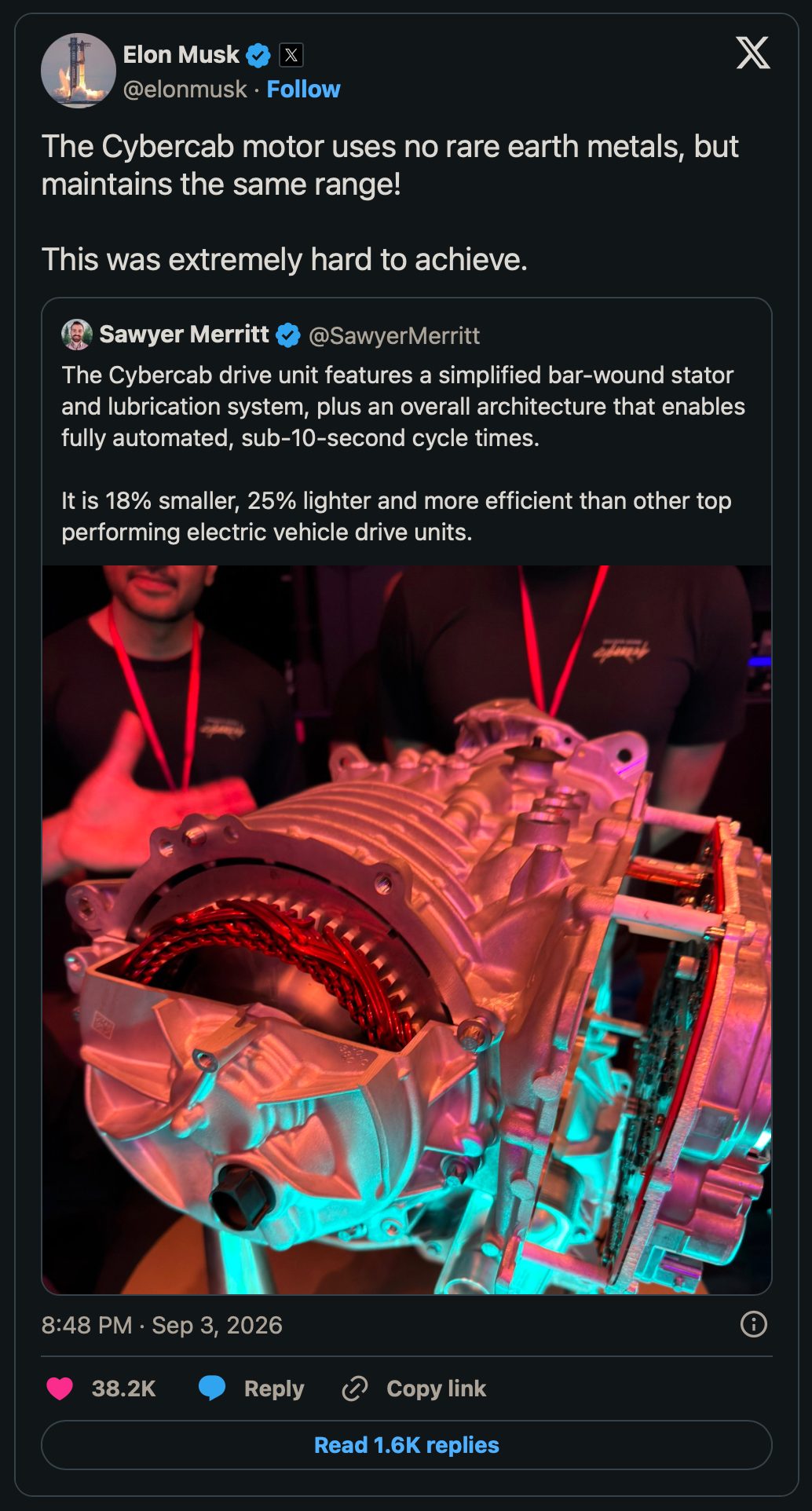
So today’s news could be a realization of Tesla’s non-rare-earth-magnet effort, but without a Tesla communications department for us to ask what materials they’re using, it will have to remain open for now.
So far, we’ve only seen this motor in the Cybercab, but it’s possible that Tesla will migrate it to other vehicles, as it did with its original switch to permanent magnet motors with the Model 3, which were then seen elsewhere across Tesla’s model line.
As for it being “extremely hard to achieve,” well, Musk says that about everything. Maybe it was. Good on Tesla for doing it. But what practical benefit are we getting here?
Why does Tesla’s claim matter?
The reason all of this matters is because permanent magnet motors tend to be more efficient and smaller than induction motors, both of which are obviously important for automakers.
The Cybercab has been certified to consume 165Wh/mi, making it the most efficient electric car on the road. This is due to its small size, low-slung aerodynamic design, light weight, two-seat nature, and indeed, seemingly, its more-efficient electric motor.
But more efficient electric motors don’t really matter all that much. Even the most inefficient electric motors used in EVs are already incredibly efficient, converting 90% or more of input energy into rotational torque.
So eking a few more percent isn’t actually going to give you any mindblowing effect on overall system efficiency. Note, for example, that while Tesla quoted percentage changes in size and power, it did not quote the percentage improvement in efficiency – probably because it’s relatively minor.
What matters more is that if Tesla was able to create a rare-earth-free permanent magnet motor, it can get the power density it needs and stuff it into a small vehicle like the Cybercab, freeing up a few more inches here and there to pack it all together nice and tight. A relentless focus on minor optimizations like this is the sort of thing that allows a hyper-efficient vehicle to exist.
So the packaging and efficiency is a gain, and a gain that fits into an overall scheme of chasing hyper-efficiency, but that probably could have been had with rare earth magnets anyway. But there’s another reason to remove rare earths from a motor.
Why do rare earths actually matter?
But the downside of rare earths is that, despite not being all that particularly rare, they are still hard to get. This is because most of the world’s supply of most rare earth elements is processed through one country, China, which theoretically gives China power to dictate who gets to use them.
In the former free trade paradigm of the world, that didn’t matter too much – commodities were commodities and you could buy them from whomever had them. In this case, China is who had them.
But resource concentration became particularly relevant over the course of the past year as China became tired of the nonsense coming out of the senile squatter in the White House (who Musk is the largest individual backer of) and decided that it would impose export controls on rare earth processing.
Top comment by Beario
I think this is actually significant considering the state of politics these days and the quick erosion of diplomacy on the grandest of scales under the current administration. China is by the far the largest exporter of rare earth minerals by far. Even though the US is ranked number 2 for rare earth's, it still requires importing from China. This will reduce that dependency for Tesla anyway which is a cost reduction. Not exciting news but still notable.
Everyone knew this is the sort of thing that could happen, which is why Tesla and others were working to reduce their rare earth usage in the first place. But then it did happen (and Musk was part of the reason for it, really helping your company there, buddy), and suddenly it became a lot more urgent for everyone to either find new supply refined outside of China, or reduce their usage.
So… how big a deal are we talking here?
So that’s the importance of this news – nothing to do with batteries, not so much due to environmental or human rights effects, an efficiency gain but not that huge of one, and not really a huge new technology breakthrough that nobody’s thought of before. It’s simply an implementation of technologies that have been thought about for a while, responding to a concern that has recently become all the more real, in a way that is presumably scalable if Tesla ever does get around to scaling it into more than the ~45 Cybercabs the company currently has registered for use in Texas (and we are sure it will).
That’s news, and it’s interesting. But perhaps not exactly earth shattering.
Charge your electric vehicle at home using rooftop solar panels. Find a reliable and competitively priced solar installer near you on EnergySage, for free. They have pre-vetted installers competing for your business, ensuring high-quality solutions and 20-30% savings. It’s free, with no sales calls until you choose an installer. Compare personalized solar quotes online and receive guidance from unbiased Energy Advisers. Get started here. – ad*


FTC: We use income earning auto affiliate links. More.



Comments