
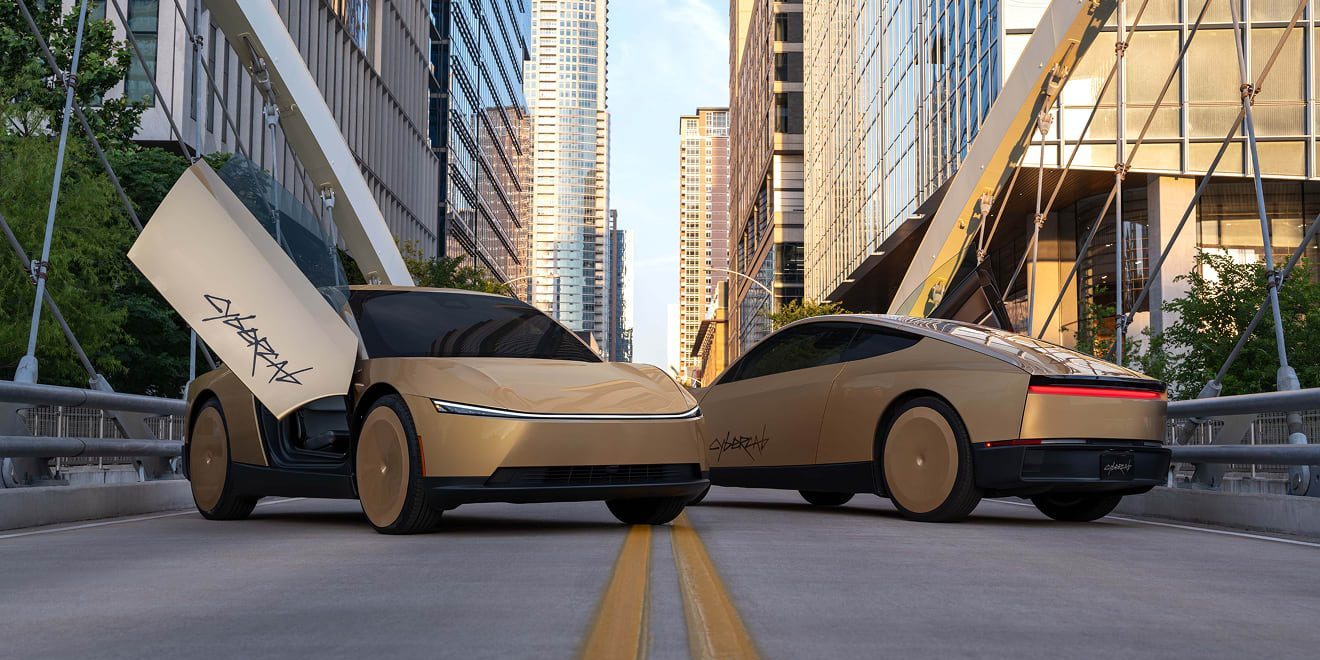
Tesla has started distributing a “Robotaxi interest form,” collecting interest from fleet buyers who would want to build a Robotaxi network or provide related infrastructure services.
It’s the first step in allowing non-Tesla entities to make money off of Tesla’s FSD driver-assist software… but the owners who were promised they could make passive income with their cars are still out of luck.
Today was supposed to be Tesla’s big Cybercab launch event (er, uh, re-launch event?), where it finally puts its steering-wheel-less two-seater autonomous taxi on the road.
But, unlike most Tesla events, this one has so far had little to no hype attached. There’s no livestream, media has been turned away, and we have little to base anything on except for reports from hand-picked Tesla superfans posting on Twitter, the white supremacist/deepfake porn website.
There were a number of questions related to this launch, about where the car might be rolled out and when, whether it would have a steering wheel or not (perhaps a removable one?), and how many actual Cybercabs will be seen in the wild in the coming weeks, rather than just on the opening day or two.
But we don’t have any of that right now. So alright, we’ll have to digest whatever we see in the coming hours and get back to you about whether there’s any news.
But what we have seen so far is a new interest form, which Tesla has been circulating at the event and on its website.
Tesla’s Robotaxi interest form is looking for fleet buyers
The form is labeled “Help Us Build Our Robotaxi Network: Complete our interest form to be considered for future Robotaxi opportunities.”
There’s not much information beyond that as to what exactly the opportunities might be, but the form collects name, email address, phone number, and company name.
It further has four checkboxes to indicate your interest (but you’re only allowed to click one of them): Cybercab fleet vehicle purchasing, Mobility hubs and infrastructure, Event collaboration, and Other.
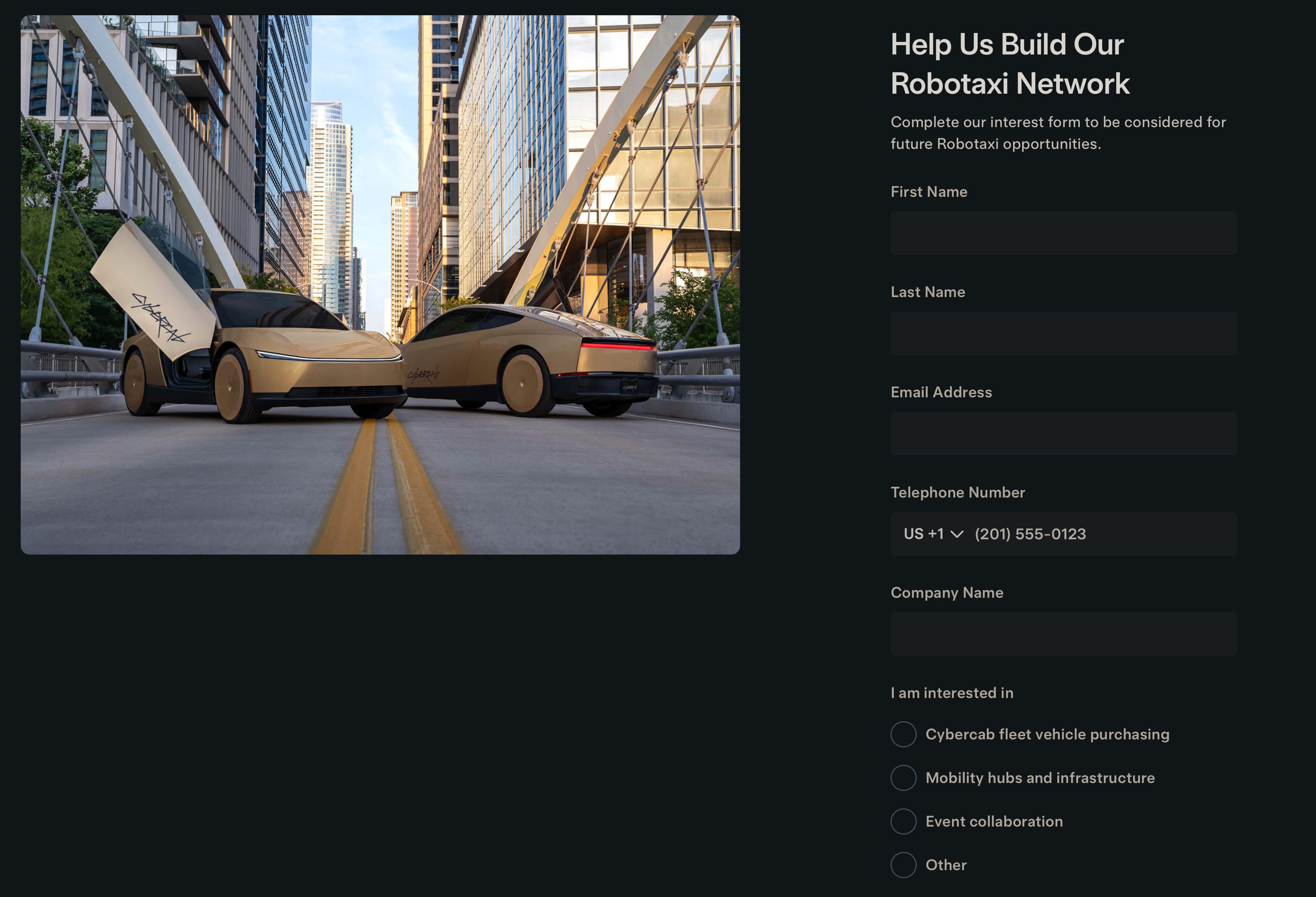
Below, you can add additional notes and say which region you would want to deploy your projects in.
Tesla has been scaling up its Robotaxi network, but the scaling has been going slowly. While Tesla will make a big deal out of rolling out new cities (coincidentally just before each quarterly earnings call), those cities often end up with very few cars operating within them over the longer term.
So far, Tesla has used Model Ys with specific geofenced versions of FSD as its Robotaxi cars. Today’s Cybercab launch is supposed to be the beginning of public availability of the 2-seat, designed-for-autonomy vehicle, with less space than a Model Y but much higher efficiency.
A “Cybercab interest form” for fleet buyers is a betrayal of the Tesla faithful
The software used by Tesla’s Robotaxis has so far been inaccessible to the public. Even though Tesla started saying that all its cars are capable of full autonomy ten years ago, it has not delivered on that promise.
Further, Tesla stated that your car would be an “appreciating asset” due to this autonomous capability, and the reason it would appreciate is because as soon as Tesla solves autonomy, you could send your car out to do errands or run a taxi service, making money while you’re not otherwise using your vehicle.
Tesla sold this capability to owners for up to $15,000, with the claim each would be able to run such a money-making venture. But even though Tesla has been taking fares for rides for over a year now, no private owner has yet to profit off of FSD as Tesla said they would.
(Not only has Tesla failed to deliver the software, it’s also refusing to give owners the hardware to run it ,which they already paid for, leading one owner take the upgrade into his own hands, and said it was “easy.”)
Tesla CEO Elon Musk even once said that Tesla would stop selling cars once it solves autonomy, instead preferring to keep the vehicles in-house and run a transportation services company, which it figured would be more profitable.
Today’s interest form is a step towards that future – of restricting car ownership to fleet buyers or to Tesla itself, rather than private owners. But the fact that Tesla is seeking outside investment suggests they don’t want to spend the money required to keep those cars in-house, when it’s already spending a ton of money this year.
But it’s particularly a betrayal of the owners who purchased FSD on the promise that they would be able to use this capability when it’s ready.
Without the upfront cash of a decade worth of FSD purchasers – not a single one of which has received the fully autonomous software they paid for – surely Tesla and FSD would not be in the place they are today.
Tesla also seems to be looking for help with infrastructure, after failing on its own plans
The “mobility hubs” checkbox is another interesting portion of the form, considering Tesla’s recent attempt to build a robo-charging hub in San Francisco.
The company had planned to lease a parking garage in downtown SF, developing it into a Supercharger location that could be used both for human-driven and Robotaxi purposes. But the company abruptly dropped plans on the same day as it had a planning meeting scheduled, and we never heard any more about it.
We have heard of other companies working on the same issue, though. Some former Tesla employees formed a company called Hubber in the UK, which plans to build urban charging hubs with robotaxis in mind.
So given Tesla’s sudden pivot from building its own charging station, and the existence of other businesses that have decided to serve this niche, it looks like Tesla is less interested than it perhaps once was at building infrastructure.
When will this happen? Autonomy isn’t solved yet
Of course all of this happens against the backdrop that Tesla still has not solved autonomy.
Despite years of touting its big-data, vision-only, neural-net approach that would supposedly be able to send full autonomy to everyone everywhere at the flip of a switch, Tesla’s Robotaxi rollout has been restricted to small numbers of Tesla-owned vehicles in specific small urban areas, geofenced and pre-mapped with LiDAR sensors.
While Musk says that autonomy is just around the corner, he has said that many times before.
If anyone else were collecting a robotaxi interest form, we might think that’s an indication that the company is getting closer to providing the software capability to run said robotaxis. But with so many promises that get delivered late or never, we wonder if this interest form might be a bit premature.
Top comment by Philip234
Dear local taxi operators, prior to investing in this latest Tesla scheme er business opportunity, please consult with the roofing and solar companies who invested hundreds of thousands to be Tesla Solar Roof installation partners. You have been warned.
And regardless, even if it is not premature (after all, infrastructure takes time to build), it still represents a failure to deliver on Tesla’s promise to its early funders – a failure which it still hasn’t really addressed.
But maybe the very bottom of the interest form gives up what this is all about. It states “By clicking ‘Submit’, I authorize Tesla to contact me about this request as well as with more information about Tesla products, services and regional events using the contact information I provide.”
As Tesla works to recover from the past two years of sales declines in a rapidly rising global EV market, it seems like it will take any excuse to expand its interest list. More rubes who think they’ll be able to profit off of robot taxis anytime soon, after ten years of broken promises on exactly that front, seem like a good group to sell to.
Charge your electric vehicle at home using rooftop solar panels. Find a reliable and competitively priced solar installer near you on EnergySage, for free. They have pre-vetted installers competing for your business, ensuring high-quality solutions and 20-30% savings. It’s free, with no sales calls until you choose an installer. Compare personalized solar quotes online and receive guidance from unbiased Energy Advisers. Get started here. – ad*


FTC: We use income earning auto affiliate links. More.


Comments