
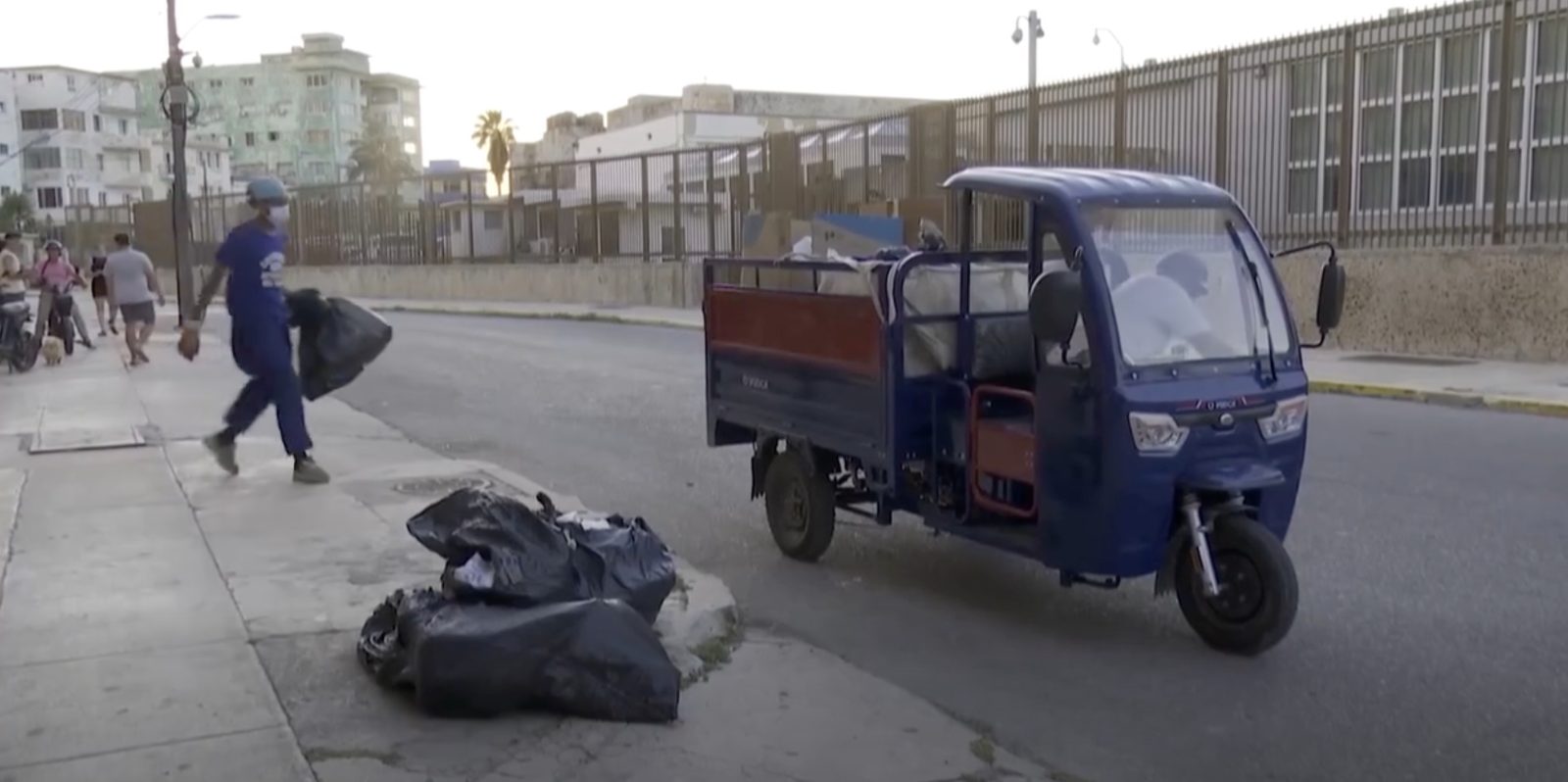
Cuba is struggling with a US-imposed blockade on fuel shipments, which has led to many crises, including a breakdown in garbage collection in Havana. But a startup is stepping up to collect garbage in one neighborhood, using electric three-wheeled vehicles powered by solar.
Cuba has found itself in the crosshairs of the current squatter in the US White House (who cannot legally hold office in the US), who feels as if causing misery to a populace will somehow make that populace have a more positive opinion of the country causing that misery.
In this case, that misery takes the form of a total blockade on fuel shipments to Cuba imposed this January, regardless of which country those shipments come from.
Cuba has responded by rapidly expanding solar power, with help from China in doing so – another example of the brilliant foreign policy of a total idiot who is pushing basically every country away from the US and towards China.
Given that Cuba was previously reliant on imported oil, the blockade has resulted in a crisis that has hit the country in several ways, including threats to food supply (in a country where this was already a difficulty even before the recent blockade), electricity shortages and great difficulties for Cuba’s famously capable medical system.
But beyond those big headline effects, one of the most visible ways that the fuel blockade has affected Cuban life is in terms of trash collection in Havana, the nation’s capital.
It is not an uncommon sight to find trash piling up (or burning) in the streets, as over half of the city’s fleet of garbage trucks are not currently operational. Havana was already a city with a fair amount of grit and aging infrastructure, but now there just isn’t enough fuel to go around, and the streets are full of trash.
But if there’s anything Cubans have experience with, after decades of a US-imposed embargo, it’s scrappy solutions to problems that have been imposed upon them by foreign governments.
A private company is picking up trash in Cuba
The latest effort is “El Rampeño,” a project focused in a small part of the Vedado neighborhood of Havana, named after the neighborhood’s main street, La Rampa, near the Plaza de la Revolución.
Vedado is a historically more upscale neighborhood of Havana, positioned along the coast to the west of the poorer and denser Centro Habana, and Habana Vieja, the city’s old town and primary downtown area.
The project was launched last month with a novel plan for communist Cuba, where trash collection has always been free and provided by the government. Rather than being a government program, it’s run like a private business (though supported by the local government), and charges monthly fees.
The project charges 100 pesos per month for trash pickup for homes and 15,000 pesos for businesses. El Rampeño says that it provides the service for free to “vulnerable people.”
By comparison, average Cuban monthly wages are around 5,000 pesos – though given that many services are paid for by the government, and the country has different currencies for locals and foreigners and a large informal economy, it’s hard to compare these to wages in the rest of the world.
Solar powered electric tricycles make this possible
El Rampeño’s operations are centered around the “Solinera,” a small parking lot with solar canopies where the electric tricycles park and charge. The solar canopies are attached to a battery system to store extra power.
The tricycles were purchased from Vehiculos Electricos del Caribe (Caribbean Electric Vehicles), or VEDCA. The company is a joint venture between manufacturer Tianjin Dongxing Industrial and Commercial Group and Minerva, a Cuban state-owned electric micromobility company. The vehicles are built in a factory west of Havana.
Each of the tricycles has a 5.4kWh lithium iron phosphate (LFP) battery, 30-44mi (50-70km) of range depending on how much of its 600kg (1,322lb) cargo capacity is loaded, and a top speed of 24mph (39km/h) from the 1200W (1.6hp) motor. They are operated with motorcycle-style handlebars, rather than a steering wheel.
Those aren’t particularly stellar specs, but they get the job done. They’re in the same ballpark as the Honda Fastport quadcycle, which we tested at the last LA Auto Show.
The most recent update on the project comes from Belly of the Beast, an independent journalistic outlet showing the reality of the situation on the ground in Cuba.
While El Rampeño launched with 5 vehicles in operation, company president Yasiel Hernández says that it has 30 tricycles, with 10 currently running.
And only a couple weeks after the project started, streets in El Rampeño’s service area were already much cleaner. The service area is quite small, and the difference between it and the areas around it is stark in terms of the amount of trash on the streets.
Top comment by Mrvc
Solar is big in the Caribbean. Alot of the countries have had some kind of solar plants at one time or another. Now they get cheap Chinese solar panels. It seems like the could get the rest of the components needed for micro grids and little cars cheap. Would likely improve their lives.
This isn’t the first time Cuba has gotten out of a fuel crisis with electric vehicles. In 2019, electric motorcycles boomed in the country in response to another fuel shortage, with Cubans offering rides to help each other with commutes. Since then, the number of electric motorcycles on Havana’s roads has continued to grow. (for what it’s worth, when I was there in 2016, I already saw many Chinese electric motorcycles)
In the US, Garbage trucks have long been considered ripe for electrification. They’re large vehicles with a difficult start-stop duty cycle that could benefit from the greater low-end torque and higher efficiency (including regenerative braking) and reliability of electric motors, along with lower noise and air pollution in the neighborhoods they service. And since they run fixed routes and return to a depot every day, it’s easy to know how much range they’ll need and know where they’ll get a charge.
We’ve seen a number of electric garbage trucks deployed in the US and Europe, and it looks like, at least in one neighborhood of Havana, Cuba is getting a taste of the benefits of electrification as well.
Charge your electric vehicle at home using rooftop solar panels. Find a reliable and competitively priced solar installer near you on EnergySage, for free. They have pre-vetted installers competing for your business, ensuring high-quality solutions and 20-30% savings. It’s free, with no sales calls until you choose an installer. Compare personalized solar quotes online and receive guidance from unbiased Energy Advisers. Get started here. – ad*


FTC: We use income earning auto affiliate links. More.





Comments