
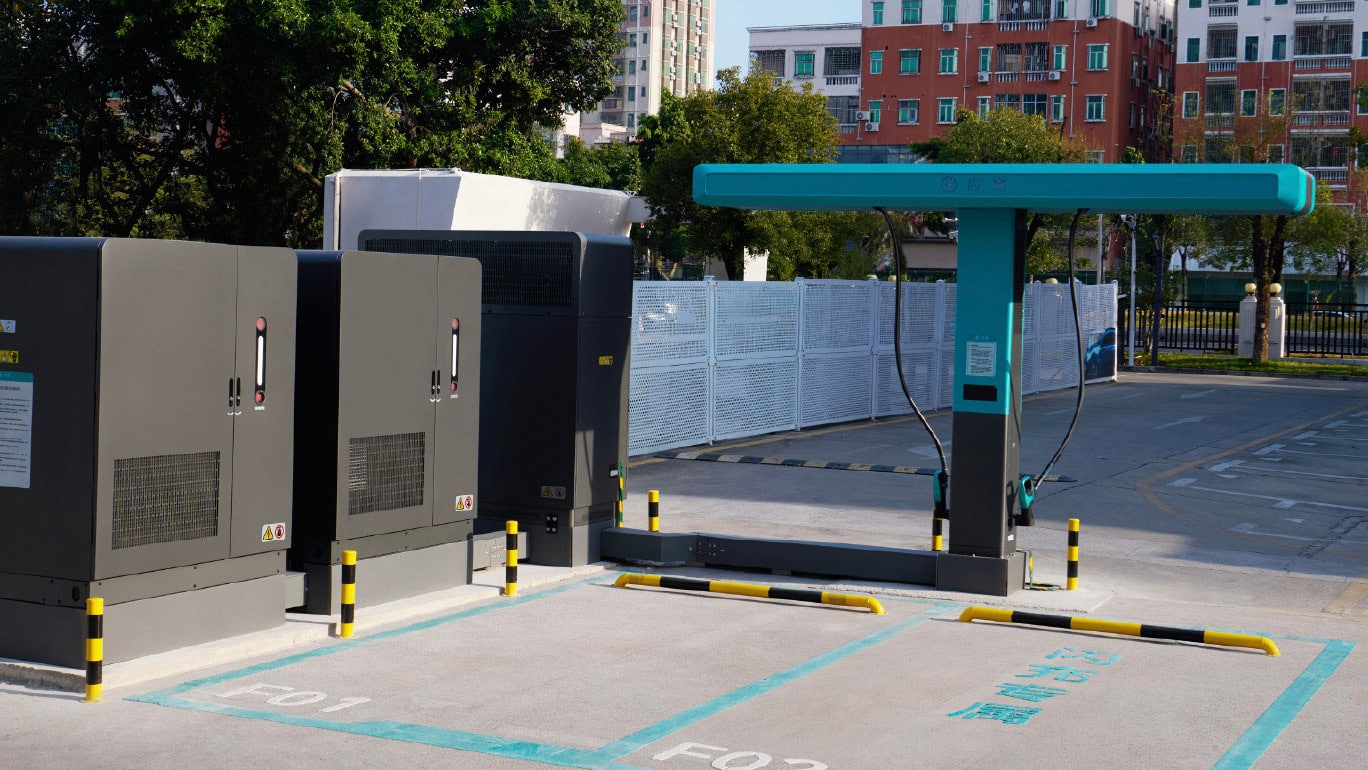
BYD unveiled its rumored 1,500kW charging station today, with the capability of charging two cars simultaneously at a rate much faster than we’ve seen elsewhere in the world. But this time, the company is planning to expand installation of its ‘flash chargers’ outside of China, too.
Last week we brought you rumors of BYD’s upcoming charger announcement, along with an announcement of a new version of its “blade battery” (which was also officially announced this morning).
Now BYD has unveiled the juicy details of its plans for this mega-fast charging system and how customers will get access to it.
The 1,500kW system is 50% faster than BYD’s 1,000kW charger unveiled last year, not that that was any slouch to begin with. The fastest chargers you’ll find in the US and Europe are usually in the 250kW-350kW range, and still many sites are limited to 150kW.
There are a few faster ones sprinkled around (not counting heavy duty truck chargers, which can be over 1MW). Certainly, nothing near the 20,000-site number BYD is targeting, though.
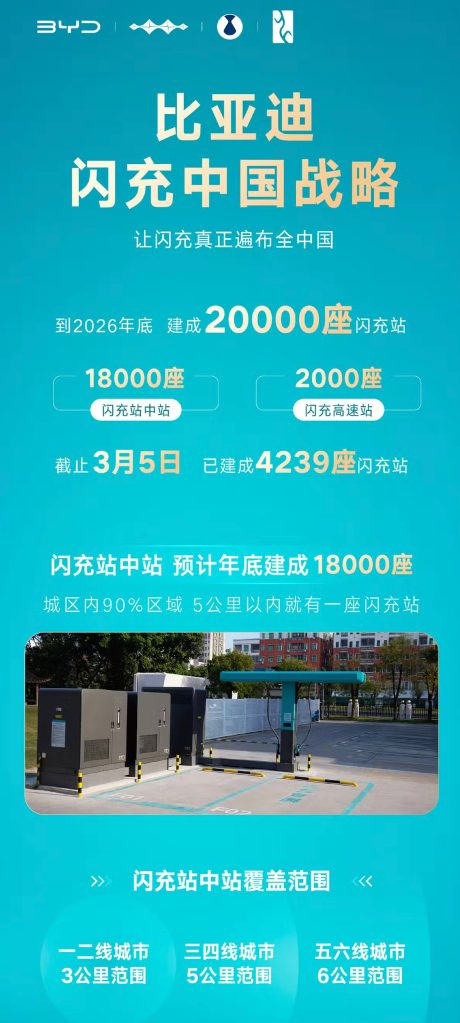
BYD is calling the system “flash charging” and it plans to install 20,000 of them by year’s end, with 4,239 in place already (we couldn’t verify if any of these are 1,500kW or merely 1,000kW) and some even slated to appear overseas, though we haven’t yet heard specifics on which markets will get these chargers first.
It wants to install 1,000 new stations along highways in China by the beginning of May, and is targeting a density of one every 100-ish kilometers (62-ish miles) along highways. It also wants to place them nearby urban areas, ensuring they’re less than 6km away from urban centers (or even denser in the biggest Chinese cities). And for those who live elsewhere, BYD will let owners of flash charger-capable vehicles submit a request for the company to open a charger near them.
Better yet, the chargers use a novel overhead design that seems like it will help to reduce some of the problems seen by other chargers.
It’s common for the connected cables on EV chargers to get abused horribly by the public, falling out of their receptacles and being driven over. Just this week I was at a Supercharger station (charging a new Bolt… more on that on Monday) with 8 inoperative chargers, all with visible damage to the charging head from being run over.
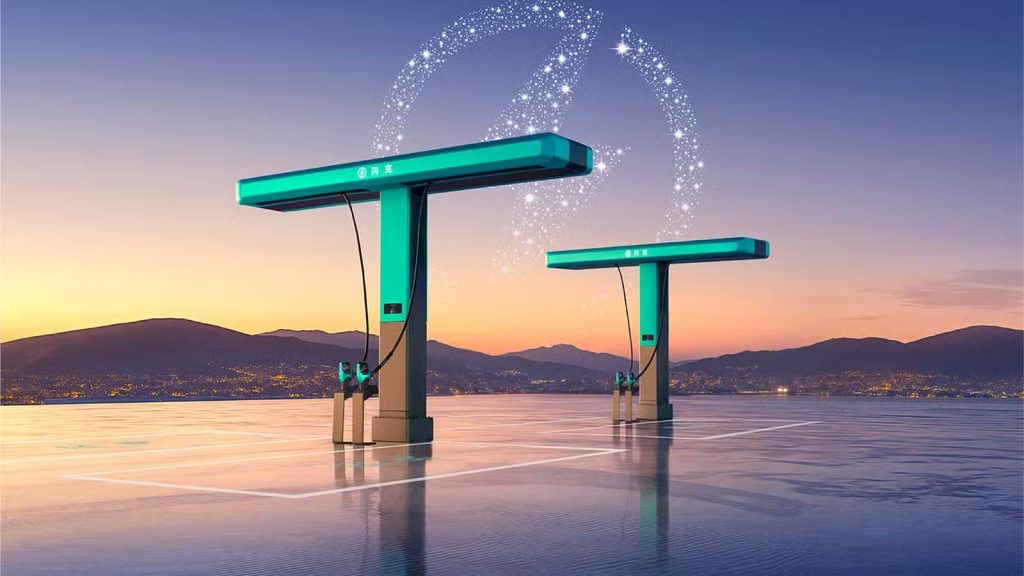
So BYD’s flash charging stations use an overhead “T”-shape with cables hanging down from it, attached to a sliding rail. BYD calls it a “zero gravity” charging head, promising simplicity of operation (as many of us know, those CCS plugs can be quite hefty – this is one of the big benefits of the NACS transition).
The overhead design allows the chargers to plug in to either side of a car, makes it easier to back into spaces (cutting risk of sideswiping a charging cabinet or opening your door into it), and cuts the risk of the charging head being dropped and impacting the ground or being run over.
It also looks like it could enable ‘pull-through’ design, making it easier for cars with trailers to charge, or to allow for cleaner traffic flow in certain parking lots.
BYD says that these stations are fast enough to power each bay at 1,500kW, rather than sharing 1,500kW of power between them, as is the case with many other stations (the leak we saw seemed to show 1,500kW for the whole unit, but maybe the labeling was for each head, rather than the station as a whole).

Alongside the fast charger announcement, BYD also announced a new generation of its blade battery which is capable of charging from 10-97% in 9 minutes. It’s all well and good to be able to deliver so much power, but you need a car capable of accepting that much power, and BYD seems ready to provide that too. Owners of these vehicles will get a year of free flash charging, but will have to pay market rates (usually equivalent to 15-30 cents per kWh) after that.
The chargers will be open to the public, but of course every car will be limited by the amount of juice its battery can take. So, if you’ve got a measly 150kW-capable car, expect to be treated like a 50kW Bolt on a 350kW charger while everyone rolls their eyes at you while they wait (or… head over to the 150kW charger down the street instead and let the fast guys use the flash charger).
Electrek’s Take
Meanwhile, there are a total of ~3k Supercharger sites, and ~35k total charging bays across the US. Those are generally limited to 250-325kW, or sometimes even lower.
It has taken Tesla 14 years to install all of those.
And BYD wants to have 20,000 chargers installed, each of which charge 4x+ as fast as the ones we have here, by the end of one year.
Top comment by Craig Merrow
It used to be that China would imitate. Then they learned to duplicate. Now they innovate. I've made mention before that China graduates more engineers every year than we have in the United States.
They didn’t get to that point by firing their whole Supercharging team over a giant baby’s ego conflict, and they didn’t get to that point through another giant baby promising to kill EVs if the oil industry gives him a billion dollar bribe and then doing his worst to stop deployment of EV chargers.
They got to that point by recognizing the current state of the auto industry, realizing how it can be better, and then doing that.
Maybe it would be nice to have figures in control who are interested in making things better than making things worse. Anyone agree?
Charge your electric vehicle at home using rooftop solar panels. Find a reliable and competitively priced solar installer near you on EnergySage, for free. They have pre-vetted installers competing for your business, ensuring high-quality solutions and 20-30% savings. It’s free, with no sales calls until you choose an installer. Compare personalized solar quotes online and receive guidance from unbiased Energy Advisers. Get started here. – ad*


FTC: We use income earning auto affiliate links. More.



Comments