
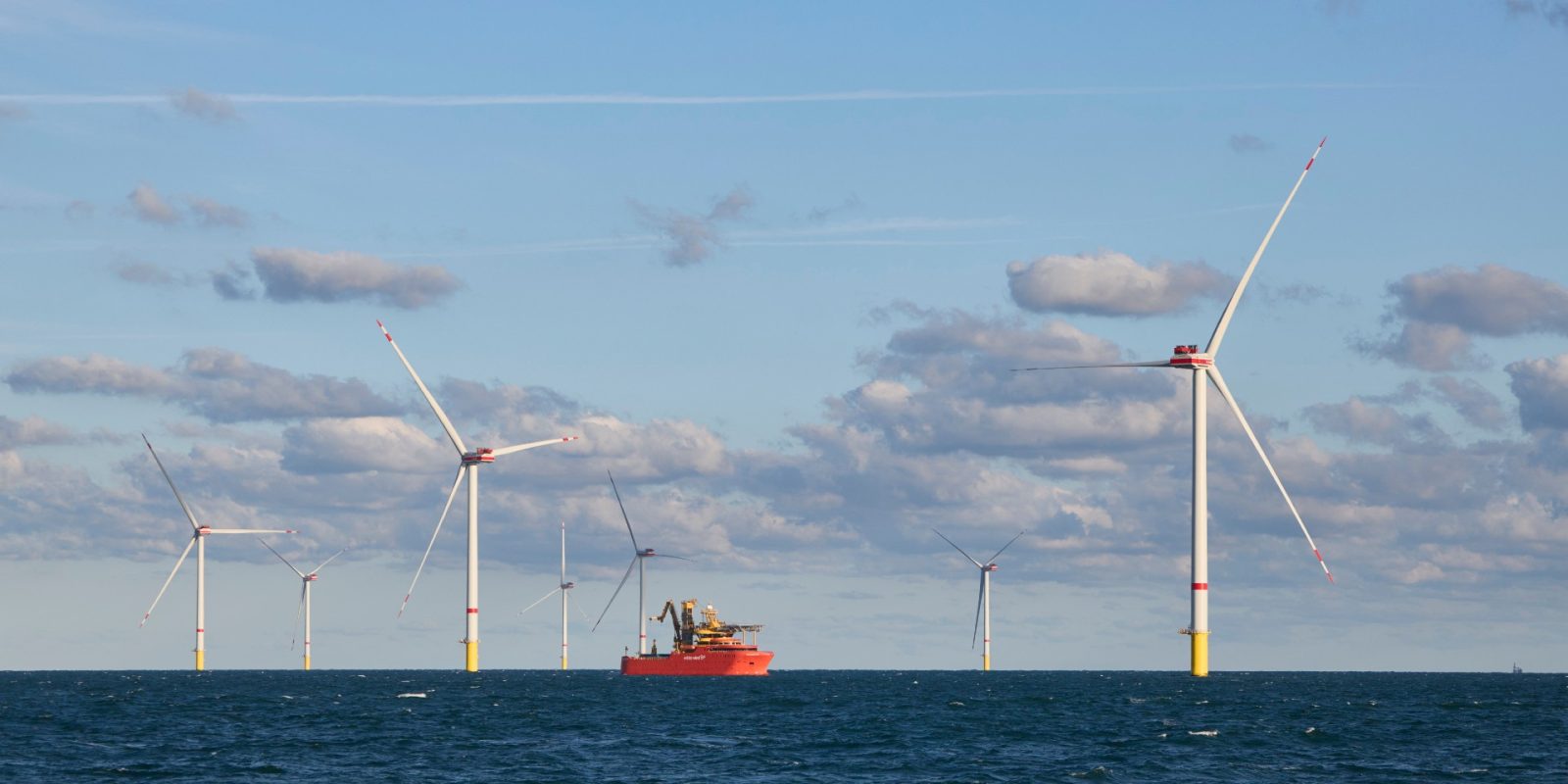
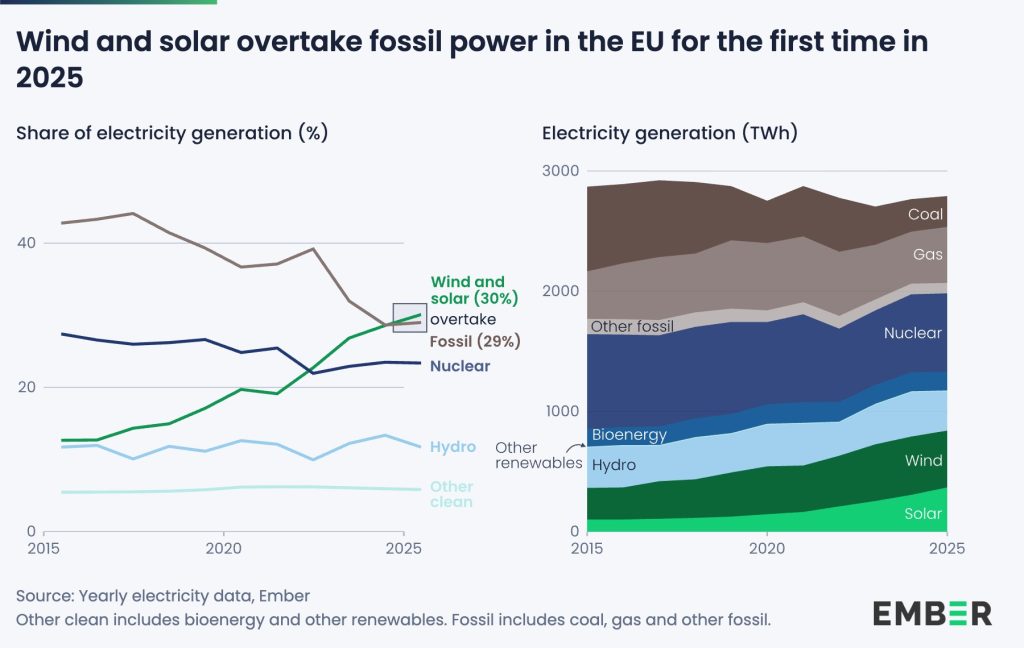
Europe’s power mix hit a tipping point in 2025. Wind and solar generated more electricity across the European Union than fossil fuels for the first time last year, according to Ember’s newly released European Electricity Review. Wind and solar supplied a record 30% of EU power, edging past fossil fuels at 29%.
“This milestone moment shows just how rapidly the EU is moving toward a power system backed by wind and solar,” said report author Dr. Beatrice Petrovich. “As fossil fuel dependencies feed instability on the global stage, the stakes of transitioning to clean energy are clearer than ever.”
The report offers a full-year look at electricity generation and demand across all 27 EU countries in 2025, tracking how the region’s power mix is shifting away from fossil fuels and toward clean energy.
Solar did most of the heavy lifting
The big reason wind and solar pulled ahead last year was solar’s continued surge. Solar generation jumped 20.1% in 2025, marking its fourth straight year of growth above 20%. It delivered a record 13% of the EU’s electricity, beating both coal and hydropower.
That growth showed up everywhere. Every EU country generated more solar power than the year before, driven by a massive buildout of new solar capacity. In Hungary, Cyprus, Greece, Spain, and the Netherlands, solar supplied more than 20% of total electricity.
Altogether, renewables accounted for 48% of EU electricity in 2025. Weather played a role in shaping the mix: hydropower generation fell 12% and wind dipped 2%, while sunnier conditions boosted solar output. Even so, wind remained the EU’s second-largest electricity source at 17%, producing more power than gas.
The shift is becoming structural. In 14 of the EU’s 27 countries, wind and solar generated more electricity than all fossil fuels combined in 2025. Over the past five years, wind and solar’s share has climbed from 20% in 2020 to 30% in 2025. Over that same period, fossil fuels fell from 37% to 29%, while nuclear and hydropower stayed mostly flat or declined slightly.
Gas rebounds, and prices follow
Gas-fired power generation rose 8% in 2025, largely filling the gap left by weaker hydropower output. Even with that increase, gas use remains in long-term decline in the EU and was still 18% below its 2019 peak.
Still, more gas meant higher costs. The EU’s gas import bill for power climbed to €32 billion in 2025, up 16% from the year before. It was the first rise in gas import costs for electricity since the 2022 energy crisis, with Italy and Germany footing the largest bills. Hours with heavy gas use also drove electricity price spikes, with average prices during those hours up 11% across the EU compared to 2024.
Coal, meanwhile, kept sliding. Its share of EU electricity fell to a new historic low of 9.2% in 2025. A decade ago, coal supplied nearly a quarter of Europe’s power. Today, 19 EU countries get either no coal power at all or less than 5%. Even in coal-heavy countries like Germany and Poland, coal generation dropped to all-time lows.
“The next priority for the EU should be to put a serious dent in reliance on expensive, imported gas,” Petrovich said. “Gas not only makes the EU more vulnerable to energy blackmail, it’s also driving up prices. In 2025, we saw some early signs of using more battery storage to shift homegrown renewable power to gas-heavy hours. As this trend accelerates, it could limit how much gas is needed in evening hours, therefore stabilizing prices.”
Read more: Solar power overtakes coal and gas in Germany, a country with little sun
If you’ve ever considered going solar, make it easy by finding a trusted, reliable solar installer near you that offers competitive pricing by checking out EnergySage. It has hundreds of pre-vetted solar installers competing for your business, ensuring you get high-quality solutions and save 20-30% compared to going it alone. Plus, it’s free to use, and you won’t get sales calls until you select an installer and share your phone number with them.
Your personalized solar quotes are easy to compare online and you’ll get access to unbiased Energy Advisors to help you every step of the way. Get started here.


FTC: We use income earning auto affiliate links. More.



Comments