
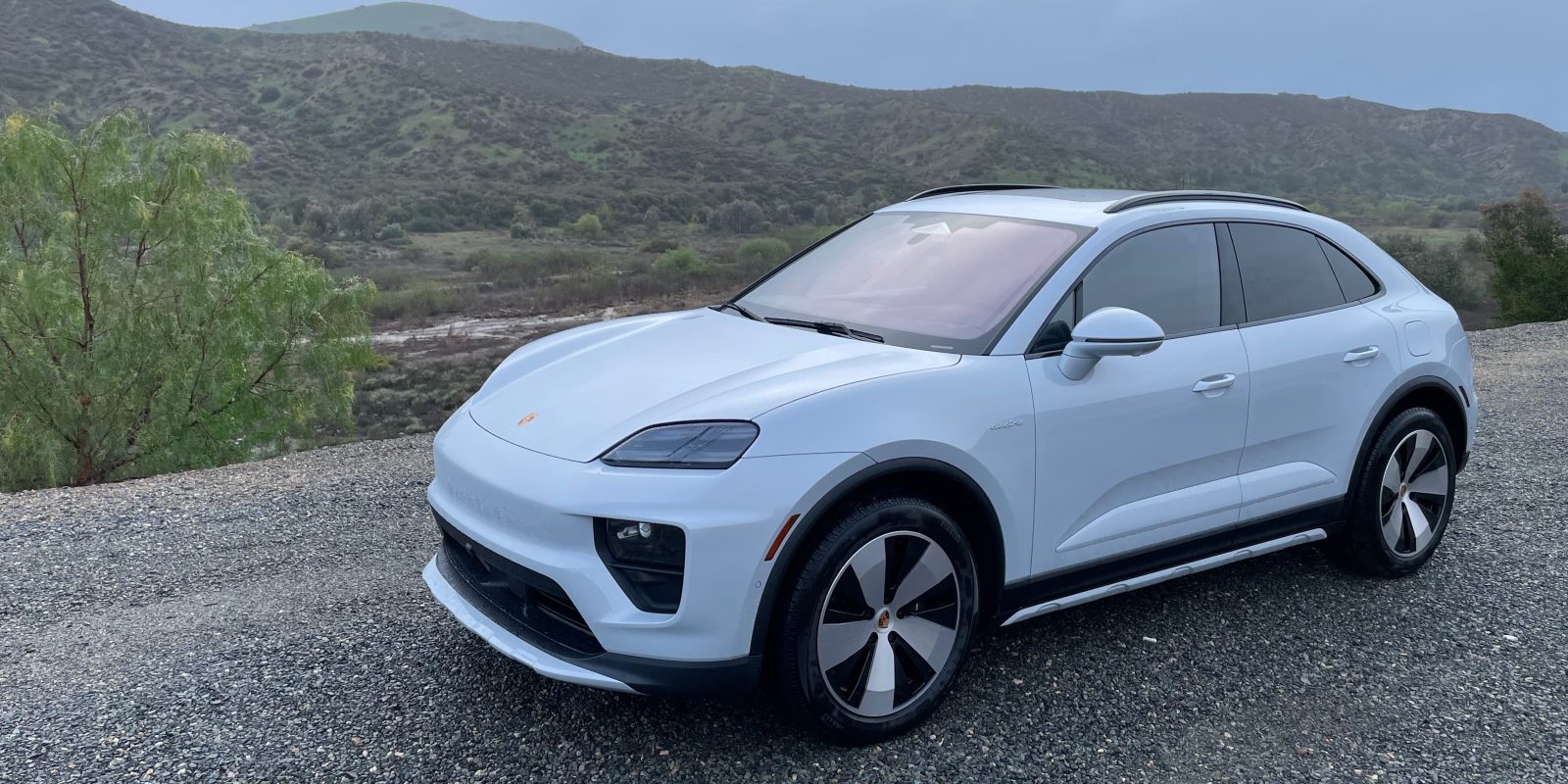
Porsche’s all-electric Macan outsold its combustion-engined one in 2025, the only model where the company sells both gas and electric versions. And yet, the company still recently committed to delaying future EV models and extending availability of combustion ones, despite the weakness that combustion car sales are showing globally.
Porsche released its full-year 2025 global sales numbers today, showing growth in electrified car sales that defied an overall drop in combustion car sales for the company.
Porsche’s overall global sales of “electrified” models (Porsche defines this as PHEV+BEV) increased 7.4%, while sales of all models combined dropped 10%, showing strength in plug-in models and weakness in combustion-engines ones. 22.2% of Porsche’s global sales were fully electric, and 12.1% were plug-in hybrids.
And in Europe, a majority (57.9%) of Porsche’s deliveries were plug-ins, with 1/3 of its European sales being fully electric. For models that have no fully electric version but do have a PHEV (Cayenne and Panamera), the plug-in hybrid version dominated sales.
Of particular note, the Macan sold better with an electric powertrain than it did with a gas one, and was the company’s strongest-selling model line and the line with the largest sales growth.
The Macan sold 84,328 units globally (up 2% from last year), with 45,367 (53.8%) of those being electric.
That 53.8% may seem like a slim majority, but when compared to EV sales globally, it’s incredibly high. About a quarter of new cars sold globally were electric in 2025, so Porsche is beating that number with the one model where direct comparisons are available.
And even in the US, about a third of Macans sold were electric. That’s notable given the tough year EVs had in the US, with it being the only major car-buying region that experienced a tick down in EV sales, largely due to a republican push to increase pollution.
And again, while 1/3 is a minority of Macan sales in the US, it’s also well over the US’ average ~10% EV sales. So it’s clear the EV Macan isn’t just performing like an average EV, but well beyond it.
It wasn’t all good news for Porsche’s EVs, though. The Taycan, Porsche’s fully electric four-door sport sedan and its first electric model, was down 22% in sales. The Taycan saw some new trims released in the beginning of 2025, but the model is perhaps showing its age at this point, having first been unveiled back in 2019.
So, overall, great news for Porsche’s EVs, and not so great news for its gassers.
Porsche’s analysis seems to miss something important
But in giving reasons for its sales numbers, Porsche blamed a nonexistent slowdown in electric vehicle sales, despite that this is clearly not the case given the numbers above (nor overall global car sales numbers, where EV sales increased more in 2025 than they did in 2024).
It said that Taycan sales dropped “mainly due to the slowdown in the adoption of electromobility.” But this is clearly not the case for global numbers, nor is it the case for Porsche’s own numbers, which show strength in Macan EV sales and in overall PHEV sales, despite those powertrains being limited only to certain models across its line.
Other possible explanations could involve the model’s age, or on a shift away from sedans across the industry, or on Porsche simply having another EV option available now, which means buyers who wanted an EV and previously defaulted to the Taycan are now moving to the Macan instead. And these all feel more correct than blaming an nonexistent slowdown on EV sales.
It did not give a similar explanation for why its combustion cars had weak sales. The Cayenne, which only sold combustion versions in 2025 (with EV coming this spring) saw a drop of 21%, on par with the Taycan, but Porsche said this was “partly due to catch-up effects the previous year.” It blamed overall declines in Europe and Overseas regions partially on “supply gaps for the combustion-engined 718 and Macan models due to EU cybersecurity regulations.”
But speaking of regions, where did Porsche’s sales drop the most? In China and Europe – where EV sales were strongest, and only accelerated during 2025. Porsche blamed its 26% drop in China on “challenging market conditions… particularly for fully electric models.” Which sounds like the opposite of a slowdown in electromobility, and more a recognition of the largest car-buying country’s intense desire for EVs.
It did not, however, mention at any time that its overall slowdown in combustion car sales could be related to the overall global decline in combustion vehicle sales, which reached their peak in 2017 and have trended downwards since.
Electrek’s Take
Why are we hammering home on this point? Because Porsche made a commitment last year to extend some combustion models and delay some EV models.
It’s an example of a trend I mentioned just two days ago and many other times before of automakers seemingly making decisions based on the preponderance of false reporting rather than actual market conditions.
If it is clear that Porsche’s EV sales are doing well and its combustion sales are doing worse, committing to the falling part of the business doesn’t seem like it will serve them well. It also defies global trends towards electrification, especially in important markets like Europe and China.
And it’s also important strategically, because the auto industry has been key to Germany’s economy for as long as any living person on Earth can remember. Refusing to see the global trend towards electrification will and already has harmed the German economy.
Top comment by JoeElectric
I have been driving Macan EV for the last year. Before, I have been driving different Teslas (since 2012). Last one was Plaid. I love my Macan EV, but the engineering is still stuck on ICE age. Why do I need FOB when I have phone? There is still a star up button that I never use it. Software is years behind Tesla, it's very easy to get lost in settings. There is only ONE wireless phone charger. Switching user takes a long time. It's like Porsche was afraid to make the leap into EV era. I gave up Tesla thanks to Elon, but I will never go back to ICE. So, if Porsche will stop developing new EV models, I will go somewhere else.
Porsche’s recent commitment to extend the combustion engine, and it and its parent company’s successful attempts to lobby for more pollution in Europe, will not help the company or region strategically. And a sober analysis of its own full-year sales numbers are another easy place to look to find out what the right decision going forward should be.
This isn’t to say that Porsche is doing a poor job of electrifying. As stated above, they’re doing an above-average job in a lot of ways, and we’re quite excited about the Cayenne EV, which will be the most powerful Porsche ever. It also has new variants of the Macan EV coming soon.
We just wish it would realize that, and return to its previous industry-beating electrification commitments, rather than watering them down. And certainly to stop lobbying for industry-wide slowdowns, like many Western automakers are (and like Chinese automakers aren’t), as these slowdowns will only harm human health and contribute more to climate change, the largest problem that humanity has ever created for itself.
If you’re interested in test driving or buying a 2026 Porsche Macan EV, you can use our link to get in contact with a local dealer – or ask them about the upcoming Cayenne EV, which we’re quite excited about.


FTC: We use income earning auto affiliate links. More.




Comments