
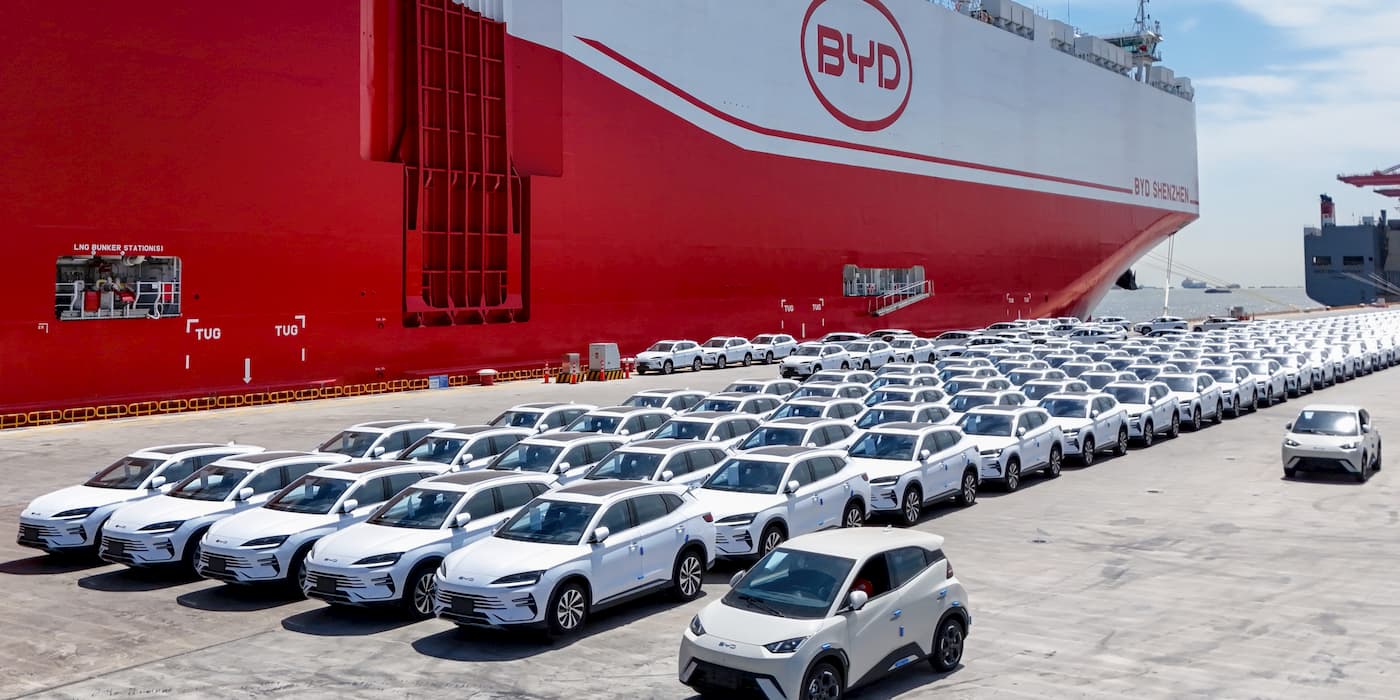
Perhaps you’ve heard the news – automakers across the industry are canceling EV investments, taking tens of billions in losses in response to a claimed lack in customer demand for EVs (even as EV sales in fact continue to rise globally and gas car sales have peaked).
A new analysis by InfluenceMap shows how automakers actually made their own bed, by flip-flopping on their own lobbying efforts and contributing to the regulatory instability that currently plagues an industry with long planning timelines and global competitors that have not hamstrung themselves with such uncertainty.
The last year has been punctuated by announcements from automakers taking multi-billion-dollar writedowns on EV investments, totaling around $70 billion across the industry.
These have mostly been a reaction to a changing regulatory environment in the US, such as the illegal attempts to repeal the endangerment finding and to reverse California’s emissions rules, changes which are likely to be caught up in court for years, and were brought on by the flailing of a senile ex-reality TV host who cannot legally hold office in the US.
After tens of billions in losses due to this flailing, automakers could claim to be a victim of this regulatory whiplash. But in fact they actively participated in these rollbacks, lobbying for them to happen, even when those same companies acknowledge how unhelpful regulatory uncertainty is to business.
Lobby groups work against the interests of their members
InfluenceMap’s analysis picks out several instances of major automakers urging restraint in rolling back regulations. For example, on the endangerment finding, Honda said proposed changes would cause “prolonged regulatory limbo,” Ford said they would harm “long-term stability,” and Tesla said that maintaining the regulation would aid “continued innovation” and is “vital to continued global competitiveness.”.
But despite its members’ concern on that proposal, the Alliance for Automotive Innovation (AAI), the auto industry’s largest lobby group that repeatedly takes anti-EV stances, did not oppose the repeal of the endangerment finding. And while Tesla did oppose the repeal, its CEO gave $288 million to support the anti-EV campaign that proposed it (that advocacy cost his company $1B in a single quarter).
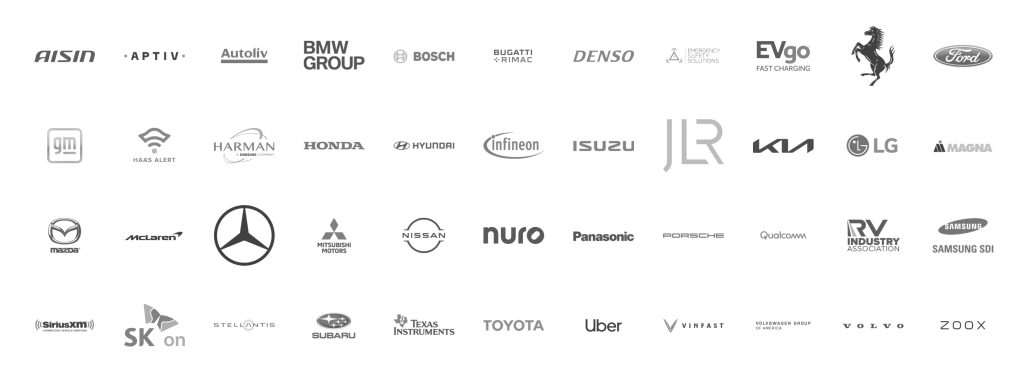
Another lobby group, the Truck and Engine Manufacturers Association (EMA), which represents electric truck makers Daimler and Volvo, said it could not “absorb or plan around those potential increased litigation risks” from the repeal of the endangerment finding. And yet, after the illegal and unwise plan was put into place, the EMA joined a lawsuit to support it.
InfluenceMap says that this pattern has played out in other instances as well, such as with California’s truck and car regulations.
Companies and lobbying organizations often show no strategic consistency, and will flip-flop their support based on political factors or to follow whatever way they perceive the wind to be blowing – sometimes to appear to be on the side of political leadership.
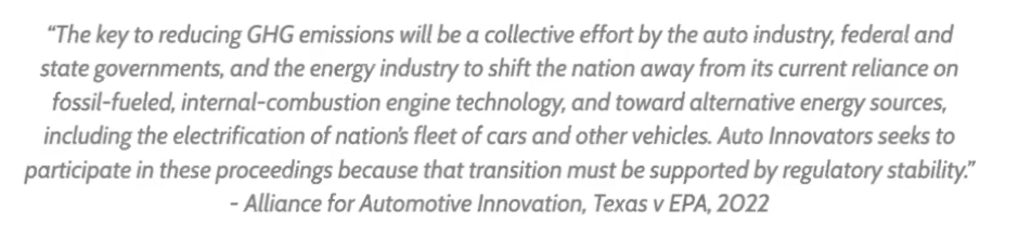
We’ve seen it before, even from the same group – since the 1960s, California had stronger emissions standards than the rest of the country. Those standards were finally harmonized between California and the federal government by President Obama in 2011, making it much easier to do business across the country.
But the auto lobby (then called Global Automakers, now called AAI, both led by John Bozzella, who doesn’t know basic math), led the charge to torpedo those standards. That just fractured the national regulatory environment, leaving California’s standards stronger than federal ones once again, a situation that remains the case today and which Bozzella himself hasn’t stopped complaining about, despite that he’s the one who asked for it.
Global competitiveness will be harmed as well
The harm done by these activities isn’t just limited to the tens of billions of dollars automakers have written off, it’s also in the lack of preparedness the industry will now have to confront global changes that are happening regardless of what one country’s auto industry is lobbying for.
Meanwhile, the Chinese auto industry is rapidly growing and exporting massive amounts of low-price, high-quality EVs to the rest of the world. China recently became the world’s largest auto exporter. As EV demand continues to rise globally, China is filling that demand, while US export share falls.
The growth in EVs has been directly beneficial to Chinese cities and the one billion humans who live in them, in the form of better air quality and less noise.
As Honda itself said, “if the U.S. market were to become a ‘low-regulation’ outlier… Such regression would not only harm American consumers but also risk global competitiveness.” (Honda did strongly oppose the repeal of the endangerment finding, and did take California’s side, but has also canceled EV programs and remains a member of AAI)
US automakers, instead, are choosing to focus on gas and diesel vehicles, for which global sales peaked in 2017 and will never reach that peak again. Ask Kodak, Blockbuster and Nokia how selling into a shrinking market worked for them.
Companies hide harmful lobbying from investors
Making it worse, automakers have not fully disclosed these lobbying activities to the investors they are being taken on the behalf of. These lobbying activities have cost investors and retirement funds tens of billions of dollars, and harmed global competitiveness of the companies they’re invested in, but many investors don’t even know that the companies they’re invested in are responsible for these losses.
InfluenceMap ranked each company by how transparent they’ve been in disclosing their lobbying activities, with most hiding significant amounts of the positions that they have taken as a company.
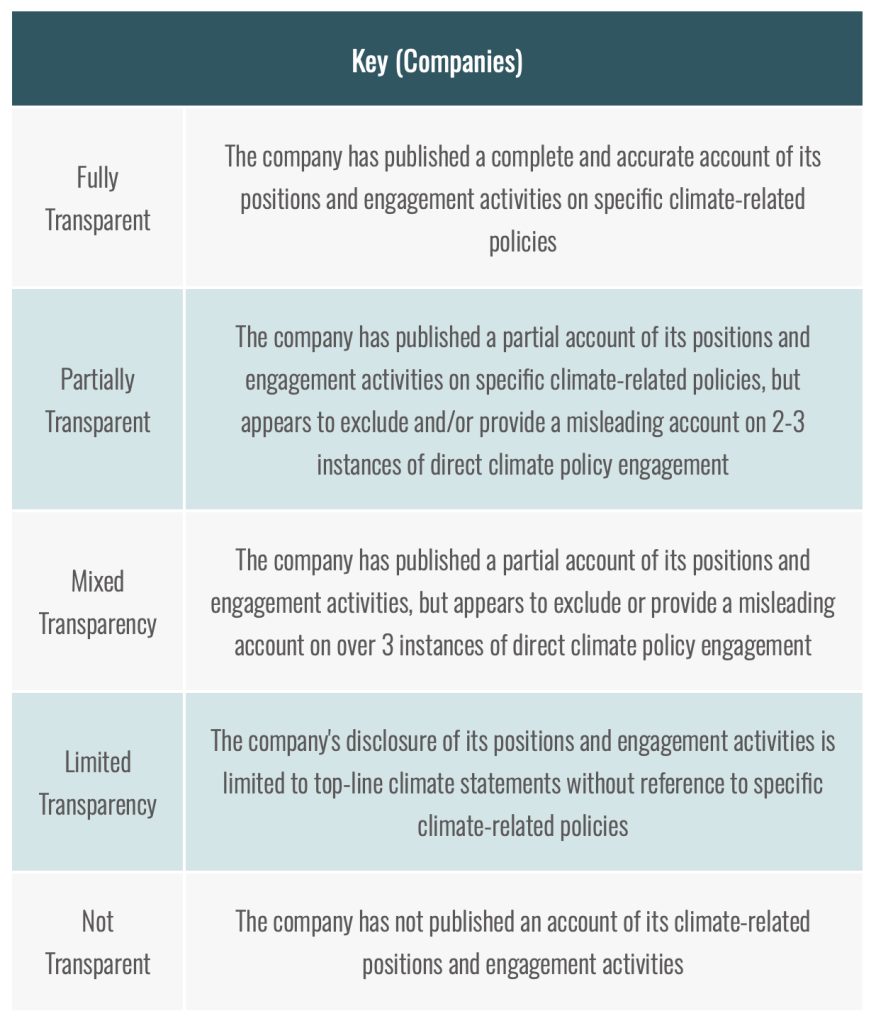
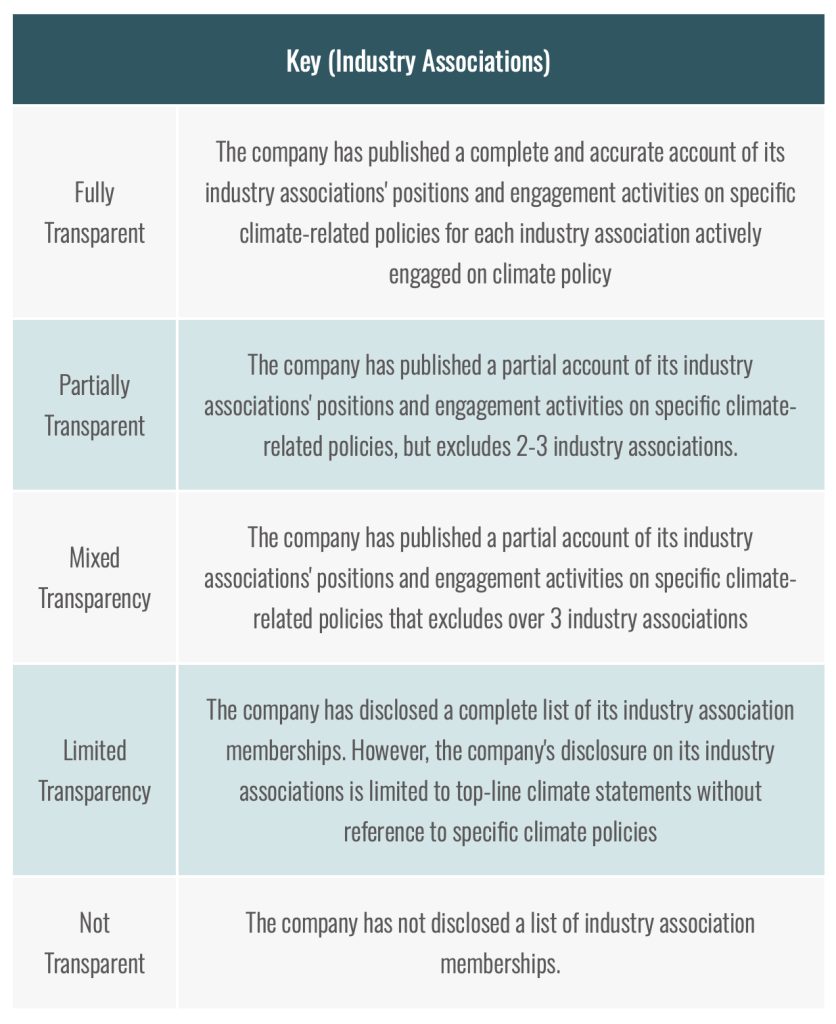
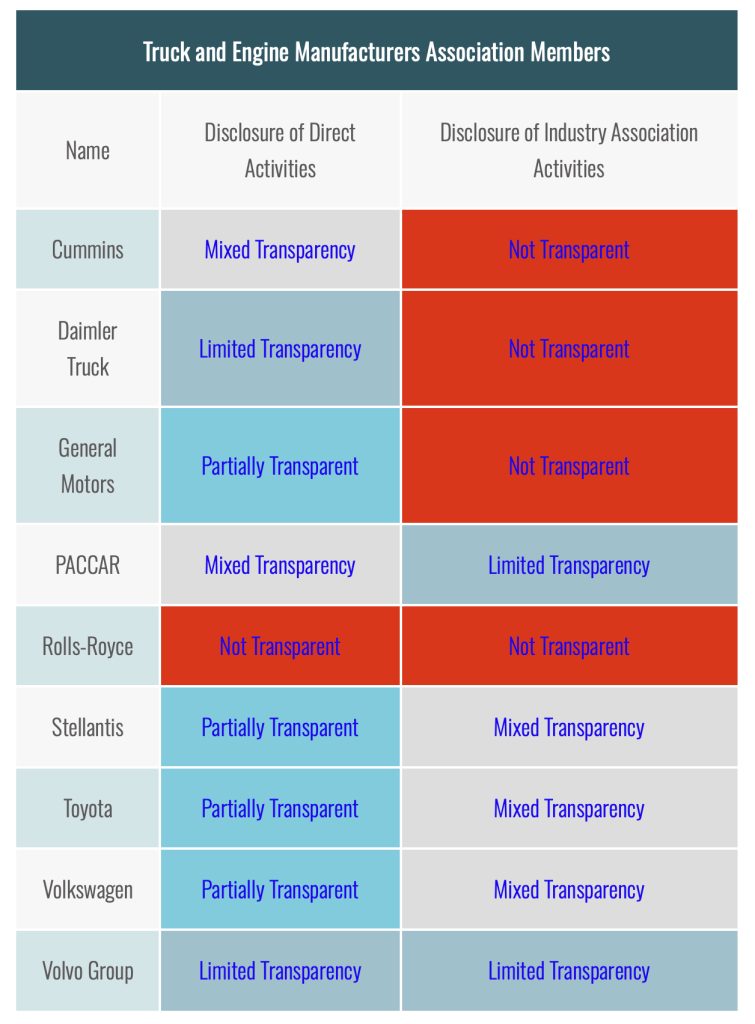
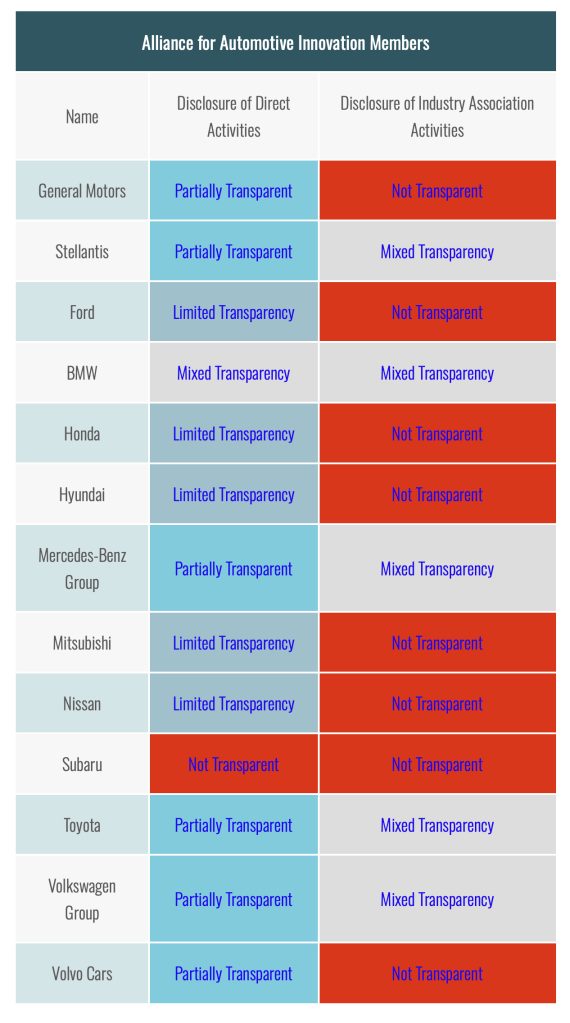
This information, if it were available, would better inform investors as to what activities the companies they invest in have been up to. It should be of interest to an investor whether company leadership has been working to harm the company, or worse, the health of the planet on which we all rely for everything that matters the most.
Automakers know they may be let off the hook for failures
But in the end, automakers may know that they won’t be on the hook for these tens of billions of losses they’ve caused for themselves. Most countries consider manufacturing to be an important strategic asset, and will consider giving government support to ensure industry remains healthy.
Because of the commonality of these bailouts, companies know that they will not be held responsible for their failures, and a few tens of billions of losses here or there can be recovered with the next change in government policy. After all, it’s not their fault that this all changed, they were just doing what the government wanted them to do, so how can the poor little automakers be blamed for that?
This could be why no US auto CEOs have taken a strong stance against the harmful activities of the country’s current dictator. By remaining in the better graces of a famously thin-skinned and corrupt egomaniac, these companies hope that they will be able to benefit from that corruption, even if his whims cost them tens of billions of dollars.
And when the US does get a real government again, that government may attempt to repair the damage done by today’s dictatorship, and offer significant incentives to companies to try to catch up with global competition. Companies will happily take these incentives, despite having fumbled the billions they were already given to clean up their act during the Biden Administration.
European automakers are doing the same
The analysis only covered US lobbying activities, but Europe has seen similar moves from automakers lately. Stellantis and Porsche each took billions in writedowns, and both of their CEOs lobbied for Europe to soften its EV timelines.
The policy changes may have been less severe in Europe, and done in a less anti-democratic manner, but have still led to big losses, delay or cancellation of EV programs, uncertainty over future regulations, and creating a gap for Chinese EVs to sell into, which has terrified domestic automakers and caused them to ask for similar unhelpful tariffs.
How do we fix it?
As this analysis shows – and, frankly, any casual following of automaker lobbying activities even prior to this analysis – the companies are not victims but active participants. And thus should not be awarded monetarily for their malfeasance.
Top comment by ionique
I hope none are bailed out. The US auto industry and its lobbyists need to feel the pain they brought onto both us and themselves.
One hope for accountability could be from investors, whose money and retirements are risked by these games (and yes, that includes you, via your 401k, which surely holds Ford/GM stock). Investors could propose resolutions seeking to force companies to take electrification seriously, or to disclose lobbying, or to break associations with lobbying groups that are harmful to business or health.
Pension funds could take seriously the threat to people’s retirements if these companies dwindle into irrelevance due to refusal to address present technologies and environmental challenges. That would obviously not be helpful for fund value, so it would be appropriate to flex the muscle of any large shareholder who is concerned about the direction of the company.
And political entities that are actually interested in the health of their national industries could recognize that coddling an industry into a false sense of security is not the way to help it grow, and that exposing that industry to competition is the way to encourage innovation. National strategies should include clear all-of-government approaches to confronting the future, rather than fighting these debates in the public comment sections of ill-considered dirty air regulations, and constant bailouts for industries that rush to abandon national priorities when they find it convenient.
Charge your electric vehicle at home using rooftop solar panels. Find a reliable and competitively priced solar installer near you on EnergySage, for free. They have pre-vetted installers competing for your business, ensuring high-quality solutions and 20-30% savings. It’s free, with no sales calls until you choose an installer. Compare personalized solar quotes online and receive guidance from unbiased Energy Advisers. Get started here. – ad*


FTC: We use income earning auto affiliate links. More.




Comments