
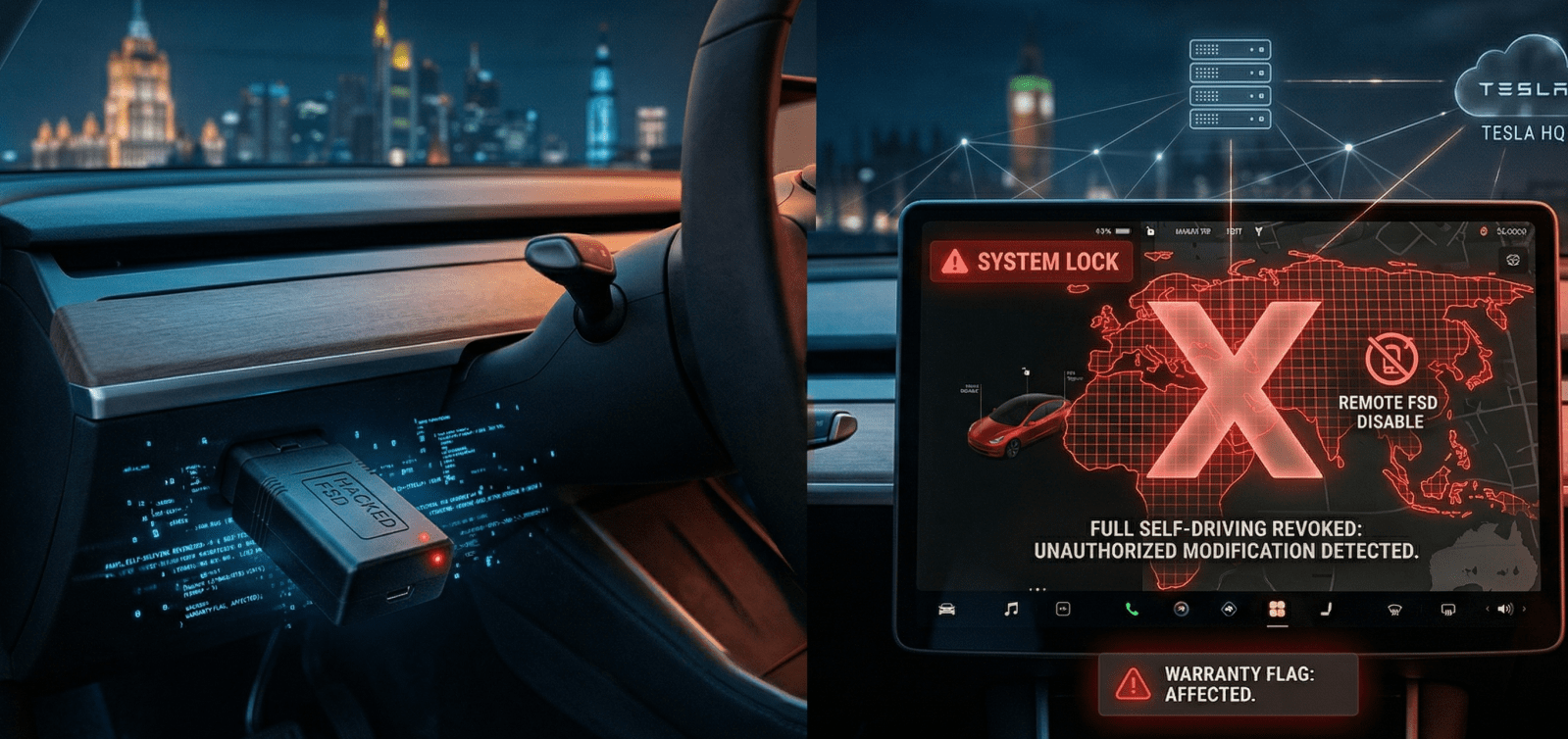
Tesla is hitting back at a growing gray market of unauthorized devices that unlock Full Self-Driving (FSD) in regions where the software hasn’t been approved. The automaker has been remotely disabling FSD on affected vehicles — permanently revoking access without warning.
Reports are surfacing from owners in Europe, South Korea, China, and Turkey that Tesla remotely woke their vehicles, detected the unauthorized CAN bus devices, and stripped FSD entirely — reverting them to basic Autopilot.
The €500 hack that bypasses Tesla’s geofencing
The devices at the center of this crackdown are small, USB-like hardware modules that cost around €500 and plug directly into a Tesla’s Controller Area Network (CAN) bus. They bypass Tesla’s regional software locks and geofencing to activate FSD (Supervised) in countries where the feature hasn’t received regulatory approval.
The concept gained significant attention after Michal Gapinski, the developer behind the Tesla Android project, demonstrated how a CAN bus device could be used to unlock Tesla’s software-locked features by piggybacking on the infotainment system. Since then, a cottage industry of similar devices has sprung up — particularly in Europe, where Tesla owners have been waiting years for FSD approval that keeps getting delayed.
That frustration is understandable. As we reported last month, Tesla’s European FSD approval through the Dutch RDW has been pushed back repeatedly, with the latest expected date being April 10 — tomorrow. EU owners have been burned so many times by missed deadlines that many turned to these hack devices instead of waiting.
Tesla’s enforcement: permanent bans, voided warranties
Tesla’s connected vehicle architecture gives it full visibility into what’s running on its cars. The company has been monitoring vehicle logs for abnormal behavior, and when it detects an unauthorized CAN bus device, the response is severe.
In China, owners who activated FSD through the hack received in-vehicle notifications that they were permanently banned from using FSD — even those who had paid for it. Their driver-assistance service packages were reset to the initial configuration, reverting to standard Autopilot with no advanced features.
Tesla mass-emailed affected owners with warnings that they are “100% liable for any accident that occurs” while using unauthorized devices and that the company “reserves the right to refuse warranty repairs regardless of whether the device actually caused the damage.” Tesla also flagged these devices as a “cybersecurity threat,” arguing they may create vulnerabilities that bad actors could exploit.
This isn’t the first time Tesla has flexed its over-the-air muscle. The company has a history of remotely removing features it deems unauthorized, including stripping Autopilot from used vehicles sold through third-party dealers.
Prison time in South Korea
The legal consequences extend far beyond losing access to a software feature. In South Korea, where FSD (Supervised) launched but remains exclusive to US-built Model S, X, and Cybertruck units, the Ministry of Land, Infrastructure and Transport has classified the use of these hack devices as criminal activity.
Under the Automobile Management Act, unauthorized vehicle modifications can result in up to two years in prison or fines of 20 million won (~$13,200 USD). That’s a steep price for a €500 gadget.
The South Korean crackdown is particularly aggressive because China-made Model 3 and Model Y vehicles sold there don’t qualify for FSD, even though some owners paid over $6,000 for the package — money that’s effectively locked up until Tesla and regulators work out the regional access issues.
Tesla’s double standard on driver monitoring hacks
The crackdown on CAN bus hack devices is particularly ironic given Tesla’s own history of benefiting from similar driver monitoring workarounds.
Omar Qazi, who runs the Whole Mars Catalog account (@WholeMarsBlog) on X, has been one of Tesla’s most visible FSD promoters — the Wall Street Journal identified him as the account Elon Musk most frequently interacts with. Qazi published numerous videos showing zero-intervention FSD drives where he never touches the steering wheel, presenting the system as far more capable than the average driver experiences.
The problem: Qazi was evidently using a third-party nag defeat device to suppress Tesla’s standard driver monitoring alerts — the steering wheel prompts that require drivers to confirm they’re paying attention. When questioned about the conspicuous absence of nag alerts in his videos, Qazi dodged the questions. These devices are functionally the same category of unauthorized hardware that Tesla is now cracking down on globally.
Musk regularly shared and amplified Qazi’s FSD videos on X, using them as evidence of the system’s performance. Tesla’s own official accounts promoted similar content. NHTSA eventually took notice, sending Tesla a letter expressing concern that so-called “Elon Mode” — a hidden configuration that reduces or eliminates nag alerts — “could lead to greater driver inattention and failure of the driver to properly supervise Autopilot.” The regulator had previously shut down other defeat devices meant to bypass Autopilot monitoring.
So Tesla promoted influencer content made possible by unauthorized driver monitoring hacks, benefited from the favorable FSD portrayal those hacks enabled, and is now aggressively punishing regular owners for using similar unauthorized devices. The difference is that the CAN bus hack devices activate FSD in unapproved regions — a regulatory liability — while the nag defeat devices disabled safety monitoring — arguably a more dangerous modification.
Electrek’s Take
Top comment by SethNES
Put me in camp that doesn't want continuous updates from car manufacturer or checking in on car whenever they want to.
Tesla is well within its rights to disable unauthorized software modifications on its vehicles, and the safety argument is real — running unvalidated driver-assistance software on public roads is genuinely dangerous. But the broader picture here raises uncomfortable questions.
The reason these hack devices exist in the first place is that Tesla has been collecting money for FSD in markets where it can’t deliver the product. European owners have been paying for a feature that has been perpetually delayed, and Tesla’s recent push to move everyone to subscriptions while changing the transfer rules hasn’t helped the trust deficit.
The remote disable capability itself also deserves scrutiny. Tesla can remotely wake a vehicle, scan its software configuration, and permanently revoke a paid feature — all without the owner’s consent or even knowledge until it’s done. That’s an extraordinary level of control over a product someone has purchased. It’s the right move here against hack devices, but it’s a reminder of how much power automakers have in the software-defined vehicle era. If Tesla can take away Autopilot from a used car sold through a dealer, and now permanently ban owners from FSD for using unauthorized hardware, the question of what you actually “own” when you buy a Tesla feature gets harder to answer.
The real fix is simple: get FSD approved in these markets and deliver what people paid for.


FTC: We use income earning auto affiliate links. More.



Comments