
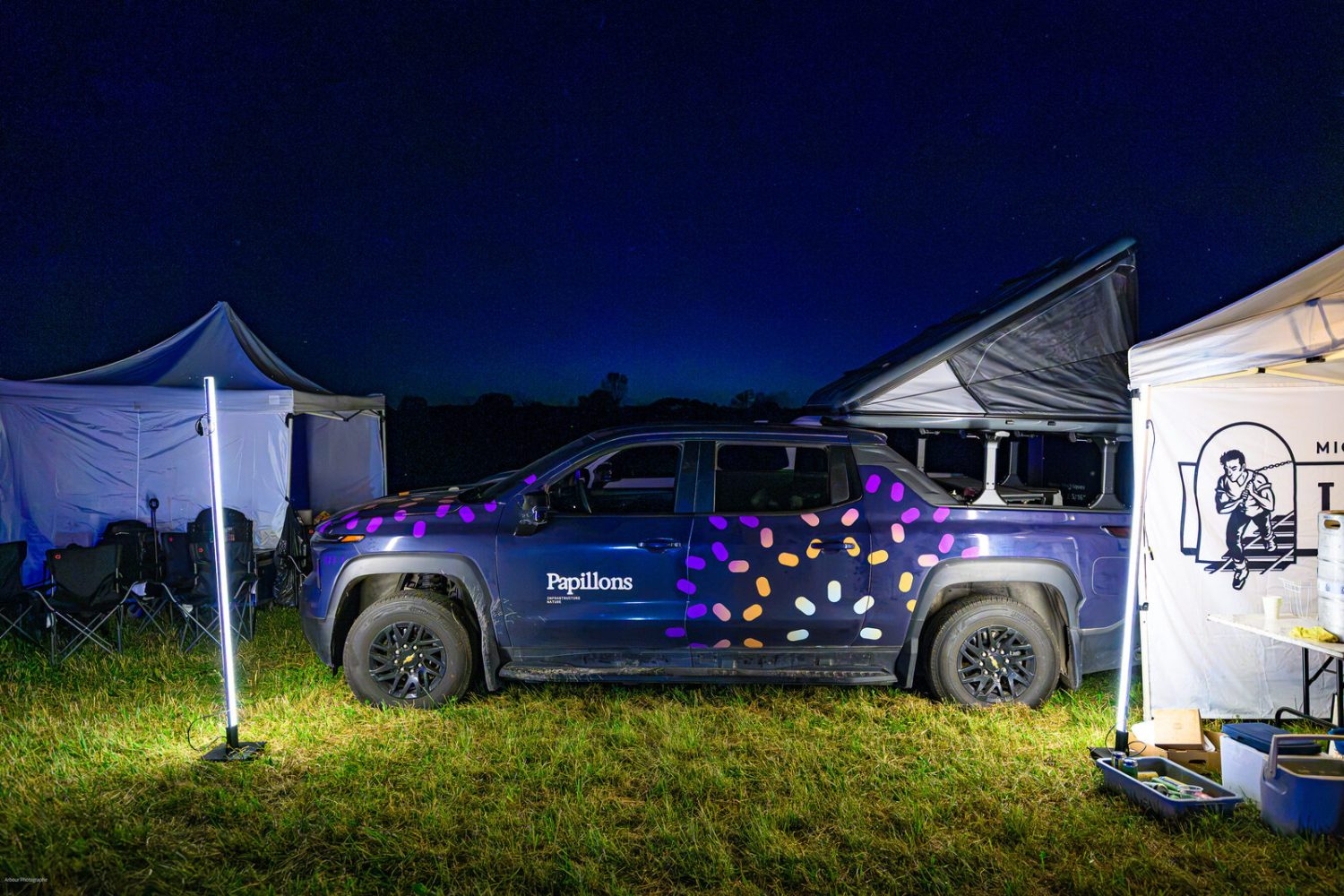
A five-stop concert tour in Quebec ran entirely on two Chevrolet Silverado EVs and a 150 kWh mobile power plant this summer. No diesel generator, and no hookup to the grid.
I went to the final show, held in a grocery store parking lot in Montreal’s Saint-Henri neighborhood, and everything from the speakers to the stage lights to the kitchen was running off batteries.
A free tour powered by EV batteries
The tour, called “Le goût du paysage” (roughly “a taste of the landscape”), was put together by Papillons. That’s the Quebec company behind the RechargÉco fast-charging network, which it operates across Quebec and New Brunswick.
The idea was simple: bring Québécois artists Émile Proulx-Cloutier and Dumas, along with chef Oli cooking free corn dishes made with regional ingredients, to scenic spots across the province. Admission was free.
It ran from August 15 to 22 with stops in Trois-Pistoles, the Vallée Bras-du-Nord in Saint-Raymond, Parc Éco-Laurentides in Mont-Blanc, and Île-aux-Castors in Berthierville (that one sold out). The tour wrapped up with both artists on stage in the IGA parking lot in Saint-Henri.
Papillons billed the whole production as “100%” powered by EV batteries, with “zero emissions from start to finish.” Based on what I saw on site, that’s accurate.
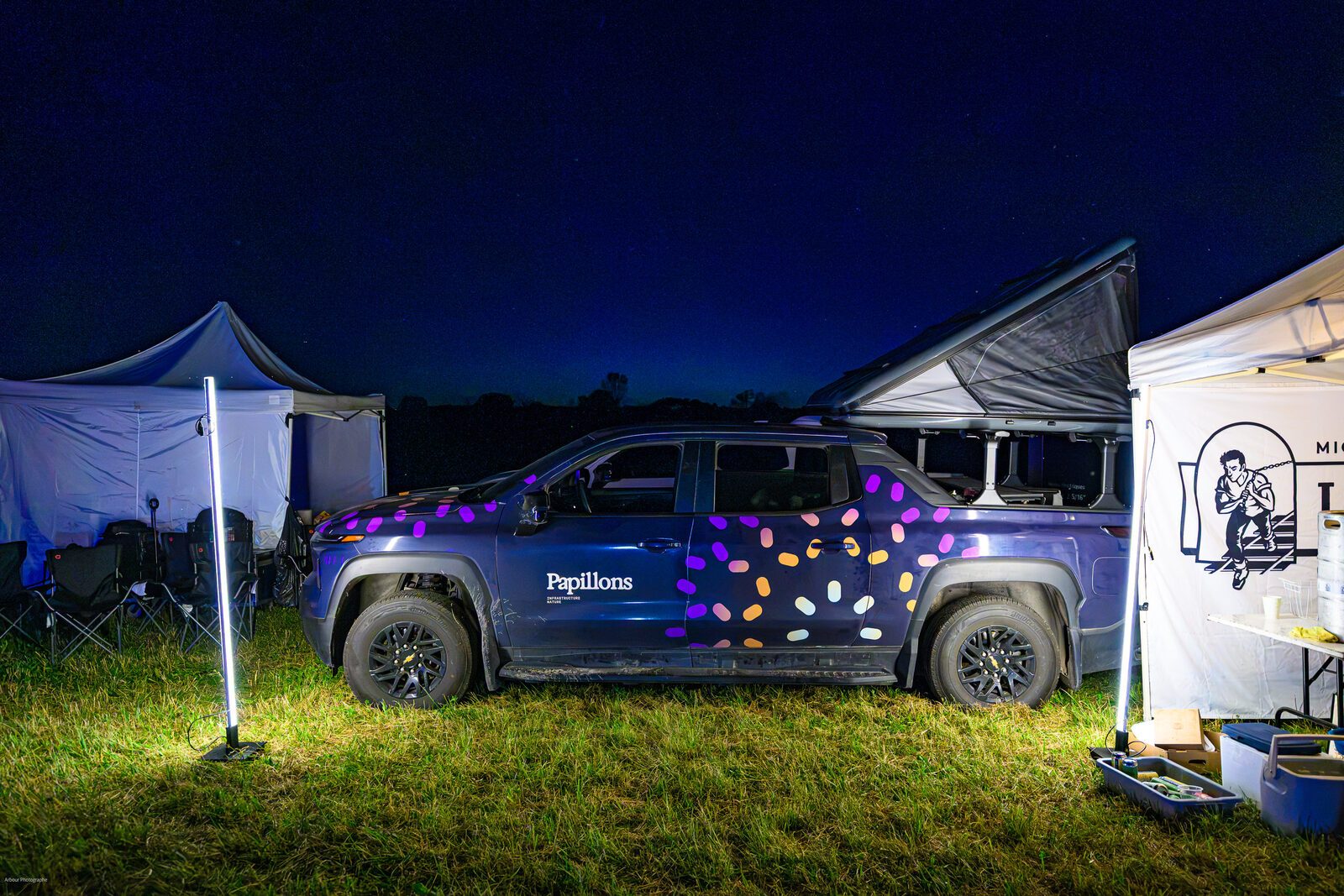
Two pickups running the stage
The two Silverado EVs handled the stage: the sound system, the lighting, and the site lights once the sun went down. In Saint-Henri, I could follow the cable straight out of the power outlet in one truck’s bed to the stage.

It’s a good job for the truck. The Silverado EV can be had with up to a 205 kWh battery pack, one of the biggest you can buy in a consumer vehicle, and GM rates its onboard power at 7.2 kW to 10.2 kW depending on the trim. We’ve already seen GM run an entire mansion off a Silverado EV when it launched its GM Energy products, and the 2026 Silverado EV only pushed range further.
For comparison, Ford’s F-150 Lightning tops out at 9.6 kW of onboard power. And Tesla only just added 2.4 kW of vehicle-to-load to the Model Y Premium, and you need an $80 adapter for it.

The kitchen ran on a 150 kWh mobile power plant
The kitchen is the hard part. Cooking equipment pulls a lot of power, and it runs for hours.
For that, Papillons used a trailer-mounted mobile power plant with 150 kWh of energy capacity. It powered chef Oli’s kitchen at every stop.
Full disclosure: my company, Ixian, was involved in this project. We helped Papillons engineer the mobile power plant. Papillons isn’t ready to share more details about the system just yet, so I’ll leave it at that for now, but you can reach out to them if you are interested in such a product.
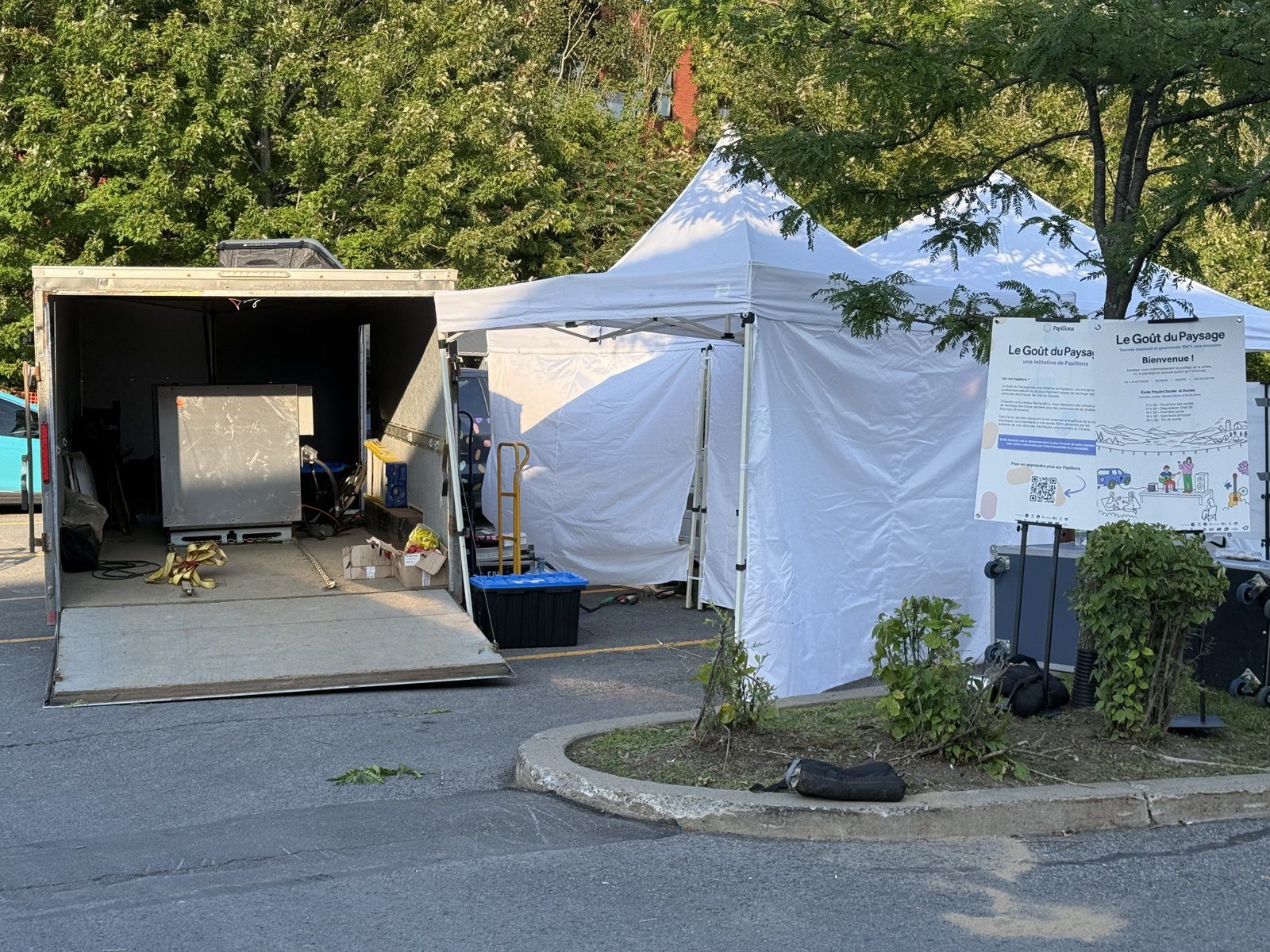
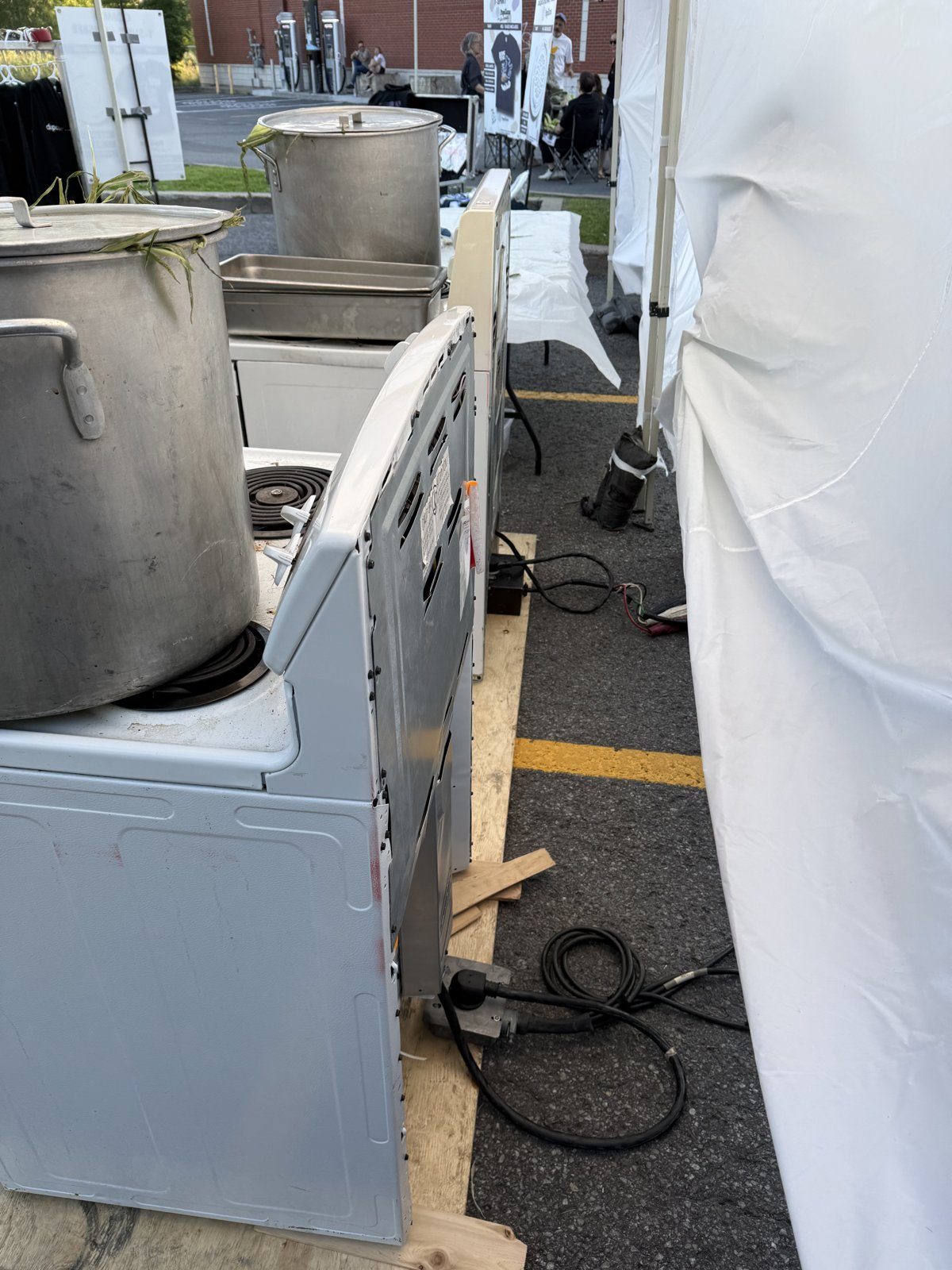
At the Saint-Henri stop, the trailer was parked right next to the kitchen tent, feeding full-size electric ranges topped with giant stockpots.
Why bother with batteries in the city?
The show I attended was in the middle of Montreal. There’s power everywhere in Saint-Henri: the grocery store, the buildings around the lot, the streetlights.
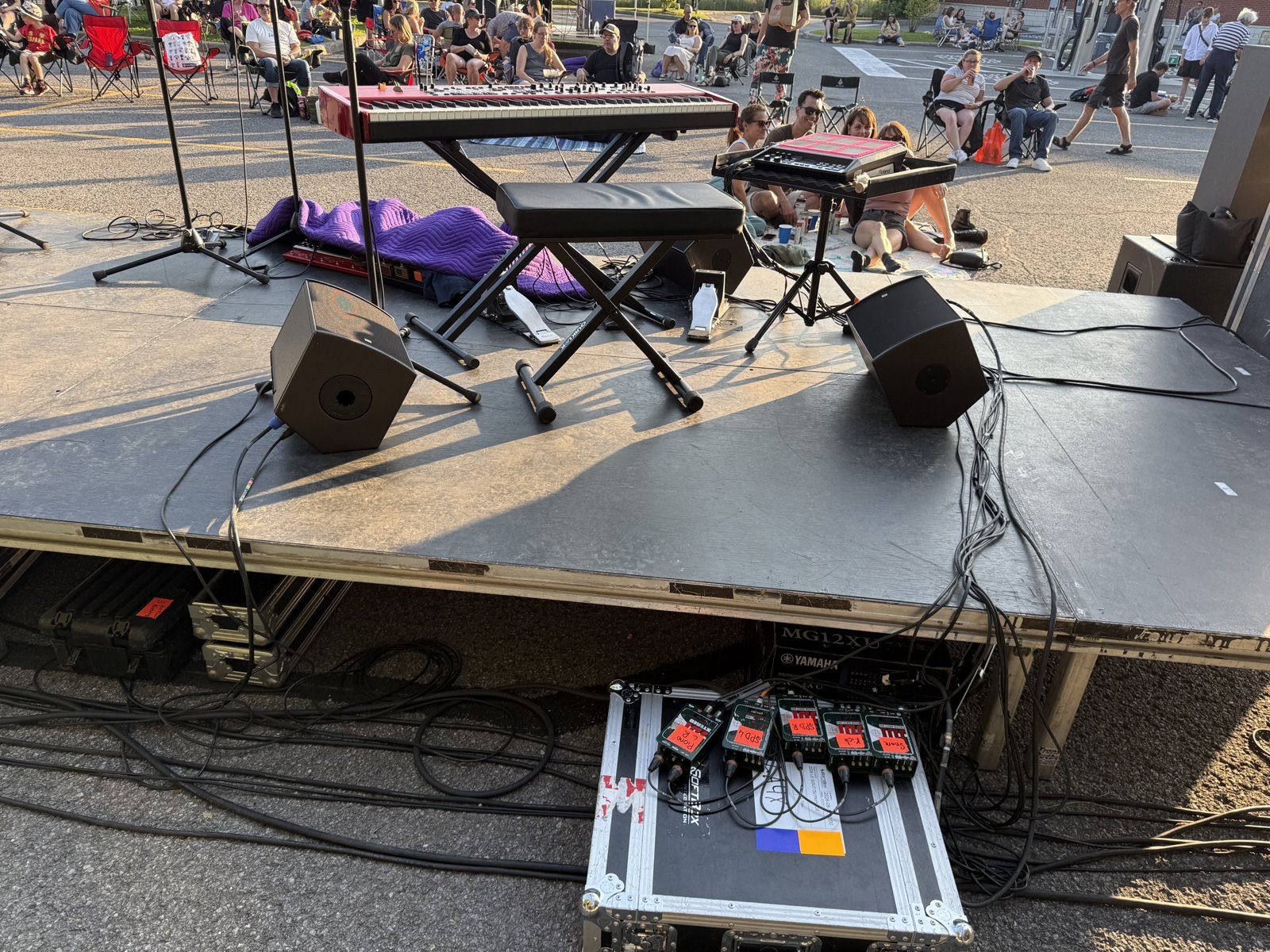
But having power nearby and being allowed to use it are two different things. Getting a temporary connection for an event usually means dealing with the utility or the property owner, hiring an electrician, and paying for all of it, often for a single evening. Plenty of organizers skip the headache and rent a diesel generator instead.
With batteries, you roll in, plug in, and you’re done. And on a stage where people are there for quiet acoustic songs, the lack of a rumbling generator behind the crowd matters.
But the real advantage showed up at the other four stops. A riverside island in Berthierville, a valley in Saint-Raymond, a park in the Laurentians. There’s no grid access at those spots, period. Normally, that’s where the diesel generators come out, if the show happens at all.

And the energy itself is about as clean as it gets. The trucks and the power plant recharge on Quebec’s grid, which Hydro-Québec says is over 99% renewable, mostly hydro.
Electrek’s Take
Top comment by Beario
I can think of quite a few people that would fall in love with an EV if they were able to get one in their budget that has the capability to provide power for their home. They have quite a few power outages in their area and use generators a lot, but having a car as backup with be a game changer for them. Interestingly enough, some much more affordable Chinese EVs mostly have these features and coming to Canada very soon.
Events are a great fit for mobile power supply. Festivals, outdoor concerts, film shoots, and construction sites burn a lot of diesel in rented generators, and they do it right next to people. A big battery on wheels does the same job silently, with no fumes, and it can be recharged at a charging station between stops. It helps that Papillons runs a fast-charging network.
The limit right now is output. Even the Silverado EV caps out around 10 kW per truck, which is plenty for sound and lights but not enough for everything.
But the concept works. I saw it work. It’s a great use case example for bidirectional charging, which I think is going to become an increasingly important part of the EV revolution.
Charge your electric vehicle at home using rooftop solar panels. Find a reliable and competitive solar installer near you on EnergySage, for free. They have hundreds of pre-vetted installers competing for your business, ensuring you get high-quality solutions and save 20-30% compared to going it alone. Plus, it’s free to use, and you won’t get sales calls until you select an installer and share your phone number with them. Your personalized solar quotes are easy to compare online and you’ll get access to unbiased Energy Advisers to help you every step of the way. Get started here.


FTC: We use income earning auto affiliate links. More.




Comments