
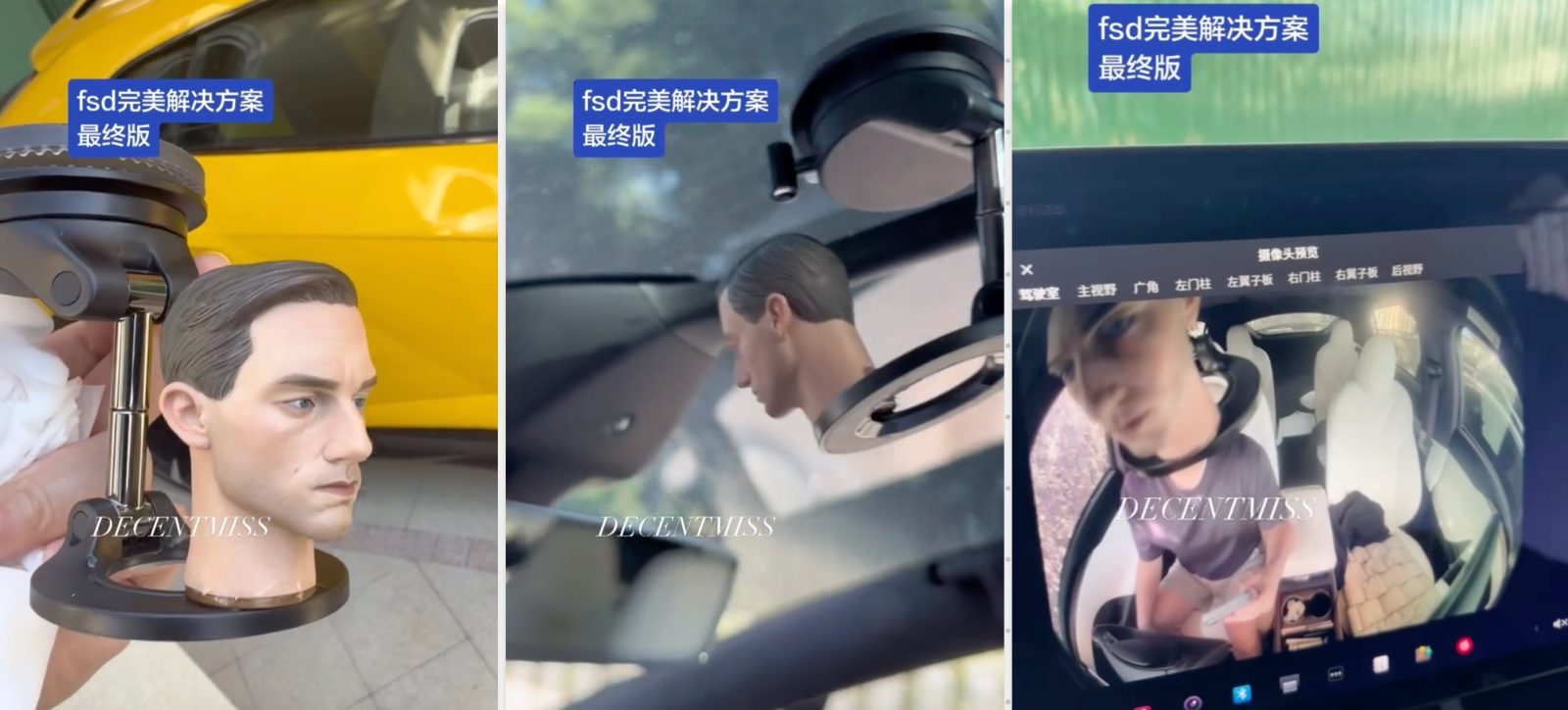
A cottage industry has emerged on Chinese e-commerce platforms selling tiny plastic doll heads designed to trick Tesla’s cabin camera into thinking a driver is paying attention. The devices cost as little as $20 to $50.
The products — marketed as “travel companions” and “dashboard decorations” — represent the latest and most absurd escalation in the arms race between Tesla’s driver monitoring safeguards and people determined to defeat them. It’s also incredibly dangerous and irresponsible.
How the bypass works
Chinese Tesla drivers are mounting miniature celebrity figurine heads near the rearview mirror to fool the cabin-facing camera that monitors driver attention during Autopilot and “Full Self-Driving” (Supervised) use.
Tesla’s driver monitoring system uses the cabin camera to track head position and eye movement, ensuring drivers keep their eyes on the road. A strategically placed plastic head with forward-facing features apparently satisfies the system’s detection criteria.
Digital Trends reports that one Tesla Model 3 owner in China used a fake head resembling Dwayne Johnson and reportedly drove for 30 minutes without a single safety alert — one hand eating sunflower seeds, the other filming video. That’s a driver operating a 4,000-pound vehicle at highway speeds with zero attention on the road.
The sellers offer everything from celebrity figurines to screens that display blinking eyes, with custom solutions that attach directly to seat headrests or dashboards. The customer reviews make clear what buyers want: freedom to look at their phones, eat, or nap while the car drives – regardless of whether that’s safe or legal.
The latest round of a dangerous arms race
This isn’t new behavior — just a new form of it. Tesla drivers have a long history of trying to defeat safety monitoring, and the safety systems have consistently failed to stay ahead.
The first generation of defeat devices were steering wheel weights designed to trick the torque sensor into believing someone was holding the wheel. NHTSA shut down one product called the “Autopilot Buddy” with a cease and desist, but knockoffs persisted. Tesla then expanded its driver monitoring to include the cabin camera, which was supposed to be the smarter answer.
Now a $30 plastic toy defeats that “smarter answer.”
The timing makes this especially concerning. Tesla just launched FSD (Supervised) in China, and it is already facing a fraud lawsuit from 10 Chinese owners over “Full Self-Driving” promises. The company also recently had to crack down on over 100,000 vehicles using hacked FSD enabler devices in countries where the software wasn’t approved.
There is clearly a pattern here: a significant subset of Tesla owners treats safety systems as obstacles to be defeated rather than protections to be respected.
Real consequences, real deaths
The consequences of driving without attention on a Level 2 system are not theoretical. Tesla’s Autopilot and FSD (Supervised) are not autonomous — they require a human driver to supervise and take over at any moment.
We’ve covered what happens when that supervision fails: a Tesla on FSD crashed through a railroad gate seconds before a train arrived, a former Uber self-driving chief crashed his Tesla on FSD while demonstrating the supervision problem, and a Tesla driver crashed during a livestream showing off the feature.
NHTSA has identified 80 FSD traffic violations including running red lights and crossing into wrong lanes, and has upgraded its investigation to an engineering analysis covering 3.2 million vehicles — the final step before a potential recall.
Every one of these incidents involves a system that assumes a human is watching. A plastic head staring at the windshield is not a human watching.
Electrek’s Take
Let me be direct: anyone mounting a fake head to defeat their Tesla’s driver monitoring system is putting their life and the lives of everyone around them at risk. And the sellers profiting from these devices are enabling potentially fatal behavior for $30 a pop.
Top comment by kbrannen
Completely irresponsible of the drivers doing this. OTOH, my evil twin thinks it's hilarious that the monitoring software can be fooled so easily.
But ultimately, the biggest problem is the culture around Level 2 automation that treats the driver as an optional component.
No, not really.
Until the car can actually drive itself without supervision,...
That's the ultimately biggest problem. If the car really could drive itself -AND- Tesla would take liability for the software's actions, then the whole problem of wanting/needing to fool the monitoring software goes away.
There’s a tendency to treat this as a funny story, the absurdity of a Dwayne Johnson figurine fooling a neural network. But there’s nothing funny about a driver eating sunflower seeds at highway speeds while a Level 2 system, which can and does make mistakes, is the only thing between them and a crash. These systems fail. We’ve documented it over and over again.
Tesla deserves criticism here too. The company has known for years that drivers will try to defeat its safety monitoring, and yet its cabin camera system can apparently be fooled by a static plastic object. That’s not robust enough. If a $30 toy can bypass your safety system, your safety system needs work. Tesla should implement liveness detection, body-pose correlation, gaze tracking that accounts for occlusion, and stricter anti-spoofing measures. The company also continues to undermine its own safety messaging — we just reported that Tesla promotes FSD misuse in its own official videos.
But ultimately, the biggest problem is the culture around Level 2 automation that treats the driver as an optional component. Names like “Autopilot” and “Full Self-Driving” — even with “Supervised” tacked on — set expectations that the technology cannot meet. Until the car can actually drive itself without supervision, the human behind the wheel is the safety system. A plastic head is not a substitute for that, no matter how much you’d rather be eating sunflower seeds.
If you’re a Tesla owner looking to cut your energy costs, powering your EV with home solar is one of the smartest moves you can make. With electricity rates climbing nearly 10% last year, home solar protects you against future rate increases. And with lease and PPA options, you can go solar with zero upfront cost and start saving immediately. If you want to find the best deal, check out EnergySage. It’s a free service with hundreds of pre-vetted installers competing for your business, so you save 20 to 30% compared to going it alone. No sales calls until you pick an installer. Get your free quotes here.


FTC: We use income earning auto affiliate links. More.


Comments