
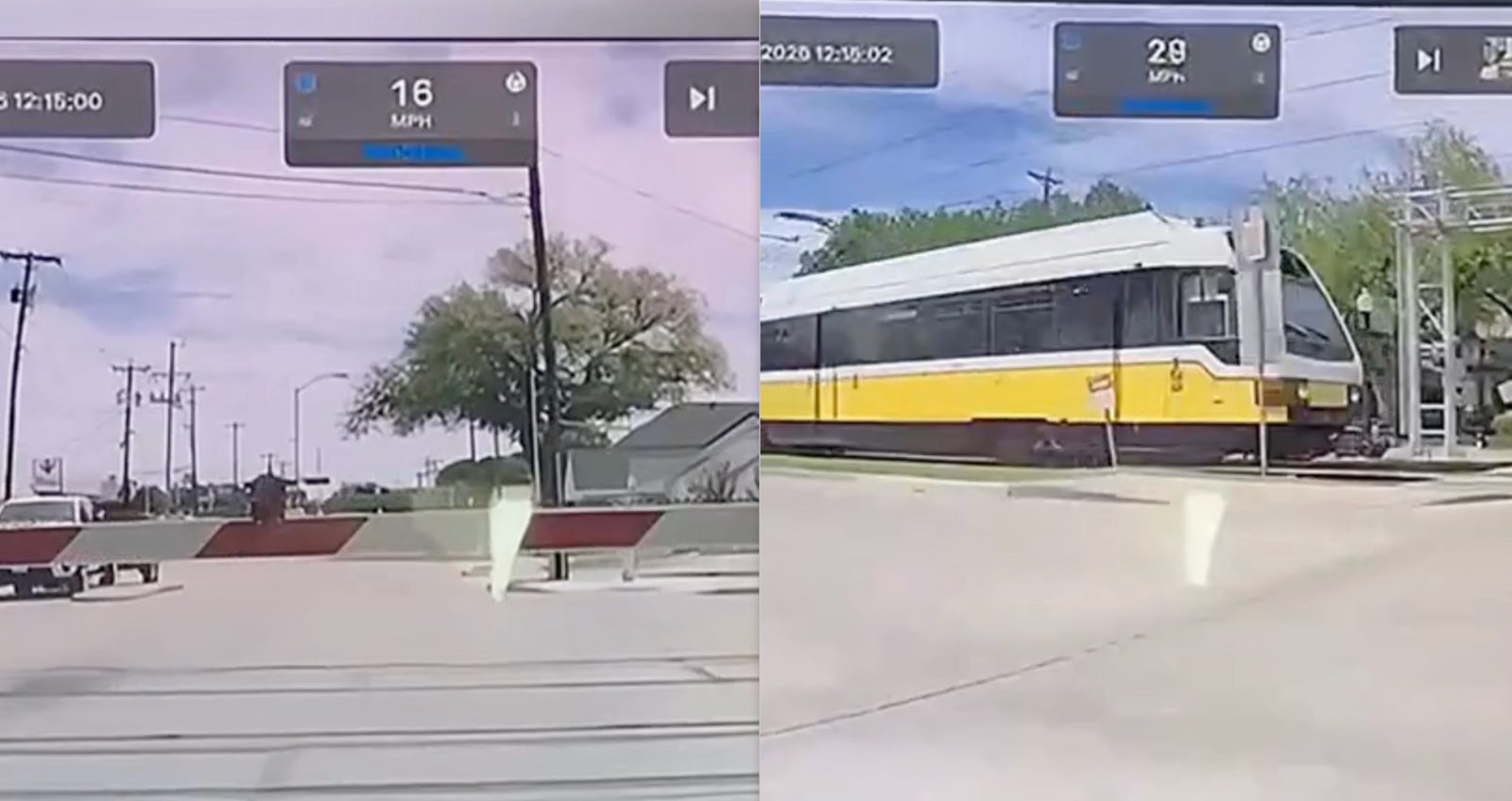
A Texas Tesla owner says he punched the accelerator to outrun an oncoming train after his car on “Full Self-Driving” drove itself through a lowered railroad crossing arm as the train closed in on the tracks.
Joshua Brown, who says he has logged more than 40,000 miles using Tesla’s driver assist, described the incident as the first time FSD has ever “let me down.”
According to Brown’s account to Storyful, he was stopped at an active level crossing — arm down, lights flashing, a train visible in the distance — and settled in for what he assumed would be at least a minute’s wait.
Then, he says, the Tesla took off on its own.
“Without any warning… my Tesla suddenly accelerated forward on its own,” Brown said. “I was completely shocked. It took me a full second — longer than I care to admit — to react.”
Brown, who says he has a racing background, did not slam the brakes. Citing the racing adage “when in doubt, throttle out,” he floored the accelerator to try to clear the tracks before the train arrived. The car smashed through the crossing arm — which Brown says hit the center of his driver’s side window and knocked items off his dashboard and center console — and crossed the rails with the train bearing down.
“In that chaotic moment, I glanced to my right and saw the train barreling toward us — lights glaring, horn blaring. It was terrifyingly close,” Brown said. “Somehow, the car pushed through to the other side of the tracks. Only then did I slam on the brakes and bring it to a stop.”
Only then, Brown says, did the Tesla’s touchscreen throw up a prompt: “Autopilot disengaged, what happened?” He walked away shaken but unharmed.
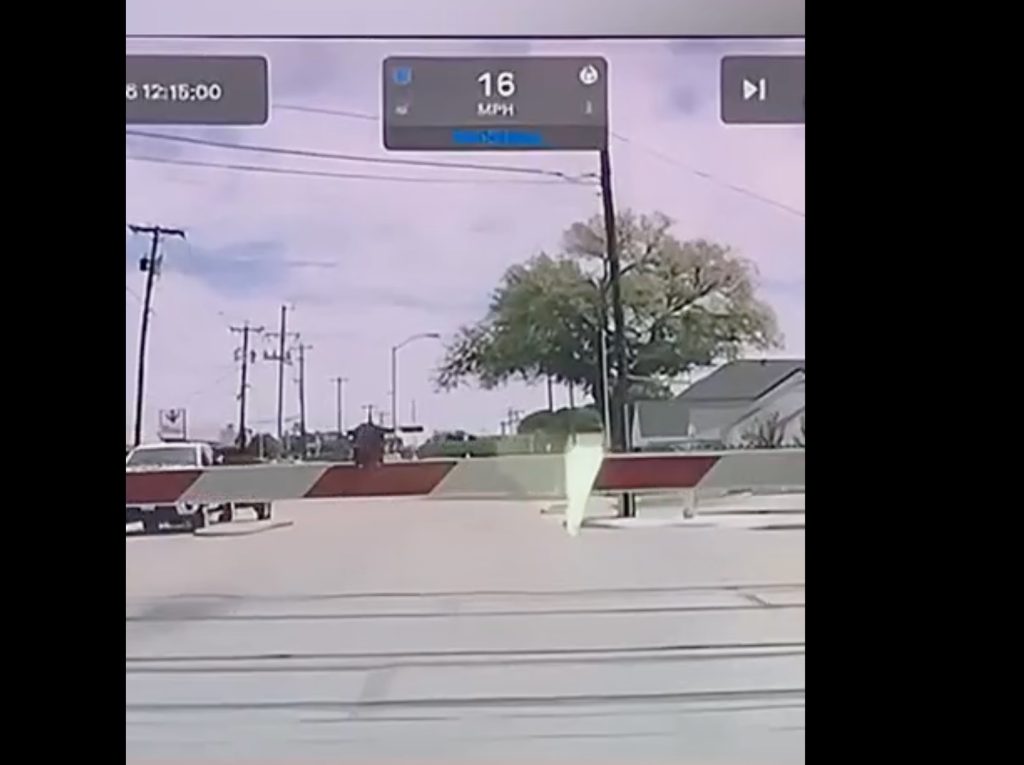
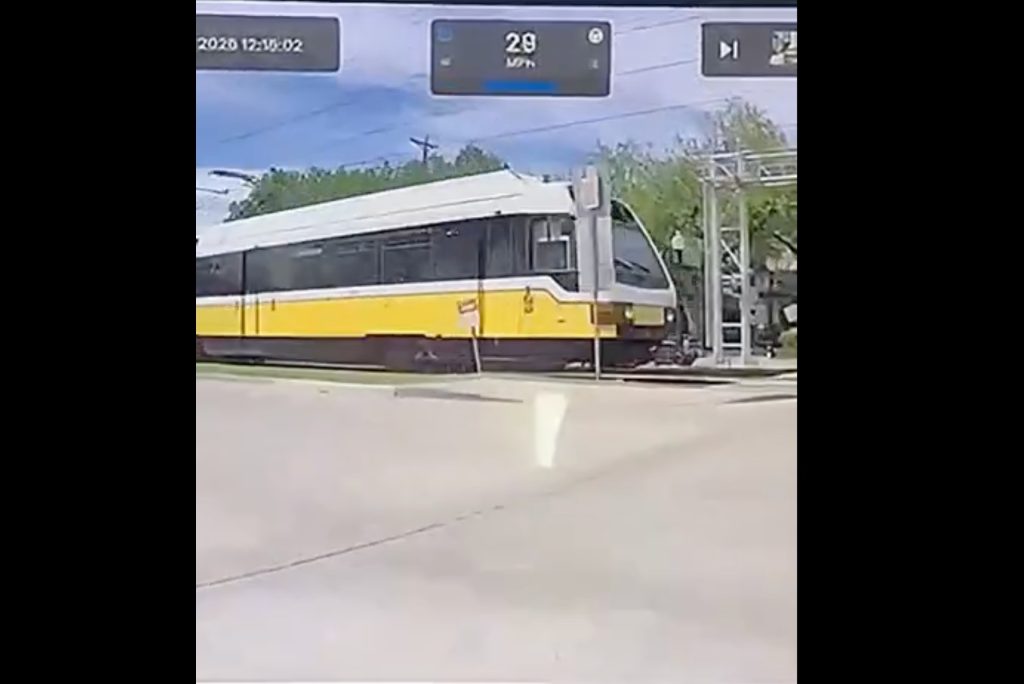
You can look at the full video on Storyful.
Not the first FSD railroad failure — and NHTSA is already investigating
Brown’s account fits a pattern Electrek has been tracking for more than a year. In March, dashcam footage showed a Model 3 on FSD drive straight through a railroad crossing arm at 23 mph in the West Covina, California area, with the owner captioning the video “Tesla FSD almost killed me today.” NBC News has documented more than 40 social-media reports of FSD failures at railroad crossings, and in 2025 a Tesla on FSD was struck by a train in eastern Pennsylvania after the system steered the car onto the tracks.
Those incidents prompted Senators Ed Markey and Richard Blumenthal to ask NHTSA to formally investigate FSD’s behavior at rail crossings. NHTSA already has an open probe into FSD after linking the system to at least 58 incidents, 14 crashes, and 23 injuries — a list that has since grown to roughly 80 documented violations, including crossing into opposing traffic lanes and running red lights.
Tesla pushed a new FSD build the day after
The day after Brown’s incident, Tesla began rolling out FSD v14.3, built on a new MLIR-based compiler and runtime that Tesla claims delivers “20% faster reaction time.” The release notes also promise improved handling for “rare and unusual objects extending, hanging, or leaning into the vehicle path” — language several observers interpreted as an attempt to address crossing-arm failures, though Tesla does not mention railroad gates explicitly.
Tesla’s own marketing says FSD Supervised is seven times safer than the average U.S. driver, citing one crash every 5 to 7 million miles versus roughly 660,000 for humans. The company does not break that figure out by incident type, does not disclose how it counts disengagements that occur seconds before a crash, and does not share the underlying dataset with outside researchers.
Top comment by betterbruce
At this point I think it's irresponsible to include the words between the beginning and end of this quote:
"Tesla...does not share the underlying [FSD] dataset with outside researchers."
It would be incredibly simple for tesla to share the data that allegedly shows supervised FSD Supervised is safe and that transparency should be the bare minimum for being allowed on public streets. Why are they hiding the data?
Despite the “Full Self-Driving” product name, FSD remains a Level 2 system and Tesla instructs drivers to keep their hands on the wheel and their eyes on the road at all times. Earlier this year, CEO Elon Musk conceded that “the actual time from when FSD sort of works to where it is much safer than a human is several years.”
Electrek’s Take
The footage on Storyful is insane. You clearly see Tesla FSD active and deciding to go despite the barriers being down, and the train comes by literally less than 2 seconds after the Tesla crosses the railroad.
From the dashcam footage, you can see that Brown presses the accelerator as FSD crosses the railroad to ensure he clears them before the train arrives.
Crazy, but the bigger picture is that this keeps happening. Railroad crossing arms are a safety system designed specifically so that even a distracted human driver can see them. A perception system that can’t reliably detect a fluorescent orange-and-white barrier lowered directly across the vehicle’s path is not seven times safer than a human driver — full stop. And the fact that v14.3’s release notes quietly added handling for “objects extending, hanging, or leaning into the vehicle path” the day after this incident tells you everything about how Tesla frames this class of failure internally: as an edge case, rather than a repeat, documented safety defect that NHTSA is already investigating.


FTC: We use income earning auto affiliate links. More.


Comments