
Natural gas is losing its grip on the global power mix as countries increasingly turn to cheaper, more secure renewable energy, according to a new report from climate and energy think tank Ember.
Ember’s analysis found that 61 out of 124 economies that generate electricity from gas have already passed peak gas power generation. That includes four G7 countries: the UK, Germany, Italy, and Japan.
Solar is crushing gas growth
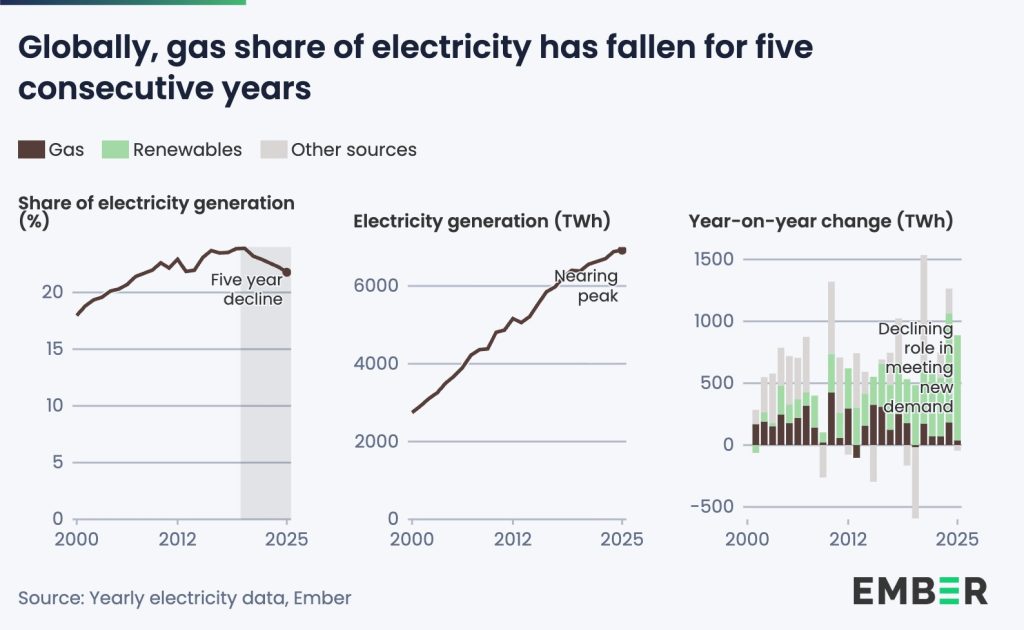
The share of gas in the global electricity mix fell for the fifth straight year, dropping from 23.9% in 2020 to 21.8% in 2025. Gas generation still increased slightly overall, but growth has slowed dramatically as solar and wind meet more of the world’s rising electricity demand.
In 2025, solar generation grew by 636 terawatt-hours (TWh) – 17 times more than gas generation, which increased by just 38 TWh. Solar alone supplied roughly 75% of new global electricity demand growth last year, while gas contributed only around 5%.
Ember said gas growth between 2021 and 2025 was about half the pace seen during 2016-2020, showing how quickly renewables are taking over new power demand growth.
“The economics and energy security case for electricity are increasingly moving in the same direction,” said Malgorzata Wiatros-Motyka, senior electricity analyst at Ember. “As renewables lower costs while reducing exposure to fuel price shocks and geopolitical disruptions, gas is steadily losing the advantages that once made it the default fuel for power system growth.”
Energy security is speeding up the shift
Ember argues that the conditions that once made gas attractive as a “transition fuel” have changed fast in recent years. Russia’s invasion of Ukraine in 2022 exposed the risks tied to imported fossil fuels and triggered major price spikes that pushed Europe and Asia to accelerate renewable energy deployment. The 2026 Middle East conflict has further reinforced the shift.
More recently, LNG market disruptions tied to the 2026 Middle East conflict have added to those concerns.
“Recent geopolitical crises highlighted the risks of relying on imported gas,” Wiatros-Motyka said. “Countries are increasingly turning to renewables because they are domestically available, more price stable, and faster to deploy.”
The report also found that gas growth is becoming more concentrated geographically. The US alone accounted for 26% of global gas generation in 2025 and was the biggest driver of gas growth over the past decade.
Among G7 countries, gas generation fell by 50 TWh in 2025 while renewables grew by 123 TWh. Ember said renewables generated almost as much electricity as gas across the G7 last year, helping clean power overtake fossil generation overall.
Big emerging economies are skipping gas
Some of the world’s fastest-growing electricity markets are also adding power without leaning heavily on gas. China, India, and Brazil accounted for around 42% of global electricity demand in 2025, but all three kept gas use relatively low.
India’s gas share in the electricity mix fell from 12.6% in 2010 to just 2.3% in 2025. In Brazil, gas accounted for 13.7% of the electricity mix in 2014 and now accounts for 7.3%. China kept gas at around 3% of its electricity mix despite huge growth in power demand.
Ember says the trend points to a broader global shift away from imported fossil fuels as countries prioritize domestically produced clean electricity for affordability, energy security, and industrial competitiveness.
Top comment by Philip234
This is one of the hidden economic benefits of renewables and it is rarely acknowledged. Wind and Solar have reduced natural gas prices in the US by ~$2 mmbtu over the past decade. The effect is that consumers who do not use ANY renewables are saving around $200 million a day. (Yes really.) It is around $70 billion a year. The "subsidies" for utility scale solar have always gone directly back to the rate payer as lower-cost electricity and it has a bonus multiplier of lower natural gas prices.
With nearly half of gas-generating economies already past peak gas power and renewables continuing to scale rapidly, the report suggests the world may be approaching global peak gas generation.
Read more: Most big US solar projects don’t spark backlash after all, study finds

If you’ve ever considered going solar, make it easy by finding a trusted, reliable solar installer near you that offers competitive pricing by checking out EnergySage. It has hundreds of pre-vetted solar installers competing for your business, ensuring you get high-quality solutions and save 20-30% compared to going it alone. Plus, it’s free to use, and you won’t get sales calls until you select an installer and share your phone number with them.
Your personalized solar quotes are easy to compare online, and you’ll get access to unbiased Energy Advisors to help you every step of the way. Get started here.


FTC: We use income earning auto affiliate links. More.



Comments