
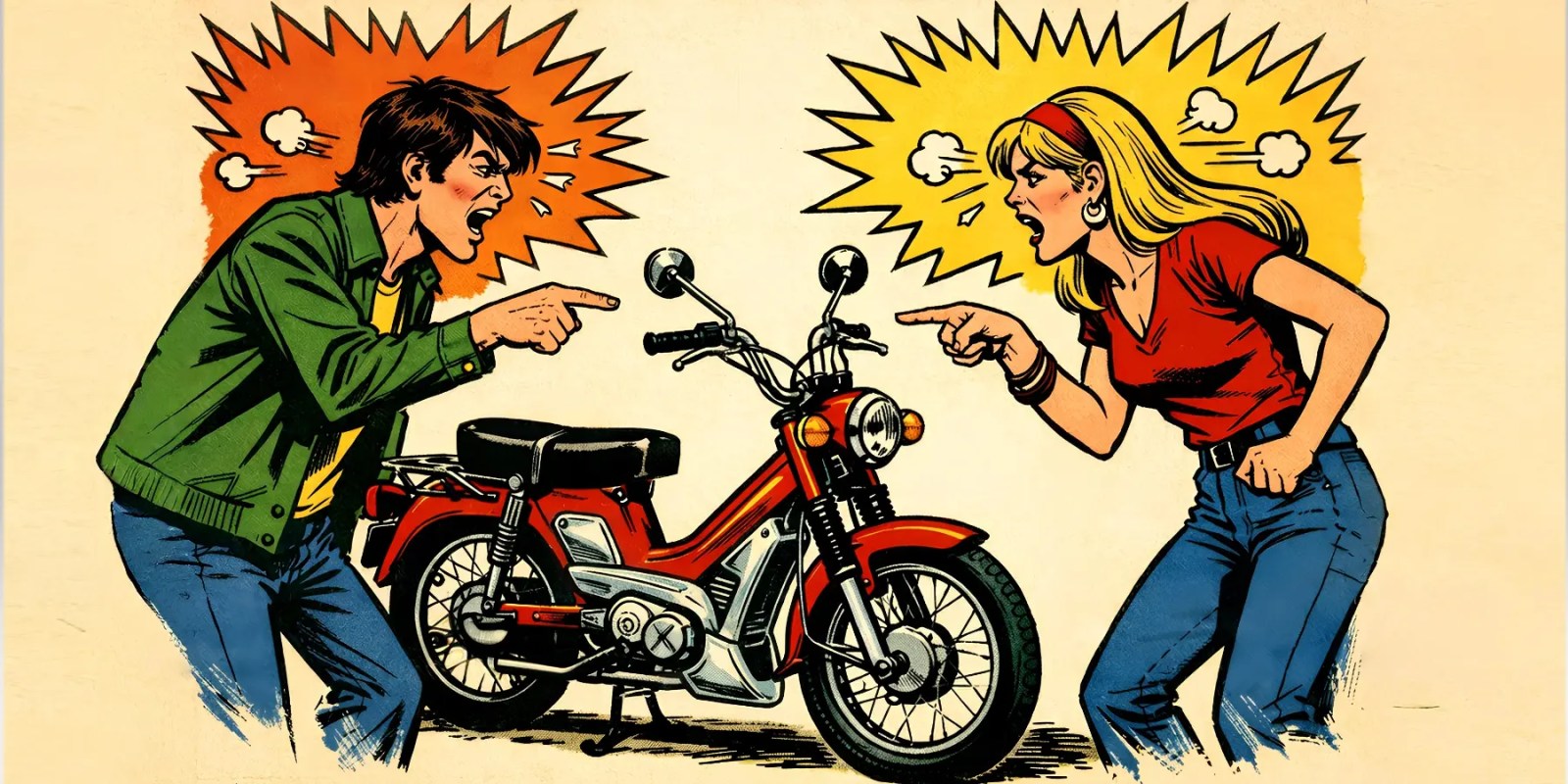
There’s a surprisingly strong debate long-swirling around the term “moped.” For a word that started as a simple mashup of “motor” and “pedal,” moped has caused an outsized amount of contention. Now, with the prevalence of a new age of light electric two-wheelers, that debate has only grown.
What began as a literal description of a pedal-equipped motorbike has, over the decades, evolved into something broader – from legal definitions to common usage. That evolution hasn’t sat well with everyone. So let’s talk about what a moped was, what it became, and why insisting that language remain stuck in time might be missing the bigger picture.
I’ve worked in and professionally covered the light electric two-wheeler space for over a decade and a half – nearly but not quite as long as the space has existed. And so I’ve had to grapple with some of these issues longer than most.
When I recently referred to Honda’s interesting new ICON e: electric two-wheeler as a “moped,” it would appear to some that I apparently committed a grave crime against etymology. The comment section quickly filled with reminders that “moped” is short for motor + pedal. Therefore, a vehicle without pedals cannot be a moped. Case closed. Someone fetch the dictionary.
But then the downpour of downvotes on such comments would beg to tell a different story, that perhaps times aren’t quite as simple as they used to be, and that perhaps the wisdom of the hive has changed.
Now, to be fair to those who take such a strong objection to the apparently willy-nilly usage of the term moped, historically, they’re not wrong. But language didn’t freeze in 1972. So let’s rewind a bit.

The original mopeds that became popular in Europe in the 1950s and 1960s were indeed a step above rudimentary motorized bicycles. They had small gasoline engines, bicycle-style frames, and actual pedals. Those pedals were often used to help start the engine or to limp home if the motor gave up. The name made perfect sense: motor + pedal.
They were low-powered, low-speed machines designed to skirt stricter motorcycle licensing laws. In many countries, mopeds were limited to around 30 mph (48 km/h) or even less, required minimal registration, and were positioned as a step up from a bicycle but a step down from a motorcycle.
But fast-forward a few decades and take a look at what most Americans mean when they say “moped.”
They usually mean a small, low-speed, step-through motorbike. Something 30–40 mph-ish (48-64 km/h-ish). Something that doesn’t quite feel like a “real motorcycle.” Something that may or may not require a full motorcycle license, depending on the state. Something your friend might have ridden to high school in the early 2000s.
Many of those gas-powered “mopeds” didn’t have functional pedals either. In fact, by the 1990s and 2000s, plenty of so-called mopeds sold in the US had abandoned pedals entirely, using small-displacement engines and automatic transmissions in scooter-style frames. The term stuck, even as the pedals quietly disappeared.
And so it wasn’t as much a matter of ignorance as it was classic linguistic drift. It’s actually something we do all the time. We still say we’re “rewinding” a video, even though there is no tape physically winding anywhere. We “hang up” a phone, even though the receiver hasn’t been slammed onto a cradle in decades. We “dial” a number on a glass touchscreen that has never had a rotary dial in its life. We measure engine output in “horsepower,” but I’ve never fed a carrot to a car.

The real problem is the English language
Language often describes usage, not just original construction. And in common American usage, “moped” has come to mean a small, low-speed motorbike – pedals optional. You can’t even dismiss it as uninformed colloquial usage, since the term “moped” for a pedal-less two-wheeler has been enshrined in law across the US, from Oregon to the Carolinas, and many places in between.
It’s similar to another frustrating example of a poorly defined alternative two-wheeler: the scooter.
In English, “scooter” might be one of the most overloaded vehicle terms in existence.
A Razor kick scooter is a scooter. A Vespa-style step-through motorcycle is a scooter. A mobility device for older folks to get around the neighborhood is a scooter. We’ve lumped together wildly different machines under one word, and it’s terribly frustrating, but somehow everyone survives.
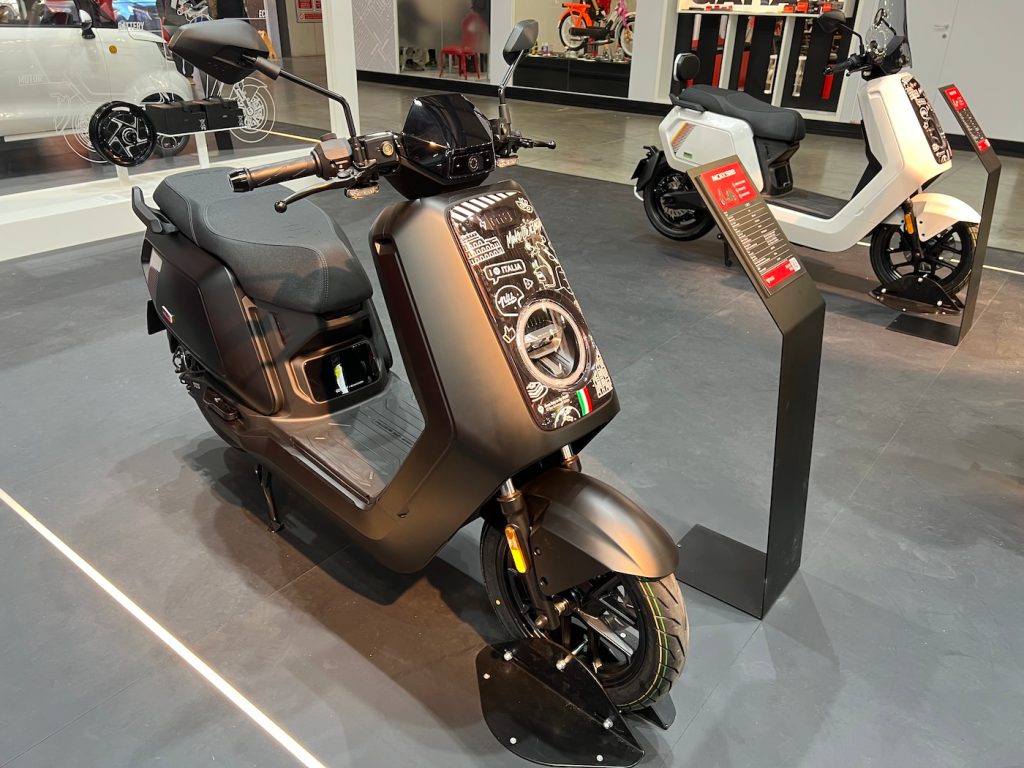
So when I call a low-speed electric step-through bike a moped, it’s not because I’m unaware of the word’s origin. It’s because I’m using the term in the way most readers intuitively understand it: small, approachable, city-speed motorbike.
There’s also a practical dimension here.
Writers covering the fascinating and ever-expanding industry of micromobility sit at the intersection of regulatory definitions and everyday language. Legally, a vehicle might fall into a very specific classification depending on motor wattage, top speed, or the presence of pedals. But readers don’t think in CFR codes and DMV subsections. They think in categories that feel familiar.
If I describe something as a “small electric motorcycle,” many readers imagine a 70 mph freeway-capable machine. If I say “scooter,” some picture a Lime rental, others picture a Vespa, and still others imagine a mobility aid.
If I say “moped,” most readers visualize a low-speed, step-through motorbike meant for city streets. That mental image is doing communication work. And communication is kind of the entire point, here.
Does that mean definitions don’t matter? Of course not.
Regulators absolutely need precise language. Lawmakers deciding licensing requirements or helmet rules need clarity. Engineers need technical accuracy.
But everyday language evolves based on how people use it, not on how it started.
No one storms into the comments to correct someone for “rewinding” a Netflix show. No one objects when you “hang up” a FaceTime call. No one insists we stop saying “horsepower” because there are no horses involved. We all understand that words carry history, but they also carry contemporary meaning.
The same thing has happened with “moped.”
In many parts of the world, especially in the US, the word has drifted from its literal “motor + pedal” roots into a broader category. It now often refers to small, limited-speed motorbikes, whether they have pedals, foot pegs, or nothing but a floorboard.
That evolution is simply how language works.
And if we zoom out even further, this debate highlights a bigger issue: micromobility lacks clean vocabulary in English. We’re trying to describe everything from pedal-assist bicycles to throttle-only e-bikes, from Sur Ron-style light electric motorcycles to seated step-through urban commuters. Our words are playing catch-up with technology.
The Sur Ron debate is perhaps the latest example of how the English language’s limited vehicle vocabulary ends up shaping – and sometimes distorting – our discourse. Functionally small, compact electric motorcycles like Sur Rons often get lumped in as “e-bikes,” not because they share much with a pedal-assist commuter, but because we don’t have a widely accepted everyday term for this relatively new category of two-wheelers. Some policy makers and advocacy groups have started coalescing around “e-moto” to describe these smaller, off-road-focused electric machines. It’s not perfect, but it may be the best shorthand we currently have. And that compromise itself proves the point: when technology evolves faster than language, people don’t stop inventing new machines – they stretch old words until they fit.
So yes, historically, a moped had pedals. Fifty years ago.
But today, in common American usage, a moped doesn’t always have to. The word has stretched to cover a category, not a literal feature list.
Top comment by Chet Kuhn
Well done on a reasonable, well thought out response to people who just like to argue about inconsequential details on the internet. I mean, it won't work, but I applaud the effort!
I’d describe that as less of a crime against language and more of proof that language is alive.
You’re still allowed to prefer the original definition. You’re also allowed to acknowledge that meanings shift over time. Those two ideas aren’t mutually exclusive.
Just don’t be surprised when the rest of the world keeps rewinding videos, hanging up phones, and riding pedal-free mopeds.
Because language didn’t freeze in 1972, and neither did mobility.


FTC: We use income earning auto affiliate links. More.


Comments