
In 2025, the world sold 20.7 million EVs – 3.6 million more EVs than it did in the previous year, according to a new report by Rho Motion. That’s a larger increase than last year’s 3.5 million increase, which was also higher than the previous year, showing that EVs keep growing despite unprecedented attacks against them by governments, media and even by automakers themselves.
2025 was once again marked by ubiquitous falsehoods in the media regarding electric cars.
If you spent the year reading headlines, or listening to lobbying from automakers, or political statements by fossil shills squatting in government, you’d think the bottom was falling out of EV sales.
After all, for not just this past year, but over two years now, there have been stories all throughout media claiming that EV sales are slowing, cooling, falling, or any other number of inaccurate words.
Even automakers have reacted to these falsehoods and reduced their EV production plans – even ones which have increasing EV sales and declining gas car sales, and which know will lose billions due to their EV intransigence.
The mildly-informed person might see these headlines and these actions and think that doom and gloom is on the horizon, that the EV transition has fizzled out.
But anyone who bothered to look up one single sales number all year would perhaps see things differently.
Yes, once again, EV sales are up. By a lot.
It turns out, EV sales are actually up. Not only are they up, they’re up by a lot. Though that shouldn’t be a surprise, because they’ve never not been up.
And now, once again, we have more data to show it.
Rho Motion/Benchmark Minerals Intelligence released its annual tally of EV sales today, showing a big jump in global electric vehicle sales in 2025 as compared to 2024.
Globally, EV sales went up 20% to 20.7 million, setting yet another record (note: there has never been a year that a global record wasn’t set for EV sales, because EV sales have never gone down year over year). Any company, especially one in a long-term low-growth industry, would kill for a sales increase that large.
Not only were sales up globally, they were up in most regions. China saw a 17% rise to 12.9 million, Europe rose 33% to 4.3 million, and “Rest of World” sold 1.7 million EVs, a whopping 48% increase.
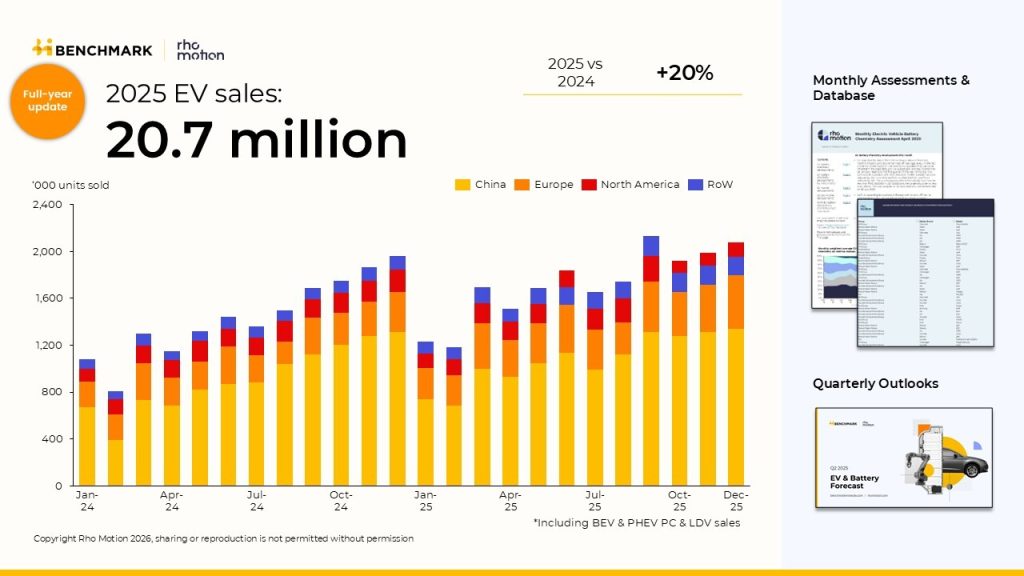
One region did go down though – North America, which saw a 4% decrease in EV sales year-over-year, with 1.8 million total EVs sold (only barely above the RoW number… a fairly pathetic showing for the market dominated by the richest country in the world).
The drop in North American EV sales shares similarities to what happened in Europe from ’23-’24. When Germany abruptly cancelled EV incentives in late 2023, EV sales dropped significantly in Europe’s most car-buying country.
This dragged down European EV sales totals for the next year or so, even though almost all other countries still experienced an increase in sales. And was accompanied by many thinkpieces about the end of the EV transition, or incorrect sentences suggesting that EV sales were dropping Europe-wide.
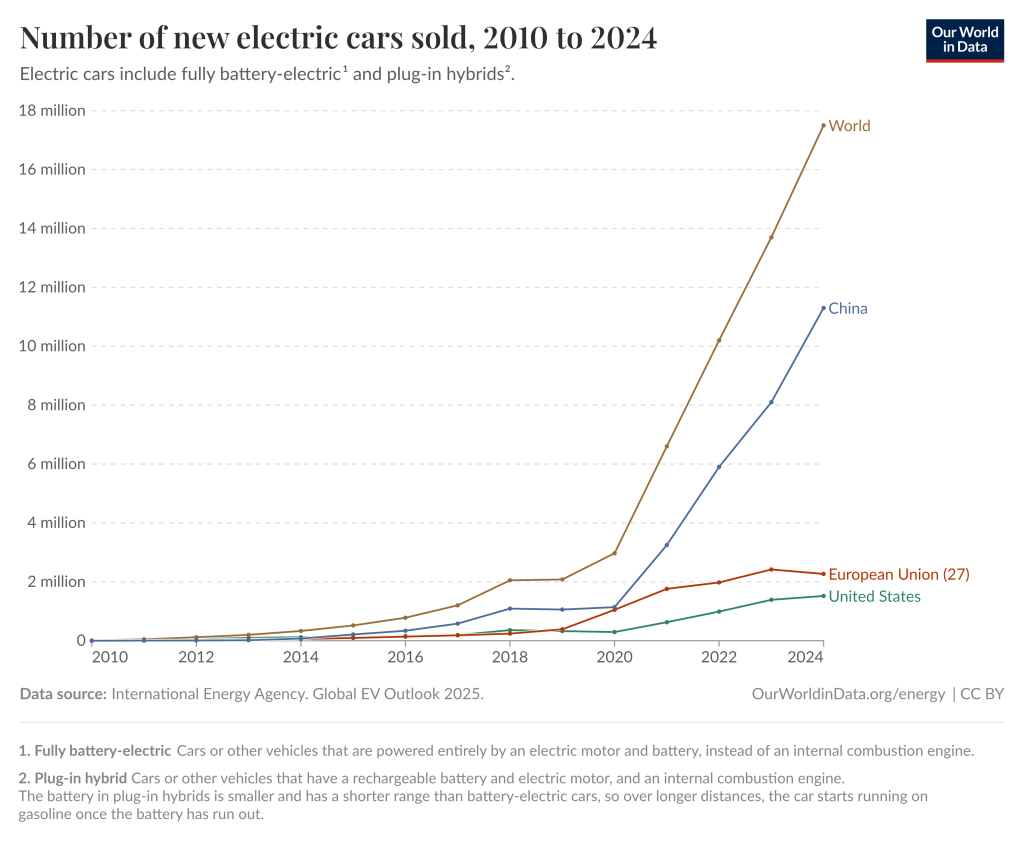
And yet, look at that new number for 2025 – European sales were up 33% year-over-year. It turns out, the EV transition is still going on quite well enough, after working through the hiccup from one country.
Does this sound familiar?
Indeed, in the US, republicans just inflated the price of EVs by $7,500, on the way to their goal of sending the US auto industry to China and in response to asked-for bribes from the fossil fuel industry. This led to a big boom in EV sales in Q3 before incentives expired, and a big drop in EV sales in Q4, after they were gone. And just like Germany, we expect depressed sales will remain for some period of time, after which sales will resume rising once again.
Not only are EV sales up, they’re up more than last year
Over the course of the last couple years of false headlines about EV sales, some have tried to suggest that the phrase “EV sales slow” doesn’t refer to the sales numbers themselves, but to growth of sales numbers.
But in fact, the 3.6 million unit increase in EV sales in 2025 is larger than the 3.5 million unit increase in 2024, which is larger again than the 3.2 million increase in 2023.
So, not only are sales up, but sales growth is up. If a unit sales increase gets larger every year, that’s accelerating growth, not decelerating.
And gas car sales are still down
Meanwhile, gas car sales are actually down long term.
Globally, sales of internal combustion vehicles are down about a quarter from their peak in 2017, and are expected to never reach that peak again. The combustion engine’s time in the sun is over, and it has been for a while.
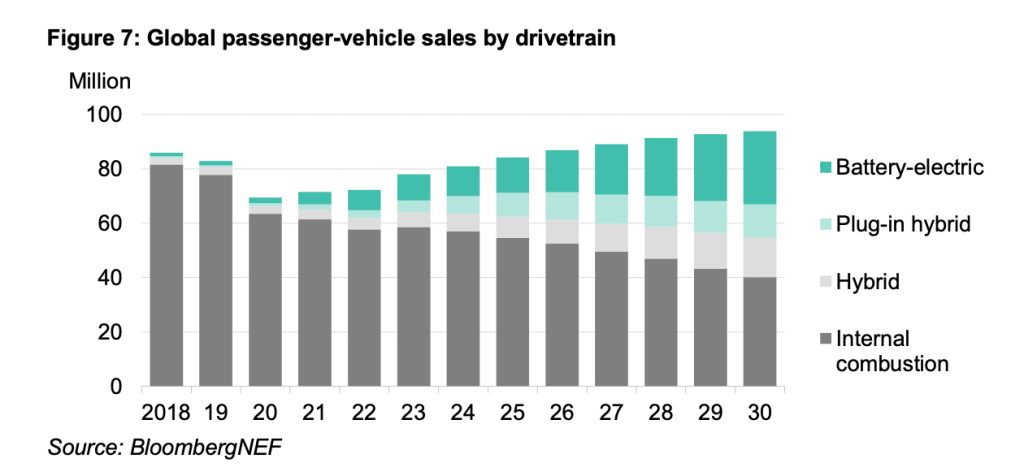
So, to look at rising EV sales and claim a problem there while ignoring – or worse, re-committing – to the falling internal combustion market makes no sense whatsoever, especially in a business with long development timelines.
So of course, that’s what Western auto manufacturers have done.
Western automakers will fail if they commit to a falling market
Throughout the last couple years, automakers have played their standard tune – begging governments to let them poison everyone just a little bit more.
There’s even reason to believe that incorrect headlines about EV sales were an intentional effort by automakers to influence regulations, as argued by Union of Concerned Scientists’ David Reichmuth. By claiming that EV sales are softer than they are, and ignoring falling gas car sales, automakers were hoping to influence governments to soften targets, so that they could save a few pennies on regulatory costs.
Automakers did have some success in getting governments to soften their targets as a result of these falsehoods. The Biden EPA adopted softer exhaust rules as a result of automaker lobbying, and Europe recently softened its EV timeline for a second time, both in response to incorrect claims about EV demand. Expect the same behavior in the UK this year, even though that country is on track to meet timelines.
But those same automakers seem to have gotten too high on their own supply, adjusting their plans to incorporate the misinformation about EV sales that they themselves planted. Many have reduced their EV production plans and re-committed to outdated and unpopular gas cars going forward.
Yet despite their best efforts, EV sales still rise, and gas car sales still fall, as we’ve seen above.
Guess who isn’t doing that? China
This push against progress has at least been true for Western automakers, and for Japanese ones too (the Koreans, Hyundai/Kia, do participate in backwards industry lobbying organizations, but have mostly been clear that EVs are the way to go).
Not so for Chinese automakers. Chinese automakers are charging forward with EV production, committing to produce the more efficient vehicles that the world needs and is demanding. Instead of putting their effort into providing the outdated gassers that nobody wants, they’re making state-of-the-art EVs that are far more affordable to use.
Top comment by Weezedog1
The US media are going to report more on US or North American market EV stats than the worldwide market and in that sense they are correct to report sales of EV have declined in NA. But they aren't declining for the rest of the world, and the US is going to be left behind in this technology race. Reality is that like everything else, EVs have been politicized in this country and that will end up harming us in the long run.
And instead of competing, Western countries have thrown up unwise trade barriers that won’t work to get those countries back on track.
This is why China recently became the largest auto exporter in the world – it planned and competed, instead of playing the same stupid game of trying to stop progress that incumbent industry always plays.
We here at Electrek have been clear about this for years now – automakers should look forward, not backwards, and should stop pushing misinformation about their own sales numbers by claiming that up is down. We haven’t had any special insight here, just the simple ability to compare two numbers to see which one is bigger. Try it out sometime.
Charge your electric vehicle at home using rooftop solar panels. Find a reliable and competitively priced solar installer near you on EnergySage, for free. They have pre-vetted installers competing for your business, ensuring high-quality solutions and 20-30% savings. It’s free, with no sales calls until you choose an installer. Compare personalized solar quotes online and receive guidance from unbiased Energy Advisers. Get started here. – ad*


FTC: We use income earning auto affiliate links. More.




Comments