
Another company that made big claims about its ability to scale and deploy EV battery swapping stations has just gone bankrupt – and, frankly, it’s not too surprising that it has.
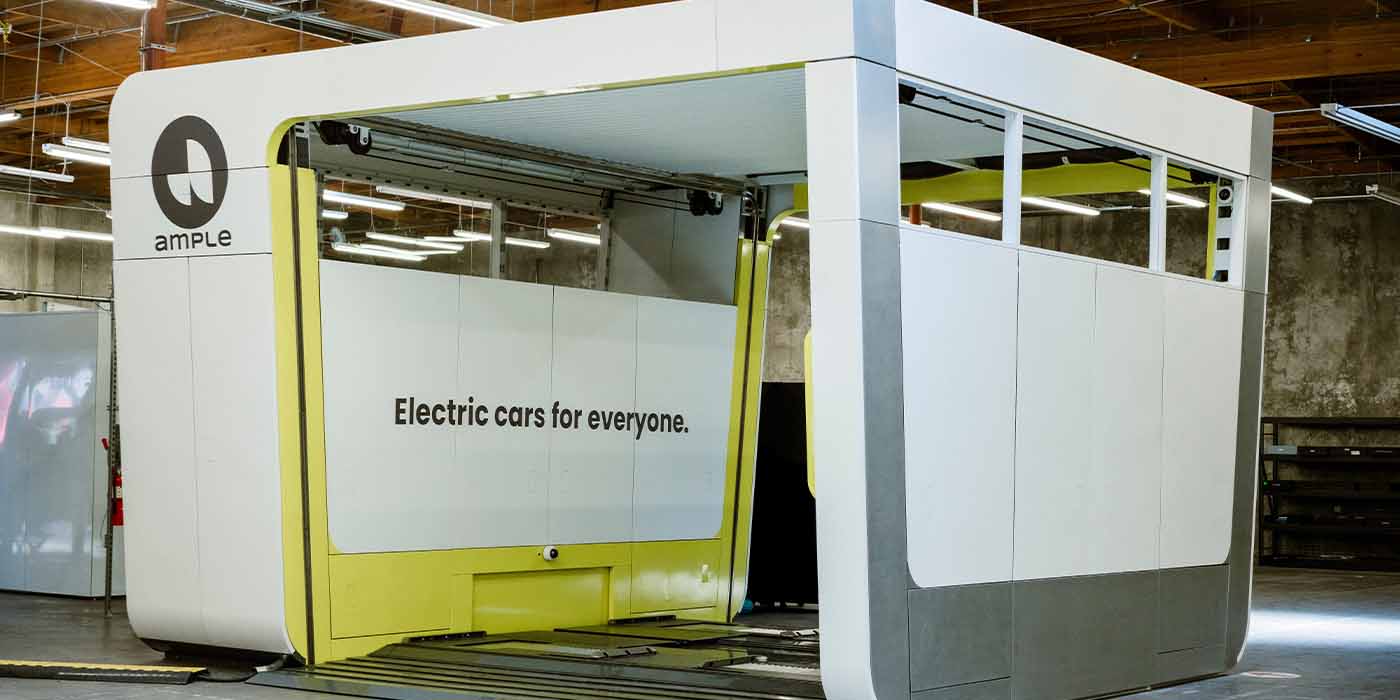
Ample is a company that made big claims about its EV battery swapping technology. It claimed to have designed autonomous battery swapping stations that would be rapidly deployable, cheap to build, and could adapt to any EV design with a modular battery which would be easy for manufacturers to use.
An Ample battery swap would take around 5 minutes and cost as little as $13, the company said.
The plan was to use this technology to scale up EV charging much faster than traditional charging stations, with the goal of getting a billion electric cars on the road.
Unfortunately, the San Francisco-based company has now filed for Chapter 11 bankruptcy in the Southern District of Texas.
Ample had raised $330 million in total over its lifetime, but shut down due to “liquidity constraints.” It was able to raise some money this year, but cited a challenging environment for renewable energy investments.
The company’s filing says it has $10-50 million in assets and $50-100million in liabilities, and is seeking $6 million in financing for working capital and to fund its bankruptcy case. Currently the company has fired all but two employees.
An anonymous tip sent to Electrek told us the employees were laid off abruptly “a few months ago,” and the company is now facing a lawsuit for violating the federal WARN act. Our tipper said the technology is real, but that the reason for the bankruptcy is regular-old poor management due to inexperience, overhyped company statements, and inefficient use of money. Take that anonymous tip with a grain of salt, but that story does sound about right for a tech startup.
Where this bankruptcy leaves Ample’s technology is unclear. Another company could snap it up and try to do something with it, if they find that the technology is real and useful. Ample had gotten investments and partnerships with Shell, Mitsubishi and Stellantis, for example, so the company wasn’t alone in touting its tech.
Or, it could just disappear, as other EV battery swapping plans have before. Both Tesla and a startup called Better Place tried and failed to set up battery swapping before. Tesla dropped the idea after a single demonstration station was built in California (both because people didn’t care to use it and because California snatched away credits which Tesla was planning to use, because they were intended for hydrogen… long story), and Better Place went bankrupt after failing to scale out of a small number of demo stations in Israel and Denmark.
That’s not to say that nobody has been successful at at implementing battery swap, though. NIO seems to be successful with its battery swapping tech in China, though the company did miss its 2025 scaling goals by a longshot. But as of yet, this is the only notable example of a successful battery swap initiative, and it was done by an automaker itself, rather than a startup claiming to work for every automaker.
Electrek’s Take
Some are covering this as a major blow to the industry, but frankly I’m not surprised.
I’m just not bullish on battery swapping as a solution in general.
Currently, the fastest-charging vehicles can charge from 10-80% in about 18 minutes. While that’s longer than 5 minutes, it’s not really a terrible amount of time to spend during most stops. I’ve done it myself on trips where I never felt like I was waiting for the car to charge, and many EV drivers can tell you the same.
Then come the power demands. While DC fast charging stations demand very high and peaky power supply, so would a fully utilized battery swap station. In fact, if cars come and go in 5 minutes instead of 18 minutes, then you’re going to have more than triple the throughput at peak utilization.
That demand could be balanced out by holding a large store of batteries in the station and charging them up at slower rates during non-peak swapping times, but then you also have to consider the additional space required to store batteries and charge them on the property. And if you don’t have enough charged batteries to give out, you need to notify people before they show up that they’ll have to wait for a battery to charge.
Ample said its swaps could be as cheap as $13, but also said that they would cost “10-20% cheaper than gas.” That’s not far off from the normal pricing of EV quick charging (and much more expensive than home charging), so there’s no real advantage there.
Then come the ownership concerns. Early on, one of the reasons Tesla drivers didn’t use Tesla’s swapping system is because after spending all that money on a Tesla Model S, much of which went to purchasing a then-quite-expensive battery pack, why would an owner want to give up their nice pristine battery pack that they’ve babied for some random pack that might have been beat up all to hell by some other owner?
There are some ways around this, like having battery health metrics or leasing and guaranteeing battery packs so people don’t feel ownership concerns. But there’s a certain pride among some of us EV nerds, especially the early ones, who understand how to be kind to batteries and want to feel ownership over how well we’ve taken care of them (my 17 year old Roadster battery still has 83% capacity).
Top comment by Alexander Platt
Waiting 20 minutes to charge a battery on the road is fine. Waiting 20 minutes for a charging stall to come available before you start charging your battery isn't. There is still a need for something to improve EV charging throughput at times of heavy demand. (Battery-swapping needn't be the solution, either.)
That concern might also fade away as the industry moves to more durable battery chemistries like Lithium Iron Phosphate, but that will require a migration across the industry, and owning a startup whose main physical assets are big piles of batteries just turns that asset into a liability if everyone decides to change chemistries. Nevermind the process of trying to get everyone onto the same battery in the first place – which is why only NIO has been successful at this so far, since it’s just one company and can dictate its own battery use, whereas a small startup is going to have a hard time getting the whole industry to agree on batteries.
So as I’ve said many times before, I still think the real solution to EV charging is ubiquitous level 2 charging where people park their cars most often (apartment buildings, homes, workplaces) and then standardized DC fast charging on the road for longer trips. We don’t need to reinvent the wheel, and we don’t need to make EVs more like gas cars (they’re already better anyway). Just plug in, it’s easy (also, as a note to governments and businesses: make it easier).
The 30% federal solar tax credit is ending this year. If you’ve ever considered going solar, now’s the time to act. To make sure you find a trusted, reliable solar installer near you that offers competitive pricing, check out EnergySage, a free service that makes it easy for you to go solar. It has hundreds of pre-vetted solar installers competing for your business, ensuring you get high-quality solutions and save 20-30% compared to going it alone. Plus, it’s free to use, and you won’t get sales calls until you select an installer and share your phone number with them.
Your personalized solar quotes are easy to compare online and you’ll get access to unbiased Energy Advisors to help you every step of the way. Get started here.


FTC: We use income earning auto affiliate links. More.




Comments