

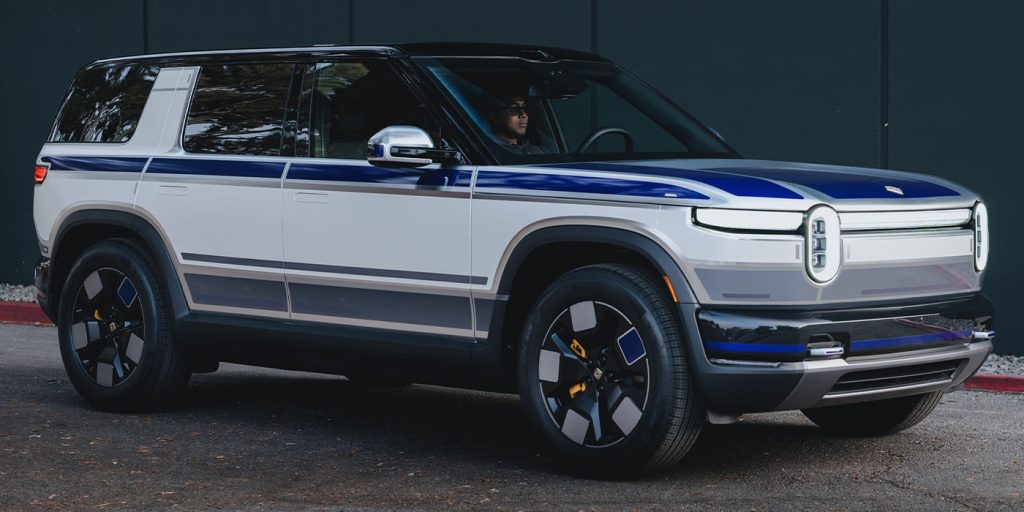
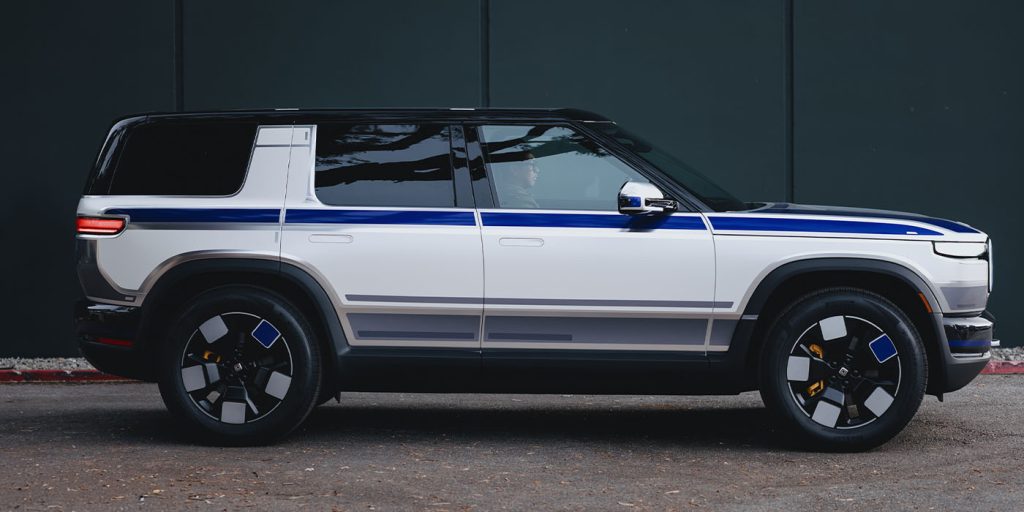
As promised, we are here in Palo Alto, California, live at Rivian’s inaugural AI and Autonomy day, which the American automaker has been teasing for a month now. The event was filled with numerous exciting updates, including new in-house technology, a new AI assistant, the addition of LiDAR, and a uniquely wrapped Rivian R2.
Today’s AI and Autonomy event has been on our radar since Rivian released its Q3 2025 financial report, back in early November. At the time, the American automaker shared it had recently founded a new AI-focused company called Mind Robotics, joining its recently launched e-bike brand, ALSO.
When Rivian’s comms team shared the news about Mind Robotics, it said not to bother asking any additional questions, as the company wasn’t sharing any other details at the time. Instead, more would be revealed at an upcoming event called Rivian’s AI and Autonomy Day, slotted for December 11, 2026.
Here we are, and if you’re reading this, Rivian’s livestream of the inaugural event is either happening or has recently taken place. In addition to AI news, Rivian shared a slew of exciting updates, including some new component integrations as the automaker joins the race to achieve full-fledged Level 4 autonomy someday.
There’s a lot to unpack here, so let’s dig in.

Rivian to deliver new AI and autonomy tech in early 2026
Since today’s event was partially an AI Day, let’s start there. To begin, it revealed a new Rivian Autonomy Processor (RAP1) and Gen 3 Autonomy Computer, powered by a new in-house silicon chip designed for vision-centric AI.
According to Rivian, RAP1 will power its Gen 3 Autonomy computer, called the Autonomy Compute Module 3, or “ACM3.” Here are some key specs:
- 1,600 sparse INT8 TOPS (Trillion Operations Per Second)
- Processing power of 5 billion pixels per second
- RAP1 features RivLink, a low-latency interconnect technology allowing chips to be connected and multiply processing power
- RAP1 is enabled by an AI compiler and platform software developed in-house by Rivian
Additionally, AI plays a key role in Rivian’s business infrastructure and user experience through a shared, multi-modal, and multi-LLM data foundation it calls “Rivian Unified Intelligence” (RUI).
Rivian says RUI will integrate AI into diagnostics to assist techs and quickly identify “complex issues.”Rivian states that the AI platform will also aid in the development of powerful new features, enhance service infrastructure, and facilitate predictive maintenance.
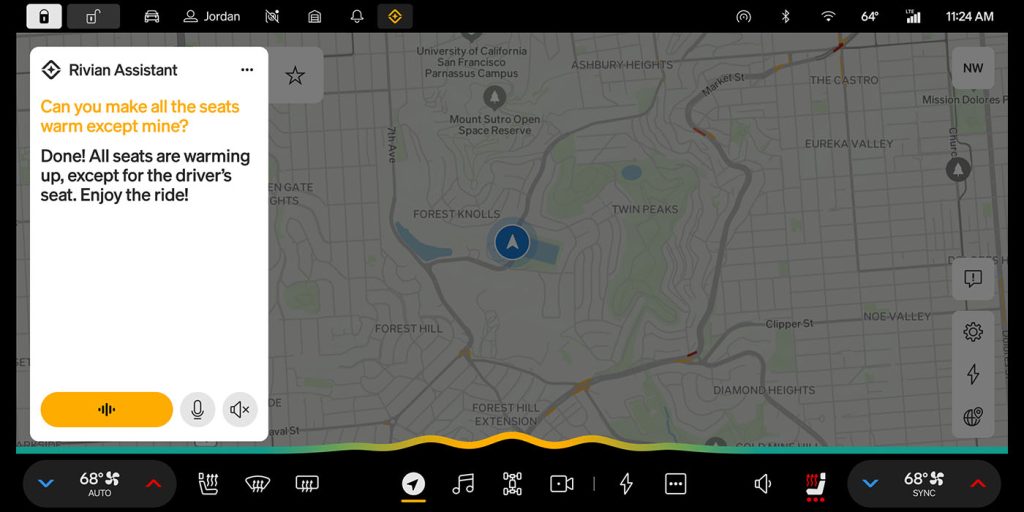
A notable addition that stood out to me in this new architecture is the Rivian Assistant (pictured above), which we’ve learned will launch in early 2026 on Gen 1 and Gen 2 R1 vehicles. Here are some highlights, per Rivian:
- Built on Rivian’s edge models to understand your vehicle, your digital life, and the world around you
- Connects vehicle systems with third-party apps using an in-house agentic framework, with Google Calendar named as the first integration
- Augmented by frontier large language models for grounded data, natural conversation and
- powerful reasoning.
Now for the second part of Rivian’s special event – autonomy. This morning, Rivian shared details of its new Autonomy Platform as well as an end-to-end data loop used to train it. This Large Driving Model (LDM) is trained similarly to a Large Language Model (LLM), but programmed to achieve foundational autonomy, with the ultimate aim of reaching Level 4 self-driving capabilities.
The new LDM will gather ideal driving strategies from massive datasets using Group-Relative Policy Optimization (GRPO) and will then incorporate those techniques into a compatible Rivian vehicle. According to Rivian, those autonomy software enhancements will be rolled out to Gen 2 R1 models in the near future, unlocking Universal Hands-Free (UHF) driving capabilities for over 3.5 million miles of roads across the US and Canada. Check it out:
To access this feature, Rivian has introduced an autonomy subscription called Autonomy+, launching in early 2026 for a one-time fee of $2,500 or a monthly payment of $49.99 to access the feature and its ongoing improvements.
Rivian hinted at some of those autonomy-centric improvements in the works for the Gen 2 R1 and R2 EVs, which include point-to-point, eyes-off, and personal Level 4 driving capabilities. Rivian founder and CEO, RJ Scaringe, spoke to the new tech debuting at AI and Autonomy Day:
I couldn’t be more excited for the work our teams are driving in autonomy and AI. Our updated hardware platform, which includes our in-house 1600 sparse TOPS inference chip, will enable us to achieve dramatic progress in self-driving to ultimately deliver on our goal of delivering L4. This represents an inflection point for the ownership experience – ultimately being able to give customers their time back when in the car.
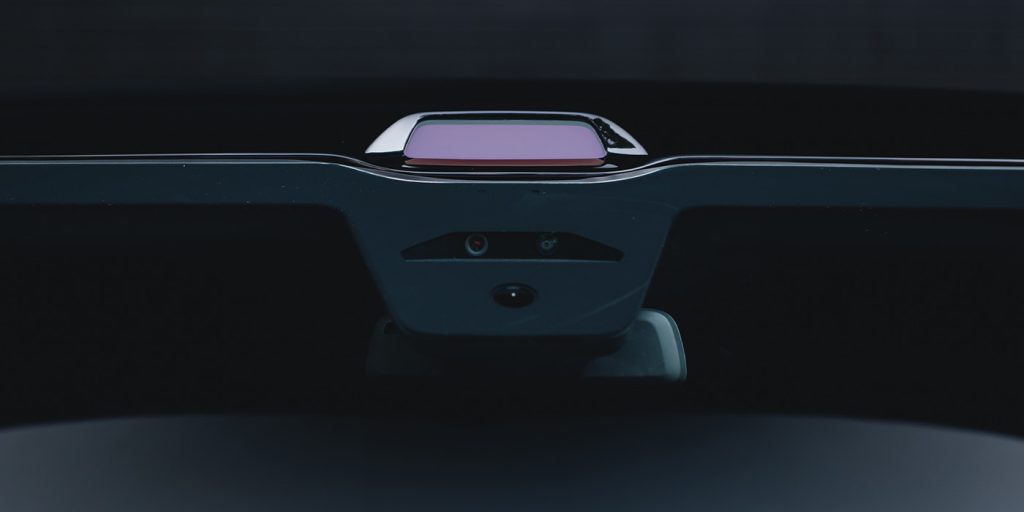
Last but not least, the upcoming R2 made an appearance, cleverly “dressed” as R2D2 from Star Wars. What was more interesting, however, was that the R2 was equipped with a new piece of autonomy tech new to Rivian EVs – LiDAR.
That’s right; today, Rivian confirmed that it plans to integrate LiDAR into future R2 models, alongside the previously mentioned ACM3. Per Rivian:
LiDAR will augment the company’s multi-modal sensor strategy, providing detailed, three-dimensional spatial data and redundant sensing, and improving real-time detection for the edge cases of driving.
Here’s a peek at how it works:
How are we feeling? I know I just threw a lot of technical jargon at you, but here’s the gist – Rivian is continuing to develop, introduce, and integrate its own in-house technologies. Today’s was a purpose-built silicon chip and software-centric autonomy platform bolstered by AI.
LiDAR is likely to be introduced in R2 next year, and future models beyond that, and new autonomy capabilities are on the way (for a fee). That will include more hands-free-friendly routes around the US and Canada. Exciting stuff all around from Palo Alto.
Electrek’s take
While we will still need to see Rivian actually roll out these AI and autonomy technologies to owners for real-world use (and critique), it is exciting to see the American automaker not only deploying technologies like software-first autonomy platforms and silicon chips, but also developing them in-house.
Rivian is by no means the first to do so (Tesla introduced its FSD silicon chip years ago, and several Chinese automakers have followed suit). However, it’s still quite encouraging to see Rivian put a pony in the race to true, Level 4 self-driving.
I also find it interesting (while not surprising) that Rivian has chosen to integrate LiDAR into the R2 to support autonomy as part of its multi-modal approach discussed above. LiDAR remains a hot topic as Tesla still swears by vision cameras and has been joined by other recent converts, such as XPeng Motors. Meanwhile, most other OEMs still see LiDAR as the long-term best option, especially when paired with other sensors.
Rivian has opted for that same route to autonomy, and I can’t disagree with the decision. From a business standpoint, owning IP is a significant advantage, and it’s exciting to see Rivian continuing to develop such technological advancements internally, similar to other American EV brands like Tesla and Lucid.
Top comment by Ryan Ballantyne
Thus far Rivian has been following the playbook of, "Do everything Tesla has done, but better." This looks like more of the same along those lines. I really hope they don't then take the next step that Tesla took, which was to stop developing new vehicles, diverting most of their R&D into AI and autonomy.
I also hope they can do better at AI and autonomy than Tesla has done...
Look, I know that, in today's investment climate, sticking the letters "A" and "I" together is necessary to attract investment dollars. Rivian needs money. I get it. I just hope it doesn't prove a faustian bargain that destroys the company's future, because I want to own an R2 and drive it for a decade or more, and I'd love it if Rivian was still alive to support it.
Their focus on EVs not only promotes a sustainable future but also gives these companies more freedom to invest more heavily in one form of technology (BEVs) compared to legacy automakers, who must spread their R&D budgets across combustion, hybrid, PHEV, and BEV models.
Automakers like Rivian, Lucid, and Tesla have a few proprietary aces up their sleeves that they could one day wield toward other OEMs, whether that’s building and selling that hardware or software to them, or even licensing it. Take, for example, Rivian’s agreement with the Volkswagen Group, which includes EVs from Scout Motors.
Right now, I’m sure those brands are utilizing most of their technology in their own models, but developing their own motors, inverters, chips, and software platforms does have its advantages, whether that’s in Rivian EVs or other makes and models.
I’m personally excited to see Autonomy+ roll out to my Gen 2 R1S and will be sure to test the expanded Hands Free routes when I can. That’s all for now; thank you for reading.


FTC: We use income earning auto affiliate links. More.



Comments