
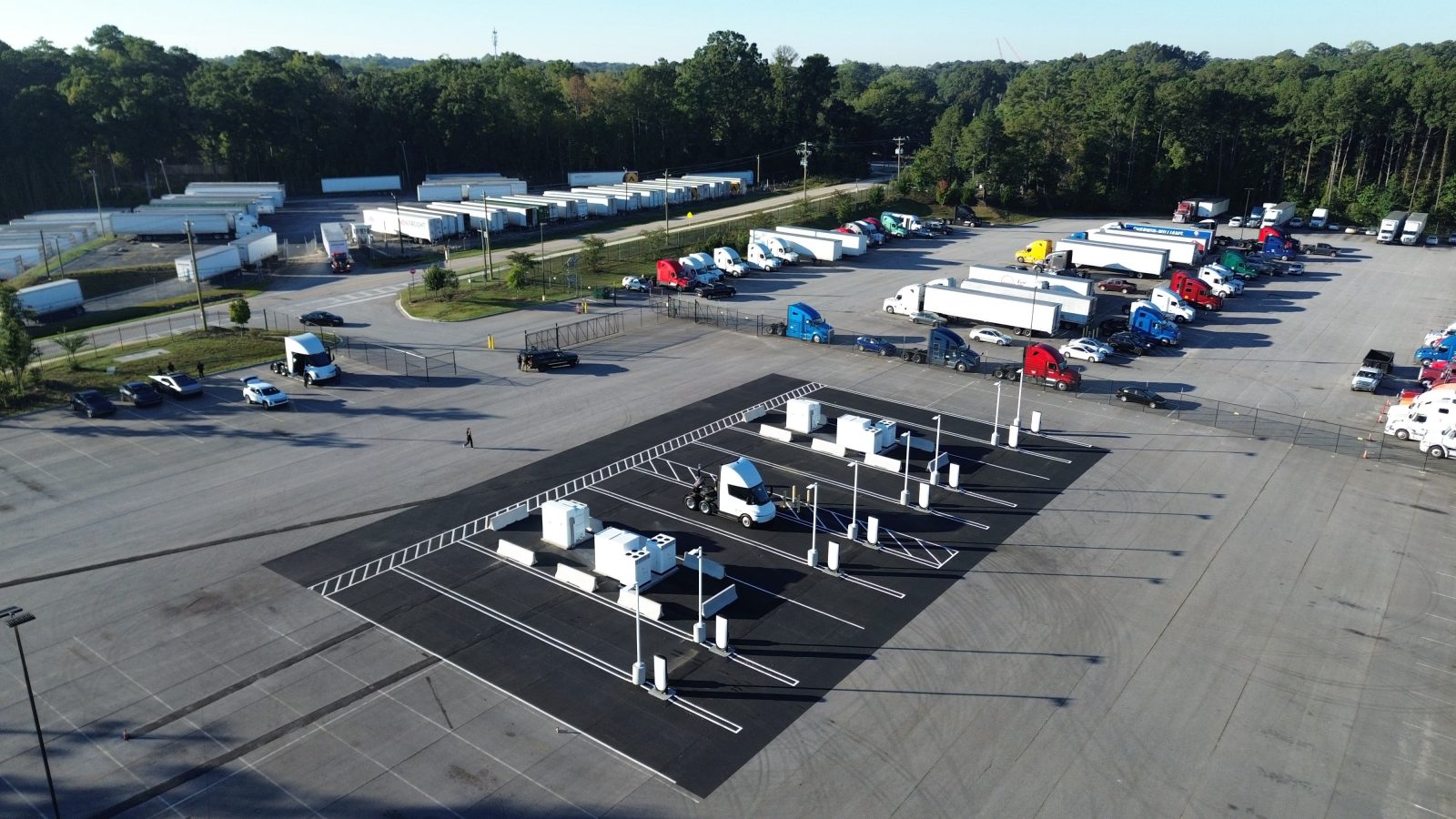
Tesla has opened its first Semi Megacharger sites in the Southeast: an 8-stall station just south of Atlanta and a 6-stall station outside Savannah, each rated for up to 1.2 MW per stall.
The Savannah site is also the first Megacharger at a Pilot truck stop, a rollout that was supposed to start this summer. Together, the two stations give the Tesla Semi its first public charging corridor outside California.
Two sites on one freight lane
The Tesla Semi account announced the openings on X on Thursday with a map of the route and a note that more Southeast sites are coming.
The Atlanta end is in Conley, Georgia, about 10 miles south of downtown near I-285 and I-675. Tesla’s location page lists it at 1820 Rock Cut Road with 8 Megachargers at up to 1.2 MW.
The other end is in Ellabell, about 20 miles west of Savannah on I-16. Pilot confirmed the same day that it’s the first site to come out of its Megacharger deal with Tesla: six stalls at Pilot #1390 on Interstate Exchange Way.
The two stations are roughly 220 miles apart on I-75 and I-16. That’s an easy one-way run for either version of the truck. Tesla rates the Semi at 325 miles for the Standard Range and 500 miles for the Long Range at 82,000 lbs, and it says a Megacharger puts back up to 60% of that in 30 minutes.
So a Standard Range truck can leave the Savannah port area, drive to Atlanta, charge during the driver’s break, and drive back. Without a charger at both ends, that 440-mile round trip is out of reach for the 325-mile truck.
Tesla’s aerial photo of one of the sites shows pull-through stalls in the middle of a truck yard, with a Semi tractor parked at one of them.
Pilot’s first Megacharger is a season late
When Pilot and Tesla announced their partnership in January, the first sites were due this summer. The first one opened on October 8.
Three more Pilot sites are getting ready: a Flying J in Tulare, California, which opens today, then a Flying J in Fort Stockton, Texas, and a Pilot in North Las Vegas, Nevada. Nine others are under construction behind them, according to Pilot, and each site gets four to eight stalls.
That last one is in the same corner of the Las Vegas valley where Tesla just filed a permit for a Semi service center.
The state list changed, too. January’s announcement named California, Georgia, Nevada, New Mexico, and Texas. This one drops New Mexico and adds Indiana.
Shannon Sturgil, who runs alternative fuels at Pilot, said the first sites make fleet electrification “a more accessible option for long-haul transportation.”
Where the Megacharger network stands
Tesla’s public Megacharger list now shows three sites: Vernon and Bloomington in California, with six stalls each, and Conley. Ellabell isn’t on it yet. Count it, and that’s four customer-facing sites and 26 stalls.
That’s well short of the plan. Tesla’s Q4 2025 report showed about 37 Megacharger sites for 2026, and the company has said it wants 46 by early 2027. In February, it put 66 Megacharger locations on its map, four of them in Georgia.
And the trucks are coming. Tesla launched volume production of the Semi two weeks ago at a Nevada factory built for 50,000 trucks a year, days after it was named primary supplier on a 2,500-truck order.
Electrek’s Take
Megacharger deployment is likely a good way to track progress as it is essential to Tesla Semi deployment.
Savannah is one of the busiest container ports in the country, and a lot of that freight heads to Atlanta. If you run that lane, you can now buy a Semi and never put diesel in it. There’s also some irony in the location. Ellabell is home to Hyundai’s Metaplant, which moves parts with hydrogen fuel cell trucks. Tesla just put megawatt charging at a truck stop in the same town.
But Tesla is way behind its own schedule. It planned about 37 sites this year and it has four in the second week of October. Not great, but Tesla could still surprise us with an efficient rollout in the next two months.
If you drive an EV, or you’re thinking about one, the logic behind megawatt truck charging works at home too: electricity you make yourself beats fuel you have to buy. With electricity rates up almost 10% last year and expected to keep climbing, going solar is one of the best ways to protect yourself against rising costs. And with lease and PPA options, you can do it with zero upfront cost and start saving immediately. If you want to find the best deal, check out EnergySage. It’s a free service with hundreds of pre-vetted installers competing for your business, so you save 20 to 30% compared to going it alone. No sales calls until you pick an installer. Get your free quotes here.


FTC: We use income earning auto affiliate links. More.


Comments