
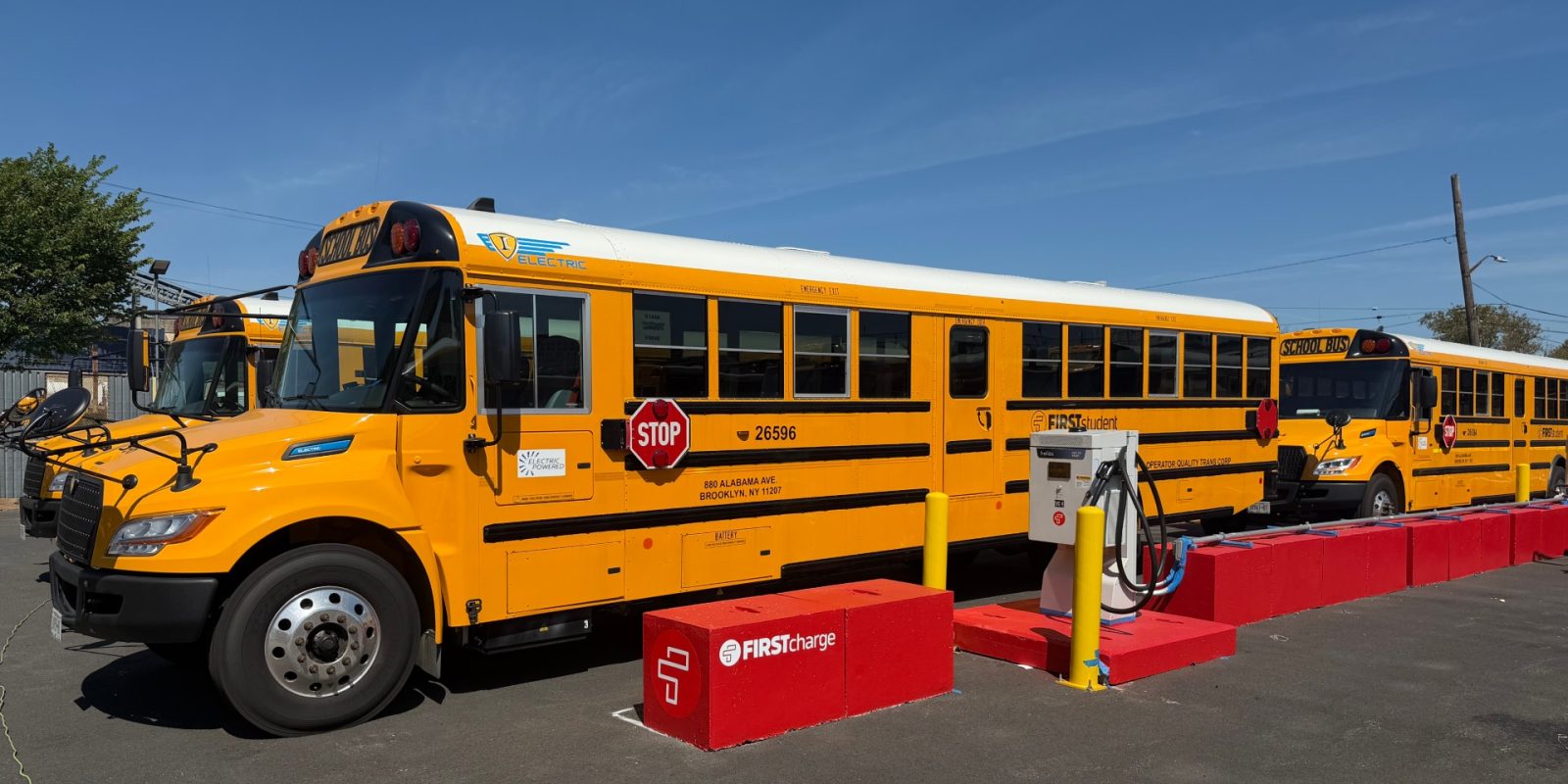
First Student is adding 40 electric school buses in New York City after completing the first phase of a charging project that cut infrastructure costs by 20%.
The electric school buses will serve NYC Public Schools in Brooklyn and Queens, building on a demonstration project with Con Edison that tested a less disruptive way to install charging equipment in a dense urban environment.
At the center of the project is First Charge, First Student’s above-ground charging system. Instead of digging trenches to bury electrical cables, the equipment carries them overhead, cutting construction costs and making installations faster and less disruptive. Here’s how First Charge works:
“Eliminating the need to bury the service line to these chargers lowers the upfront costs for First Student and is a strategy that other fleet owners can replicate to save money and complete projects more quickly,” said Vicki Kuo, senior vice president of Customer Energy Solutions at Con Edison.
That could be especially useful in cities like New York, where digging up paved bus yards can be expensive and complicated.
Con Edison and the New York State Energy Research and Development Authority (NYSERDA) helped fund the demonstration project. The funding included six electric school bus vouchers awarded through NYSERDA’s New York School Bus Incentive Program, plus support for four buses converted from diesel to electric.
The project is also using load-management software to charge buses during off-peak hours, when electricity is generally cheaper. For a large school bus fleet, coordinating charging times can help control energy costs and reduce pressure on the grid.
“Deploying electric school buses at scale requires more than vehicles; it requires the right infrastructure, technology, and utility partnership,” said Kevin Matthews, head of electrification at First Student. “Working with Con Edison, we’ve demonstrated a more efficient approach that can help overcome some of the cost and construction challenges that have traditionally made fleet electrification difficult in dense urban environments.”
First Student is considering more clean-energy upgrades at its Brooklyn facilities, including solar and a smart energy hub.
New York State mandated that all new school buses purchased by 2027 must be zero-emission and all school buses on the road must be zero-emission by 2035.
Read more: Colorado’s largest electric school bus fleet gets a 26-plug charging hub

If you’re looking to replace your old HVAC equipment, it’s always a good idea to get quotes from a few installers. To make sure you’re finding a trusted, reliable HVAC installer near you that offers competitive pricing on heat pumps, check out EnergySage. EnergySage is a free service that makes it easy for you to get a heat pump. They have pre-vetted heat pump installers competing for your business, ensuring you get high quality solutions. Plus, it’s free to use!
Your personalized heat pump quotes are easy to compare online and you’ll get access to unbiased Energy Advisors to help you every step of the way. Get started here. – *ad


FTC: We use income earning auto affiliate links. More.




Comments