
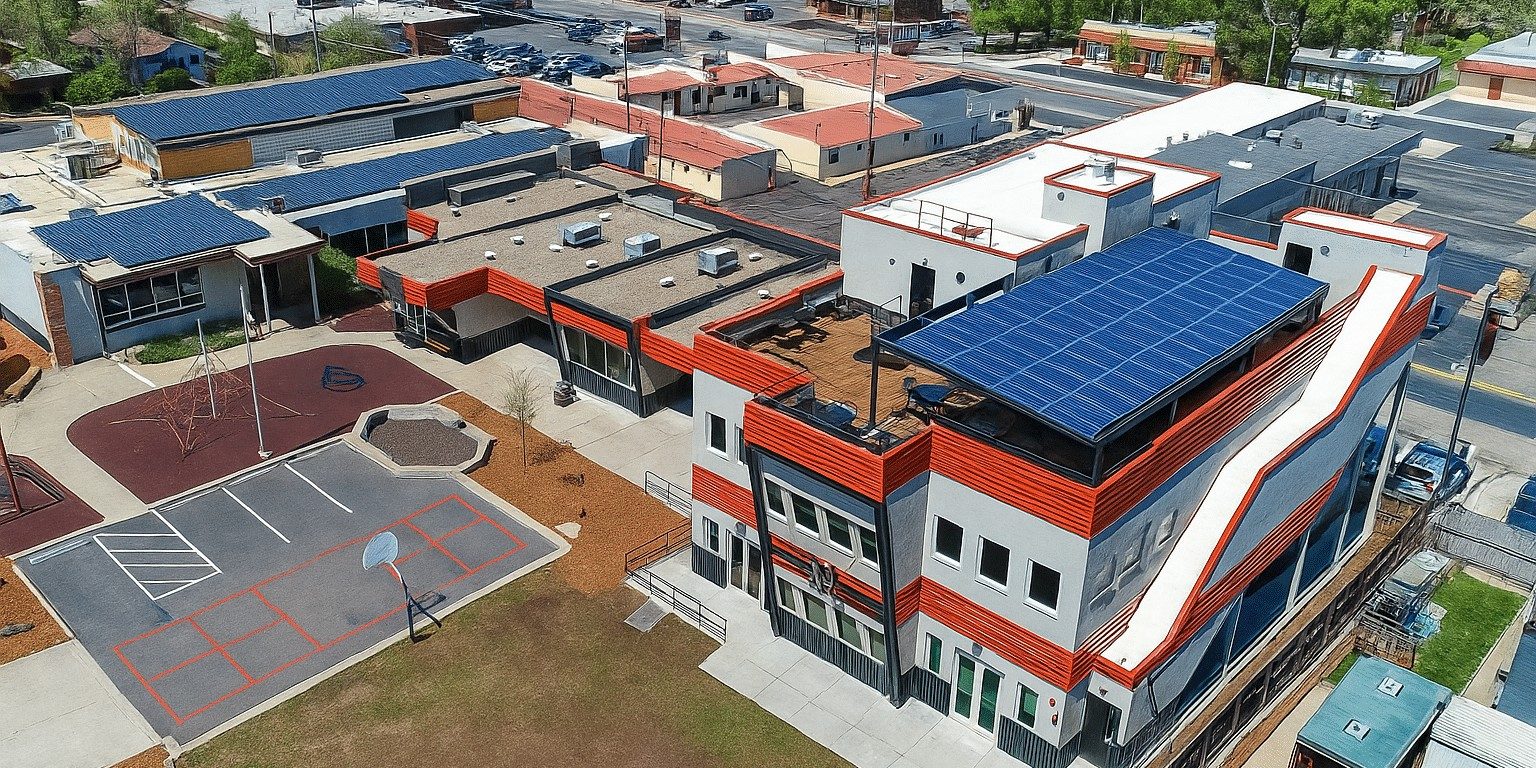
Solar power now powers more than 10,800 US K-12 schools – that means 1 in 7 students goes to a school powered by the sun – but battery storage hasn’t quite caught on yet.
That’s more than 7 million students, according to the sixth edition of Generation180’s Brighter Future report, which tracks solar and battery storage at US schools. The data is current through April 2026.
The number of solar-powered schools has nearly doubled from 5,450 in 2016, while their combined solar capacity has more than tripled to over 2.4 gigawatts. Generation180 says that’s enough solar to cover the annual electricity use of more than 450,000 homes – roughly every household in Austin, Texas.
And for cash-strapped school districts, solar can mean a lot more money stays in the classroom.
Roanoke City Public Schools in Virginia, for example, is installing nearly 9.4 megawatts (MW) of solar across 29 sites. The district estimates that solar alone will save it $46.5 million in energy costs over 35 years.
“This report shows that school solar is no longer concentrated in just a few places. Urban, suburban, and rural school districts across the country are using clean energy to reduce costs, improve facilities, and prepare students for the economy of the future,” said Tish Tablan, lead report author and senior director of Generation180’s Electrify Our Schools program.
California leads the country with 2,921 solar-powered schools, followed by New Jersey, New York, Illinois, and Arizona.
But some of the fastest recent growth is happening elsewhere. Virginia, Connecticut, Pennsylvania, New Jersey, and New York added the most new solar capacity at schools between 2021 and 2025. Illinois, Minnesota, Wisconsin, Virginia, and Massachusetts were also among the states that added the most solar-powered schools.
Battery storage at schools is still a rarity
The report also includes Generation180’s first national count of battery storage at K-12 schools, and adoption drops off sharply there.
Just 155 schools have installed battery storage systems since 2016. Ninety-four pair batteries with solar, while 61 have standalone storage.
That’s less than 0.1% of US K-12 schools, even though the number of school battery systems has grown sevenfold over the past decade.
California accounts for 109 of the identified systems – about 70% of the national total. Massachusetts follows with 10, Oregon has seven, Hawaii has six, and Arkansas has three.
A school battery can store excess solar power for later, help cut expensive peaks in electricity demand, and keep critical equipment running during an outage. Generation180 says about one-third of US public K-12 schools are FEMA-designated emergency shelters, so backup power can benefit the surrounding community as well as students and staff.
“We have a huge opportunity to turn schools into clean-powered resilience hubs, community spaces that can keep the lights on, provide shelter, and support families when the grid goes down,” said Tablan.
Batteries may also have a longer federal policy runway than solar. Trump’s 2025 tax law accelerated the end of clean electricity tax credits for new wind and solar projects that began construction after July 4, 2026, and are placed in service after December 31, 2027. But IRS guidance specifically excludes energy storage from that accelerated deadline.
Battery storage still qualifies for the federal Clean Electricity Investment Credit, and government and tax-exempt entities such as public schools can access the credit through elective pay.
That creates an opening for more schools to add batteries even as the window for new school solar projects tightens. Turning schools into dependable community resilience hubs with solar and storage backup is still an untapped opportunity.
Read more: Renewables’ installed capacity to beat natural gas within a year – EIA data
If you’re looking to replace your old HVAC equipment, it’s always a good idea to get quotes from a few installers. To make sure you’re finding a trusted, reliable HVAC installer near you that offers competitive pricing on heat pumps, check out EnergySage. EnergySage is a free service that makes it easy for you to get a heat pump. They have pre-vetted heat pump installers competing for your business, ensuring you get high quality solutions. Plus, it’s free to use!
Your personalized heat pump quotes are easy to compare online and you’ll get access to unbiased Energy Advisors to help you every step of the way. Get started here. – *ad


FTC: We use income earning auto affiliate links. More.




Comments