
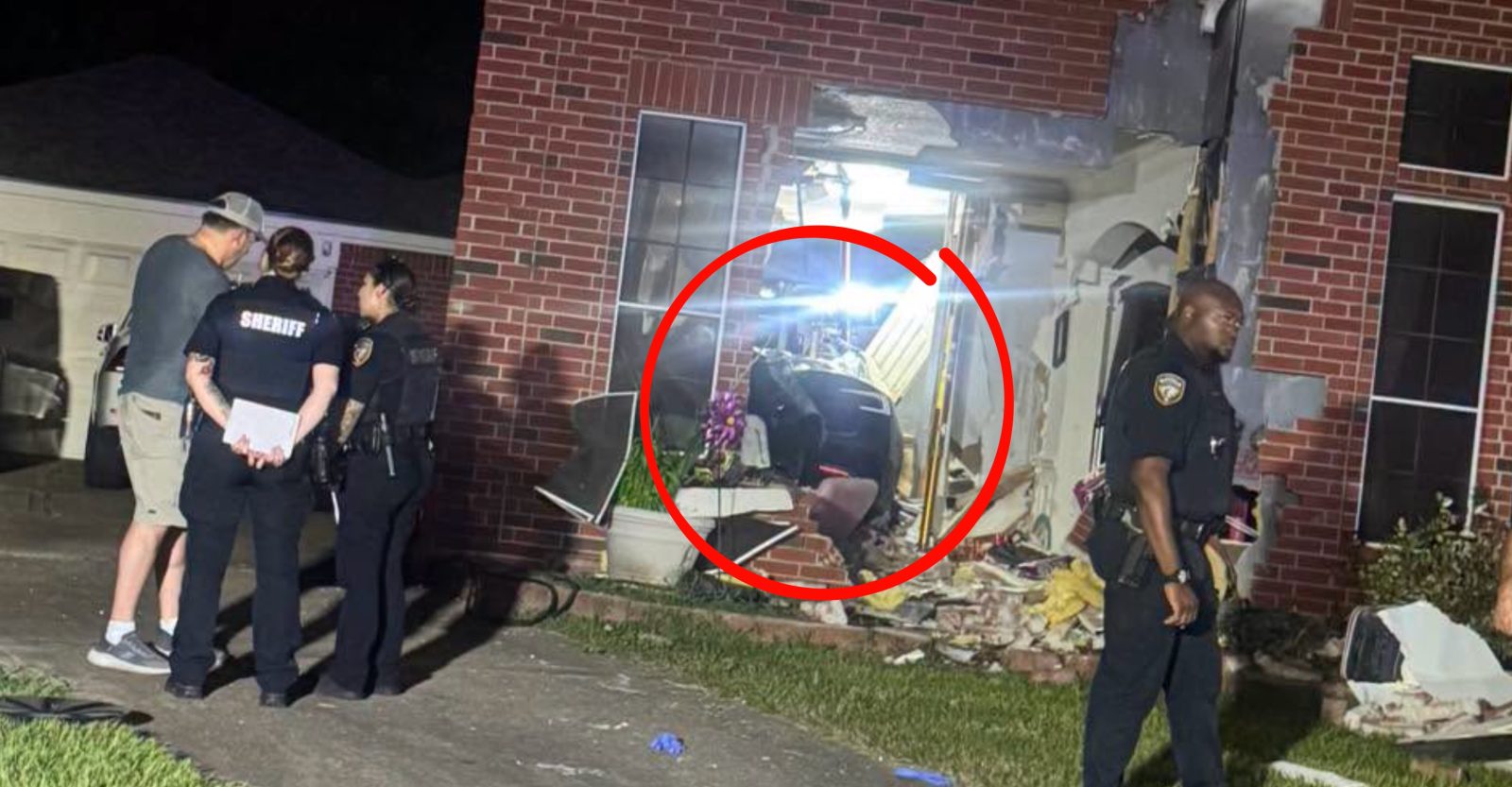
Tesla now confirms that its self-driving system was engaged when a Model 3 left a residential road in Katy, Texas, and killed a 76-year-old woman inside her home — but the company says the driver overrode it by pressing the accelerator to 100%.
Everything points to a pedal misapplication while the car was under “Full Self-Driving.” Does that mean Tesla is not at fault?
What Tesla is now saying
Tesla’s Head of AI, Ashok Elluswamy, said the company’s vehicle data shows driver Michael Butler “manually overrode self-driving by pressing the accelerator all the way to 100% of the accel pedal in this residential area.”
According to Tesla, the Model 3 reached 73 mph with the accelerator floored, and the pedal was still pressed even after the car had plowed through the brick home.
On Monday, CEO Elon Musk pushed back on the idea that the car was driving itself at all, posting that “FSD drives slowly through neighborhood streets and this was a high speed crash!” Now Tesla’s own account places its driver-assistance software in the loop at the moment of the crash, with the driver’s pedal input as the override.
The driver, 44-year-old Butler, had told Harris County deputies the vehicle was on Autopilot when it left Rose Hollow Lane and struck the front of the two-story house. The victim, Martha Avila Mantilla, was standing in the front room when the car came through the wall.
This is what we already said happened
When we covered the federal investigation, we laid out the most likely scenario before Tesla released any data.
“To me, it looks like a pedal error,” we wrote. “However, Tesla’s ADAS system, Autopilot or FSD, might still have been involved. It might have screwed up and the driver might have pressed the wrong pedal trying to correct it.”
Tesla’s new statement confirms the first half: a pedal misapplication, accelerator instead of brake. What Tesla wants you to take from its data is that this fully clears the system. It doesn’t — and that’s the part Tesla keeps skipping over.
The question Tesla isn’t answering
Here’s what the “driver pressed the accelerator” framing leaves out: why.
People don’t floor the accelerator into a brick house for no reason. A pedal misapplication like this almost always has a trigger, and the most plausible one fits Tesla’s own timeline. The driver is on FSD. The car does something he doesn’t expect or want approaching the turn. He goes to intervene — but his feet aren’t already over the pedals, because the whole point of the system is that he wasn’t actively driving. In the scramble to correct, he hits the accelerator instead of the brake, panics, and keeps pressing. That panic-and-hold pattern is exactly why pedal misapplications so often end in catastrophic, full-speed impacts.
If that’s what happened, “the driver overrode the system” isn’t an exoneration. It’s a description of the failure mode that Level 2 systems create. Both Autopilot and FSD (Supervised) require an attentive driver who can take over instantly — but they’re designed to do the driving, which conditions people to disengage exactly when the rare emergency takeover is hardest to execute.
This is the complacency problem we’ve written about candidly with FSD v14: the system is good enough to lull you and nowhere near good enough to trust. A driver who is mentally and physically “out of the loop” is slower and clumsier in the half-second when it matters most.
We’ve seen complacency assign blame to Tesla before
This wouldn’t be the first time a driver clearly misused the system and Tesla still ended up sharing the blame.
Last year’s landmark Florida verdict is the precedent that matters here. In August 2025, a Miami federal jury found Tesla 33% responsible for a 2019 Key Largo crash in which driver George McGee, using Autopilot, blew through a T-intersection and killed Naibel Benavides Leon. The jury put 67% of the fault on McGee — he admitted he’d dropped his phone and taken his eyes off the road — but still held Tesla partly liable, landing a $243 million judgment that a federal judge upheld in February.
The driver was plainly misusing the system, just like Butler appears to have. Yet the jury concluded Tesla shared responsibility because its marketing and weak, steering-torque-based driver monitoring fostered a false sense of what the car could do — the same complacency dynamic. Misuse and Tesla’s responsibility are not mutually exclusive. That’s the precedent Tesla’s “the driver pressed the accelerator” framing is up against, even if this case adds a pedal misapplication to the mix.
Why Tesla’s own data deserves scrutiny
Tesla’s vehicle logs are real data, and they matter. But the company has a history that complicates taking its self-serving readout at face value. Tesla is already under an NHTSA Engineering Analysis covering roughly 3.2 million vehicles — the last step before the agency can force a recall — and a separate probe into whether it properly reported crashes involving Autopilot and FSD in the first place.
The Florida case is the clearest example of why. In that litigation, Tesla told the plaintiffs the crash data didn’t exist — until an independent researcher recovered the “collision snapshot” the car had automatically uploaded to Tesla’s servers, which showed the system had detected the pedestrian. We covered how Tesla withheld data and misdirected police and plaintiffs to avoid blame in that crash.
So what Tesla has put out about the Katy crash is its own public interpretation of its own logs. NHTSA has now opened its own Special Crash Investigation and will pull the event data recorder and onboard logs independently. That’s the version of the data that counts — not the one Tesla chooses to post on X.
Electrek’s Take
Tesla confirming FSD was engaged is a bigger admission than the company’s framing suggests, and it tracks precisely with what we said on day one: a pedal misapplication with the driver-assistance system in the loop.
Top comment by HBrown
Impact speed is given at 73 mph. Most residential areas have either a 25 or 35 mph speed limit. Even if the mistaken pedal theory is correct, it would take a fair period of time of acceleration for a standard M3 to go from this speed up to 73 mph. Furthermore, the car is going to cover a fair bit of distance while accelerating. This makes me wonder if perhaps the car was already going too fast before the driver's intervention. 3 facts I'd really like to know: 1. How fast was the car going at the moment the driver first pressed the pedal? 2. How long was the pedal depressed for? and 3. How far did the car travel after the pedal was depressed and FSD was overridden?
But Tesla is fighting the wrong battle. It’s treating “the driver pressed the accelerator” as a full defense, when the real question is why an experienced driver floored his car into a house. The most likely answer is the one Tesla least wants to discuss — that its system did something the driver had to urgently correct, and that the design of these Level 2 features makes that correction harder, not easier, by breeding exactly the kind of inattention that turns a recoverable moment into a fatal one.
Pinning it entirely on a “100% accelerator” input is technically convenient and substantively hollow. The Florida verdict already showed that a jury will hold Tesla partly responsible even when the driver was clearly misusing the system, precisely because the complacency is a product of Tesla’s own marketing and monitoring.
To be clear, we should be careful here too. What Tesla has released is its own interpretation of its own logs, and the Florida case — where Tesla told plaintiffs the data didn’t exist until a researcher recovered it — is a reminder that the company is not always forthcoming with the full picture. The independent NHTSA data recorder should fill in what Tesla left out, and we’ll hold full judgment until it does. But the broader pattern is already clear: until Tesla takes the complacency problem seriously — the names, the marketing, the easily-gamed driver monitoring — these cases will keep landing on people who never agreed to be part of the experiment, this time a grandmother standing in her own living room.
If you’re a Tesla owner, powering your EV with home solar is one of the smartest ways to lock in low fuel costs. With electricity rates climbing nearly 10% last year, home solar protects you against future rate increases. And with lease and PPA options, you can go solar with zero upfront cost and start saving immediately. If you want to find the best deal, check out EnergySage. It’s a free service with hundreds of pre-vetted installers competing for your business, so you save 20 to 30% compared to going it alone. No sales calls until you pick an installer. Get your free quotes here.


FTC: We use income earning auto affiliate links. More.



Comments