
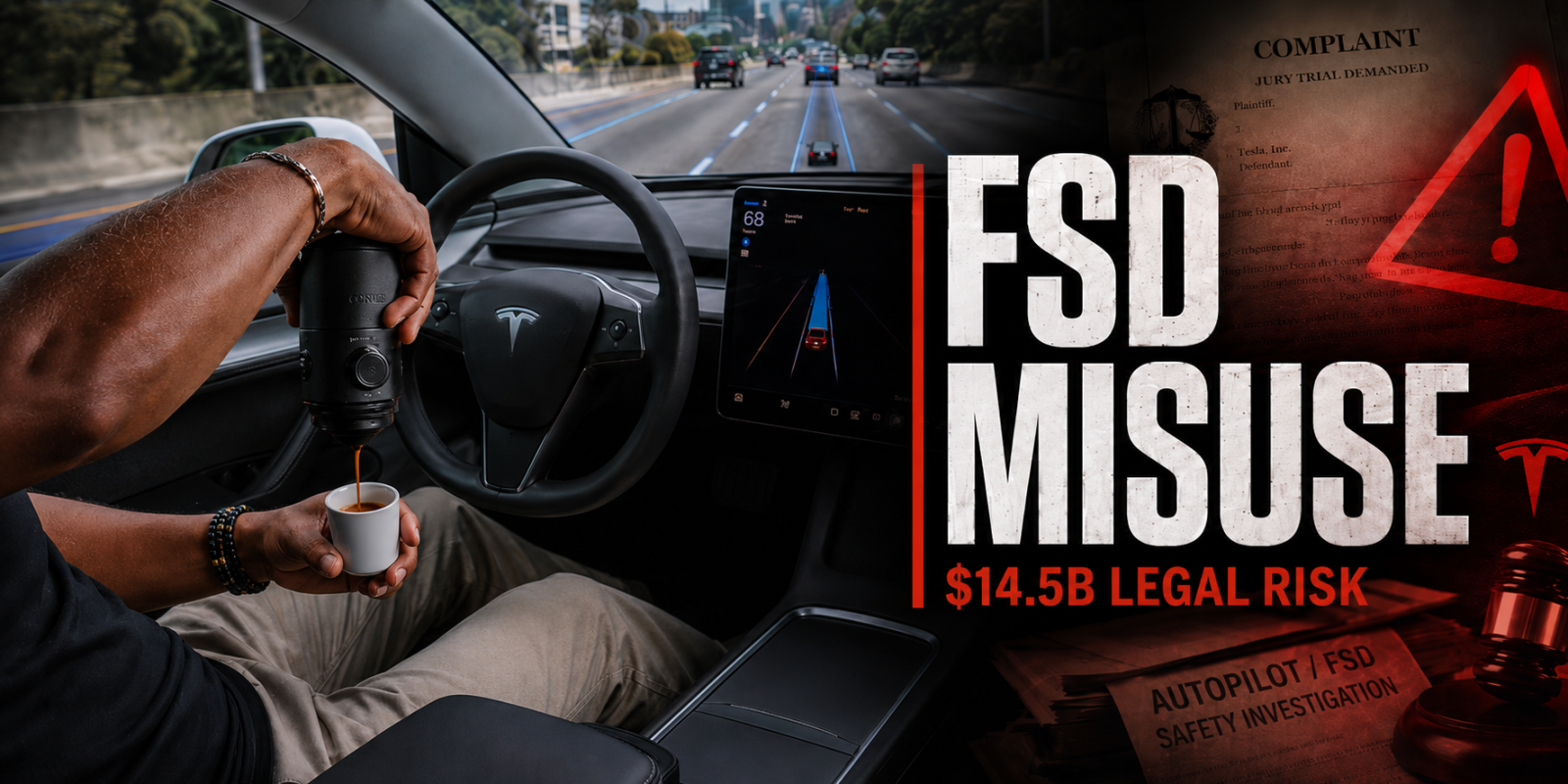
Tesla is facing up to $14.5 billion in lawsuits related to its “Full Self-Driving” and Autopilot systems — and the company’s own marketing department keeps making the problem worse. In two official promotional videos published in the last three weeks, Tesla showed a driver making espresso while FSD drives and shared footage where FSD committed multiple traffic violations in Denmark.
The problem is obvious: Tesla’s entire legal defense in crash lawsuits rests on the argument that drivers are responsible for supervising FSD at all times. But Tesla’s own promotional content actively encourages the opposite behavior.
Tesla’s espresso video: “Try it yourself”
On May 26, Tesla’s official account on X posted a video of a driver making espresso in the driver’s seat while FSD Supervised drives. The video, credited to creator @lucapasturini, shows the driver operating a portable espresso machine — hands off the wheel, eyes off the road — with the caption: “I do my espresso while I’m driving.”
Tesla’s own caption on the post reads: “With FSD Supervised, your Tesla can drive you anywhere you want. Try it yourself.”
The fine print disclaimer at the bottom says: “Currently enabled features require active driver supervision and do not make the vehicle autonomous.” But the entire point of the video is a driver not supervising the vehicle. The disclaimer and the content are in direct contradiction — and the video, with 5.6 million views, is far more persuasive than the fine print.
This is the kind of marketing that California’s DMV ruled was “actually, unambiguously false” — and rather than fix its marketing, Tesla sued the DMV to overturn the ruling.
Denmark PR video: FSD breaks the law in Tesla’s own footage
Two weeks later, on June 9, Tesla Europe posted a promotional video celebrating FSD’s approval in Denmark — the fourth European country to approve the system. Elon Musk personally shared the video to his followers.
There was just one problem: the video showed FSD breaking Danish traffic laws.
Danish newspaper Politiken analyzed the footage, which was shot near Rådhuspladsen in central Copenhagen, and identified multiple violations. FSD drove in a bus-only lane, made an illegal right turn past a “right turn prohibited” sign, ignored a “no entry” sign, drove onto Vesterbrogade — a street closed to car traffic — and drove on a bicycle path.
FDM, Denmark’s equivalent of AAA, reviewed the findings and called them “worrying” and “quite critical.” Tesla told Politiken it had no comment.
This is Tesla’s own promotional material — footage the company chose to film, edit, and publish to celebrate a regulatory milestone. And in that carefully curated video, FSD committed at least four traffic violations. This comes while NHTSA has an open Engineering Analysis covering 3.2 million vehicles over FSD’s safety performance, with over 80 documented FSD traffic violations already in the agency’s files.
The legal problem Tesla is creating for itself
Tesla’s legal strategy in Autopilot and FSD crash lawsuits depends on one core argument: drivers are responsible for supervising the system at all times, and any crash is the result of driver misuse — not a product defect.
That argument already took a devastating hit when a jury awarded $243 million to the victims of a fatal Autopilot crash in the Benavides case — a verdict a federal judge upheld in February 2026 after Tesla tried to overturn it. Tesla had rejected a $60 million settlement offer before trial.
As we detailed in our deep dive into Tesla’s $14.5 billion lawsuit exposure, the company faces litigation across at least 21 separate tracks, including crash lawsuits tied to 50-60 fatal Autopilot/FSD incidents, a certified class action over FSD false advertising, a China fraud lawsuit from 10 owners that got its first hearing in May, and securities fraud claims. Since the Benavides verdict, Tesla has quietly settled at least four additional Autopilot crash lawsuits rather than face another jury.
Every single one of these cases involves a version of the same question: did Tesla adequately warn drivers about FSD’s limitations, or did it encourage overreliance on the system?
Now plaintiff attorneys have exhibit A and exhibit B handed to them by Tesla itself. A video where Tesla tells people to “try” FSD while showing a driver making coffee. And a video where FSD breaks multiple traffic laws in Tesla’s own promotional footage.
Tesla has also been caught retroactively modifying FSD purchase contracts to insert “supervised” language that wasn’t there when owners originally signed — another move that strengthens the argument that Tesla knew its marketing was misleading and tried to cover its tracks.
Electrek’s Take
Top comment by Kevin
It's a calculated risk. They're betting they'll make more money from people who watch and/or tell people about the videos than they'll lose from the people suing them. Elon knows that without the aura of Tesla as a self-driving leader, Tesla is dead anyway. It's the same reason they faked the paint it black video. Calculated risk. And it has always paid off for Musk, so why stop?
We’ve been covering Tesla’s FSD legal exposure for years, and the pattern is always the same: Tesla markets FSD as something close to autonomous driving, then when something goes wrong, it argues in court that drivers should have known it wasn’t autonomous. The company wants it both ways — the marketing hype that sells FSD subscriptions and the legal cover that shifts blame to drivers.
These two videos crystallize the contradiction better than anything we’ve seen. Tesla can’t post a video telling drivers to “try” FSD while someone makes espresso behind the wheel and then argue in court that drivers should have been paying attention. Tesla can’t share footage of FSD committing traffic violations in its own promotional material and then claim the system is safe when used as intended.
Every plaintiff attorney in every pending FSD lawsuit now has fresh ammunition. When Tesla’s lawyers tell a jury that drivers are responsible for misuse, the jury will see Tesla’s own marketing promoting that exact misuse. The $243 million Benavides verdict could be just the beginning. Tesla isn’t just failing to fix its marketing problem — it’s actively making its $14.5 billion legal problem worse, one promotional video at a time.
If you’re a Tesla owner looking to offset your energy costs, home solar is one of the smartest investments you can make. With electricity rates climbing nearly 10% last year, home solar protects you against future rate increases. And with lease and PPA options, you can go solar with zero upfront cost and start saving immediately. If you want to find the best deal, check out EnergySage. It’s a free service with hundreds of pre-vetted installers competing for your business, so you save 20 to 30% compared to going it alone. No sales calls until you pick an installer. Get your free quotes here.


FTC: We use income earning auto affiliate links. More.


Comments