
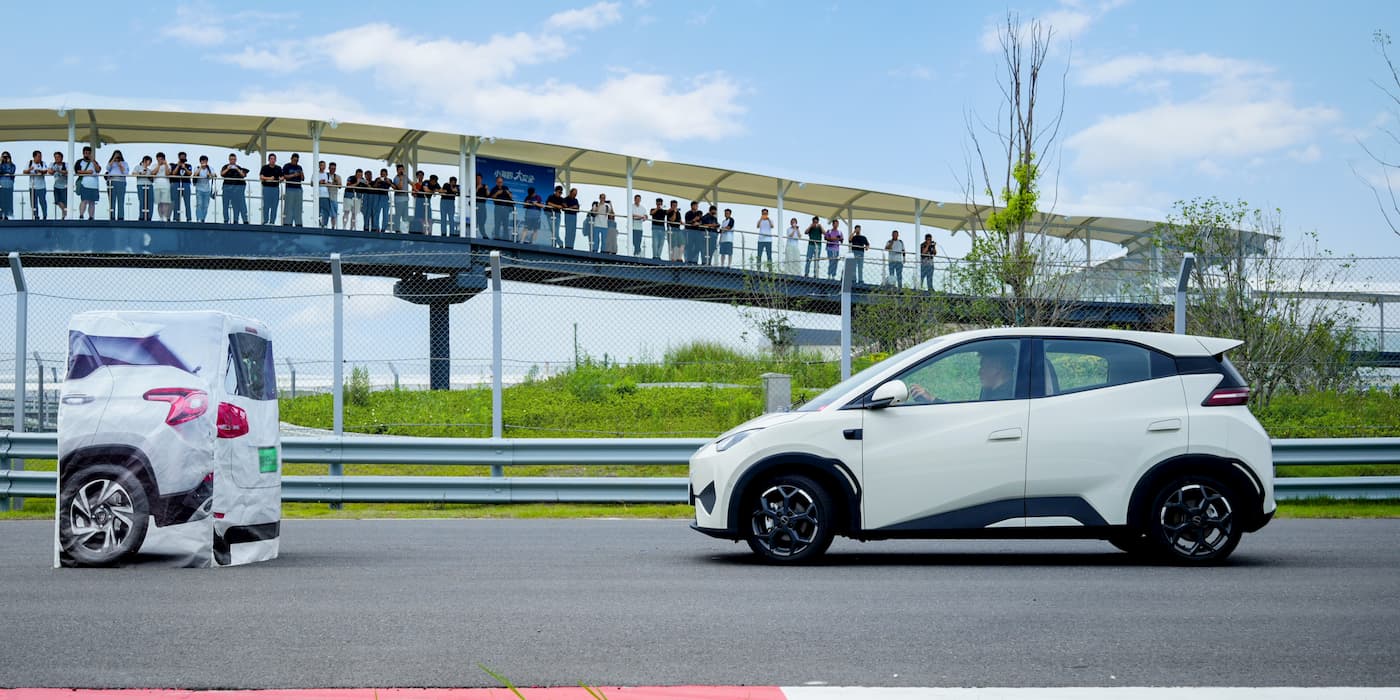
BYD says it will assume full financial liability for at-fault accidents that happen while its “God’s Eye” urban driving system is active in China — with no cap on the payout.
It’s a commitment Tesla has never made for “Full Self-Driving,” and it flips the industry’s standard liability model on its head.
What BYD actually committed to
BYD announced the policy on May 28 at its vehicle intelligence strategy event, the same showcase where it revealed China’s first in-house 4nm smart driving chip.
Under the new guarantee, if a driver is using BYD’s urban “navigate-on-autopilot” function in compliance with regulations and is at fault in a crash, BYD will cover all direct economic losses the vehicle is liable for — repairs to the owner’s car, third-party property damage, and personal injury.
The terms are unusually generous. There’s no payout cap, owners don’t need to buy a separate “intelligent driving insurance” product, and a claim won’t raise their commercial insurance premium the following year.
The coverage applies to the God’s Eye A and B systems and runs for one year from delivery. Existing owners get it once they update to God’s Eye 5.0 over the air, and BYD says it isn’t restricted to the first or registered owner of the vehicle.
“Taking on Level 3 and Level 4 liability early during the Level 2 stage demonstrates the company’s absolute confidence in its own technology,” BYD chairman and president Wang Chuanfu said.
This isn’t BYD’s first move here. The automaker unlocked L4 smart parking with a similar guarantee in July 2025, and it says that pledge pushed the feature’s actual usage rate from 21% to 93%. The new policy extends the same logic from parking to city driving, which BYD frames as a “double guarantee.”
Why this is something Tesla has never done
Tesla’s “Full Self-Driving (Supervised)” is a Level 2 system, and the driver carries 100% of the responsibility. Tesla’s own owner’s manual is explicit: “You are responsible for the speed and control of your vehicle at all times, whether FSD (Supervised) is enabled or not.”
That’s the catch that defines the entire ADAS market. When the system performs, the automaker markets it as near-autonomous. When it fails, the liability sits entirely with the human in the seat — what we’ve previously called Schrödinger’s FSD: the car is driving itself right up until something goes wrong, at which point you were always the one driving.
The financial stakes of that distinction are not theoretical. A Miami federal jury hit Tesla with a $243 million judgment over a fatal Autopilot crash, assigning the company a third of the blame — a liability Tesla fought hard rather than absorbed voluntarily.
BYD is doing the opposite. It is contractually stepping in front of that liability before regulators force the question.
The price gap makes it sharper
BYD is also bundling this into a far cheaper package than Tesla’s.
The LiDAR-equipped God’s Eye B system is a one-time 12,000-yuan option (about $1,770), and BYD is making it available across its entire lineup. Tesla’s equivalent, rebranded in China as “Tesla Assisted Driving,” and sold as Supervised FSD elsewhere, costs 64,000 yuan (about $9,400) as a one-off purchase in China, with no subscription option.
So BYD is offering full, uncapped crash liability on a system that costs roughly one-fifth of what Tesla charges for software that still puts every dollar of risk on the driver.
BYD says it now has 3.15 million vehicles on the road with assisted driving, generating up to 200 million kilometers of driving data per day — the kind of fleet scale that, until recently, was Tesla’s signature advantage in the autonomy race.
Electrek’s Take
The liability question is the one the entire “self-driving” industry has spent a decade avoiding, and BYD just answered it out loud.
There are caveats worth keeping in view. This is a China-only program, it’s tied to “compliant” use of the urban function, and it’s a one-year guarantee rather than a permanent change to how the system is classified. It’s as much a marketing weapon as a legal one — BYD’s own numbers show these guarantees dramatically boost feature usage, and usage is what feeds the data flywheel. This is a confidence play designed to sell hardware and harvest miles.
Top comment by Aigars Mahinovs
This is the deciding legal difference between a Level 2 system and anything above Level 2. It is impossible for a system to be level 3 or above without the manufacturer taking legal responsibility for the actions that the system decides to do on the road.
If the system is taking the decisions then the system must also take the responsibility. It is no longer the responsibility of the driver or the owner of the car, because they are no longer involved in the moment-to-moment driving decisions. From level 4 onward, there might not even be a driver with a valid driving license in the car at all. And yet, there must be someone who takes responsibility for the driving decisions. Especially legal responsibility. And that responsible can only be the entity that has actual control over the contents of these driving decisions - the manufacturer of the self-driving system.
And that applies to all levels of infraction: the car ran a red light or exceeded the speed limit and got a ticket (while the system is active) - the manufacturer of that system has to pay the fine, the car damaged itself or another car - the manufacturer has to pay, the car injured or killed someone - the manufacturer has to pay and maybe the individual people involved (especially managers) should be considered for jail time pending negligent manslaughter charges.
A company driving a car via software needs to have the exact same responsibilities as a person driving the same car directly.
But that’s exactly why it matters. BYD looked at the same Level 2 framework Tesla hides behind and decided that standing behind its product was a competitive advantage rather than a legal exposure to be managed. Tesla, meanwhile, leans on arbitration clauses and “the driver is always responsible” disclaimers, and only accepts liability when a jury makes it.
If you’re confident your system is safe, putting your own money behind it is the most credible statement you can make. BYD just made it. The obvious question now: with 10 billion FSD miles and years of “next year” promises, why won’t Tesla?
With that said, BYD’s God Eye, like Tesla FSD, or ‘Tesla Assisted Driving’ in China, where they are having none of Tesla’s misleading labels, is a still a level 2 system and therefore, you need to pay attention when using it. I strongly recommend you do.
If you’re shopping for an EV, the smartest way to cut your long-term driving costs is to power it at home with solar. With electricity rates climbing nearly 10% last year, home solar protects you against future rate increases. And with lease and PPA options, you can go solar with zero upfront cost and start saving immediately. If you want to find the best deal, check out EnergySage. It’s a free service with hundreds of pre-vetted installers competing for your business, so you save 20 to 30% compared to going it alone. No sales calls until you pick an installer. Get your free quotes here.


FTC: We use income earning auto affiliate links. More.



Comments