
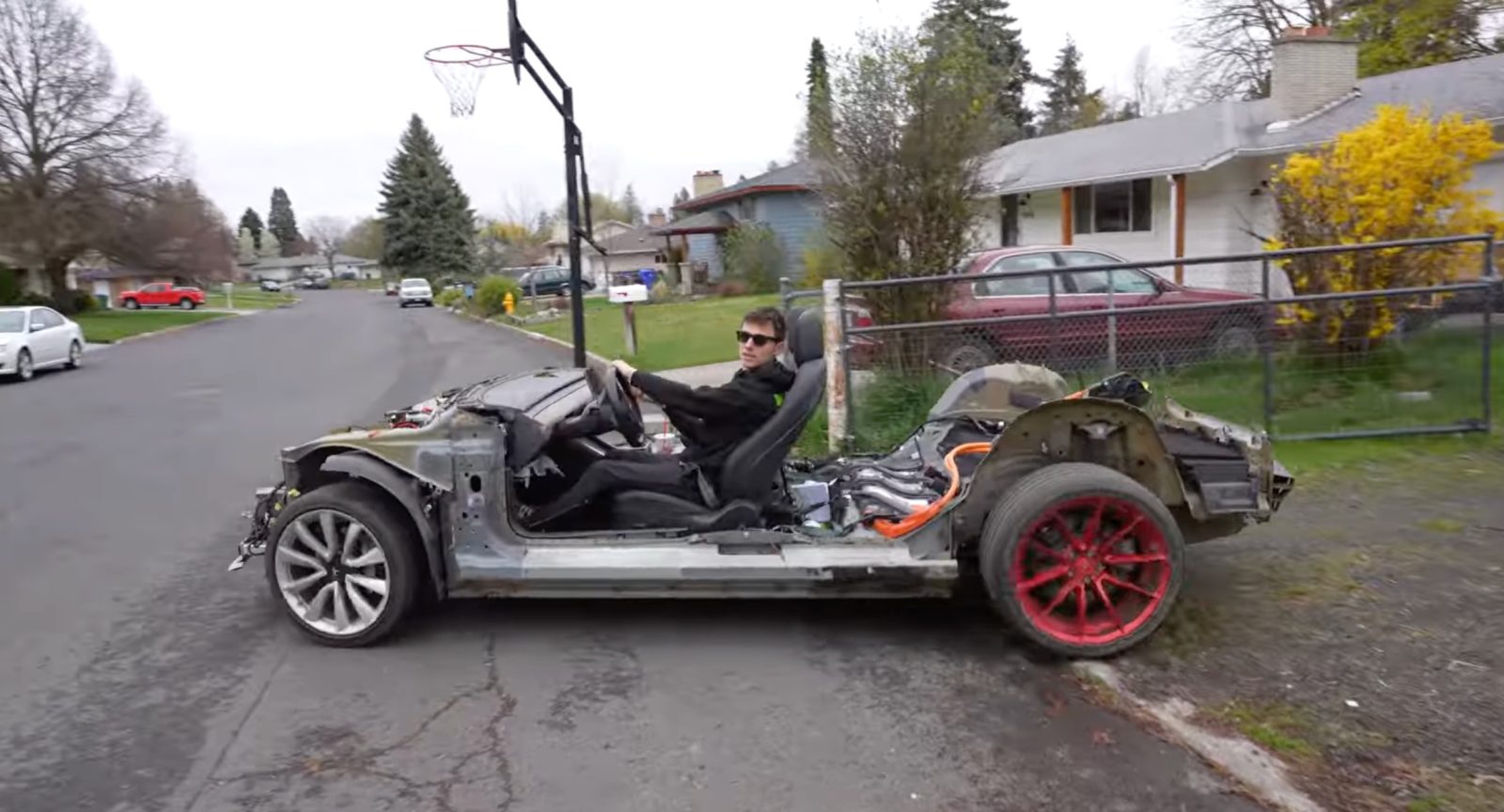
A YouTuber bought a completely stripped-down Tesla Model 3 for just $2,000 — no body panels, no windshield, no seatbelts — and took it off-roading, drifting, and even jumping it. The wildest part? It still showed 212 miles of range on a full charge.
The video, posted by Remmy Evans, is a testament to both the durability of Tesla’s drivetrain and the questionable decision-making that makes YouTube entertaining.
From abandoned project to $2,000 ‘go-kart’
The story starts with a phone call. Evans gets a tip from his friend Jake about a special vehicle at Jake’s brother-in-law’s house in Idaho: a Tesla Model 3 that has been stripped down to almost nothing. The previous owner, Grayson, had purchased the Model 3 for $6,000–$7,000 with plans to transplant the drivetrain into a 1970s concept car. They even had a 3D artist render the finished design and started fitting parts, but abandoned the project after estimating it would take 800 hours to complete the body work.
Evans negotiated the price down from $3,000 to $2,000, and walked away with what is essentially a Tesla rolling chassis — seats, steering wheel, motors, battery pack, and screen, but no windshield, no body panels, and no seatbelts. The car had been sitting unregistered for at least two years.
Tesla drivetrains have become popular swap candidates for classic car and custom builds in recent years, with companies like EV West even selling Tesla crate motors specifically for conversions. But most builders transplant the drivetrain into something else — Evans decided to just drive what was left.
212 miles of range and 78 error codes
After swapping out the stock tires — which were “delaminating” down to the wire — for a set of bright red wheels and new tires, Evans charged the stripped Model 3 to full and found it still displayed 212 miles of range.
The screen, however, told a different story on the software side. The car was throwing 78 different error codes, which is what happens when Tesla’s software expects cameras, sensors, and safety systems that no longer exist. All the safety sensors had been disabled by the previous owner, which had the side effect of unlocking the ability to drift — something Tesla’s Track Mode normally manages with software controls rather than fully disabling.
Evans rigged a DOT-rated ratchet strap as a makeshift harness and proceeded to do what any reasonable person would not: he drove the stripped Tesla 25 minutes on public roads to Best Buy — no cops stopped him — then took it drifting, off-roading, and jumping it over a dirt tabletop on a friend’s property. His friend Drew compared its handling to “a Polaris Slingshot but way faster.”
The charging nightmare
Charging the stripped Model 3 proved to be its own adventure. On the first night, Evans drove to a DC fast charger only to discover his adapter didn’t fit. His solution: a trip to Harbor Freight for cutting tools, where he literally sawed the top off a charging adapter to make it fit the station, then had to shove an object into the charger handle to keep it engaged. It worked — barely.
The bigger problem emerged later. Evans and a friend with a regular Model 3 discovered that CCS fast charging — the protocol used by most public DC fast chargers — may not be enabled on the stripped car’s software. Enabling it would require a software update, but Evans was terrified that updating would cause the car to recognize all its missing components and refuse to drive entirely. Without fast charging, the car takes 7–8 hours on a Level 2 charger and over 14 hours on a standard 110V outlet.
Tesla’s software fights back
Evans avoided updating the car’s software for the charging reasons above, but after downloading the Tesla app and connecting it to the vehicle, the car began displaying “Service Required” messages and became increasingly difficult to operate.
This is a known dynamic with salvaged and heavily modified Tesla vehicles. Tesla’s over-the-air update system and deep software integration means the car is constantly monitoring its own hardware. When critical safety components are missing, the software can progressively restrict functionality — a design choice that prioritizes safety but creates headaches for DIY builders and salvage rebuilders.
Top comment by Well-O
Unless the drivetrain, especially the battery, was compromised or stripped down, the range indeed shouldn't change that much, save for the now questionable aerodynamics of that, huh, thing.
(But hey, it's lighter)
What I'm a bit more surprised about though — but probably shouldn't be nowadays — is that someone would drive this on public roads.
Evans ends the video teasing a “Part 2” where he plans to take the stripped-down Tesla to an official Tesla service center about 40 minutes from his house in Washington state, which should make for interesting content regardless of how Tesla’s service team reacts.
In our experience, Tesla will charge him a hefty fee to “evaluate” if the vehicle is eligible for fast-charging, but they might just avoid this entirely and give him a simple ‘no’ just based on the state of the car.
Electrek’s Take
This video is pure entertainment, but it also accidentally demonstrates something important about electric vehicles: the drivetrain is the most durable part of the car. While everything else on this Tesla was ripped off, broken, or missing, the motors and battery pack just kept working. That’s the fundamental advantage of EVs — fewer moving parts, fewer things to break.
We’ve seen Tesla drivetrains survive crashes, floods, and now apparently being stripped to a skeleton and jumped off dirt ramps. It’s a compelling advertisement for the longevity of EV powertrains, even if Tesla would probably prefer a more… conventional endorsement.


FTC: We use income earning auto affiliate links. More.



Comments