
Tesla has quietly switched on a public configurator for its Supercharger for Business program, and the numbers tell us exactly what it now costs a third party to buy into the network: $500,000 in hardware and roughly $940,000 all-in for a standard V4 8-stall site.
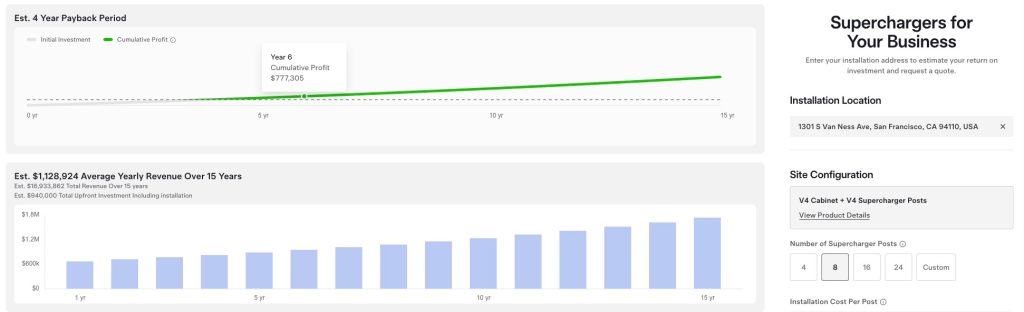
The tool also spits out ROI estimates that swing wildly by location — from a 4-year payback in San Francisco to 7 years in Manhattan — and effectively prices Tesla’s own cut at a flat $0.10/kWh.
What the configurator actually quotes
Tesla launched the Supercharger for Business program in late 2025, letting property owners buy the hardware and pay for installation while Tesla continues to run the stalls on its network. Until now, the economics were vague. The new configurator changes that.
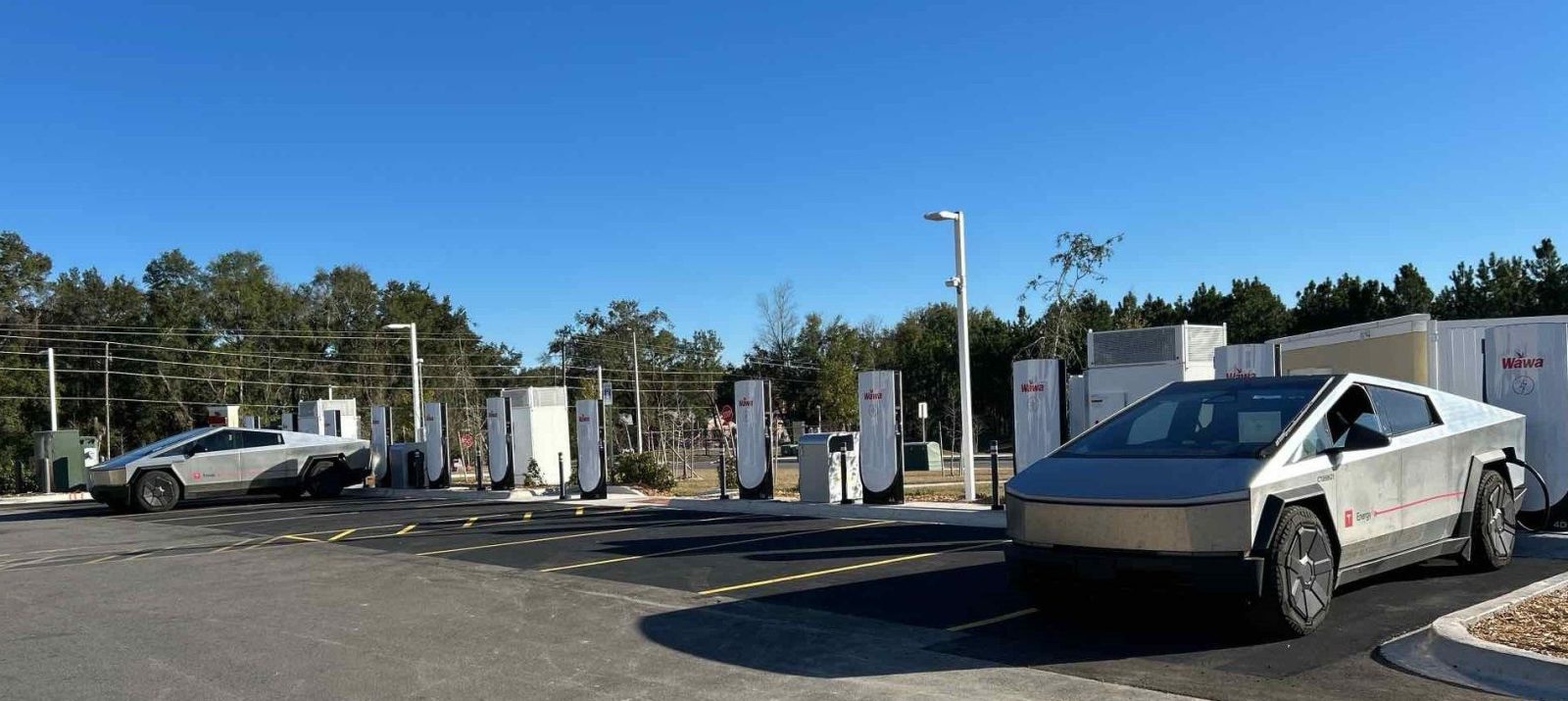
Enter any US address, and Tesla generates a site model built around a V4 Cabinet plus eight V4 Supercharger posts — the same hardware being rolled out at Wawa’s first self-branded Tesla Supercharger site and other third-party locations.
The fixed line items don’t move with geography:
- Estimated hardware purchase price: $500,000 (8 V4 posts)
- Installation cost per post (Medium tier): $55,000
- Total upfront investment, including installation: $940,000
- Tesla’s revenue-share fee: $0.10/kWh, “all-inclusive”
What does move is the revenue side. Tesla’s model pulls in localized electricity costs, a median fast-charging retail price, and an expected utilization figure in kWh per post per day — all derived from Tesla’s actual fleet data. The output is an estimated 15-year revenue curve and a payback period.
Four gas station addresses, four very different answers
To stress-test the tool, we ran it against gas stations in four states: Texas, California, Florida, and New York. Hardware, post count, and install tier were held constant — only the address changed.
| Metric | TX — New Braunfels (I-35) | CA — San Francisco (S Van Ness) | FL — Miami Beach (Collins Ave) | NY — New York (610 Broadway) |
|---|---|---|---|---|
| Burdened electricity cost | $0.108/kWh | $0.222/kWh | $0.138/kWh | $0.228/kWh |
| Median retail selling price | $0.51/kWh | $0.59/kWh | $0.46/kWh | $0.54/kWh |
| Expected utilization | 302.3 kWh/post/day | 449.6 kWh/post/day | 453.4 kWh/post/day | 318.8 kWh/post/day |
| Avg yearly revenue (15-yr) | $656,137 | $1,128,924 | $887,617 | $732,653 |
| Total 15-year revenue | $9.84M | $16.93M | $13.31M | $10.99M |
| Estimated payback period | ~5 years | ~4 years | ~5 years | ~7 years |
San Francisco comes out best despite having the second-highest electricity cost in the sample — Tesla’s fleet data suggests a downtown SF site would push 449.6 kWh per post per day and command a $0.59/kWh retail price, the highest in the group. Miami Beach nearly matches it on utilization (453.4 kWh/post/day) while paying a lot less for power, making Florida arguably the best unit economics in the set.
Manhattan is the worst of the four. New York City combines the highest burdened electricity cost ($0.228/kWh) with lower utilization than SF, pushing the payback period out to seven years.
Texas, despite having the cheapest power by a wide margin, suffers from low expected utilization — around 302 kWh/post/day — and ends up middling on ROI.
The $0.10/kWh Tesla tax
The most interesting single data point isn’t in the revenue projections. It’s buried under the price breakdown:
“For revenue-generating sites, Tesla will charge an all-inclusive $0.10/kWh fee.”
That fee covers software, payment processing, billing, mapping, customer support, and network operations. At an average of 302 to 453 kWh per post per day across eight stalls, that’s roughly $88,000 to $132,000 per year flowing back to Tesla from a single third-party site — on top of the $500,000 in hardware Tesla already sold them.
That’s the real business model here. Tesla isn’t just selling chargers. It’s building a wholesale layer on top of its own network, where hardware sales and a per-kWh operational fee are both recurring revenue streams.
What’s fixed, what isn’t
A few things worth flagging for anyone running the tool themselves, based on what we tested so far:
- The configurator locks the hardware price at $500,000 regardless of ZIP code, and the Medium installation tier at $55,000 per post. Low and High tiers ($45,000 and $65,000) are selectable.
- Post counts of 4, 8, 16, and 24 are available, plus a custom option. We held the 8-post configuration constant for this comparison.
- All projections assume 7% year-over-year utilization growth, roughly 15% energy loss from grid to vehicle, and no land rent. Taxes are not included.
- Tesla’s assumed “average session” is about 35 kWh. At the 250 kWh-per-post-per-day baseline Tesla cites in the tool, that’s “about 7 cars per post per day.”
Electrek’s Take
Top comment by TinyTim
The cost of a large battery to go along with it (and reduce super high demand charges with the utility) is missing.
This is the most transparent Tesla has ever been about what it actually costs a third party to host Superchargers. A $940,000 all-in number for eight stalls is a real data point the industry didn’t have in public form a week ago, and it lets any property owner do back-of-envelope math against recent Electrek coverage of Tesla’s Supercharger network expansion to decide whether it’s worth picking up the phone.
But the configurator is also, clearly, a sales tool. The utilization numbers Tesla is plugging into these sites are optimistic — 300 to 450 kWh per post per day assumes you’re a gas station, a Wawa, or a downtown lot with real foot traffic, not a random suburban strip mall. The $0.10/kWh Tesla fee is also not nothing: it’s a recurring operating cost that scales directly with your success, and it effectively means Tesla is taking about 20% of your gross revenue right off the top at the median retail prices the tool itself quotes.
The more interesting question this tool raises isn’t “should a gas station buy one?” — it’s whether the $500,000 hardware price holds when DC fast-charger costs are trending down globally and Chinese suppliers are shipping full 480 kW liquid-cooled units for a fraction of that. Tesla is betting the network effect, the software, and the uptime numbers justify the premium. For now, it probably does. But the moment a competitor offers comparable hardware with a smaller operational take, this pricing sheet gets tested.
For now, it looks like Tesla has a massive lead in charging costs.


FTC: We use income earning auto affiliate links. More.



Comments