
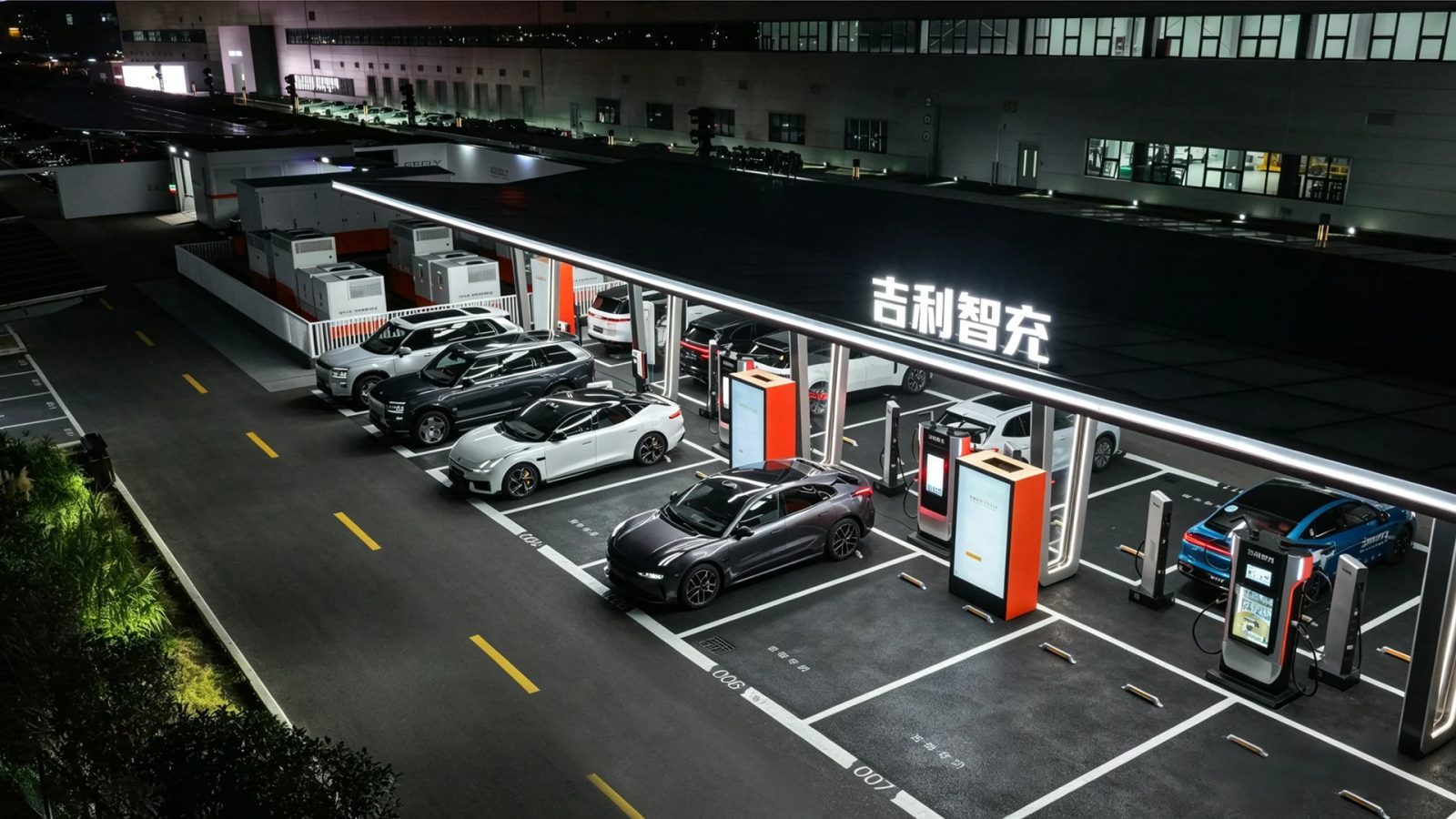
Just last week, Geely announced it would roll out 2.2 megawatt chargers, able to charge an EV in under 5 minutes. Those chargers are now already in service in 5 cities, with 15,000 charging sites planned by the end of next year.
Meanwhile, the fastest upcoming charger in the US, a respectable 750kW, is coming sometime next year, after being pushed back from 2026.
China’s EV industry has been advancing incredibly rapidly, and its EV charging ecosystem is no exception.
The country already has tens of thousands of megawatt-level chargers which can charge an EV in 5-10 minutes, but China’s EV companies are rolling out even faster charging as they compete over seconds, not minutes of faster charging times.
The latest development is Geely’s 2.2MW charger, announced just last week. The company even says that it uses an advanced thermal-control algorithm that helps increase longevity, which is a consideration when you’re pumping so much power so quickly into a battery.
2.2MW might be a bit of a misnomer here, since it’s shared by two charging heads. The charger runs at 1,500V/1,500A, but no cars exist (yet) that can accept a 1,500V charge, so instead two cars can get over 1MW of power simultaneously.
China’s scale and speed are phenomenal
But the real story is the scale and speed at which these developments happen. Geely released a 1.5MW charger in March of this year. Its 2.2MW charger comes just six months after that last development.
Even more impressively, Geely already has working chargers in the wild, just a week after the announcement. CarNewsChina cites National Business Daily and says that Geely’s chargers have already rolled out in five cities: Hangzhou, Shanghai, Ningbo, Jiaxing, and Xi’an.
The same happened when BYD announced its 1.5MW system in March. In just 5 months, the company installed 10,000 chargers. Geely plans a rollout of a similar scale, installing 15,000 chargers by the end of next year.
Geely also announced a partial purchase of NIO’s battery swapping unit, which is a bit puzzling for a company with leading fast-charge technology, but it doesn’t hurt to hedge your bets (well… until battery swapping fails as a concept and Geely’s $2 billion investment goes down the drain, but we’ll cross that bridge when we get there).
Compare to the US, which is both behind and moving slower
Meanwhile, it’s still rare to find even one or two 350-400kW chargers at a US charging station, let alone anything quicker.
We did get some news this week offering a reprieve: EVgo says it will release 750kW charging in America next year, which is about twice as fast as the current state of the art. Those chargers would take about ten minutes to charge an EV, assuming it can accept enough juice (so far, the upcoming Mercedes AMG GT is the only US EV that can handle numbers like that).
EVgo’s 750kW system will also share power between stalls, so we’re not sure what kind of juice it will deliver to each individual stall, but regardless the peak is still quite a lot lower than China’s.
What’s notable about the EVgo announcement is how long it took. It started with a partnership forged in 2024, which predicted availability in the second half of 2026. We’re now in that second half, and yesterday’s press release delayed availability until sometime in 2027.
So in the same amount of time as that delay – a half year – Geely added another 750kW to its already-mega-fast 1.5MW charging system.
As for other quick chargers in the US, the largest system is Tesla’s Superchargers. In 2022, Tesla announced its V4 Supercharger, with 500kW peak power.
It took about three years for the first of those to show up in the wild – the vast majority of Superchargers in the US are still capped at 350kW or lower (which CEO Elon Musk once referred to as a “children’s toy“).
Tesla also has a “Megacharger” system for its Tesla Semi, but that runs at 1.2MW, which is slower than the light-duty consumer offerings from either BYD or Geely.
The US chose to have worse charging
The US could have had a faster charging rollout, as President Biden’s Inflation Reduction Act and Infrastructure Investment and Jobs Act built programs to help accelerate the buildout of these chargers.
But those programs have moved slower than they should, for several reasons both at the state and federal level.
The federal reasons have had to do with intentional roadblocks from the republican party, like illegally trying to pause disbursement of funds, dismantling the government office intended to increase efficiency, and making up rules to make it impossible to install faster chargers.
At the same time, republicans have shipped EV jobs to China by canceling Biden-era programs that had led to a renaissance in US manufacturing.
Top comment by Elysia
No one in the US is selling any EV that could handle 750kW, much less 2.2MW. That sort of power makes sense for heavy trucking. Not sure it moves the dial much for passenger cars.
Then there has been the unfortunately bipartisan effort to put up tariffs against China. We may all finally be starting to realize at this point what a bad idea tariffs are for the whole economy, but tariffs on Chinese autos were also expanded greatly by President Biden, and there is currently an effort to ban any Chinese car from even thinking about crossing the border, even as a private vehicle on vacation from Canada or Mexico.
The intent seems to be to hide how advanced Chinese autos are from American consumers, so we don’t realize how much better automotive technology is in the rest of the world, outside of the city-in-a-hole we’ve created for ourselves.
But you don’t win a technology war, or a trade war, by refusing to participate. China is advancing automotive technology rapidly, and those advancements happen whether we’re covering our eyes and ears or not. The only way to compete is to get better, faster. And we’re already behind, so you better start moving faster than China if you want to catch up.
Charge your electric vehicle at home using rooftop solar panels. Find a reliable and competitively priced solar installer near you on EnergySage, for free. They have pre-vetted installers competing for your business, ensuring high-quality solutions and 20-30% savings. It’s free, with no sales calls until you choose an installer. Compare personalized solar quotes online and receive guidance from unbiased Energy Advisers. Get started here. – ad*


FTC: We use income earning auto affiliate links. More.




Comments