
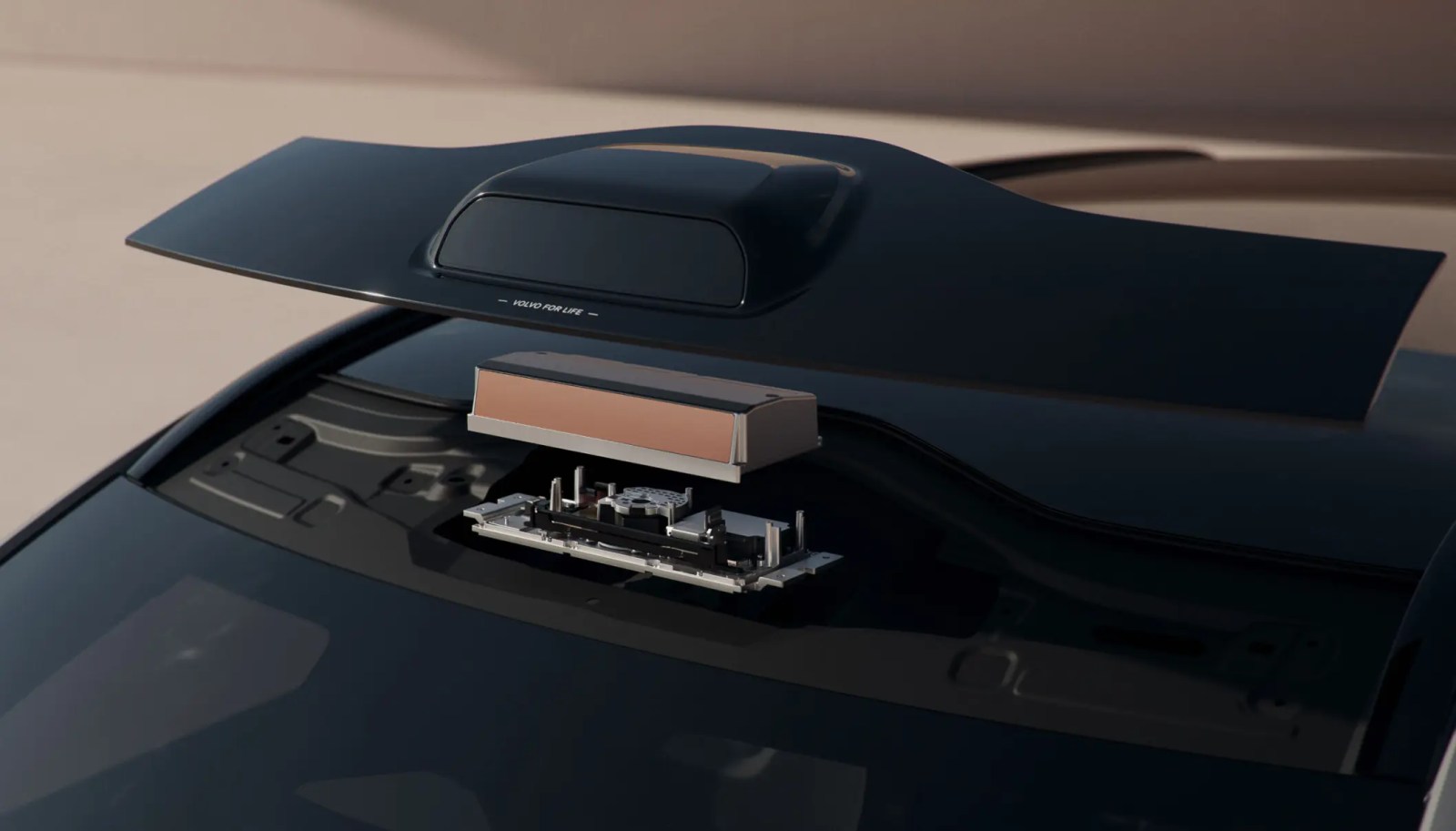
Volvo has confirmed it’s dropping lidar for good on the EX90 and ES90, and it’s paying owners compensation for a feature they were promised but will never get.
In Norway, that payout is NOK 18,000 (about $1,900) per car, one of several market-by-market checks Volvo is writing after cutting ties with lidar supplier Luminar.
Owners get paid for a sensor that never worked
The EX90 and ES90 shipped with a roof-mounted Luminar Iris lidar unit baked into the hardware. The catch: the software features meant to use it never arrived, and now they never will.
Henrik Juel Teige, a spokesperson for Volvo Cars Norway, confirmed the decision this week. “Volvo Cars has ended its partnership with the company’s supplier of LiDAR technology and has discontinued its plans to develop LiDAR-based functions for the EX90 and ES90,” he said.
So Volvo is compensating the people who already bought the cars. The amount depends on where you live. Norway gets NOK 18,000 (~$1,900). Sweden saw a SEK 16,000 (~$1,600) price cut on affected pending orders back in November. In the US, owners are offered roughly $1,500 in optional packages, including SiriusXM and charging credits, a tire-and-wheel plan, or a maintenance package. Dutch buyers get €1,500 and Canadians get C$2,000.
It’s a quiet admission that customers paid for hardware that turned into dead weight on the roof.
Why Volvo walked away from Luminar
This has been building since last fall. We reported in November that Volvo was set to ditch lidar for 2026 and that Luminar was furious about it. Volvo terminated the contract entirely on November 14, citing supply chain risk and what it called Luminar’s failure to meet its contractual obligations.
Then the bottom fell out for the supplier. Luminar filed for Chapter 11 bankruptcy protection on December 15, 2025. Without a solvent supplier able to deliver and support the sensor, the lidar-based features Volvo had marketed were never coming.
Volvo insists the cars are still safe without it. “The company’s products can deliver a high level of safety and driver support, enabled by the cars’ powerful core computing coupled with their advanced sensor set, with or without a lidar,” the automaker said.
That sensor set is real. The EX90 still carries five radars, eight exterior cameras, two interior cameras, and 16 ultrasonic sensors. Losing the lidar removes one layer, not the whole safety stack.
Electrek’s Take
Predictably, a lot of people are reading this as a win for Elon Musk’s camera-only gospel. Musk himself jumped on it this week, responding to a fan’s post about the payout: “I did try to warn them. Humans drive using neural nets and optical sensors. Same is true for robot cars.”
Top comment by Aigars Mahinovs
Volvo stepped back from lidars and doubled down on high resolution radars, mostly due to problems by the supplier of their specific lidar unit.
It does not mean that Volvo is completely done with lidar. And notably Volvo cars being discussed here are not Level4+ cars and are not even "aiming" to be such. For cars below Level4 lidar is a nice-to-have, not a nearly mandatory thing.
What camera-only fan miss completely is that lidar is not there to identify stuff. Sure, lidar is an alternate tech high-resolution radar to determine where the road is free and where there are obstructions. But it is also more than that - lidar is also a centimeter-precision GPS unit that also works fully in tunnels and around other obstructions. Reliably figuring where exactly the car is positioned right now is essential for 90% of driving, even when there are zero other vehicles on the road you need this to know where to drive to.
GPS precision in real life often drops to +/- 20 meters. Never mind figuring out which lane you are in, you might be positioned on a completely different road. This can be deadly as you speed along on a lane that is about to end or a road that is about to take a sharp turn.
LIDAR uses HD maps with identified reference points on well visible fixed locations, like overpasses, church towers, building edges, electrical poles, ... to backtrack to figure out the cars location. Even if the road itself is completely invisible (like covered by snow or rain or fog).
Critical for Level5
But look at what Volvo actually kept. The EX90 and ES90 still run five radars each, plus a dozen cameras and 16 ultrasonic sensors. That’s not vision-only. That’s Tesla’s approach with a radar suite bolted on, which is closer to what Tesla itself keeps quietly flirting with going back to than to Musk’s pure-camera dream. Volvo didn’t validate the vision-only bet. It dropped one expensive sensor and leaned on the rest.
And Elon should be ashamed to respond to this:
Instead, he should take notes. What Volvo did, compensate owners for its failure to deliver features, is something he has been delaying to do for Tesla HW3 owners for years now.
If you’re shopping for an EV like the EX90, the cheapest miles you’ll ever drive come from charging at home on your own solar. With electricity rates up almost 10% last year and expected to keep climbing, going solar is one of the best ways to protect yourself against rising costs. And with lease and PPA options, you can do it with zero upfront cost and start saving immediately. If you want to find the best deal, check out EnergySage. It’s a free service with hundreds of pre-vetted installers competing for your business, so you save 20 to 30% compared to going it alone. No sales calls until you pick an installer. Get your free quotes here.


FTC: We use income earning auto affiliate links. More.



Comments