
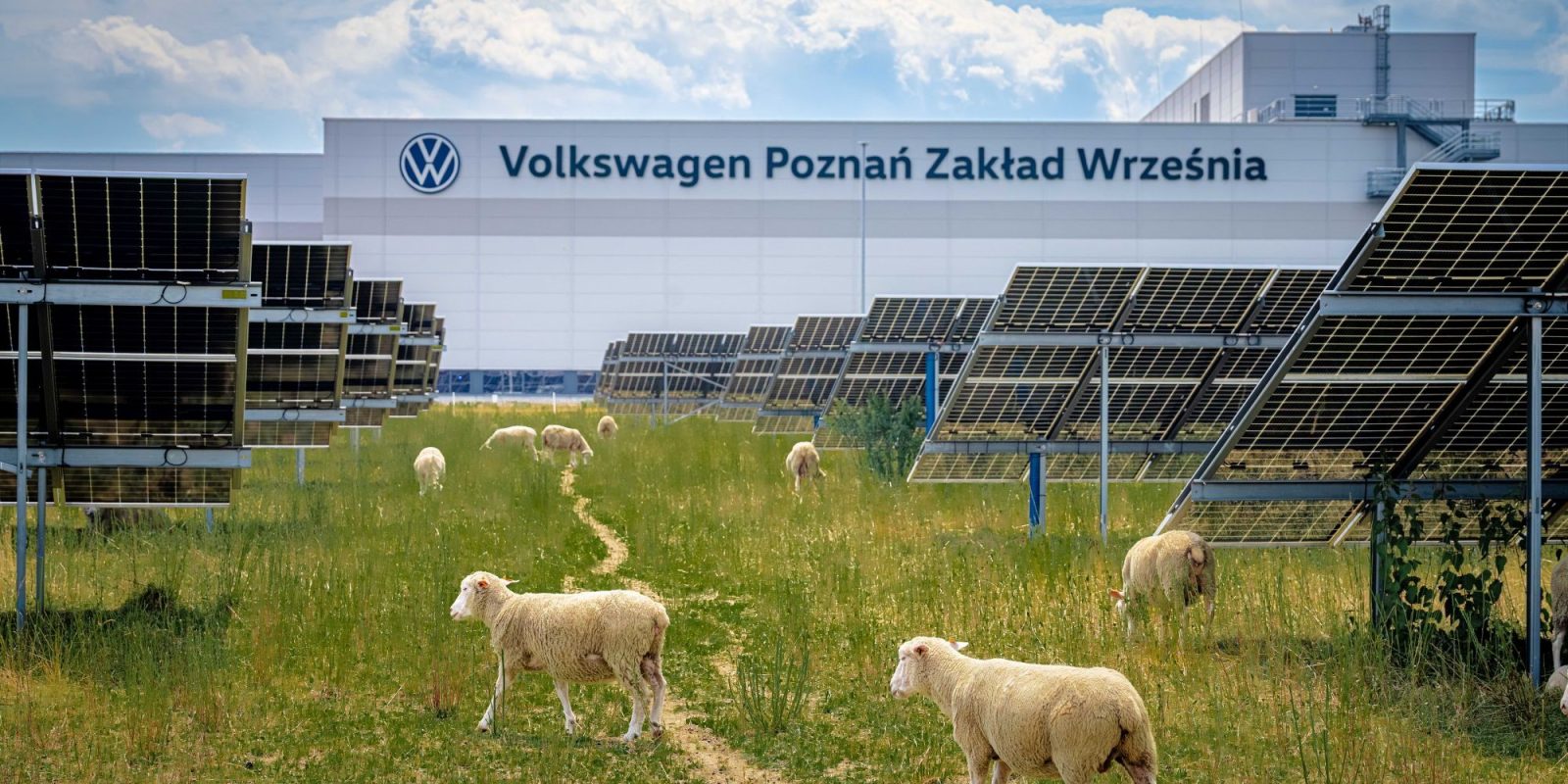
Volkswagen has traded lawnmowers for sheep at the massive solar farm that helps power one of its factories in Poland, and the animals are doing more than just keeping the grass short.
Instead of using lawnmowers, a flock of 100 sheep is now grazing beneath more than 31,000 solar panels that help power Volkswagen’s manufacturing plant in Poznań, Poland (where it makes the VW e-Crafter commercial van, among other models). It’s a practical way to maintain the site while allowing researchers to study how farming and solar power can coexist on the same land.
Berlin-based Quanta Energy built and manages the 18.3-megawatt (MW) solar farm. On sunny days, it can generate enough electricity to meet the factory’s entire power demand, and over the course of a year, it supplies around 25% of the plant’s electricity needs.
The grazing project is part of a wider agrivoltaics effort, which combines solar power with agriculture on the same land. While sheep grazing at solar farms has become increasingly common in countries like the US and the UK, Volkswagen says this is one of Europe’s most advanced industrial agrivoltaics projects because it also includes a major scientific research program.
“Today, the photovoltaic farm delivers much more than green electricity. It has also become a place that supports biodiversity, local agriculture, and scientific research. The sheep grazing project demonstrates that modern industry can work in harmony with nature,” said Marzena Pillich-Grońska, director of Volkswagen Poznań.
The project is being carried out with Poznań University of Life Sciences, whose researchers are studying how sheep grazing affects animal welfare, biodiversity, soil quality, vegetation, and the site’s microclimate. The goal is to better understand how large-scale solar generation and agriculture can successfully cohabit on the same land.
“Agrivoltaics allows us to look at photovoltaic farms from a much broader perspective than energy generation alone,” said Dr. Joanna Składanowska-Baryza from the university’s Department of Animal Breeding and Product Quality Assessment. “We are studying how photovoltaic installations affect animal welfare, the local ecosystem, and whether the shade created by solar panels reduces heat stress in animals. At the same time, we analyze changes in the microclimate, vegetation, and soil to identify solutions that support the effective integration of renewable energy generation with agricultural activity.”
The sheep will live at the solar farm through the fall, under the supervision of experienced breeders. Besides eliminating the need for mechanical mowing, grazing can reduce maintenance costs and emissions while creating habitat for insects and other wildlife.
According to flock owner Justyna Nowak-Gajek, the sheep have settled in quickly.
Top comment by BCGeiger
Studies have shown that even many crops do better in partial shade from the solar panels. This is especially true in areas that are seeing more heat stress due to climate change. It really is a win-win situation. Add to this the huge number of farmers in the upper midwest and elsewhere that are rising crops between windmills. Renewables can be a huge boon to agriculture.
“We can clearly see that the flock feels safe – the sheep naturally split into smaller groups and graze calmly in different parts of the solar farm. This is the best evidence that they have adapted well to these conditions, because a flock that feels threatened always stays together,” she said.
Read more: Enel is deploying 6,000+ sheep to 8 Texas solar farms
If you’ve ever considered going solar, make it easy by finding a trusted, reliable solar installer near you that offers competitive pricing by checking out EnergySage. It has hundreds of pre-vetted solar installers competing for your business, ensuring you get high-quality solutions and save 20-30% compared to going it alone. Plus, it’s free to use, and you won’t get sales calls until you select an installer and share your phone number with them.
Your personalized solar quotes are easy to compare online, and you’ll get access to unbiased Energy Advisors to help you every step of the way. Get started here.


FTC: We use income earning auto affiliate links. More.



Comments