

“We should not let them into our country,” Ford’s CEO Jim Farley warned during a recent interview, admitting it wouldn’t be a fair fight.
Ford CEO warns against allowing Chinese EVs in the US
Farley has warned several times now that Chinese EV brands pose an “existential threat” to US automakers, including Ford.
During an interview with Fox & Friends on Monday, Ford’s CEO said China has enough capacity to build over 50 million vehicles, or enough “to cover all the manufacturing, all the vehicle sales in the US.”
“We should not let them into our country,” Farley said, referring to Chinese EVs entering the US. Ford’s CEO stressed the economic impact would be “devastating,” given that manufacturing is the “heart and soul of our country.”
Farley also pointed out the “cyber and privacy” risks of allowing Chinese EVs in the US, noting that they feature multiple cameras that “collect a lot of data.”
Although he admitted “there’s no way this is a fair fight,” Farley said Ford still needs to do its part to make its vehicles competitive with Chinese brands.
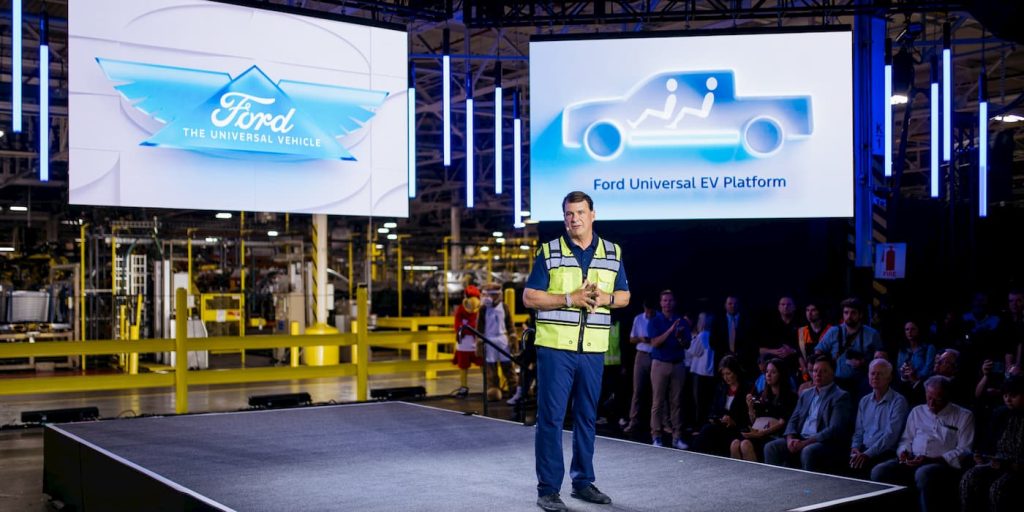
Ford is betting on its smaller, more affordable EVs based on its new Universal EV (UEV) platform, which Farley believes will help it compete with leading brands like BYD.
The first vehicle based on Ford’s new UEV platform will be a mid-size electric pickup, set to launch in 2027 with a starting price of around $30,000. By focusing on reducing battery weight and simplifying the manufacturing process, Ford claims the UEV platform enables affordable EVs to be produced at scale.
Ford will build new UEV-based vehicles at its Louisville Assembly plant, using lithium iron phosphate (LFP) batteries from its Michigan battery plant.
Electrek’s Take
While Farley is urging against allowing Chinese EVs into the US, it’s using licensed tech from China’s CATL to assemble LFP batteries in Michigan for its “affordable” mid-size vehicles.
Earlier this year, several people familiar with the matter told Bloomberg that Farley recently brought up the idea with the Trump administration to allow US carmakers to partner with Chinese EV brands to build vehicles in the US.
This is not the first time Farley has warned that China is quickly gaining an edge. While Chinese brands are not allowed to sell passenger EVs in the US, Canada signed a deal with China in January to cut the tariff rate on imported EVs from 100% to 6.1% in a move to promote affordable electric options.
Top comment by Dan B
"Farley has warned several times now that Chinese EV brands pose an “existential threat” to US automakers, including Ford."
I say too bad.
"given that manufacturing is the “heart and soul of our country.”
I say, you should have thought about that before sending so many of those "manufacturing" jobs over-seas.
“cyber and privacy” risks"
You mean, not like all the info Ford and GM and Toyota and others already collect?
I'm sorry (not really!!), but I have zero empathy for him and Ford or others. They gave us the middle finger so many times it's not even funny. Want a car (sedan)? Go pound sand said Ford MoCo. Want an EV? Buy our truck or MachE. Both very expensive and neither was a vehicle for me. I'm honestly at the point where I don't really care any more about these "American" companies that have fought EV's for so long all while sending billions to big oil special interests. I say open the gates and let the best man win.
The US, or more specifically, the Trump Administration, can only protect Ford for so long, and only on its home turf.
Farley admitted during an episode of the Office Hours: Business Edition podcast in November that “We can’t walk away from EVs, not just for the US, but if we want to be a global company,” he added, “I’m not going to just cede that to the Chinese.”
After flying a Xiaomi SU7, which outsold the Tesla Model 3 in China last year, from Shanghai to Chicago in 2024 and driving it around for six months, Farley said he didn’t want to give it up, calling Xiaomi an “industry juggernaut.”
While allowing Chinese EVs into the US would be “devastating,” as Farley said, Ford will still face them overseas, and to do so, it will need competitive electric models. Focusing on gas and hybrid vehicles will only delay the inevitable.


FTC: We use income earning auto affiliate links. More.


Comments