
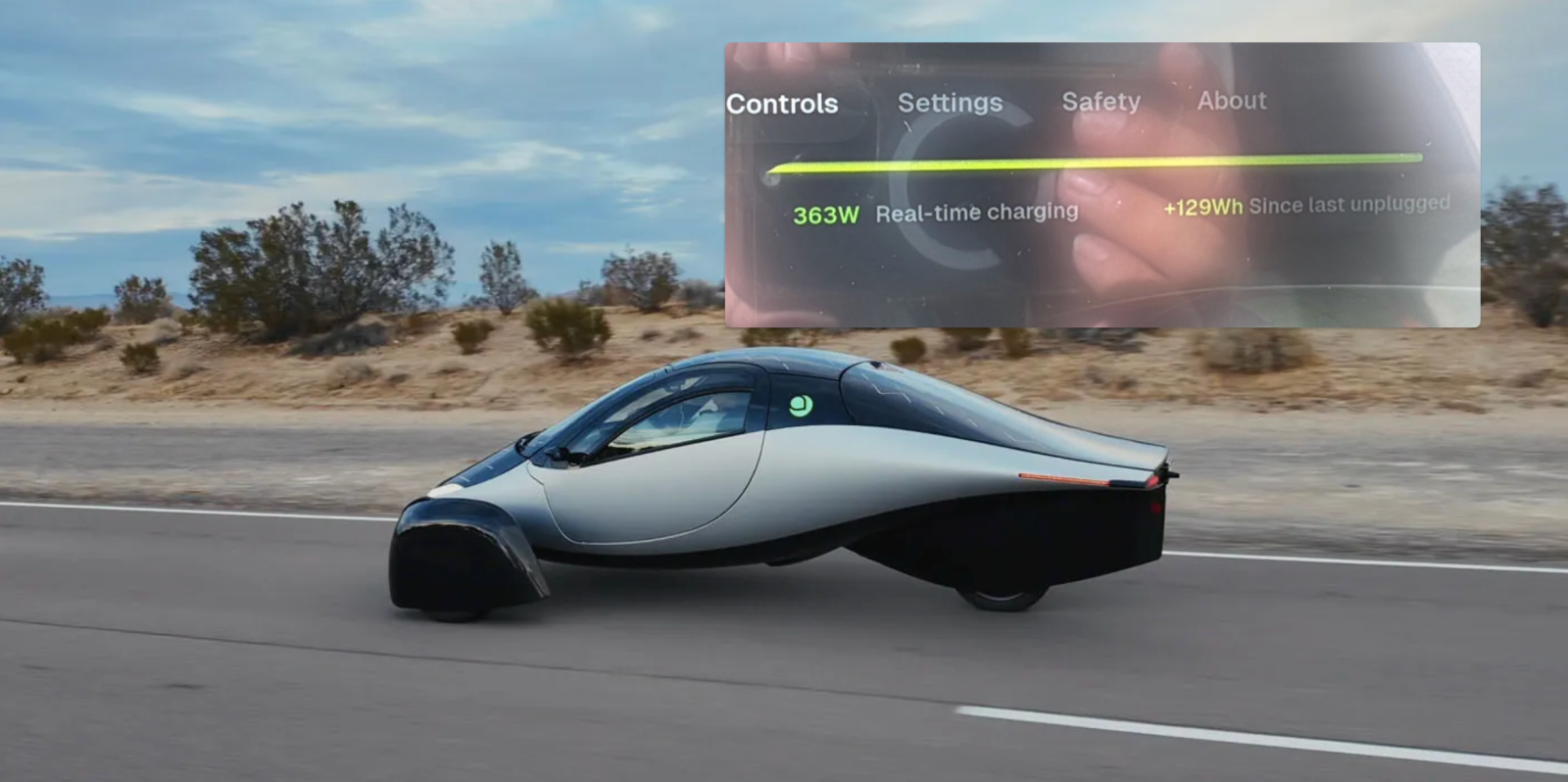
Aptera co-CEO Steve Fambro posted a data point this morning that neatly illustrates what his company has been trying to build for more than a decade: his solar electric vehicle was generating more electricity from the sun than his house was.
Just after 8 a.m., Fambro said his home rooftop was producing 136 watts of solar power while the Aptera sitting outside was putting more than 300W — more than double.
Obviously, this is a particular example highlighting different solar optimization strategies, but neat nonetheless.
The tweet
The update came on X, where Fambro wrote: “At this very instant, just after 8:00 am, my house is only making 136W of solar power. Aptera? About 300W!!”
In fact, Fambro showed that his Aptera was producing 363 watts of solar power:

It’s a small, off-the-cuff observation, but it matters for a company whose entire pitch rests on the idea that a purpose-built solar EV can harvest enough energy to meaningfully cut how often you plug in. Early morning, with the sun still low in the sky, is exactly when a fixed rooftop array underperforms — and exactly the moment the Aptera’s curved, sun-facing panels are designed for.
Why the car is beating the house
Residential rooftops are usually optimized for peak midday output. They’re fixed at a single pitch, often partially shaded by trees or chimneys, and oriented to whatever direction the roof happens to face. At 8 a.m. with a low sun angle, most of that panel area is catching light off-axis.
Aptera’s vehicle is the opposite design philosophy. Its 700-watt solar package wraps across the hood, dash, roof, and rear hatch, so at any given sun angle at least some of the cells are close to perpendicular to the light. The company has said the system can add up to 40 miles of range per day in sunny climates — a figure it’s been validating in real-world testing throughout 2025 and 2026.
That doesn’t mean the car is “better” than a rooftop system in absolute terms. Fambro’s house will almost certainly out-produce his Aptera by the end of the day. But at low sun angles, the geometry favors the car, and that’s the scenario the SEV’s efficiency case depends on.
Aptera’s progress after its latest earnings
The tweet lands two weeks after Aptera (NASDAQ: SEV) reported its Q4 and full-year 2025 earnings — the company’s first full annual report as a public company after listing on the Nasdaq late last year.
The headline numbers were rough, but not surprising for a pre-revenue EV startup. Aptera posted a full-year 2025 GAAP net loss of $43.9 million, or $18.5 million on an adjusted non-GAAP basis. Q4 alone came in at a $15.5 million GAAP loss. The company ended December with $9.6 million in cash.
On the operational side, there’s been real movement. Aptera completed the first solar EV off its validation assembly line in Carlsbad on March 3, and its facility received Foreign-Trade Zone designation in February. It also secured a lease extension through March 2028.
Funding-wise, Q1 2026 brought in about $17.1 million in gross proceeds, including a $9 million follow-on offering in late January and $8.1 million from warrant exercises, the bulk of it from a $6.3 million warrant inducement transaction in mid-March. That’s on top of the $75 million equity line of credit Aptera secured ahead of its public listing.
Co-CEO Chris Anthony framed 2025 as “a transformative year” in which the company “transitioned to a publicly traded company and began standing up our validation assembly line.”
Electrek’s Take
We’ve been tracking Aptera for years, and we’ve been open about our concerns — we flagged back in October that the company’s decision to go public through a reverse merger was a worrying sign about its ability to raise capital through normal channels. That concern hasn’t gone away. $9.6 million in cash at year-end, a $43.9 million annual loss, and a business model that still requires scaling a validation line into real volume production is a tight financial window, and the company is going to need a lot more money to finish the job.
Top comment by Jonmod3
So sad to think about the Lightyear when I see this. The Lightyear was a such a cool car even if it was not quite yet refined. Having a car refuel itself from the sun is probably the best way to use EV power.
But the technical case for the product is still the most interesting thing in the solar-EV space, and moments like Fambro’s tweet are why. A fixed-orientation rooftop array losing to a parked vehicle at 8 a.m. isn’t a breakthrough — it’s geometry — but it’s the exact kind of anecdote that makes the Aptera concept work in the buyer’s head. A commuter who parks outside at work could plausibly add enough range during an average day to offset a meaningful share of their driving, without ever touching a plug.
Whether Aptera can execute on production before running out of runway is still the question that matters. The earnings tell us the clock is real. The tweet tells us the physics still works.
If it can keep going and sell a few solar cars profitably, it could attach itself to constant improvements in battery and solar cells to deliver increasingly ultra-efficient solar cars that eventually never have to plug.
If you’re interested in reserving an Aptera, you can use our referral link to save $30 on the reservation fee.


FTC: We use income earning auto affiliate links. More.



Comments