
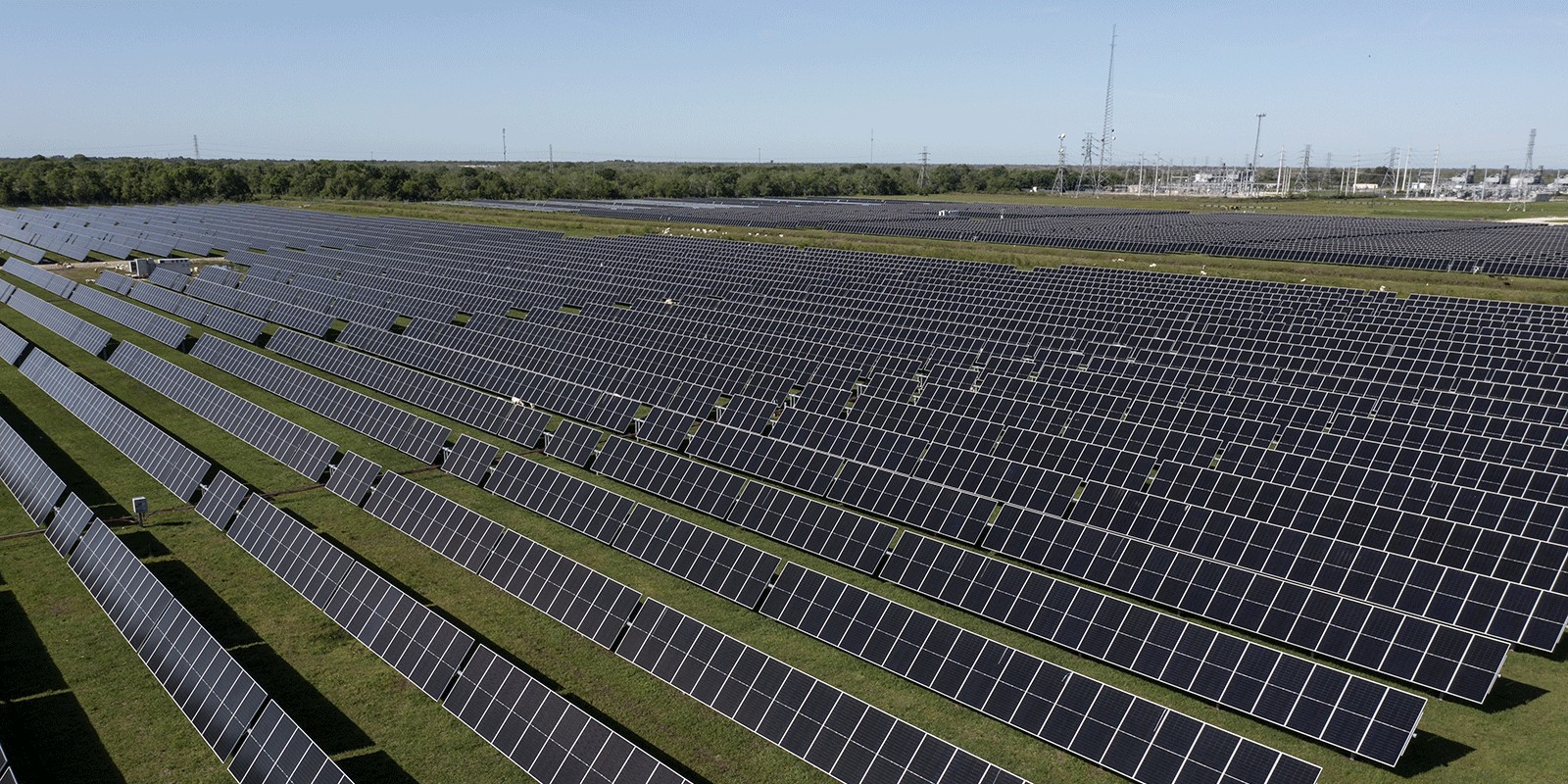
Solar accounted for more than 72% of US electrical generating capacity added in 2025, with another 16% from wind, according to belatedly released data from the Federal Energy Regulatory Commission (FERC) reviewed by the SUN DAY Campaign.
When it comes to new capacity additions, solar has held the lead among all energy sources for 28 consecutive months. Installed utility-scale solar capacity now exceeds the individual capacities of wind, hydropower, and nuclear power. Further, FERC expects solar to add another 86 gigawatts (GW) over the next three years, during which time solar capacity will also surpass that of coal.
Solar was 83% of new generating capacity in December
In its latest monthly “Energy Infrastructure Update” report (with data through December 31, 2025), FERC says 17 “units” of solar totaling 993 megawatts (MW) were placed into service in December, accounting for 83.2% of all new generating capacity added during the month.
The 710 utility-scale (>1 MW) solar units added during 2025 total 26,556 MW and accounted for 72.6% of the total new capacity placed into service by all sources.
Solar has now been the largest source of new generating capacity added each month for 28 months straight, from September 2023 to December 2025. During that period, total utility-scale solar capacity grew from 91.82 GW to 164.53 GW. No other energy source added anything close to that amount of new capacity. Wind, for example, expanded by 13.40 GW, while natural gas’s net increase was just 6.83 GW.
As a consequence, the installed generating capacity of utility-scale solar is now 164.5 GW, or 12.2% of the total, and has surpassed that of wind (161.1 GW, or 11.9%), nuclear power (104.39 GW, or 7.7%), and hydropower (102.09 GW, or 7.5%).
Wind capacity additions in 2025 beat natural gas
In 2025, new wind provided 5,763 MW of capacity additions – an increase of 26% compared to 2024 and more than the new capacity provided by natural gas (4,179 MW). Wind accounted for 15.7% of all new capacity added during 2025.
Renewables were 88% of new capacity added in 2025
In 2025, wind and solar (joined by 4 MW of hydropower and 6 MW of biomass) accounted for 88.4% of all new generating capacity, while natural gas added just 11.4%. The balance of net capacity additions came from oil (66 MW) and waste heat (17 MW).
Solar + wind are a quarter of US generating capacity
Taken together, wind and solar account for 24.1% of the US total installed utility-scale generating capacity.
Moreover, more than one-fourth of US solar capacity is in small-scale systems (e.g., rooftop) that are not reflected in FERC’s data. Including that additional solar capacity would bring the share provided by solar + wind to more than 25% of the US total.
With hydropower (7.5%), biomass (1.1%), and geothermal (0.3%) included, renewables currently claim a 33.0% share of total US utility-scale generating capacity. If small-scale solar capacity is included, renewables now account for more than one-third of total US generating capacity.
Solar is still on track to become No. 2
FERC reports that net “high probability” net additions of solar over the next three years (January 2026 to December 2028) total 86,126 MW – an amount more than four times the forecast net “high probability” additions for wind (19,821 MW), the second fastest growing resource. Further, the average annual combined growth from solar and wind over the next three years (35,316 MW per year) would closely match that over the last two years (35,382 MW per year), suggesting no slowdown despite the hostile policies of the Trump administration.
FERC also foresees net growth for hydropower (554 MW) and geothermal (102 MW) but a decrease of 116 MW in biomass capacity.
Meanwhile, natural gas capacity would expand by far less – 8,154 MW, and nuclear power would add just 335 MW, while coal is projected to contract by a massive 40,828 MW, and oil is forecast to fall by 1,590 MW.
Taken together, the net new “high probability” net utility-scale capacity additions by all renewable energy sources over the next three years – the Trump administration’s remaining time in office – would total 106,487 MW. On the other hand, the installed capacity of fossil fuels and nuclear power combined would shrink by 33,929 MW.
Should FERC’s three-year forecast materialize, by January 1, 2029, utility-scale solar would account for 17.6% of installed US generating capacity, more than any other source besides natural gas (40.6%). Further, the capacity of the mix of all utility-scale renewable energy sources would be almost 39%. Inclusion of small-scale solar, assuming it retains its 25% share of all solar, could push solar’s share to over 20% and that of all renewables to over 40%, while natural gas’s share would drop below 39%.
In fact, the numbers for renewables could be significantly higher.
FERC notes that “all additions” (net) for utility-scale solar over the next three years could be as high as 240,152 MW, while those for wind could total 64,669 MW. Hydro’s net additions could reach 9,513 MW, while geothermal and biomass could increase by 575 MW and 44 MW, respectively. Such growth from renewable sources would significantly exceed that of natural gas (36,628 MW).
“FERC’s data confirm that very strong growth in electrical generation by solar and wind dominated the first year of the Trump administration,” noted the SUN DAY Campaign’s executive director, Ken Bossong. “Equally important, the trend lines are on track to continue during the next three years, notwithstanding efforts by the White House to reverse course.”

If you’ve ever considered going solar, make it easy by finding a trusted, reliable solar installer near you that offers competitive pricing by checking out EnergySage. It has hundreds of pre-vetted solar installers competing for your business, ensuring you get high-quality solutions and save 20-30% compared to going it alone. Plus, it’s free to use, and you won’t get sales calls until you select an installer and share your phone number with them.
Your personalized solar quotes are easy to compare online, and you’ll get access to unbiased Energy Advisors to help you every step of the way. Get started here.


FTC: We use income earning auto affiliate links. More.



Comments