
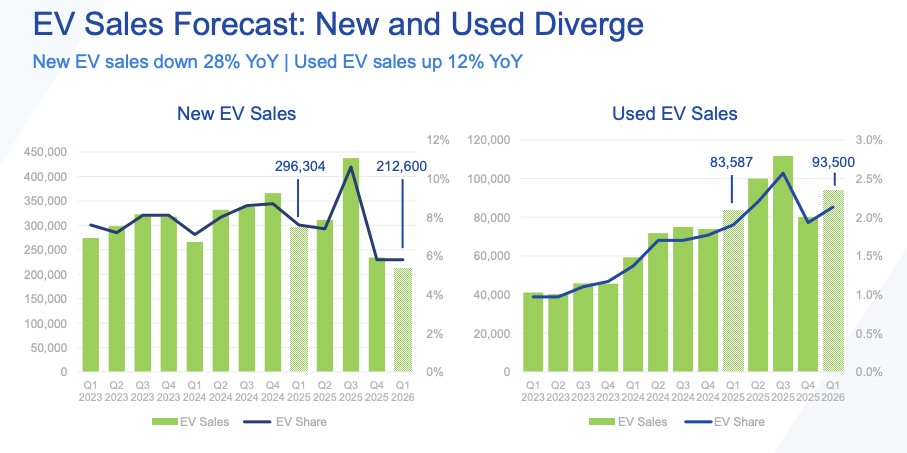
The US electric vehicle market has split into two diverging realities. New EV sales cratered 28% year-over-year in Q1 2026 to just 212,600 units, according to new data from Cox Automotive — but used EV sales surged 12% to 93,500 units, with prices now within $1,300 of equivalent gas cars.
The data, presented in Cox Automotive’s Q1 2026 Industry Insights call on March 25, reveals the clearest picture yet of how the federal tax credit’s expiration is reshaping the EV market — and creating what may be the best buying opportunity in the history of electric vehicles.
New EV sales collapse after tax credit death
The numbers are stark. Americans purchased just 212,600 new EVs in the first quarter, down from 296,304 in Q1 2025 — a 28% decline. EV market share fell to an estimated 5.8% of total new vehicle sales, matching Q4 2025’s share and well below the 7.5% peak reached in Q3 2025.
The culprit is obvious: the $7,500 federal EV tax credit expired on September 30, 2025, and nothing has replaced it. The One Big Beautiful Bill Act sunsetted the purchase credit, and the impact has been immediate and severe.
New EV inventory has ballooned to 130 days’ supply — 46% higher than the 89 days’ supply for combustion vehicles. That glut is forcing automakers to pile on incentives. According to Cox Automotive’s Stephanie Valdez Streaty, Director of Industry Insights, EV prices fell to an average transaction price of $55,300 in February, narrowing the gap with gas cars to a record-low $6,500.
Tesla, still the largest US EV seller, moved an estimated 122,196 units in Q1 — down 4.6% year-over-year but holding a 3.3% share of the total market. The broader industry decline hit harder: total new vehicle sales fell 6.5% to 3.67 million units, with a SAAR of 15.5 million.
Used EVs tell the opposite story
While the new EV market struggles, the used side is booming. Cox Automotive data shows 93,500 used EVs sold in Q1 2026, up 12% from 83,587 in Q1 2025 and up 17% from Q4 2025.
The most striking data point is pricing. Used EVs now average $34,821 — within just $1,300 of the $33,487 average for used gas vehicles. That near-parity is unprecedented. For context, the used EV-to-ICE price gap was over $10,000 as recently as early 2023.
Used EV days’ supply sits at 42 — just four days higher than the 38 days for combustion vehicles. That means used EVs are turning at nearly the same pace as gas cars on dealer lots, a sign of genuine consumer demand rather than a supply glut.
Cox’s Deputy Chief Economist Mark Strand pointed to one specific factor that will accelerate this trend: lease returns. The wave of EVs leased under the IRA’s so-called “leasing loophole” between 2023 and 2025 is now starting to hit dealer lots. As we reported in November 2024, used electric car deals were expected to surge as lease returns spiked — and that’s exactly what’s happening.
Cox Automotive’s lease maturity data shows EV and PHEV lease returns ramping dramatically throughout 2026 and into 2028, with monthly lease return volumes expected to climb to 240,000 total units — roughly 20% of which, or nearly 50,000 per month, will be electric.
The paradox: more EVs on the road, fewer being sold new
The underlying dynamics create a fascinating contradiction. There are now roughly 5.8 million EVs on US roads, and they’re charging more than ever — US public charging sessions hit 141 million in 2025, up 30%. Electrified vehicles (including hybrids) reached an all-time high of 26% of new vehicle sales in Q4 2025, up nearly 4 percentage points year-over-year.
But the electrification growth in the US is being driven almost entirely by hybrids, not battery-electric vehicles. HEVs hit a record 756,000 units in Q4 2025, up 57% year-over-year. Toyota commands 43% of hybrid sales, with Honda at 16.3%.
Meanwhile, rising gas prices from the Middle East conflict are pushing more consumers to consider electrified vehicles. Cox Automotive’s consumer shopping data shows the Hybrid + Plug-In Index spiking well above baseline levels in February and March. The EV Index has also climbed, though more modestly. As EV consideration hit 23.8% on Edmunds for the week of March 9-15, the problem isn’t interest — it’s conversion.
The $7,500 tax credit was the bridge that made new EV pricing competitive. Without it, consumers who are price-sensitive enough to be motivated by gas prices are finding a better deal in the used EV market — or opting for a hybrid.
2026 outlook: more pressure ahead
Cox Automotive’s full-year 2026 forecast projects 15.8 million total new vehicle sales, down 2.6% from 2025. Lease penetration is expected to fall to 22% (down 2 percentage points), and used retail sales are forecast at 20.4 million.
The auto industry is also absorbing an estimated $35 billion in tariff costs from 2025, with roughly $3,800 per vehicle in added costs being passed through via MSRP hikes, higher destination fees, and tighter incentives. That upward price pressure makes the used EV value proposition even more compelling.
Electrek’s Take
Top comment by Henry
🚒Don't buy a used Tesla without a warranty!! I did and 3 mo later the PCS failed (will not charge at Level 2 anymore). Tesla wanted $3,500 to fix it, refused to cover it under the battery warranty with only 34,000 mi on the Model Y LR AWD. I don't know what will break next. 🚒🚒🚧🚦
The Cox Automotive data confirms what we’ve been tracking for months: the federal government killed the new EV market’s momentum, and the used EV market is the biggest beneficiary.
We think this is actually a silver lining for EV adoption, even if it’s painful for automakers. Used EVs at near-parity with gas cars — averaging $34,821 versus $33,487 — removes the single biggest objection most consumers have about going electric: price. A three-year-old Tesla Model 3 or Hyundai IONIQ 5 coming off lease in 2026 represents extraordinary value, especially with gas prices climbing above $4.
The lease return wave is just getting started. Cox projects EV lease returns will ramp through 2028, meaning the used EV market is about to get flooded with relatively new, well-maintained vehicles at prices that make the total cost of ownership calculation a no-brainer versus gas.
The real question is whether this used EV boom will eventually feed back into new EV demand. If millions of Americans get their first taste of electric driving through a used purchase, that’s a pipeline of future new EV buyers. But for now, automakers are stuck watching their new EV lots fill up while the used market they don’t directly profit from takes off.


FTC: We use income earning auto affiliate links. More.



Comments