
A newly published Tesla patent application describes a sophisticated dual-battery management system designed to integrate an auxiliary battery pack with a vehicle’s primary pack — including a configuration where the auxiliary battery lives inside a towed trailer.
The patent was filed in August 2024, months before Tesla officially cancelled the Cybertruck’s bed-mounted range extender, suggesting the automaker’s engineering team continued developing the underlying technology even as the original product was being abandoned.
What the patent describes
Patent application US 2026/0048683 A1, titled “Electric Vehicle Range Extender Integration,” was filed on August 15, 2024, and published on February 19, 2026. It lists four inventors, including Wes Morrill, Tesla’s lead Cybertruck engineer and Sr. Director of Engineering.
The system pairs an 800V primary battery pack with a 400V auxiliary pack connected through two parallel DC/DC converters that step voltage up or down as needed. The patent details three distinct operating modes that govern how the two packs interact.
The first is “State of Energy (SOE) Balancing” — during normal driving, the system adjusts power draw from the auxiliary pack proportionally to its remaining energy relative to total energy across both packs. This keeps both batteries draining at the same rate rather than exhausting one first.
The second mode, “Open Circuit Voltage (OCV) Matching,” kicks in when the vehicle’s navigation system detects the driver is heading toward a Supercharger or other DC fast charger. The system actively manages discharge from both packs to equalize their open circuit voltages, preparing them for parallel charging.
Once voltage alignment is confirmed — along with safety checks for in-rush current, thermal conditioning, impedance, and component health — the system enters the third mode: parallel charging, where both packs charge simultaneously at a DC fast charger rated between 50 kW and 500+ kW.
Two physical configurations — including a trailer
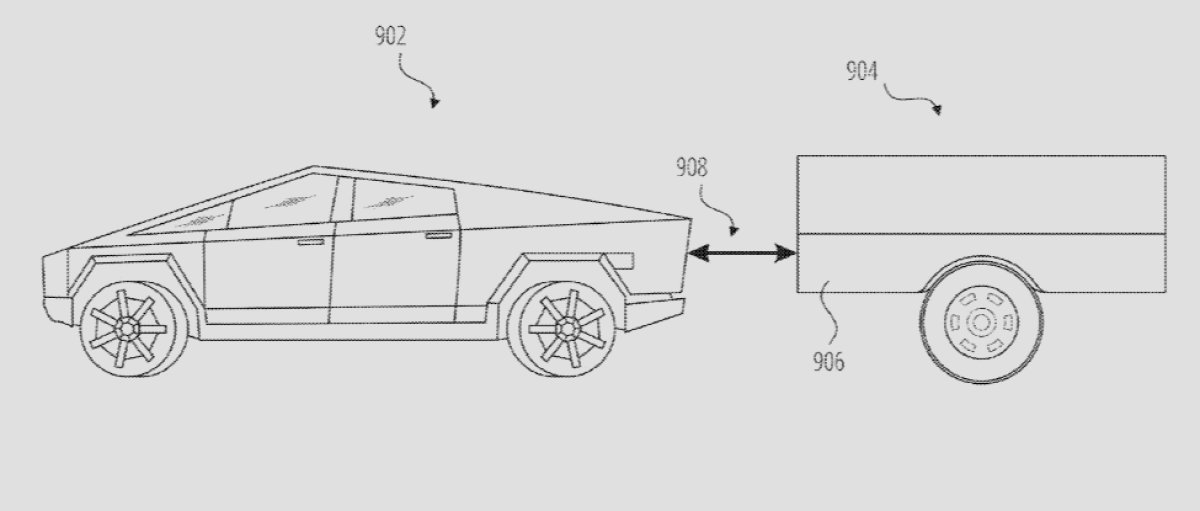
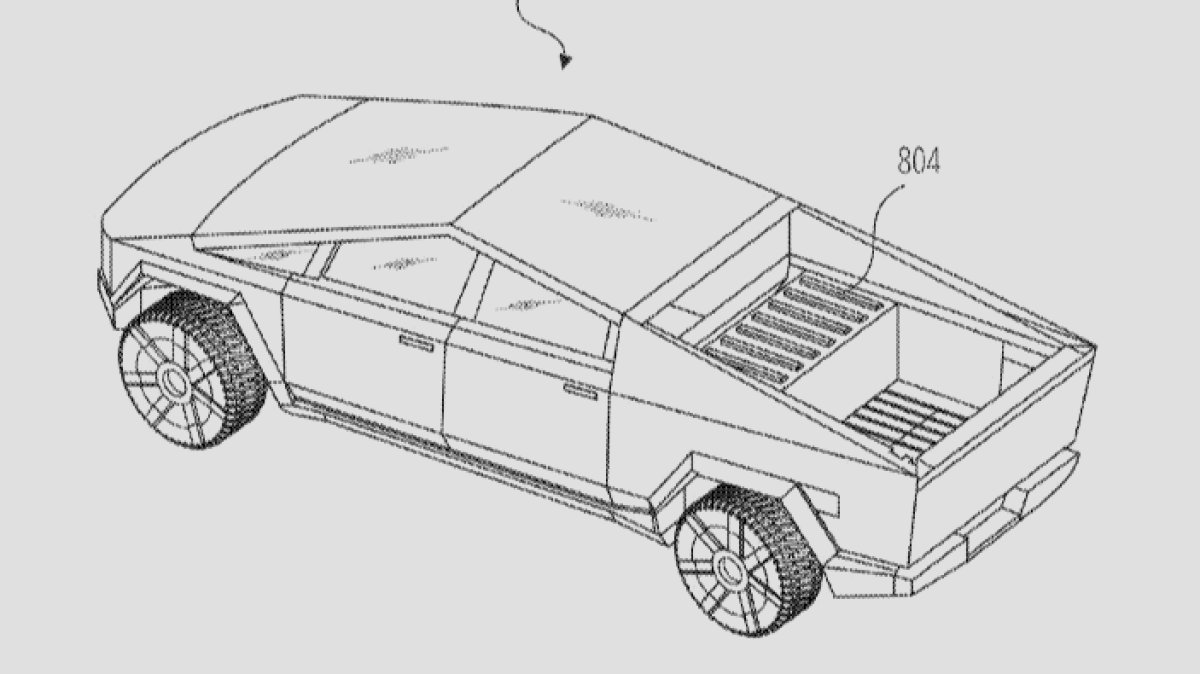
The patent describes two mounting options for the auxiliary battery. The first is a truck bed installation, similar to what Tesla originally announced for the Cybertruck range extender. The second — and the more interesting one — places the auxiliary battery pack inside a trailer connected to the vehicle via a high-voltage electrical interface at the hitch.
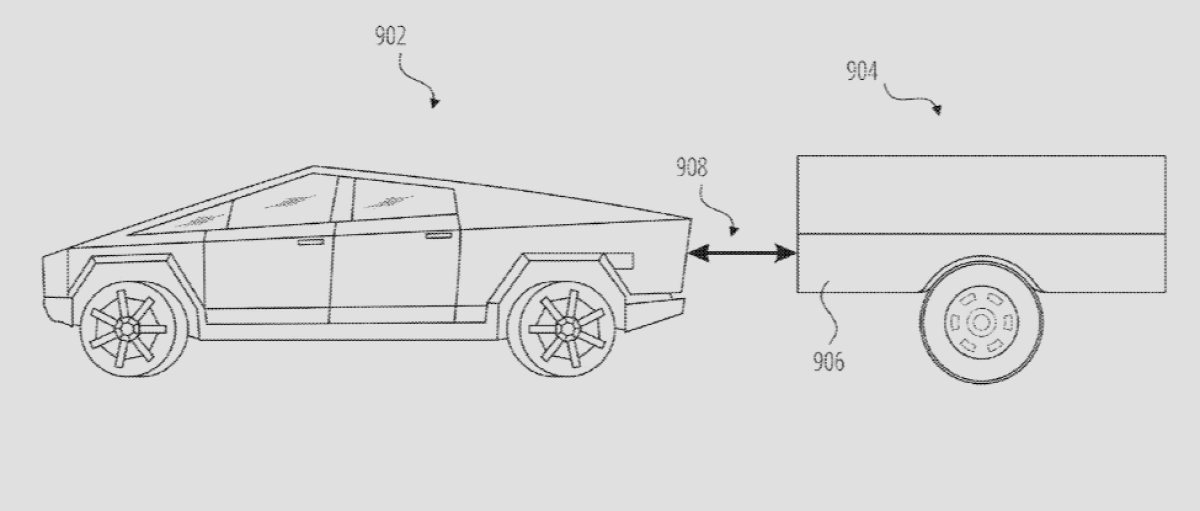
A trailer-mounted battery would solve the fundamental problem that killed the original Cybertruck range extender: the bed-mounted pack consumed roughly one-third of the Cybertruck’s cargo space and had to be installed and removed at a Tesla service center. Owners couldn’t do it themselves.
A trailer configuration eliminates the cargo space penalty entirely and would be particularly useful for long-distance towing — the exact scenario where EVs lose the most range. The patent even includes an MC4 connector for solar panel integration, enabling panels on the trailer to trickle-charge the auxiliary pack.
The thermal management trick
One clever detail in the patent involves thermal conditioning. The system can intentionally induce losses during power transfer between the DC/DC converters, using the resulting waste heat to warm the auxiliary battery pack in cold weather. This eliminates the need for a separate heating system for the trailer-mounted pack and addresses one of the biggest challenges of operating lithium-ion batteries in cold climates.
The patent also describes a full thermal loop with a coolant heat exchanger that interfaces with the vehicle’s main cooling system, a circulation pump, and a dedicated coolant heater for extreme cold starts.
Context: the range extender saga
Tesla first revealed the Cybertruck would need a separate battery pack to achieve its promised 470+ mile range when it launched the truck in late 2023. The $16,000 add-on was repeatedly delayed — from “early 2025” to “mid-2025” — with its range promise reduced from 470+ miles to 445+ miles along the way.
Tesla quietly removed the range extender from its configurator in April 2025, then officially confirmed the cancellation in May 2025, offering full refunds on the $500–$2,000 deposits customers had placed.
It’s worth noting that Rivian filed a patent for a removable auxiliary battery back in 2019, which was granted in 2020, years before Tesla announced the Cybertruck’s range extender concept. However, Tesla’s new patent focuses on the software and power management architecture rather than the physical packaging, which is a different approach.
The filing date of August 15, 2024 is significant. At that point, Tesla was still publicly selling the range extender option and hadn’t yet signaled any intention to cancel it. The patent’s priority date is the same as its filing date, meaning there’s no earlier provisional application — this was a fresh filing, not a continuation of older work.
Electrek’s Take
Top comment by BobM
LOL. So in order to get enough battery to tow a boat I need to tow a battery, which means I cant actually tow the boat, so I dont need the battery, which means I can tow the boat, except.....
This patent is fascinating because it reveals that Tesla’s engineering team was actively developing a much more sophisticated version of the range extender concept even as the simpler bed-mounted version was running into production problems, and/or demand problem before being fully canceled.
The trailer-mounted configuration makes far more sense than what Tesla originally promised. A bed-mounted pack that eats a third of your cargo space and requires a service center visit to install or remove was never a practical product. A battery trailer that you hitch up for long road trips or towing — and unhitch when you don’t need it — is actually a compelling solution to range anxiety for specific use cases.
The 800V/400V dual-battery architecture with three distinct operating modes shows real engineering depth. The OCV matching system that pre-conditions both packs for Supercharging is particularly smart — it ensures you don’t waste time at the charger waiting for the system to figure out how to charge two mismatched packs.
That said, a patent filing is not a product announcement. Tesla has filed thousands of patents that never became products. The fact that Tesla cancelled the simpler version of this concept suggests there are real barriers.


FTC: We use income earning auto affiliate links. More.




Comments